Understanding your finances is not just about profit. Many businesses in the UAE generate revenue but still struggle with liquidity. This is where knowing what is a cash flow statement becomes critical. It helps you track how money moves in and out of your business, giving you a clear picture of your financial health.
In this guide, you will learn exactly what a cash flow statement is, why it matters, how to read it, and how UAE businesses can use it to make smarter decisions.
What Is a Cash Flow Statement?
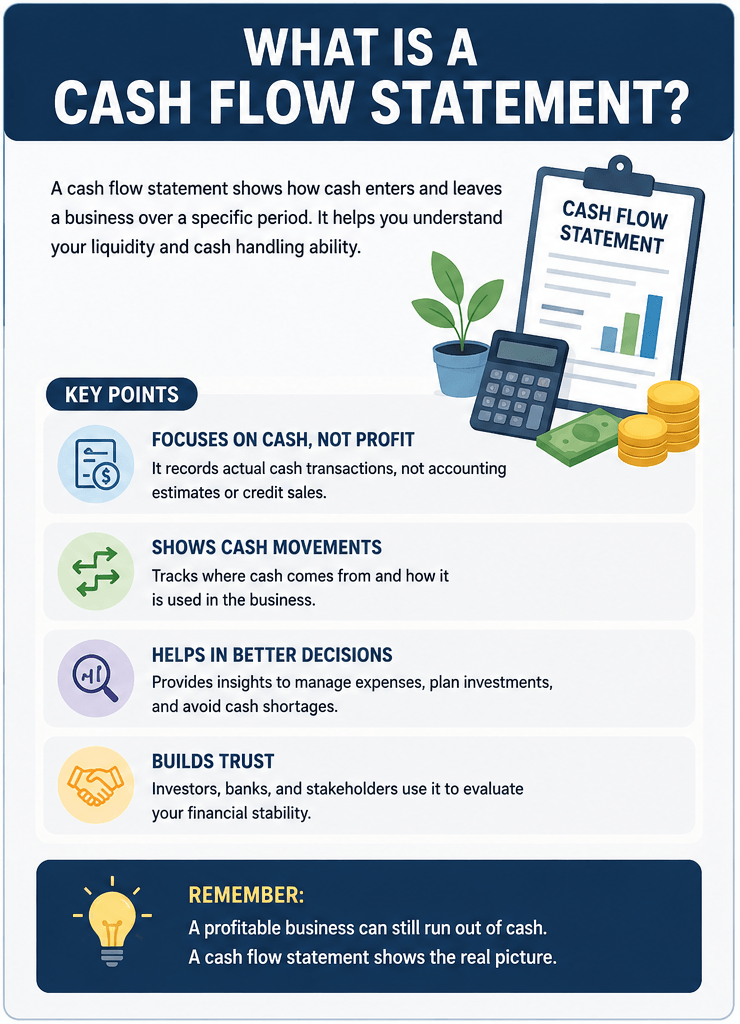
A cash flow statement is a financial report that shows how cash enters and leaves your business over a specific period. It focuses only on actual cash transactions, not accounting estimates.
If you are asking what is a cash flow statement, think of it as your business bank activity explained in a structured way. It shows whether your company can generate enough cash to pay expenses, invest, and grow.
Unlike the income statement, which shows profit, the cash flow statement shows liquidity. A company can be profitable on paper but still run into cash shortages.
Read more: How to Track Expenses for Small Business in UAE
Simplify Your Cash Flow with mazeed
Managing your finances should not be complicated. With mazeed accounting software, you can track your cash flow effortlessly.
What You Get:
- Real-time cash flow tracking
- Advanced financial reports
- Easy invoice management
- VAT-ready system for UAE businesses
Instead of manually figuring out what is a cash flow statement, mazeed shows it to you instantly.
Why Is a Cash Flow Statement Important for UAE Businesses?
For businesses operating in the UAE, especially SMEs and startups, managing cash flow is essential for survival and growth.
Here is why understanding what is a cash flow statement matters:
1. Ensures Financial Stability
It helps you confirm that you have enough cash to cover salaries, rent, and operational costs.
2. Supports VAT Compliance
With VAT regulations in the UAE, tracking actual cash movements helps ensure accurate reporting and timely payments.
3. Improves Decision-Making
You can plan investments, expansions, or cost reductions based on real cash availability.
4. Prevents Cash Shortages
It highlights periods where cash might be tight so you can act early.
5. Builds Investor Confidence
Investors and lenders often review cash flow statements to assess your business stability.
Read more: Accounting Structure for Small Businesses
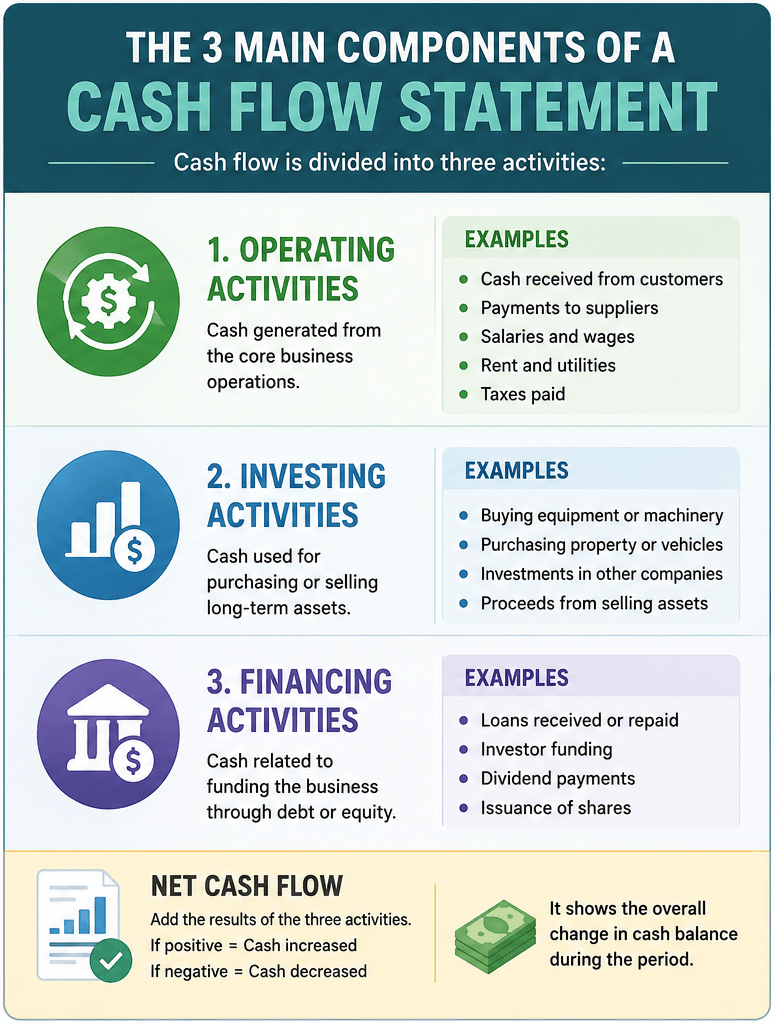
The Three Main Components of a Cash Flow Statement
To fully understand what is a cash flow statement, you need to break it down into its three key sections:
1. Operating Activities
This section shows cash generated from your core business operations.
Examples include:
- Cash received from customers
- Payments to suppliers
- Salaries and wages
- Rent and utilities
A positive cash flow from operations means your business is generating enough cash from its main activities.
2. Investing Activities
This section covers cash used for investments in long-term assets.
Examples include:
- Buying equipment or machinery
- Purchasing property
- Selling assets
Negative cash flow here is not always bad. It can indicate growth and expansion.
3. Financing Activities
This section shows cash movements related to funding your business.
Examples include:
- Loans received or repaid
- Investor funding
- Dividend payments
Understanding this section helps you track how your business is financed.
Why UAE Businesses Choose mazeed
Thousands of businesses are switching to smarter accounting solutions.
Key Benefits:
- No accounting experience needed
- Cloud-based access anytime, anywhere
- Designed for SMEs in the UAE
- Saves time and reduces errors
mazeed helps you move from confusion to clarity when understanding what is a cash flow statement and using it effectively.
How to Read a Cash Flow Statement
Once you understand what is a cash flow statement, the next step is learning how to interpret it.
Start with these steps:
Step 1: Check Net Cash Flow
Add all three sections together. If the result is positive, your cash is increasing. If negative, your business is spending more than it earns.
Step 2: Focus on Operating Cash Flow
This is the most important part. A healthy business should generate positive cash flow from operations.
Step 3: Analyze Trends
Compare statements over multiple months to identify patterns.
Step 4: Look for Red Flags
- Consistently negative operating cash flow
- Heavy reliance on loans
- Large unexplained expenses
Read more: Budget vs Actual Report
Cash Flow Statement vs Income Statement
Many business owners confuse profit with cash flow. Understanding the difference is key.
- Income Statement shows revenue and expenses based on accounting rules
- Cash Flow Statement shows actual cash movement
For example, you may record a sale today but receive payment later. The income statement shows revenue immediately, but the cash flow statement only reflects it when cash is received.
This is why knowing what is a cash flow statement is essential for accurate financial planning.
Common Cash Flow Challenges in the UAE
Businesses in the UAE often face specific cash flow challenges:
Late Payments
Clients delaying payments can disrupt your cash flow.
High Operational Costs
Rent, salaries, and licensing fees can impact liquidity.
Rapid Growth
Scaling too quickly can strain cash reserves.
Seasonal Revenue
Industries like tourism and retail may experience fluctuations.
A well-managed cash flow statement helps you navigate these challenges effectively.
How to Improve Your Cash Flow
Understanding what is a cash flow statement is only the first step. You also need to act on it.
Here are practical ways to improve your cash flow:
1. Invoice Faster
Send invoices immediately and follow up regularly.
2. Offer Flexible Payment Options
Make it easier for customers to pay you quickly.
3. Control Expenses
Review your costs and eliminate unnecessary spending.
4. Negotiate Supplier Terms
Extend payment terms where possible.
5. Maintain a Cash Reserve
Always keep a buffer for emergencies.
Direct vs Indirect Method
When preparing a cash flow statement, there are two methods:
Direct Method
Lists actual cash receipts and payments.
Indirect Method
Starts with net profit and adjusts for non-cash items.
Both methods help answer the same question: what is a cash flow statement showing about your business liquidity?
Read more: Statutory Audit for UAE Business
Real Example of a Cash Flow Statement
Here is a simplified example:
- Cash from operations: AED 100,000
- Cash used in investing: AED 50,000
- Cash from financing: AED 20,000
Net cash flow = AED 70,000
This means your business increased its cash balance by AED 70,000 during the period.
How Often Should You Review It?
For UAE businesses, it is recommended to review your cash flow statement:
- Weekly for startups
- Monthly for SMEs
- Quarterly for established companies
Frequent monitoring helps you stay in control and avoid surprises.
How Technology Simplifies Cash Flow Management
Manually tracking cash flow can be time-consuming and error-prone. Modern accounting tools automate the process and provide real-time insights.
This is where smart solutions make a difference.
Start Managing Your Cash Flow Today
If you are serious about growing your business, you cannot ignore your cash flow.
mazeed makes it simple to:
- Track your income and expenses
- Generate accurate reports
- Stay compliant with UAE regulations
Start today and take full control of your finances.
Key Takeaways
- A cash flow statement tracks actual cash movement in your business
- It has three main sections: operating, investing, and financing
- It is essential for financial stability and decision-making
- UAE businesses benefit from using it for VAT and cash management
- Tools like mazeed simplify the entire process
Resources
- International Financial Reporting Standards Foundation – IAS 7 Cash Flow Statements
- Investopedia – Cash Flow Statement Guide
- Corporate Finance Institute – Cash Flow Statement Explained
- AccountingTools – Cash Flow Statement Overview
- Federal Tax Authority
Disclaimer: This publication is for informational purposes only and should not be considered professional or legal advice. While we strive for accuracy, we make no guarantees regarding completeness or applicability. mazeed, its members, employees, and agents do not accept or assume any liability, responsibility, or duty of care for any actions taken or decisions made based on this content. For official tax guidance, please refer to the UAE Ministry of Finance and the Federal Tax Authority.