

Expanding into Saudi Arabia has become one of the smartest moves for UAE businesses looking for growth in the GCC. With strong government support, a booming economy, and investor-friendly reforms, understanding how to open a company in Saudi Arabia is now more important than ever.
In this guide, you will learn everything step by step, from legal structures to costs, timelines, and expert tips to launch smoothly.
Why Saudi Arabia Is Attractive for UAE Businesses?
Saudi Arabia is not just the largest economy in the Middle East. It is also undergoing rapid transformation under Vision 2030. This makes it a prime destination for foreign investors.
Here is why many UAE companies are entering the Saudi market:
- Access to a market of 35+ million people
- Strategic location connecting Asia, Europe, and Africa
- Government incentives for foreign investors
- Growing sectors like tech, tourism, retail, and logistics
- 100 percent foreign ownership in many industries
If you are researching how to open a company in Saudi Arabia, these advantages make the effort worthwhile.
mazeed Business Setup Services
mazeed provides end to end support for UAE businesses entering Saudi Arabia:
- Company formation and licensing
- Documentation and approvals handling
- Business structure consultation
- Government liaison support
- Fast tracked setup process
Instead of navigating the complexities alone, mazeed simplifies every step of how to open a company in Saudi Arabia so you can focus on growth.
Types of Business Entities in Saudi Arabia
Before starting the process, you need to choose the right company structure. This decision affects ownership, liability, and compliance.
1. Limited Liability Company (LLC)
The most common option for foreign investors. It offers flexibility and limited liability.
2. Joint Stock Company (JSC)
Suitable for larger businesses and those planning public investment.
3. Branch of a Foreign Company
Ideal for UAE companies that want to operate in Saudi Arabia without creating a separate entity.
4. Sole Establishment
Usually limited to Saudi nationals but may apply in specific cases.
Choosing the right structure is a key step in understanding how to open a company in Saudi Arabia successfully.
Step by Step Process to Open a Company in Saudi Arabia
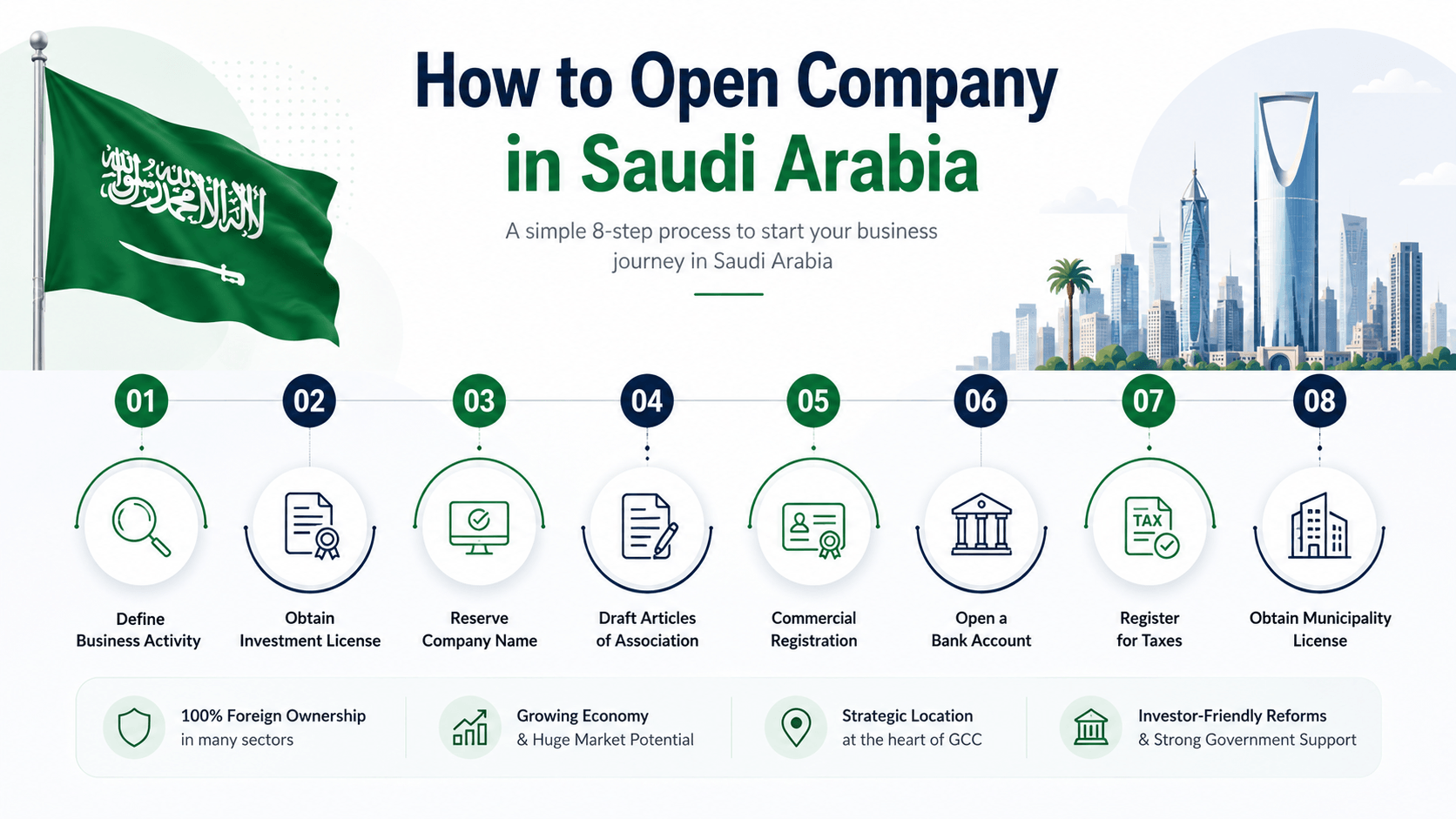
Step 1: Define Your Business Activity
You must clearly define what your business will do. Certain activities require special approvals.
Step 2: Obtain Investment License
Foreign investors must apply through the Ministry of Investment of Saudi Arabia. This is a critical step in the process.
Step 3: Reserve Company Name
Choose a unique name that complies with Saudi regulations.
Step 4: Draft Articles of Association
This document outlines ownership, roles, and responsibilities.
Step 5: Commercial Registration
Register your business officially with the Ministry of Commerce.
Step 6: Open a Bank Account
A corporate bank account is required to deposit capital.
Step 7: Register for Taxes
You must register for VAT and other applicable taxes.
Step 8: Obtain Municipality License
This allows you to legally operate from your office location.
Each of these steps is essential when learning how to open a company in Saudi Arabia without delays.
Managing Your Finances After Setup
Opening your company is just the beginning. Managing finances properly is what ensures long term success.
mazeed Accounting Software
mazeed offers a powerful yet simple accounting solution designed for growing businesses:
- Automated bookkeeping
- Real time financial dashboard
- VAT compliant reporting
- Invoice and expense management
- Multi currency support
For businesses expanding across borders, this makes financial control much easier.
Costs of Opening a Company in Saudi Arabia
Costs can vary depending on your business activity and structure, but here is a general breakdown:
- Investment license fees
- Commercial registration fees
- Office rent and address registration
- Legal and documentation costs
- Government approvals and permits
On average, setting up a company can range between SAR 20,000 to SAR 50,000 or more.
Planning your budget carefully is important when evaluating how to open a company in Saudi Arabia.
Timeline for Company Formation
The process typically takes:
- 2 to 4 weeks for initial approvals
- 4 to 8 weeks for full setup
This depends on how quickly documents are prepared and approvals are granted.
Key Legal Requirements
To successfully complete how to open a company in Saudi Arabia, you must comply with:
- Minimum capital requirements depending on activity
- Local address registration
- Proper licensing for regulated sectors
- Saudization requirements for hiring
Ignoring these can delay or even block your business setup.
Common Challenges and How to Avoid Them
Many UAE businesses face challenges during expansion. Here are the most common ones:
1. Regulatory Complexity
Saudi regulations can be detailed. Work with experts to avoid mistakes.
2. Documentation Delays
Incomplete paperwork can slow down approvals.
3. Cultural and Market Differences
Understanding local business practices is crucial.
4. Banking Setup Issues
Opening a corporate account can take time if documents are not prepared correctly.
Avoiding these issues makes the process of how to open a company in Saudi Arabia much smoother.
Taxation in Saudi Arabia
Understanding taxes is critical for long-term success.
- Corporate tax: 20 percent for foreign ownership
- VAT: 15 percent
- Zakat: Applicable to Saudi or GCC owners
Proper tax planning should be part of your strategy when considering how to open a company in Saudi Arabia.
On Demand Financial Expert Support
One of the biggest challenges after learning how to open a company in Saudi Arabia is maintaining compliance.
mazeed solves this with expert support:
- Certified accountants available on demand
- Assistance with tax filings and reporting
- Financial insights and advisory
- Compliance checks and health reviews
This means you are not just using software. You have a full financial team when you need it.
Tips for UAE Businesses Expanding to Saudi Arabia
To maximize your success:
- Start with market research
- Choose the right local partners if needed
- Ensure full compliance from day one
- Invest in proper accounting systems
- Work with experts for setup and operations
These tips will help you fully benefit from learning how to open a company in Saudi Arabia.
Frequently Asked Questions
Can UAE residents open a company in Saudi Arabia?
Yes, foreign investors including UAE residents can fully own businesses in many sectors.
Do I need a Saudi partner?
Not always. Many activities allow 100 percent foreign ownership.
Is it mandatory to have a physical office?
Yes, a registered address is required for licensing.
How long does it take?
Typically between 4 to 8 weeks depending on approvals.
Conclusion
Understanding how to open a company in Saudi Arabia is a strategic move for UAE businesses aiming to expand in the GCC. While the process involves multiple steps, the opportunities far outweigh the challenges.
With the right approach, proper planning, and expert support, you can establish your business smoothly and start tapping into one of the fastest growing markets in the region.
mazeed is here to support you at every stage, from setup to financial management, ensuring your expansion is not only successful but also sustainable.
Resources
Here are useful official resources to support your journey:
- Ministry of Investment Saudi Arabia
https://investsaudi.sa - Ministry of Commerce Saudi Arabia
https://mc.gov.sa - Zakat, Tax and Customs Authority
https://zatca.gov.sa - Saudi Business Center
https://business.sa
Disclaimer: This publication is for informational purposes only and should not be considered professional or legal advice. While we strive for accuracy, we make no guarantees regarding completeness or applicability. mazeed, its members, employees, and agents do not accept or assume any liability, responsibility, or duty of care for any actions taken or decisions made based on this content. For official tax guidance, please refer to the UAE Ministry of Finance, the Federal Tax Authority, Saudi Ministry of Commerce.