The UAE is no longer just a global business hub. It is rapidly becoming one of the world’s most advanced AI-driven economies. From government mandates to enterprise-level adoption, AI in accounting is transforming how businesses across the Emirates manage their finances, ensure compliance, and make strategic decisions.
Whether you run a startup in Dubai Silicon Oasis or a multinational in Abu Dhabi Global Market (ADGM), understanding the role of artificial intelligence in financial management is no longer optional. It is a competitive necessity.
The UAE’s AI Ambition: A Government-Led Revolution
The UAE has made artificial intelligence a national priority. According to a PwC Middle East report, AI investments are expected to contribute up to $96 billion, approximately 13.6% of UAE GDP, by 2030, positioning the country as the largest AI-driven economy in the region.
The UAE AI Strategy 2031, launched as part of the broader “We the UAE 2031” vision, aims to fully integrate AI across government services, healthcare, and the financial sector. The UAE was also the first country in the world to appoint a Minister of Artificial Intelligence, a signal to global markets of how seriously the country takes this transformation.
For the accounting profession specifically, this national strategy is creating real structural change. The UAE’s Federal Tax Authority (FTA) is moving toward machine-readable tax guidance, standardized reporting models, and an incoming e-invoicing framework, all of which are pushing businesses toward smarter, AI-compatible financial tools.
Why AI in Accounting Matters for UAE Businesses
Accounting has traditionally been one of the most manual, error-prone functions in business. Data entry, invoice processing, VAT reconciliation, audit trail generation: these tasks consume enormous amounts of time and human resources.
AI in accounting addresses this directly. According to Karbon’s State of AI in Accounting Report 2025, firms that invest in AI training are unlocking an additional seven weeks of productive capacity per employee per year. Meanwhile, a KPMG global report on AI in finance, cited by IFC Review, found that 49% of UAE finance teams are already actively using AI for accounting, reporting, and predictive analytics, compared to just 35% globally.
This gap matters. UAE businesses that embrace AI in accounting are not only operating more efficiently. They are building a compliance-ready infrastructure that aligns with the government’s digital transformation agenda.
Real Examples of AI in Accounting Across the UAE
Understanding the practical applications is crucial for any business evaluating where to invest. Below are concrete examples of AI in accounting that are already being deployed across UAE enterprises:
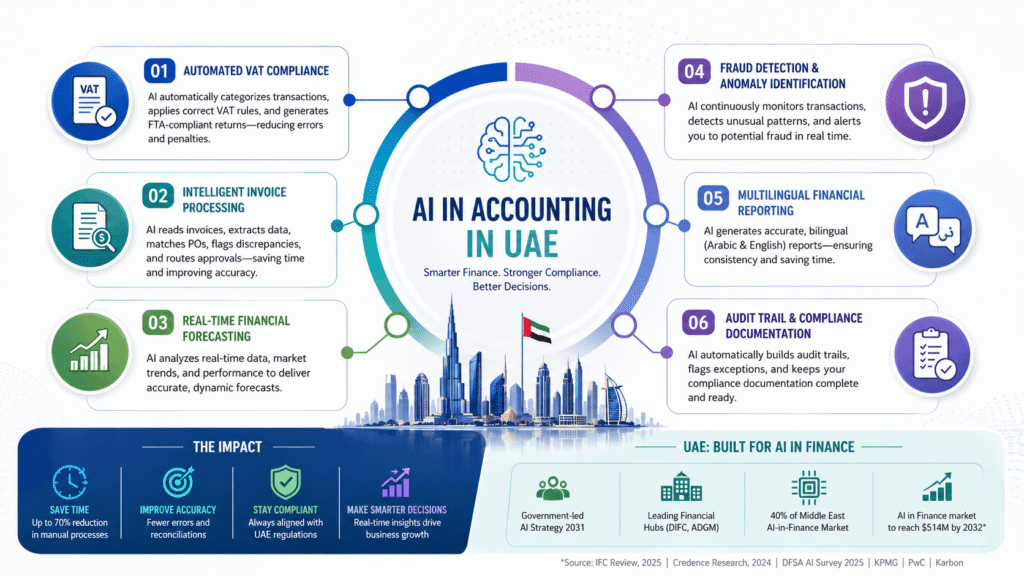
1. Automated VAT Compliance and Reporting
Since the introduction of VAT in 2018, UAE businesses have faced complex filing requirements. AI-powered accounting tools can automatically categorize transactions, apply the correct VAT treatment, and generate FTA-compliant returns, drastically reducing the risk of penalties.
The FTA’s ongoing move toward structured, digital reporting formats means that AI-ready accounting software will soon be a compliance prerequisite, not just a productivity upgrade.
2. Intelligent Invoice Processing
Manual invoice handling is slow and error-prone. AI systems can extract data from invoices using optical character recognition (OCR) and natural language processing, match them against purchase orders, flag discrepancies, and route approvals, all without human intervention.
According to KPMG research on AI-enabled finance teams, organizations using AI in their finance operations have achieved forecast cycle time reductions of 50% or more, with accuracy improvements that cascade across invoice and payables workflows.
3. Real-Time Financial Forecasting
Traditional forecasting relies on static spreadsheets and historical models. AI systems can analyze real-time cash flow, market conditions, and business performance data to generate dynamic financial forecasts. This is particularly valuable in the UAE’s fast-moving business environment, where economic conditions can shift rapidly.
A Microsoft AI Diffusion Report for the first quarter of 2026 noted that AI adoption in the UAE climbed to 70.1 per cent, sharply above the global average of 17.8 per cent.
4. Fraud Detection and Anomaly Identification
AI models can continuously monitor financial transactions, identify unusual patterns, and flag potential fraud in real time. UAE banks and financial institutions have already deployed machine-learning models for fraud prevention, and this capability is now filtering down into accounting software used by SMEs and mid-market businesses alike.
5. Multilingual Financial Reporting
The UAE’s business environment demands documentation in both Arabic and English. AI-powered generative tools can automatically produce accurate, bilingual financial reports, maintaining consistency across languages while freeing up accounting teams to focus on strategic analysis rather than translation and reformatting.
6. Audit Trail Generation and Compliance Documentation
AI systems can automatically generate and maintain detailed audit trails, flagging transactions that fall outside normal parameters. This reduces the time external auditors spend on manual reviews and improves the accuracy and completeness of compliance documentation, a critical advantage for businesses operating in the DIFC or ADGM under their respective regulatory frameworks.
The UAE Competitive Advantage: A Market Built for AI Adoption
The UAE’s financial ecosystem is uniquely positioned to benefit from AI in accounting. According to the Dubai Financial Services Authority’s (DFSA) AI Survey 2025, more than 52% of firms in the DIFC are now actively using AI, up from just 33% in 2024. Generative AI use alone jumped by 166% in a single year.
Beyond adoption rates, the infrastructure supporting AI in UAE finance is robust:
- The Dubai International Financial Centre (DIFC) has launched initiatives integrating AI into wealth management, compliance, and risk modelling.
- Abu Dhabi Global Market (ADGM) operates regulatory sandboxes that support AI-enabled fintech development.
- The UAE commands approximately 40% of the Middle East’s AI-in-finance market share (Credence Research, 2024).
- The UAE AI-in-finance market is projected to grow from $67 million in 2023 to $514 million by 2032, at a CAGR of 25.3% (IFC Review, 2025).
For accounting professionals and business owners, this context is not abstract. It defines the competitive landscape. Firms that delay AI adoption risk falling behind peers who are already compressing month-end close cycles, improving forecasting accuracy, and reducing compliance risk.
Choosing the Right Accounting Software for the UAE Market
With the growth of AI in accounting, selecting the right accounting platform has become a strategic decision, not just a software purchase. Businesses need tools built with the UAE’s regulatory environment in mind: VAT compliance, multi-currency support, FTA-ready reporting, and the scalability to handle growing transaction volumes.
mazeed is one such platform, purpose-built for the UAE market. Designed specifically to support SMEs and growing businesses operating in the Emirates, mazeed offers a clean, intuitive accounting experience that handles the complexity of UAE financial compliance without the steep learning curve of legacy enterprise systems.
mazeed’s core strengths include:
- UAE VAT compliance with built-in support for FTA reporting requirements, ensuring businesses file accurately and on time.
- Multi-currency management that is essential for UAE businesses dealing with international suppliers, clients, and employees.
- Real-time financial visibility through dashboards and reporting tools that give business owners an accurate, up-to-date picture of their financial position at any moment.
- Invoicing and accounts management with streamlined tools for creating, sending, and tracking invoices, reducing administrative overhead.
- Cloud-based accessibility so teams can access financial data from anywhere, supporting the flexible, distributed work models common across UAE businesses.
For businesses evaluating accounting software in the UAE, mazeed offers a locally attuned solution that combines ease of use with the depth needed to manage real financial complexity. You can explore the platform and start a free trial.
Challenges and Considerations
Adopting AI in accounting is not without obstacles. The DFSA’s 2025 AI survey found that while adoption is accelerating rapidly, 21% of DIFC firms still lack clear accountability or oversight mechanisms for their AI use, even in cases where AI is critical to business operations.
Common challenges UAE businesses face include:
- Legacy system integration: Older ERP and accounting platforms often lack APIs or data standards that AI tools require.
- Data quality: AI is only as good as the data it processes. Inconsistent, incomplete, or poorly structured financial data produces unreliable outputs.
- Skills gaps: Globally, 85% of accounting professionals are excited by AI, yet only 37% of firms invest in AI training (Karbon, 2025). The UAE mirrors this paradox.
- Regulatory nuance: AI tools must be calibrated to UAE-specific rules, not global or GCC generalizations, particularly for VAT, free zone compliance, and e-invoicing.
The solution is not to delay adoption, but to start with platforms already designed for the UAE market, and to invest in upskilling accounting teams to work effectively alongside AI tools.
The Future of AI in Accounting in the UAE
The trajectory is clear. The UAE’s National AI Strategy 2031 is designed to make AI adoption structural, embedded in regulation, infrastructure, and the expectations businesses face from auditors, regulators, and investors alike.
For accounting specifically, the near-term future will likely include:
- Mandatory e-invoicing: The Ministry of Finance’s framework signals that digital invoice exchange will become a compliance requirement.
- Real-time tax reporting: AI-compatible accounting systems will be essential for businesses reporting directly to the FTA through connected data streams.
- Agentic AI in finance: According to CPA.com’s 2025 AI in Accounting Report, the industry is moving beyond simple task automation toward true augmentation of accounting processes, meaning AI will not just process data but actively assist in decision-making.
AI in accounting is not coming to the UAE. It is already here. The businesses that build their financial infrastructure around AI-compatible tools today are the ones that will navigate tomorrow’s regulatory environment with confidence and compete most effectively in the region’s increasingly sophisticated economy.
Conclusion
The UAE has staked its economic future on artificial intelligence, and the accounting sector is one of the clearest beneficiaries of that vision. From VAT compliance to real-time forecasting, the examples of AI in accounting being deployed across the Emirates demonstrate that this technology delivers tangible, measurable value.
For UAE businesses ready to modernize their financial operations, the first step is choosing accounting software built for the local market. mazeed offers UAE-focused businesses a reliable, compliant, and scalable platform to manage their finances with clarity and confidence.
Explore mazeed and take the first step toward future-ready accounting.
References
- PwC Middle East, The Economic Potential of Artificial Intelligence in the Middle East: pwc.com
- UAE Government, We the UAE 2031 Vision: u.ae
- Karbon, State of AI in Accounting Report 2025: karbonhq.com
- KPMG, Global AI in Finance Report: kpmg.com
- KPMG, 6 Superpowers of the AI-Enabled Finance Team: kpmg.com
- Microsoft AI Diffusion Report for the first quarter of 2026: khaleejtimes
- Dubai Financial Services Authority (DFSA), AI Survey 2025: dfsa.ae
- Credence Research, Middle East AI in Finance Market 2032: credenceresearch.com
- CPA.com / AICPA, 2025 AI in Accounting Report: cpa.com
- AMCA Auditing, How AI and Automation Are Changing Accounting in the UAE: amcaauditing.com
Disclaimer: This publication is for informational purposes only and should not be considered professional or legal advice. While we strive for accuracy, we make no guarantees regarding completeness or applicability. mazeed, its members, employees, and agents do not accept or assume any liability, responsibility, or duty of care for any actions taken or decisions made based on this content. For official tax guidance, please refer to the UAE Ministry of Finance and the Federal Tax Authority.