

When customers buy on credit, your company must track it well to keep cash flowing. This is where accounts receivable journal entry becomes essential, especially for UAE businesses in fast-changing markets.
Learn more in our article on post-dated cheque.
Keeping accurate records helps you see who owes you money and follows VAT rules.
Properly logged transactions make audits easier, help with taxes, and show payment patterns. For Dubai or Abu Dhabi businesses, this helps them grow in tough markets.
These records also help track what you owe to vendors. Together, they show who you owe and who owes you. Keeping them up to date helps avoid cash problems and improves partner relationships in the Emirates.
Getting good at this helps your balance sheets show your company’s real value، With UAE’s push for digital growth, using efficient methods makes audits and financial choices easier.
Understanding Accounts Receivable Journal Entry Basics
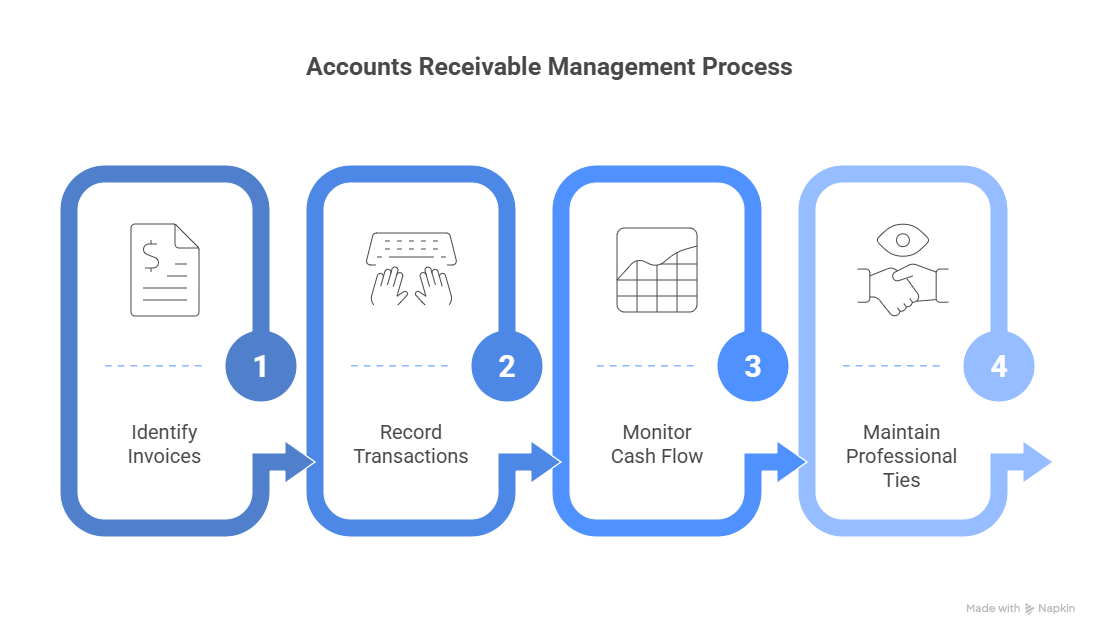
Managing accounts receivable journal entry (AR) is key to keeping your UAE business healthy.
It aligns with local financial expectations. Tracking invoices for Dubai clients or monitoring transactions across emirates is essential. Each journal entry reveals your cash flow and professional ties.
Read more: Accrual Accounting Journal Entries
How Accounts Receivable Journal Entries are Made (Double-Entry System)
In the double entry accounting system, every transaction impacts at least two accounts, with debits always equaling credits.
You may also find our guide to statement of accounts useful.
💡 Manage Accounts Receivable with Ease
Track invoices, automate AR entries, and stay VAT compliant with mazeed accounting software.
When a Sale is made on Credit:
This is the most common and initial entry for accounts receivable.
Debit: Accounts Receivable (This increases the asset account, representing the money owed to your company).
Credit: Sales Revenue (This increases the revenue account, recognizing the income earned from the sale).
Read more: VAT Accounting Entries: Input and Output VAT
What Makes Up an AR Journal Entry?
AR journal entries are like financial breadcrumbs. They show where your money comes from and when.
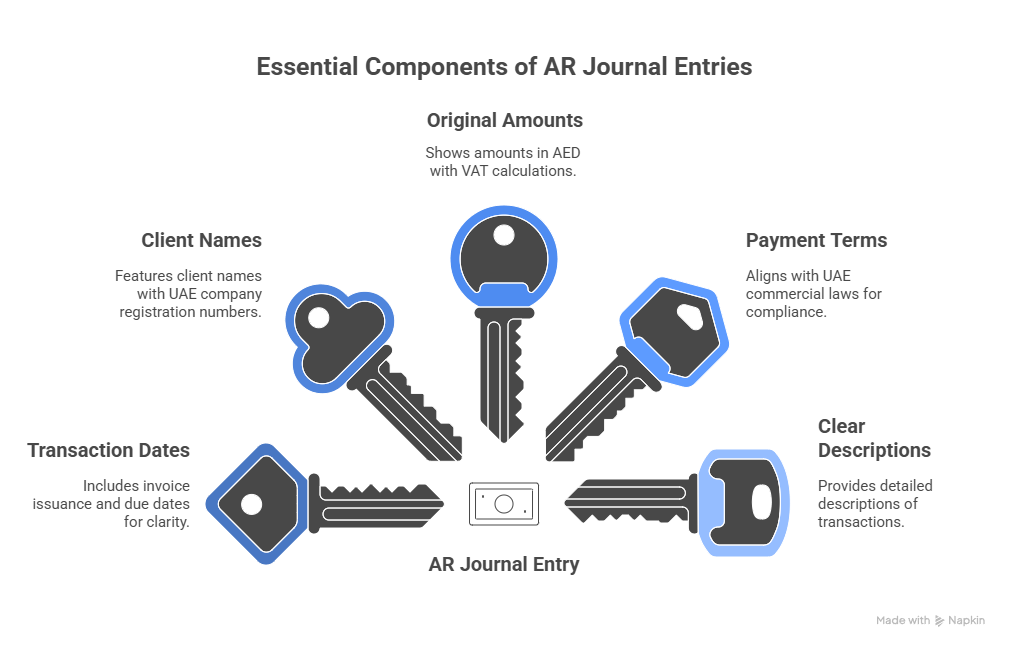
Five elements define every entry:
- Transaction dates (invoice issuance and due dates)
- Client names with UAE company registration numbers
- Original amounts in AED plus VAT calculations
- Payment terms matching UAE commercial laws
- Clear descriptions like ”Dubai office interior design project”
For instance, a Sharjah contractor records client payment with specific VAT codes. This follows Federal Tax Authority rules.
It’s crucial for businesses to have a firm grasp on account aging to maintain healthy financial operations. Understanding account aging helps in managing cash flow effectively, and a key component of this is the accounts payable aging report.
By regularly reviewing the accounts payable aging report, companies can identify overdue invoices and prioritize payments. Each accounts payable journal entry directly impacts these reports, so accuracy is paramount.
A meticulous accounts payable journal entry ensures that the data used for generating an aging report is reliable. The aging report provides a snapshot of financial obligations, clearly showing what is due and when.
This ties into the outstanding report meaning, which highlights unpaid invoices and helps assess financial liabilities. In essence, the outstanding report is about understanding the current state of unpaid debts. Utilizing robust payable software can significantly streamline these processes.
Good payable software automates the tracking of invoices and generation of reports, making account aging and accounts payable aging much simpler to manage.
The right payable software not only helps with each accounts payable journal entry but also provides insightful aging report data, offering a clear outstanding report meaning immediately.
Read more:Fixed Asset Register
Why Accurate Tracking Matters in UAE Businesses
Imagine navigating Dubai’s Business Bay without GPS. That’s what AR management without account aging feels like. It sorts unpaid invoices by days overdue.
This helps you:
“Prioritize collections without damaging valued Emirati partnerships – it’s the difference between saying ‘Your payment is late’ and ‘Let’s resolve this respectfully.’”
Outstanding reports are your secret weapon in UAE markets. They show which Abu Dhabi clients pay late, and which Ras Al Khaimah partners are reliable. You’ll notice patterns, like construction firms needing longer payment cycles than retail buyers. Bonus: These reports also help in UAE commercial disputes.
Three UAE-specific benefits come from tight AR tracking:
- Avoid VAT penalties during FTA audits
- Maintain wasta (influence) through professional money management
- Identify clients needing payment plan adjustment
How to Record an Accounts Receivable Journal Entry
Managing accounts receivable journal entry in the UAE is all about precision. This is true, thanks to VAT rules and local payment habits. Let’s go through the steps with examples from Dubai or Abu Dhabi.
Related reading: sales return journal entry.
1. Identify the Transaction Details
First, write down important info like invoice dates and client names. For instance, if you sell AED 50,000 worth of goods to a Dubai retailer with 30-day terms, remember if VAT applies (usually 5% in UAE).
2. Create Your Initial Entry
Use payable software like QuickBooks or mazeed accounting software to simplify the process.
Debit Accounts Receivable
Boost your AR balance by the total owed. For our example: Debit Accounts Receivable AED 52,500 (AED 50,000 + 5% VAT).
Credit Revenue Account
Then, record the income: Credit Sales Revenue AED 50,000 and Credit VAT Payable AED 2,500 separately for accuracy.
Read more: What is Contra Entry?
3. Handle VAT Compliance (UAE-Specific)
UAE businesses must file VAT returns every quarter. Here’s a quick guide for VAT entries:
| Transaction | Debit | Credit | |
|---|---|---|---|
| Taxable Sale (AED 10,000 + 5% VAT) | Accounts Receivable: 10,500 | Revenue: 10,000 | VAT Payable: 500 |
| VAT Payment to FTA | VAT Payable: 500 | Bank Account: 500 |
4. Track Payments Received
When a client pays, update the AR and bank records. For partial payments, split the entry between principal and VAT.
5. Manage Late Payments
Make aging reports weekly to find overdue accounts. Most UAE-friendly accounting software does this automatically:
“A well-structured aging report helps prioritize collections while maintaining positive client relationships – essential in Emirates’ business culture.”
For accounts over 60 days late, add a bad debt provision: Debit Expense Account, Credit Allowance for Doubtful Accounts.
Learning about accounts receivable journal entry is key for your UAE business. It works well with accounts payable aging analysis to show cash flow clearly. This helps track money coming in and going out in dirhams, meeting tax needs.
Regularly checking aging data helps you manage payments and negotiate better deals. It keeps your working capital healthy. This is important for your business’s success.
By tracking AR and reviewing AP aging, you can spot market trends. This helps avoid cash problems and builds trust with partners in Dubai. For more complex issues, get help from UAE accounting experts. They know the FTA rules well.
For more detail, see our guide to budget vs actual.
Read more:VAT Accounting Entries: Input VAT in UAE
💡 A New Way to Handle Receivables in UAE
We give you smart software with expert support to manage credit sales, improve cash flow, and avoid VAT issues.
How to decrease accounts receivable journal entry?
To decrease the amount of accounts receivable on your balance sheet, you can utilize the provision for doubtful accounts. This is a contra-asset account used to write off bad debt. When you determine that a loan or outstanding payment is unlikely to be collected, deducting it from this provision reduces your accounts receivable, reflecting a more accurate picture of what you expect to collect.
Is Accounts Receivable a Debit or Credit?
Accounts receivable journal entry represents money owed to your business by customers or other entities. Therefore, it is recorded as a debit in your accounting system.
Accounts Receivable Debit or Credit Journal Entry
Many people ask whether accounts receivable is a debit or credit journal entry. The answer is simple.
Accounts receivable is an asset account, which means it normally carries a debit balance.
When a business sells goods or services on credit, the journal entry is:
Debit: Accounts Receivable
Credit: Sales Revenue
This entry shows that the business has earned revenue but has not yet received the cash. The customer now owes the company money.
Example:
A company sells goods worth $1,000 on credit.
Debit: Accounts Receivable 1,000
Credit: Sales Revenue 1,000
When the customer pays later, the entry becomes:
Debit: Cash
Credit: Accounts Receivable
This reduces the receivable balance because the customer has paid the amount owed.
Accounts Payable and Accounts Receivable Journal Entries
Accounts payable and accounts receivable are often discussed together because they represent opposite sides of business transactions.
Accounts receivable records money customers owe your business.
Accounts payable records money your business owes suppliers.
Here are simple examples of both journal entries.
Accounts receivable journal entry (credit sale):
Debit: Accounts Receivable
Credit: Sales Revenue
This means the business made a sale but has not yet received payment.
Accounts payable journal entry (credit purchase):
Debit: Purchases or Expense
Credit: Accounts Payable
This means the business bought goods or services and will pay the supplier later.
Understanding accounts payable and receivable journal entries helps businesses track cash flow clearly. It shows what money is expected to come in and what payments must go out.
Example Journal Entry: Sold Goods to a Customer on Credit
Students and beginners often search for examples like “sold goods to Hari journal entry”. This type of transaction simply represents a credit sale.
If a business sells goods to a customer named Hari on credit, the entry will be:
Debit: Accounts Receivable – Hari
Credit: Sales Revenue
Example:
A company sells goods worth $500 to Hari on credit.
Debit: Accounts Receivable – Hari 500
Credit: Sales Revenue 500
This entry shows that Hari now owes the company $500. Once Hari pays the amount, the entry will be:
Debit: Cash
Credit: Accounts Receivable – Hari
This removes the receivable from the books because the payment has been collected.
How to Use a T Chart for Cash Received from Accounts Receivable
A T chart helps beginners understand how accounts change after transactions.
A T chart has two sides:
Left side: Debit
Right side: Credit
Example: cash received from accounts receivable.
Step 1: Record the original credit sale.
Accounts Receivable
Debit: 1,000
Sales Revenue
Credit: 1,000
Step 2: When the customer pays the amount owed, the T chart changes.
Accounts Receivable
Debit | Credit
1,000 | 1,000
Cash
Debit | Credit
1,000 |
The receivable account is credited to reduce the balance, while cash increases on the debit side. This simple method helps visualize how accounts move after each transaction.
Importance of Accounts Receivable Journal Entries in Financial Analysis
Accounts receivable journal entries are not only about bookkeeping. They also play an important role in financial analysis.
When receivables are recorded correctly, businesses can:
- Track how much money customers owe
- Measure how quickly customers pay their invoices
- Monitor cash flow more accurately
- Identify late payments early
Financial analysts often review accounts receivable data to calculate metrics such as the receivables turnover ratio and average collection period. These indicators show how efficiently a company collects payments.
If receivables grow too quickly, it may signal slow collections or risky credit policies. Accurate journal entries help managers detect these issues early and make better financial decisions.
Key Takeaways: Accounts Receivable Journal Entry
- Purpose: Track credit sales to manage cash flow, comply with UAE VAT rules, and support audits/taxes.
- System: Uses double-entry accounting → Debit Accounts Receivable, Credit Sales Revenue (+ VAT).
- Elements of an AR entry: Dates, client details, amounts + VAT, payment terms, and descriptions.
- Importance of aging reports: Identify overdue invoices, manage payments, and maintain good client/vendor relations.
- Software use: UAE-focused accounting tools (QuickBooks, etc.) automate VAT, aging reports, and payments.
- VAT compliance: Must separate Sales Revenue and VAT Payable, and file quarterly returns to FTA.
- Bad debts: Use allowance for doubtful accounts to adjust AR balance realistically.
- AR vs AP link: Together they show who owes you and what you owe, helping balance sheets reflect real value.
- Business benefits in UAE: Avoid VAT penalties, strengthen relationships (wasta), and spot clients needing flexible terms.
- AR role: Ensures accurate credit tracking, supports cash inflows, and improves financial decision-making.