Welcome to the world of Value Added Tax (VAT) in the UAE! Since 2018, businesses have been learning about VAT. It’s all about two main ideas: input VAT and output VAT.
When you buy things for your business, you pay input VAT. But when you sell, you charge output VAT. This system is key to the UAE’s VAT, making sure taxes are collected fairly.
It’s important to know about input and output VAT for your business in the UAE. Let’s look closer at these ideas and how they affect your business every day.
mazeed provides automated VAT services that are designed to streamline your business operations and ensure compliance with applicable tax regulations. Our AI-powered platform offers a comprehensive suite of services, including:
How VAT Works
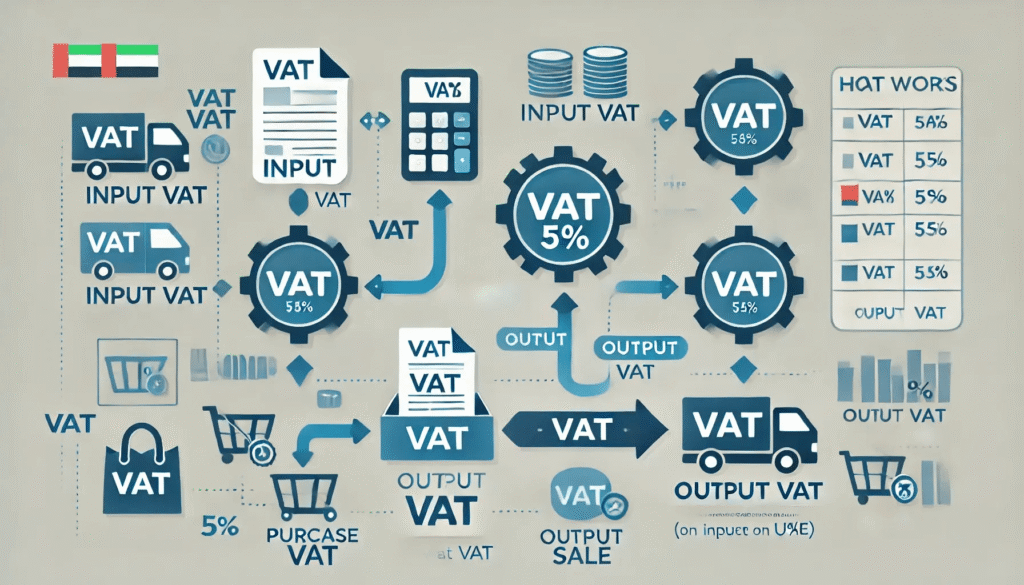
VAT calculation in the UAE is simple. Businesses collect output VAT on sales and reclaim input VAT on purchases. The UAE’s standard VAT rate is 5%, one of the lowest worldwide.
When you sell items or services, you add output VAT to the price. This is what you charge your customers. On the other hand, when you buy for your business, you pay input VAT to your suppliers.
The UAE VAT rules let businesses offset input VAT against output VAT. This figure decides if you owe VAT or get a refund.
Transaction Type | VAT Treatment | Example |
Standard-rated supplies | 5% VAT | Electronics, clothing, restaurants |
Zero-rated supplies | 0% VAT | Exports, certain healthcare services |
Exempt supplies | No VAT charged | Some financial services, residential property |
Keeping accurate records of VAT transactions is vital. This includes invoices, receipts, and VAT return forms. Regularly checking these documents helps follow UAE VAT rules and makes VAT calculations easier.
VAT is a consumption tax. Businesses collect and pay VAT, but the consumer pays it in the end. Knowing how VAT works is crucial for managing your business finances in the UAE.

💡 Your Accounting Made Simple
Save time and reduce errors with smart tools that keep your books accurate and compliant.
Entry for VAT Payable
VAT accounting is vital for managing your business finances in the UAE. It’s important to record VAT payable accurately. This ensures you follow Federal Tax Authority (FTA) rules and report taxes correctly.
To figure out VAT liability, subtract input VAT from output VAT. This shows how much you owe to the FTA. Here’s how to do it for entry for vat payable:
- Record all sales and purchases in your accounting system
- Calculate output VAT on sales
- Calculate input VAT on purchases
- Determine the net VAT payable or receivable
Here’s an example of how to record VAT payable in your books:
Account | Debit | Credit |
Output VAT | 10,000 AED | |
Input VAT | 6,000 AED | |
VAT Payable | 4,000 AED |
Accurate VAT accounting helps you meet tax obligations and avoid fines. Keep detailed records of all transactions. This supports your VAT returns and keeps you in line with UAE tax reporting rules.
Input VAT and Output VAT
It’s important for UAE businesses to know about input VAT and output VAT. Input VAT is the tax on what you buy, while output VAT is the tax on what you sell. This system is key for getting back VAT and following UAE VAT rules.
When you buy things for your business, you pay input VAT. You can often get this back, which lowers your taxes. But, when you sell things, you charge output VAT. You must then report and pay this to the tax office.
The UAE VAT rules let you get back input VAT on many business costs. This includes things like office stuff, raw materials, and professional services. But, there are some things you can’t get back VAT on. For example, personal buys or entertainment costs.
Aspect | Input VAT | Output VAT |
Definition | Tax paid on purchases | Tax collected on sales |
Treatment | Can be reclaimed | Must be paid to authorities |
Impact on Business | Reduces tax burden | Increases tax liability |
Common Examples | Office supplies, raw materials | Product sales, service fees |
Managing input and output VAT well is crucial. By keeping good records and knowing UAE VAT rules, you can get the most VAT back. This helps you follow tax laws.
Read more: What is Reverse Charge Mechanism in UAE?
Input VAT and output VAT in Balance Sheet
VAT accounting is key for businesses in the UAE. It affects your balance sheet, showing input VAT as an asset and output VAT as a liability. This changes your company’s cash flow and financial health.
Input VAT is listed as an asset. It’s the tax paid on purchases that you can get back from the government. Output VAT, however, is a liability. It’s the tax collected on sales that you must pay to the tax authorities.
VAT Type | Balance Sheet Classification | Impact on Financial Position |
Input VAT | Current Asset | Increases working capital |
Output VAT | Current Liability | Decreases working capital |
Accurate VAT reporting is vital for financial clarity and UAE tax rules. Your balance sheet should clearly show the net VAT position. This helps everyone understand your tax duties and cash flow.
“Proper VAT accounting in financial statements ensures compliance and provides a clear picture of a company’s tax position.”
It’s important to regularly check your VAT accounts. This means comparing your VAT calculations with actual payments and receipts. Doing this helps spot any mistakes early and avoids problems during UAE tax reporting.
VAT Input and Output in Chart of Accounts
In the UAE, keeping up with VAT accounting is essential for businesses. Your chart of accounts is vital for tracking VAT. By setting up accounts for vat input and output in chart of accounts, managing your VAT is easier.
When you set up your chart of accounts for VAT, make sure to have separate accounts for input and output VAT. This helps you track VAT paid on purchases and VAT collected on sales. Regularly checking these accounts ensures your financial reports are accurate and you meet UAE tax rules.
Output VAT Definition
Output VAT is the tax you charge customers on taxable sales. In the UAE, you must collect this tax and report it to the Federal Tax Authority. Recording output VAT in a dedicated account helps you track what you owe the government and pay on time.
Read more: What is VAT Taxable Goods in UAE?
Remember, good VAT accounting in your chart of accounts is more than just following rules. It also gives you insights into your business’s tax situation. This helps you make better financial decisions. Keeping up with your VAT obligations helps you avoid fines and stay financially healthy in the UAE.
💡 Your Accounting Made Simple
Save time and reduce errors with smart tools that keep your books accurate and compliant.
How to Record VAT in Accounting
Many business owners ask how to record VAT in accounting in a simple way. The process depends on whether the VAT is paid on purchases or collected on sales.
When you buy goods or services and pay VAT, this is called input VAT.
When you sell goods or services and charge VAT to customers, this is called output VAT.
Here is how it works in practice:
- Input VAT is recorded when you receive a supplier invoice.
- Output VAT is recorded when you issue a sales invoice.
- At the end of the tax period, you calculate the difference between output VAT and input VAT.
- If output VAT is higher, you pay the difference to the tax authority.
- If input VAT is higher, you may carry it forward or request a refund based on local regulations.
This process is also known as input tax and output tax accounting.
Input VAT and Output VAT Journal Entries
Understanding input VAT and output VAT journal entries helps you see how they appear in your accounting records.
1. Recording Input VAT (Purchase)
If you purchase goods worth 1,000 plus 15% VAT:
- Debit Purchases 1,000
- Debit Input VAT 150
- Credit Accounts Payable or Cash 1,150
The input VAT is recorded separately because it may be claimed back from the tax authority.
2. Recording Output VAT (Sale)
If you sell goods worth 2,000 plus 15% VAT:
- Debit Accounts Receivable or Cash 2,300
- Credit Sales 2,000
- Credit Output VAT 300
The output VAT represents the tax you collected from customers.
3. Recording VAT Payment to Tax Authority
At the end of the period:
If output VAT is 300 and input VAT is 150:
- Debit Output VAT 300
- Credit Input VAT 150
- Credit Cash 150
The remaining 150 is paid to the tax authority.
Input VAT and Output VAT in Balance Sheet
Many people wonder about input VAT and output VAT in balance sheet reporting.
Is Input VAT a Current Asset?
Yes, in most cases, input VAT is a current asset.
This is because it represents money that the business can recover from the tax authority.
So if you are asking, is input VAT a current asset? The answer is usually yes, as long as it is refundable or adjustable against future output VAT.
You may also see questions like input GST is asset or liability or input CGST is asset or liability. In general, input tax is treated as an asset because it is recoverable.
Is Output VAT a Current Liability?
Yes. Output VAT is usually recorded as a current liability.
This is because it represents tax collected from customers that must be paid to the government.
If you are asking, is output VAT a current liabilities? It is classified under current liabilities until it is paid.
Input VAT Is What Type of Account?
A common exam question is input VAT is what type of account?
Input VAT is a current asset account. It appears on the balance sheet until it is adjusted against output VAT or refunded.
Output VAT, on the other hand, is a current liability account because it represents an amount payable.
What Is Input VAT and Output VAT With Example?
Input VAT is the VAT you pay when purchasing goods or services for your business.
Output VAT is the VAT you charge customers when you sell goods or services.
Example:
A company buys materials for 1,000 plus 150 VAT.
Later, it sells finished goods for 3,000 plus 450 VAT.
- 150 is input VAT
- 450 is output VAT
The company will pay 300 to the tax authority, which is the difference between output and input VAT.
This simple example helps clarify what is input vat and output vat with example in real business situations.
FAQ: Input and Output VAT
Is input tax an asset or liability?
Input tax is generally an asset because it is recoverable from the tax authority or adjustable against output tax.
Is input GST an asset or liability?
Input GST is treated as a current asset if it can be claimed as credit.
Is input CGST an asset or liability?
Input CGST is also considered a current asset when it is eligible for credit.
Is output VAT a current liability?
Yes. Output VAT is a current liability because the business must pay it to the government.
How to record VAT in accounting?
You record input VAT when you receive purchase invoices and output VAT when you issue sales invoices. At the end of the period, you calculate the difference and pay or carry forward the balance.
What is input tax and output tax accounting?
Input tax and output tax accounting is the process of recording VAT paid on purchases and VAT collected on sales, then settling the difference with the tax authority.
Input VAT is what type of account?
Input VAT is a current asset account on the balance sheet.
True or False: Input VAT is a liability.
False. Input VAT is usually an asset because it is recoverable.
True or False: Output VAT increases business income.
False. Output VAT is not income. It is tax collected on behalf of the government.
Disclaimer: This publication is for informational purposes only and should not be considered professional or legal advice. While we strive for accuracy, we make no guarantees regarding completeness or applicability. mazeed, its members, employees, and agents do not accept or assume any liability, responsibility, or duty of care for any actions taken or decisions made based on this content. For official tax guidance, please refer to the UAE Ministry of Finance and the Federal Tax Authority.