UAE corporate tax applies to individuals as well as companies. Under Cabinet Decision No. 49 of 2023, any natural person conducting business or business activities in the UAE whose total business turnover exceeds AED 1 million in a Gregorian calendar year becomes a taxable person subject to full registration, filing, and payment obligations under Federal Decree-Law No. 47 of 2022. Salary income, personal investment returns, and rental income from unlicensed property ownership are not affected. This guide explains exactly how the AED 1 million rule works, what counts as business income, what is excluded, the sole proprietor salary trap, registration steps and deadlines, how to calculate taxable income, and how Small Business Relief interacts with the individual’s corporate tax position.
This guide focuses on UAE corporate tax for natural persons and is intended to make every rule affecting individual taxpayers easy to follow.
Who Is a Natural Person for UAE Corporate Tax Purposes
Establishing this definition is the essential starting point for understanding UAE corporate tax for natural persons.
In UAE corporate tax law, a natural person is a living individual, as distinct from a juridical person such as a company, partnership, or other legal entity. A natural person may be a UAE national, a UAE resident expatriate, or a non-resident, and may conduct business under a personal trade licence, a freelance permit, a professional licence, or in some cases without a formal licence where the activity does not require one under UAE commercial law.
Article 11 of Federal Decree-Law No. 47 of 2022 establishes that a natural person who conducts a business or business activity in the UAE is treated as a taxable person and is therefore potentially subject to UAE corporate tax. This applies to both resident and non-resident natural persons, provided the business or business activity has a nexus with the UAE sufficient to bring it within the scope of the law.
A natural person and their business are treated as a single taxable person for corporate tax purposes. This means that a sole proprietor operating under a UAE trade licence, and the licensed business through which they trade, are legally the same entity for tax purposes. There is no separate legal personality between the individual and their sole proprietorship under UAE corporate tax law. This has important consequences for the deductibility of amounts the sole proprietor pays to themselves, discussed in detail in the Sole Proprietor Salary Trap section below.
Natural Persons vs Juridical Persons
This distinction is central to UAE corporate tax for natural persons, since only the individual’s own business activity is assessed separately from any company they own.
A natural person who establishes a company, such as a UAE limited liability company or a free zone company, is a separate taxable person from the company itself. The company is a juridical person and is assessed on its own income under the corporate tax rules applicable to companies. The individual shareholder is assessed separately as a natural person only on the income they derive directly from their own business activities, not on the company’s profits simply by virtue of being a shareholder. Dividends received personally from a UAE or foreign company are excluded from the natural person’s corporate tax assessment, as discussed in the Income That Is Excluded section below.
The AED 1 Million Rule: How It Works
The AED 1 million threshold is the single most important trigger point in UAE corporate tax for natural persons.
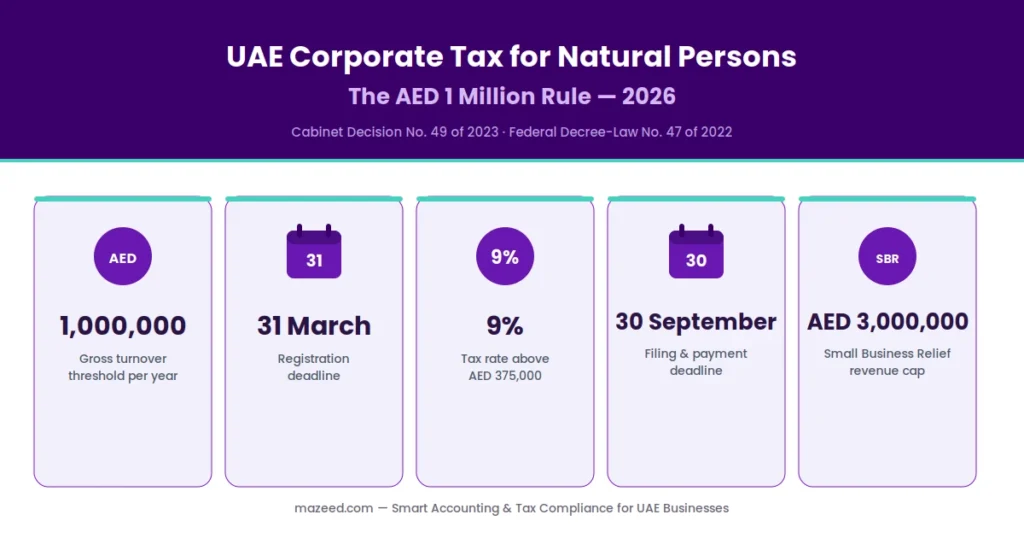
Cabinet Decision No. 49 of 2023 on Specifying the Categories of Businesses or Business Activities Conducted by a Resident or Non-Resident Natural Person that are Subject to Corporate Tax, issued on 8 May 2023 and effective from 1 June 2023, establishes the AED 1 million threshold. It provides that business or business activities conducted by a natural person are subject to corporate tax only where the total turnover from such activities exceeds AED 1,000,000 within a Gregorian calendar year.
The threshold is assessed on turnover, not on profit. Turnover means the gross amount of income derived from business activities before deducting any expenses. A natural person whose gross business revenue is AED 1.2 million but whose net profit after expenses is AED 150,000 is still required to register for corporate tax because the turnover threshold of AED 1 million has been exceeded. The level of profitability is irrelevant to the registration obligation; it affects only the quantum of tax ultimately owed.
The threshold applies to a Gregorian calendar year (1 January to 31 December), not to any other financial year period. This is different from the tax period that applies to juridical persons, which is typically the entity’s financial year. For natural persons, the relevant period for assessing whether the AED 1 million threshold is met is always the calendar year.
The Threshold Is Gross Revenue, Not Net Profit
This is the most common misunderstanding about the AED 1 million rule. A freelance architect who invoices clients AED 1.3 million in a calendar year must register for corporate tax, even if their net profit after studio rent, software subscriptions, and subcontractor costs is only AED 280,000. The AED 1 million test is applied to gross income received from business activities. Expenses are deducted later, when calculating taxable income, not when determining whether the registration threshold is met.
This gross-revenue rule is one of the most commonly misunderstood aspects of UAE corporate tax for natural persons.
What Counts as Business Turnover
Correctly classifying income is essential to applying UAE corporate tax for natural persons accurately.
The FTA’s Corporate Tax Guide on Taxation of Natural Persons (CTGTNP1, November 2023) provides detailed guidance on what constitutes business turnover for the purposes of the AED 1 million threshold. The key principle is that turnover includes all income from a business or business activity conducted regularly, on an ongoing and independent basis, in any sector including industrial, commercial, agricultural, vocational, professional, or service activities.
The following categories of income count towards the AED 1 million threshold:
- Fees from professional services: Consulting fees, advisory fees, legal fees, engineering fees, medical fees, architectural fees, and any other professional service income earned by the individual in the conduct of their business or practice.
- Revenue from trade or commerce: Income from buying and selling goods, operating a business as a trader or merchant, or any commercial activity conducted under a UAE trade licence.
- Freelance project income: Project-based or assignment-based income from freelance activities conducted under a UAE freelance permit or equivalent, including income from work delivered to clients in other countries.
- Income from international platforms: Revenue earned through international freelancing platforms such as Upwork, Fiverr, Toptal, or similar, where the individual is conducting their UAE-based business through those platforms. The location of the platform, the currency received, or the nationality of the clients does not affect the inclusion of this income in the threshold.
- Licensed real estate activities: Where a natural person conducts real estate buying, selling, or leasing as a licensed business activity (holding a real estate brokerage licence or similar), income from that activity counts as business turnover. This is distinct from personal rental income from property owned outside a business licence, which is excluded as discussed below.
VAT Is Excluded from the Turnover Calculation
As confirmed in the FTA’s CTGTNP1 guide, the AED 1 million threshold is measured on revenue net of VAT. VAT collected on behalf of the government by a VAT-registered individual is not the individual’s business income; it is a liability due to the FTA. A freelance consultant who invoices AED 1,050,000 inclusive of 5% VAT has business turnover of AED 1,000,000 (the AED 50,000 VAT component is excluded). This means the AED 1 million threshold is not breached purely as a result of the VAT component of invoices.
This VAT treatment is a detail that is often missed when assessing UAE corporate tax for natural persons obligations.
Income That Is Excluded from the Threshold
Knowing what falls outside scope is just as important as knowing what is taxed under UAE corporate tax for natural persons.
Cabinet Decision No. 49 of 2023 explicitly excludes the following categories of income from the corporate tax scope for natural persons. These categories do not count towards the AED 1 million threshold and are not subject to corporate tax regardless of their amount:
| Subject to Corporate Tax | Excluded from Corporate Tax |
| Fees from licensed professional practice (consulting, advisory, legal, medical) | Salary and wages as an employee |
| Revenue from licensed trade or commerce activities | Personal investment income (dividends, interest, capital gains for own account) |
| Freelance project income from UAE-based business | Rental income from personally owned UAE property (not requiring a licence) |
| Income from international platforms as part of UAE business | Income from the sale of personally owned UAE real estate (not licensed activity) |
| Licensed real estate brokerage or development activity income | Returns from personal savings accounts and deposits |
| Any other business activity conducted regularly and independently under a UAE licence |
Salary and Employment Income
Income earned as an employee under an employment contract, including basic salary, allowances, bonuses, end-of-service gratuity, and other employment benefits, is entirely outside the scope of UAE corporate tax for natural persons. The AED 1 million threshold does not apply to employment income regardless of amount. A senior executive earning AED 5 million in annual salary from their UAE employer has no corporate tax obligation arising from that salary.
Employment income remains entirely outside UAE corporate tax for natural persons, regardless of the amount earned.
Personal Investment Income
Income derived by a natural person from investments made for their own personal account, where the investment activity does not require a licence from a UAE licensing authority and is not conducted through a licensed business, is excluded from corporate tax. This includes dividends received personally from shareholdings in UAE or foreign companies, interest earned on personal savings or deposits, and capital gains from the disposal of personal investments such as shares or bonds.
Cabinet Decision No. 49 of 2023 confirms this exclusion explicitly: investment activities conducted by natural persons for their own personal account, not through a licence and not classified as a commercial business, fall outside the corporate tax scope for individuals.
Passive investment returns held for one’s own account sit outside the scope of UAE corporate tax for natural persons.
Personal Real Estate Income
Income from the sale, leasing, sub-leasing, and renting of land or real estate property in the UAE is excluded from corporate tax for natural persons, provided the activity is not conducted through a licence and does not require a licence from a UAE licensing authority. This covers the typical scenario of an individual who owns one or more residential or commercial properties and receives rental income from them personally. That rental income is not subject to corporate tax and does not count towards the AED 1 million threshold.
When Property Income Becomes a Licensed Business Activity
The exclusion for personal real estate income applies only where the activity does not require a UAE trade licence and is not conducted through a licence. Where an individual holds a real estate brokerage licence, a property development licence, or another relevant licence, the income generated through that licensed activity falls within the business income category and may count towards the AED 1 million threshold. The distinguishing factor is whether the individual is acting as a personal investor or as a licensed business operator in the real estate sector.
Unlicensed personal property income remains excluded from UAE corporate tax for natural persons.
Multiple Business Activities and the Aggregation Rule
Individuals running more than one licensed activity face specific aggregation rules under UAE corporate tax for natural persons.
Where a natural person conducts more than one business activity, whether under one or multiple UAE licences, the turnover from all those activities is aggregated when assessing whether the AED 1 million threshold has been exceeded in a calendar year. The threshold is a global one applied to the total of all business income from all activities, not assessed separately for each activity or licence.
The CTGTNP1 guide provides an illustrative example: a natural person who earns AED 600,000 from freelance IT services and AED 450,000 from licensed tutoring activities in the same calendar year has total business turnover of AED 1,050,000. This exceeds the AED 1 million threshold, so the individual is required to register for corporate tax and file a return for that calendar year, even though neither individual activity on its own exceeded the threshold.
When calculating taxable income in that single return, the individual declares all business income from all activities combined. There is no concept of filing separate returns for each licence or activity; the individual is a single taxable person assessed on the total of their business activities.
UAE-Based Business Income Only
The aggregation rule applies to business income from UAE business activities. As confirmed in the CTGTNP1 guide, where a natural person conducts business activities both inside and outside the UAE, only the turnover attributable to UAE business activities is included in the AED 1 million threshold assessment. Income from business activities conducted exclusively outside the UAE by a natural person who happens to be UAE-resident does not automatically count towards the threshold, although the analysis depends on the specific facts and whether a UAE nexus exists for the non-UAE activity.
This geographic scope is a key boundary within UAE corporate tax for natural persons.
Registration: Deadlines, Process, and Penalties
Meeting registration deadlines is a core compliance duty within UAE corporate tax for natural persons.
A natural person who meets the AED 1 million threshold in a calendar year must register for corporate tax with the FTA by 31 March of the following calendar year, as established under FTA Decision No. 3 of 2024. The registration deadline for natural persons is therefore fixed annually at 31 March, regardless of when during the year the threshold was first exceeded.
| Calendar Year in Which AED 1M Was Exceeded | Registration Deadline |
| 2023 (first year of corporate tax regime) | 31 March 2024 (passed) |
| 2024 | 31 March 2025 (passed) |
| 2025 | 31 March 2026 |
| 2026 | 31 March 2027 |
Registration is completed through the EmaraTax portal at eservices.tax.gov.ae using UAE Pass. The required documents for a natural person registration include a valid Emirates ID (or passport for non-residents), a copy of any applicable UAE trade or professional licences, and evidence of business income such as bank statements or invoices confirming the turnover level.
The AED 10,000 Late Registration Penalty and the Waiver
Missing the 31 March registration deadline exposes the natural person to the AED 10,000 administrative penalty under Cabinet Decision No. 10 of 2024. The penalty waiver mechanism under FTA Public Clarification CTP006 (July 2025) is available to natural persons on the same basis as for companies: the penalty is waived if the first corporate tax return is filed within seven months of the end of the first tax period. For a natural person whose first tax period is the calendar year 2025 (ending 31 December 2025), the waiver deadline is 31 July 2026, two months before the standard nine-month filing deadline of 30 September 2026.
Awareness of this waiver mechanism is valuable for anyone navigating UAE corporate tax for natural persons obligations.
Software & Experts Together!
New Way to Manage Corporate Tax in UAE
Just scan your invoices and our team will handle all your compliance process inside your mazeed account.
The Tax Period for Natural Persons
The applicable tax period is another area where UAE corporate tax for natural persons differs from the rules that apply to companies.
For natural persons subject to corporate tax, the tax period is the Gregorian calendar year (1 January to 31 December). This differs from the position for companies, where the tax period is typically the entity’s financial year and may end on any date.
As confirmed in the CTGTNP1 guide, this means that a natural person’s first tax period under the corporate tax regime is the calendar year in which their business turnover first exceeded AED 1 million, commencing on 1 January of that year. A natural person whose business turnover first exceeded AED 1 million in 2025 has a first tax period running from 1 January 2025 to 31 December 2025, with the return and any tax payment due by 30 September 2026.
Where a natural person commences a new business activity mid-year, the first tax period still runs from 1 January of the year in which the activity commenced. There is no provision for a natural person’s tax period to begin on the date the business licence was obtained or the first revenue was earned.
How to Calculate Taxable Income
Calculating taxable income accurately is the next critical step in UAE corporate tax for natural persons compliance.
Once the AED 1 million threshold is exceeded and the natural person is a taxable person, their corporate tax liability is calculated on their taxable income, not on their gross turnover. The standard corporate tax rates apply:
- 0% on taxable income up to AED 375,000
- 9% on taxable income above AED 375,000
Taxable income is calculated starting from accounting profit or loss from the business activities, adjusted for items that are not deductible under UAE corporate tax law. The CTGTNP1 guide confirms that natural persons should prepare financial records of their business income and expenses in accordance with applicable accounting standards, typically IFRS for SMEs or a simplified set of accounts where the entity qualifies, and use those records as the basis for the taxable income calculation.
Deductible Expenses
Business expenses are deductible where they are incurred wholly and exclusively for the purposes of the business activity and are not excluded under the Decree-Law or its implementing decisions. Allowable deductions for a natural person typically include:
- Licence and permit renewal fees
- Office or studio rent for business premises
- IT equipment and software subscriptions used for business
- Professional indemnity and business insurance
- Marketing and advertising costs
- Professional development and training directly related to the business
- Fees paid to employees or subcontractors (where the subcontractor is a separate legal person, not the sole proprietor themselves)
- Travel costs where wholly for business purposes
- The business-use portion of shared costs such as mobile phones and home office expenses (the business portion only, on a fair and reasonable apportionment basis)
Proper documentation of these deductions strengthens an individual’s position under UAE corporate tax for natural persons.
| Gross business revenue (net of VAT) | AED 1,400,000 |
| Less: office rent and utilities | (AED 60,000) |
| Less: professional fees (accountant, legal) | (AED 30,000) |
| Less: IT, software, and equipment | (AED 25,000) |
| Less: travel (business portion) | (AED 15,000) |
| Less: marketing and business development | (AED 20,000) |
| Accounting profit (taxable income) | AED 1,250,000 |
| 0% on first AED 375,000 | AED 0 |
| 9% on remaining AED 875,000 | AED 78,750 |
| Total corporate tax liability | AED 78,750 |
The Sole Proprietor Salary Trap
The self-salary disallowance is one of the most misunderstood aspects of UAE corporate tax for natural persons.
One of the most important and frequently misunderstood rules in the CTGTNP1 guide concerns the deductibility of amounts a sole proprietor pays or allocates to themselves as a salary or management fee.
The rule is clear: a sole proprietor cannot deduct a salary paid to themselves from their taxable income. The CTGTNP1 guide addresses this directly through a specific example involving a sole proprietor named Mr. T, who operates a business and records a salary withdrawal of AED 200,000 as an expense in the business accounts, reasoning that he is performing management work for the business.
The FTA’s guide concludes that this AED 200,000 salary is not deductible, because the sole proprietor and the business are a single taxable person. Paying a salary from oneself to oneself is not a transaction between two separate parties; it is simply a movement of funds within a single taxable entity. This applies even where the amount the sole proprietor would have paid to an unrelated employee for the same work would have been fully deductible, and even where the amount is genuinely at arm’s length.
Why This Matters: The Real Cost of the Salary Trap
A sole proprietor who earns AED 2 million in revenue, pays themselves AED 600,000 in “salary,” and records net profit of AED 1,400,000 in their accounts will find that their taxable income for corporate tax purposes is AED 2,000,000 minus allowable third-party expenses, not AED 1,400,000. The AED 600,000 self-salary is added back. If legitimate third-party expenses total AED 300,000, taxable income is AED 1,700,000, not AED 1,400,000. At a 9% effective rate above AED 375,000 this difference represents over AED 29,000 of additional tax. Sole proprietors whose tax returns show large salary deductions to themselves should correct this before filing.
Payments to Employees Are Deductible
In contrast, salaries and wages paid to genuine employees (other than the sole proprietor themselves) and fees paid to independent subcontractors or service providers who are separate legal persons are fully deductible business expenses, subject to the general arm’s length and business-purpose conditions that apply to all deductible expenses under Article 28 of the Decree-Law.
This distinction matters greatly for anyone applying UAE corporate tax for natural persons rules to a small team.
Small Business Relief for Natural Persons
Small Business Relief offers meaningful simplification for many individuals subject to UAE corporate tax for natural persons.
Natural persons who exceed the AED 1 million registration threshold but have total business revenue of AED 3 million or below in the tax period may be eligible for Small Business Relief (SBR) under Article 21 of the Decree-Law and Ministerial Decision No. 73 of 2023.
If SBR is elected, the natural person is treated as having zero taxable income for that period and pays no corporate tax. The election reduces the compliance burden significantly: the return filed is in a simplified form, and the full taxable income calculation (including the add-back of the self-salary and the entertainment expense apportionment) is not required for an SBR period.
Conditions for SBR Eligibility
- Total business revenue for the current tax period must not exceed AED 3 million
- Total business revenue must not have exceeded AED 3 million in any prior tax period since 1 June 2023
- The tax period must end on or before 31 December 2026
- The election must be actively made in the Elections section of the EmaraTax return for the relevant period
When Not to Elect SBR
A natural person who is running a loss-making business in the current period should consider carefully whether to elect SBR. Electing SBR forfeits the ability to carry forward tax losses from that period to future years under Article 39 of the Decree-Law. For a sole proprietor with significant startup costs or a business in its early loss-making phase, preserving those tax losses for carry-forward against future profitable income may be more valuable than the immediate simplification that SBR provides.
Weighing this trade-off carefully is an important part of planning around UAE corporate tax for natural persons.
Filing the Return on EmaraTax
Filing correctly on EmaraTax is the final practical step in complying with UAE corporate tax for natural persons.
All natural persons registered for corporate tax must file an annual corporate tax return on EmaraTax within nine months of the end of the tax period. Since the tax period for natural persons is always the calendar year (1 January to 31 December), the filing deadline is always 30 September of the following year. A natural person registered for their 2025 tax year must file and pay by 30 September 2026.
All natural persons registered for corporate tax must file their annual return on EmaraTax within nine months of the tax period end. The steps to file are:
1- Log in to EmaraTax using UAE Pass
Access the portal at eservices.tax.gov.ae. Log in with UAE Pass. Select the natural person taxable profile linked to your Emirates ID or passport number.
2- Prepare your business income and expense records
Before starting the return, have your gross business revenue, list of allowable business expenses, and any prior-year tax losses ready. If claiming Small Business Relief, confirm that revenue for the current period and all prior periods since 1 June 2023 does not exceed AED 3 million.
3- Enter business income details
Declare total gross business revenue for the calendar year. Where you conduct multiple business activities, all revenue streams are entered on the single return as a combined total. Revenue should exclude VAT collected on behalf of the FTA.
4- Make the Small Business Relief election if applicable
Navigate to the Elections section of the return. If eligible for and intending to claim SBR, make the election here. If SBR is not being elected, proceed to the taxable income calculation steps.
5- Complete the taxable income calculation
Enter allowable business expenses and complete the income adjustment schedule, including adding back any self-salary amounts, adding back 50% of client entertainment, and any other non-deductible items. The result is taxable income, which is then taxed at 0% up to AED 375,000 and 9% above.
6- Submit the return and pay
Review the completed return summary. Accept the accuracy declaration and submit. Pay any tax liability via GIBAN bank transfer. Both the return submission and the payment must be completed by 30 September. Download and retain the submission confirmation and the payment receipt as part of your tax records.
Deregistration: When Income Falls Below the Threshold
Deregistration rules also form part of the broader framework of UAE corporate tax for natural persons.
A natural person who has previously registered for corporate tax may apply to deregister from corporate tax where they no longer meet the registration conditions. Under the FTA’s guidance, this means applying for deregistration where business turnover has fallen below AED 1 million and is not expected to exceed that threshold again in the foreseeable future.
A natural person cannot deregister while they have any outstanding corporate tax obligations, including unfiled returns, unpaid tax liabilities, or unresolved FTA queries. Deregistration must be applied for through EmaraTax. The FTA reviews the application and, if satisfied that the conditions for deregistration are met, processes the deregistration and issues a confirmation.
Where a previously deregistered natural person’s business turnover subsequently again exceeds AED 1 million in a later calendar year, they are required to re-register for corporate tax by 31 March of the following year.
Worked Examples
These worked examples illustrate how UAE corporate tax for natural persons applies in real scenarios.
Example 1: Freelance Consultant Below the Threshold
Scenario: Independent Marketing Consultant, Calendar Year 2025
Facts: A UAE-resident marketing consultant operates under a freelance permit. In 2025, total invoices issued to clients amount to AED 840,000 (net of VAT). She also receives a personal dividend of AED 60,000 from shares she holds in a UAE company, and earns rental income of AED 120,000 from a residential apartment she owns personally.
Threshold assessment: Business turnover from the freelance permit is AED 840,000. Dividends from personal investments and personal rental income are both excluded from the threshold under Cabinet Decision No. 49 of 2023. Total threshold-relevant turnover is AED 840,000, which does not exceed AED 1 million.
Result: The consultant is not required to register for corporate tax in 2025. She has no corporate tax obligation for this year. She should monitor her freelance income in 2026 in case it exceeds the threshold.
Example 2: Mixed Income With Threshold Breach
Scenario: Self-Employed Architect, Calendar Year 2025
Facts (as in FTA CTGTNP1, Example Mr. Q): A self-employed UAE-based architect earns AED 1,200,000 from architectural services under his professional licence. He also earns AED 200,000 in dividends from personal share investments and AED 500,000 in salary from a part-time employment arrangement with an architecture firm.
Threshold assessment: Professional fee income from licensed services: AED 1,200,000. Dividends from personal investments: excluded. Salary income: excluded. Total threshold-relevant turnover: AED 1,200,000.
Registration: The AED 1 million threshold is exceeded. The architect must register for corporate tax by 31 March 2026 (for 2025 income).
Taxable income: Business revenue AED 1,200,000, minus allowable expenses (office rent AED 80,000, drafting software AED 12,000, professional insurance AED 8,000, business travel AED 15,000) = taxable income of AED 1,085,000. Note: any salary the architect records as paying to himself is not deductible.
Tax calculation: 0% on AED 375,000 = AED 0. 9% on AED 710,000 = AED 63,900.
Alternative: If the architect elects Small Business Relief (revenue AED 1,200,000 is below AED 3 million), taxable income is treated as zero and no tax is paid. He should compare AED 63,900 in tax against the value of any tax losses available from prior periods before deciding whether to elect SBR.
Example 3: The Sole Proprietor Salary Trap in Practice
Scenario: Sole Proprietor Trading Business, Calendar Year 2025
Facts: A sole proprietor operates a trading business under a UAE mainland trade licence, buying and reselling industrial equipment. 2025 revenue is AED 2.8 million. Cost of goods sold is AED 1.6 million. Other business expenses (warehouse rent, delivery costs, insurance) are AED 200,000. The owner records an additional AED 300,000 as their own salary in the business accounts, resulting in an accounting profit of AED 700,000.
Salary add-back: The AED 300,000 self-salary is not deductible. It must be added back under the CTGTNP1 rule that the sole proprietor and the business are a single taxable person.
Taxable income: AED 700,000 (accounting profit) + AED 300,000 (self-salary add-back) = AED 1,000,000.
Tax calculation: 0% on AED 375,000 = AED 0. 9% on AED 625,000 = AED 56,250.
Key takeaway: The sole proprietor’s practice of recording a personal salary in the business accounts had no effect on their taxable income. The self-salary simply shifted funds from one pocket to another within the same taxable entity. The corporate tax liability is calculated on the full AED 1,000,000 taxable profit, not on the AED 700,000 accounting profit after the self-salary.
GET STARTED TODAY
Let mazeed Handle Your Corporate Tax
Join 4,000+ UAE businesses using mazeed to stay compliant and avoid costly mistakes.
Frequently Asked Questions
These frequently asked questions address common uncertainties around UAE corporate tax for natural persons.
I have a UAE freelance permit but my income comes entirely from overseas clients. Do I still need to register?
The source of the client is not the deciding factor. What matters is whether you are conducting business activities in the UAE. A UAE-resident freelancer operating under a UAE freelance permit, performing work from the UAE, is conducting a UAE business activity even where all clients are located overseas and payment is received in a foreign currency. If total business turnover from those activities exceeds AED 1 million in a calendar year, registration for corporate tax is required.
Can I avoid the AED 1 million threshold by keeping two separate licences with AED 600,000 revenue each?
No. The AED 1 million threshold applies to the total aggregate turnover from all business activities conducted by the natural person, across all licences. Cabinet Decision No. 49 of 2023 is clear that the threshold is assessed on total turnover from all businesses or business activities, not on the revenue of any individual licence in isolation. Structuring activity across multiple licences does not reduce the applicable threshold.
If I exceed AED 1 million in one year but not in subsequent years, do I need to file a return every year?
Once registered, a natural person must file an annual corporate tax return for each tax period (calendar year) in which they are registered, regardless of whether the AED 1 million threshold is exceeded in that subsequent year. A registered natural person whose turnover falls below AED 1 million in a later year can apply to deregister from corporate tax via EmaraTax. Until deregistration is approved, the filing obligation continues.
Does a UAE Golden Visa holder have any special exemption from the AED 1 million rule?
No. The corporate tax obligation for natural persons is determined solely by whether the individual conducts business activities in the UAE with turnover exceeding AED 1 million in a calendar year, regardless of their visa category. A Golden Visa holder conducting business activities in the UAE is assessed on exactly the same basis as any other UAE resident.
I am a non-resident freelancer who performs services for UAE clients remotely from abroad. Do I owe UAE corporate tax?
This depends on whether you have a UAE business presence. A non-resident natural person who performs services entirely from outside the UAE, without a UAE licence, without UAE employees or agents, and without physical presence in the UAE in connection with the business, may not have a UAE taxable nexus sufficient to bring the income within the scope of UAE corporate tax. However, if the non-resident has a UAE freelance permit, a UAE bank account used for the business, UAE-based employees or subcontractors, or any other UAE presence connected to the business, the position is more complex and should be assessed against Article 11 of the Decree-Law and Cabinet Decision No. 49 of 2023.
How are expenses apportioned if I use my home for both business and personal purposes?
Where costs such as home internet, mobile phone, or home office utilities are shared between business and personal use, only the business-use proportion is deductible. The FTA’s CTGDTI1 guide (Determination of Taxable Income) confirms that a fair and reasonable apportionment basis should be used, documented consistently, and applied in the same way from year to year. Keeping a log of business versus personal use for shared resources provides the most defensible basis for the apportionment if the FTA queries the deduction.
The AED 1M Rule at a Glance
This quick-reference table summarizes the essentials of UAE corporate tax for natural persons.
| Threshold | AED 1,000,000 gross business turnover per calendar year |
| Measured on | Gross revenue (before expenses), net of VAT |
| Period | Gregorian calendar year (1 Jan to 31 Dec) |
| Register by | 31 March of the following year |
| File and pay by | 30 September of the following year |
| SBR available if | Revenue below AED 3M and period ends on or before 31 Dec 2026 |
| Self-salary | Never deductible for sole proprietors |
What Is Excluded (Not Taxed):
- Salary and wages from employment
- Personal investment dividends and interest
- Rental income from personal property
- Capital gains from personal investments
Official References
[1] Article 11, Federal Decree-Law No. 47 of 2022 on the Taxation of Corporations and Businesses (definition of natural person as taxable person and AED 1 million threshold authority). Ministry of Finance, UAE. mof.gov.ae
[2] Cabinet Decision No. 49 of 2023 on Specifying the Categories of Businesses or Business Activities Conducted by a Resident or Non-Resident Natural Person that are Subject to Corporate Tax. Issued 8 May 2023, effective 1 June 2023. Cabinet of the UAE. uaelegislation.gov.ae
[3] FTA Corporate Tax Guide on Taxation of Natural Persons (CTGTNP1). Federal Tax Authority, 25 November 2023. Contains worked examples including Mr. Q (multiple business activities), Mr. T (sole proprietor salary disallowance), and Mrs. R (professional services exceeding AED 3 million). tax.gov.ae
[4] PwC Middle East Tax Alert: “UAE Corporate Tax: Cabinet Decision No. 49 of 2023.” May 2023. Analysis of the categories excluded from corporate tax for natural persons. pwc.com
[5] FTA Decision No. 3 of 2024 on Timelines for Corporate Tax Registration of Taxable Persons. Federal Tax Authority. Specifies the 31 March annual deadline for natural person registrations. Effective 1 March 2024.
[6] FTA Corporate Tax Public Clarification CTP006: Waiver of Administrative Penalty for Failure to Submit a Corporate Tax Registration Application Within the Specified Deadline. Federal Tax Authority, 17 July 2025. Available at tax.gov.ae
[7] Ministerial Decision No. 73 of 2023 on Small Business Relief. Ministry of Finance, UAE. AED 3 million revenue threshold and eligibility conditions for natural persons.
[8] Article 28, Article 39, Federal Decree-Law No. 47 of 2022 (wholly and exclusively test for deductions; 75% tax loss carry-forward cap). Ministry of Finance, UAE.
[9] FTA Corporate Tax Guide on Determination of Taxable Income (CTGDTI1). Federal Tax Authority, 31 July 2024. Dual-purpose expense apportionment rules applicable to natural persons. tax.gov.ae
[10] Cabinet Decision No. 10 of 2024 on Administrative Penalties for Violations Related to Federal Decree-Law No. 47 of 2022. AED 10,000 late registration penalty applicable to natural persons. Cabinet of the UAE.
Disclaimer: This publication is for informational purposes only and should not be considered professional or legal advice. While we strive for accuracy, we make no guarantees regarding completeness or applicability. mazeed, its members, employees, and agents do not accept or assume any liability, responsibility, or duty of care for any actions taken or decisions made based on this content. For official tax guidance, please refer to the UAE Ministry of Finance and the Federal Tax Authority.