
VAT vs Corporate Tax in the UAE: The Complete Comparison Guide
The UAE now operates two concurrent federal tax systems that every business must manage separately: Corporate Tax, which launched on 1 June 2023 under Federal Decree-Law No. 47 of 2022, and VAT, which has applied since 1 January 2018 under Federal Decree-Law No. 8 of 2017. They share the same administrator (the Federal Tax Authority), the same filing portal (EmaraTax), and even some of the same thresholds numerically, but they are fundamentally different taxes that operate on different bases, carry different registration timelines, have different filing frequencies, and generate different compliance obligations. Confusing them, or assuming that compliance with one satisfies obligations under the other, is one of the most common and costly mistakes UAE businesses make.
This guide is built around the difference between VAT and corporate tax so businesses can manage both systems correctly.
1. The Fundamental Difference: Direct vs Indirect Tax
Understanding the difference between VAT and corporate tax starts with recognizing that one is a direct tax and the other is indirect.
| Corporate Tax | VAT | |
|---|---|---|
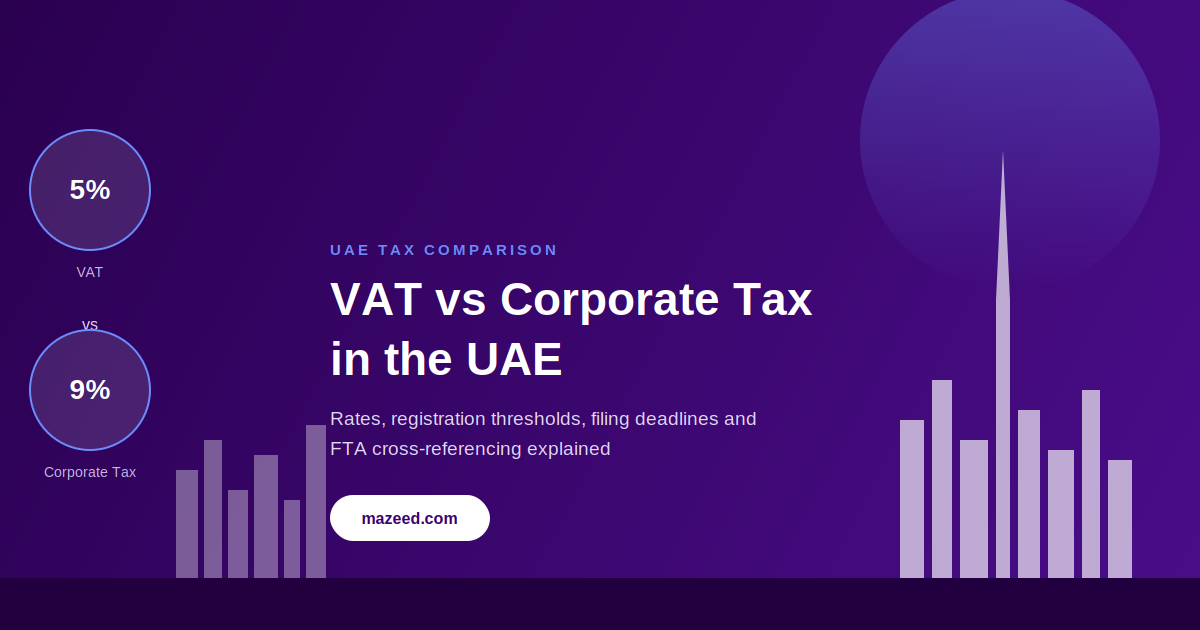
| Percentage | 9% | 5% |
| Type | Direct tax on business profits | Indirect consumption tax |
| Who bears it | The business itself, from its own earnings | The end consumer; businesses collect and remit |
| What triggers it | Generating taxable profit above AED 375,000 | Making taxable supplies above the AED 375,000 registration threshold |
| Filing frequency | Annual, within 9 months of financial year end | Quarterly (or monthly for large businesses) |
| In force since | 1 June 2023 | 1 January 2018 |
The single most important distinction between Corporate Tax and VAT is their economic nature. Corporate Tax is a direct tax: the business pays it from its own profits, and it reduces the business’s wealth. VAT is an indirect tax: the business collects it from its customers on behalf of the government and passes it on to the FTA. A VAT-registered business does not bear the economic burden of VAT (provided it has no irrecoverable input VAT). The business is acting as a tax collector.
This is the foundational difference between VAT and corporate tax that shapes every other distinction in this guide.
This distinction has direct practical implications. Corporate Tax affects profitability and must be planned for as a business cost. VAT affects pricing, cash flow timing, and invoicing compliance, but does not reduce profit where input VAT is fully recoverable. When businesses say they “pay 5% VAT,” they mean their customers pay 5% more, and the business remits that 5% to the FTA after offsetting the VAT it paid on its own purchases.
These practical implications are a direct result of the difference between VAT and corporate tax in how each is applied.
2. Legal Basis and Administering Authority
The shared administrator does not erase the difference between VAT and corporate tax in terms of legal basis and scope.
| Feature | Corporate Tax | VAT |
|---|---|---|
| Primary legislation | Federal Decree-Law No. 47 of 2022 on the Taxation of Corporations and Businesses | Federal Decree-Law No. 8 of 2017 on Value Added Tax |
| Executive regulations | Series of Cabinet Decisions and Ministerial Decisions issued from 2023 onwards | Cabinet Decision No. 52 of 2017 (Executive Regulations) and subsequent amendments |
| Administering authority | Federal Tax Authority (FTA) | Federal Tax Authority (FTA) |
| Filing portal | EmaraTax (eservices.tax.gov.ae) | EmaraTax (eservices.tax.gov.ae) |
| Registration number | Corporate Tax TRN (15-digit, separate from VAT TRN) | VAT TRN (15-digit, separate from Corporate Tax TRN) |
| Effective date | Tax periods commencing on or after 1 June 2023 | 1 January 2018 |
Both taxes are administered by the same authority (the FTA) and managed through the same portal (EmaraTax). However, they remain legally distinct obligations governed by separate legislation. A business that is registered for VAT and has a VAT TRN still needs to complete a separate Corporate Tax registration to obtain a Corporate Tax TRN. The two records are linked in the EmaraTax system, but they are separate legal registrations.
3. Who Ultimately Bears the Cost
Who ultimately bears the cost is one of the clearest ways to explain the difference between VAT and corporate tax.
Understanding who economically bears each tax is essential to understanding how the two systems interact and differ.
Corporate Tax: Borne by the Business
Corporate Tax is a direct charge on the taxable income of the business. It is paid from the business’s own profits and reduces the net return available to shareholders. A business cannot pass Corporate Tax on to customers as an itemised charge on invoices. The cost is internal to the business.
VAT: Borne by the End Consumer
VAT is designed to be economically neutral for businesses that make taxable supplies. A VAT-registered business charges 5% VAT on its sales (output tax) and pays 5% VAT on its business purchases (input tax). The net amount owed to the FTA is output tax minus input tax. In a typical supply chain, each business in the chain pays VAT on its purchases and charges VAT on its sales, with only the net difference paid to the FTA. The entire economic burden of VAT is intended to fall on the final consumer, who cannot recover the VAT they pay.
This economic neutrality highlights a further difference between VAT and corporate tax in how the burden is passed on.
The neutrality of VAT for businesses breaks down in two situations: where the business makes VAT-exempt supplies (meaning it cannot recover the input VAT it paid on related purchases), and where input VAT is specifically blocked from recovery under the VAT regulations (such as input VAT on entertainment expenses or cars available for personal use).
4. Rates Compared
Comparing rates side by side makes the difference between VAT and corporate tax easier to visualize.
| Feature | Corporate Tax | VAT |
|---|---|---|
| Standard rate | 9% on taxable income above AED 375,000 | 5% on the value of standard-rated taxable supplies |
| Zero rate | 0% on taxable income up to AED 375,000. Also 0% on qualifying income of a Qualifying Free Zone Person. | 0% on zero-rated supplies (exports, international transport, precious metals, certain healthcare and education, etc.). Input VAT is still recoverable on costs related to zero-rated supplies. |
| Exempt / out of scope | Certain income categories are exempt from Corporate Tax (qualifying dividends, Participation Exemption gains, income of exempt persons) | Certain supplies are VAT-exempt (residential property leasing, certain financial services, local passenger transport, bare land). No VAT charged and no input VAT recovery on related costs. |
| Applied to | Net taxable profit (revenue minus allowable expenses and adjustments) | The full value of each taxable supply (a percentage of the invoice value, not the profit) |
The AED 375,000 Threshold Means Something Different in Each Tax
AED 375,000 is a key figure in both taxes, but it represents completely different concepts. In Corporate Tax, AED 375,000 is the amount of taxable profit below which the 0% rate applies. In VAT, AED 375,000 is the taxable supplies turnover threshold above which registration is mandatory. A business with AED 500,000 in revenue and AED 300,000 in expenses has taxable income of AED 200,000 (within the 0% Corporate Tax band) but taxable supplies of AED 500,000 (above the VAT registration threshold). It would owe no Corporate Tax but must be VAT-registered.
5. Registration Thresholds Compared
Registration thresholds are another area where the difference between VAT and corporate tax becomes important for compliance planning.
| Registration Feature | Corporate Tax | VAT |
|---|---|---|
| Mandatory registration trigger (companies) | All UAE resident juridical persons must register, with no revenue threshold. Registration is mandatory from the date of incorporation or establishment. | Taxable supplies and imports exceed AED 375,000 in the previous 12 months, or are expected to exceed AED 375,000 in the next 30 days. |
| Mandatory registration trigger (natural persons) | Business income exceeds AED 1,000,000 in a Gregorian calendar year (Cabinet Decision No. 49 of 2023). | Taxable supplies exceed AED 375,000 (same threshold as for companies). |
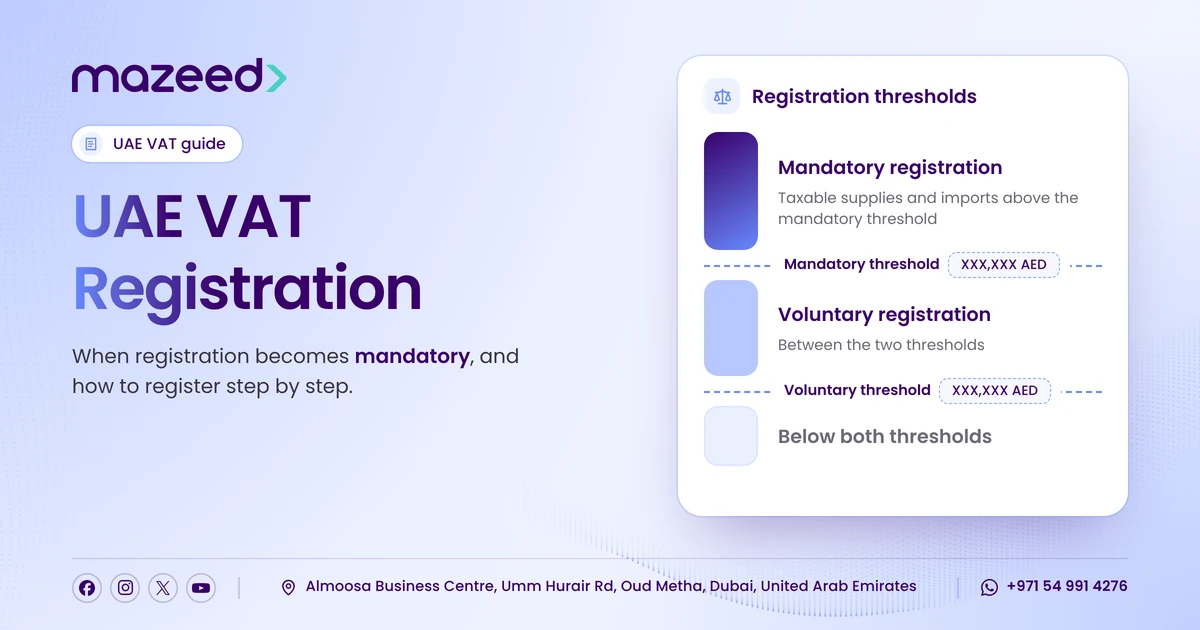
| Voluntary registration threshold | No voluntary registration concept. All UAE juridical persons must register. | AED 187,500 taxable supplies. A business below the mandatory threshold can register voluntarily to recover input VAT. |
| Registration deadline after threshold is met | Varies by entity type (3 months for new companies incorporated on or after 1 March 2024; 31 March of following year for natural persons). Established companies had 2024 deadlines. | Within 30 days of exceeding the AED 375,000 threshold in the previous 12 months, or before the anticipated date of exceeding it in the next 30 days. |
| Late registration penalty | AED 10,000 per entity (Cabinet Decision No. 10 of 2024). Waiver available under FTA CTP006 (July 2025) for first-period filers. | From 14 April 2026: AED 1,000 for the first violation; AED 20,000 for repetition (Cabinet Decision No. 129 of 2025, which also revised VAT penalties). |
| Non-resident registration | Non-residents with a UAE permanent establishment or nexus must register. Deadline based on date PE was established. | Non-resident businesses making supplies on which UAE VAT is required have no minimum threshold; they must register regardless of supply value. |
Software & Experts Together!
New Way to Manage Corporate Tax in UAE
Just scan your invoices and our team will handle all your compliance process inside your mazeed account.
6. What Each Tax Applies To
What each tax is applied to is perhaps the most fundamental difference between VAT and corporate tax.
This is the most practically important conceptual distinction between the two taxes.
This conceptual distinction underlies the entire difference between VAT and corporate tax discussed in this guide.
Corporate Tax Applies to Profits
Corporate Tax is calculated on the net taxable income of the business: revenue minus allowable expenses, adjusted for specific add-backs (such as 50% of entertainment expenses and excess interest) and deductions (such as exempt dividends under the Participation Exemption). Corporate Tax is assessed once a year, using the annual financial statements as the starting point.
A business with AED 5 million in revenue and AED 4.7 million in allowable expenses has taxable income of AED 300,000, which falls within the 0% band. It owes no Corporate Tax despite having significant revenue. Corporate Tax is entirely about the profitability of the business, not its size or turnover.
This example highlights the difference between VAT and corporate tax in how taxable amounts are calculated.
VAT Applies to the Value of Every Supply
VAT is charged on the value of each individual taxable supply made by the business, regardless of whether the business is profitable. A loss-making business that makes AED 5 million of standard-rated supplies must charge 5% VAT (AED 250,000) on those supplies, collect it from customers, and remit the net amount (after recovering input VAT) to the FTA. The business’s profitability is completely irrelevant to its VAT obligations.
VAT is transactional in nature: every qualifying sale triggers a VAT charge, and every qualifying purchase generates recoverable input VAT. The business files periodic VAT returns summarising the net position across all transactions in the period.
This transactional nature illustrates a further difference between VAT and corporate tax in how liability arises.
7. VAT Supply Types: Standard, Zero-Rated, and Exempt
Supply classification adds another layer to the difference between VAT and corporate tax that businesses must track carefully.
VAT introduces a three-way classification of supplies that has no direct equivalent in Corporate Tax:
| Supply Type | VAT Charged to Customer | Input VAT Recoverable | Examples |
|---|---|---|---|
| Standard-rated | 5% | Yes | Most goods and services in the UAE: retail, professional services, hospitality, B2B services, commercial property rental |
| Zero-rated | 0% (technically taxable) | Yes (this is the key difference from exempt) | Exports outside the GCC, international transport, investment-grade precious metals, first sale of a new residential property within 3 years of completion, qualifying education and healthcare, crude oil and natural gas |
| Exempt | No VAT | No (cannot recover input VAT on related costs) | Residential property rental and resale (other than the zero-rated first sale), certain financial services where no explicit fee is charged (interest on loans), bare land, local passenger transport |
| Out of scope | No VAT | Not applicable | Supplies outside the UAE, employment income, supplies by non-VAT-registered businesses below the registration threshold |
Zero-Rated and Exempt Are Not the Same
The most common source of VAT classification errors is treating zero-rated and exempt as equivalent. They are fundamentally different. A business making zero-rated supplies charges 0% VAT on its sales but can still recover the VAT it paid on its purchases (input VAT). A business making exempt supplies charges no VAT on its sales but also cannot recover the input VAT on related costs. Making exempt supplies is more expensive than making zero-rated supplies because the input VAT becomes an irrecoverable cost to the business. For example, a landlord renting residential properties (VAT-exempt) cannot claim back the VAT paid on maintenance, renovation, or management fees for those properties.
8. Filing Frequency and Deadlines
Filing frequency is a practical difference between VAT and corporate tax that affects day-to-day compliance workload.
| Filing Feature | Corporate Tax | VAT |
|---|---|---|
| Filing frequency | Annual (one return per tax period) | Quarterly for most businesses. Monthly for businesses with annual taxable turnover above AED 150 million. |
| Filing deadline | Within 9 months of the end of the financial year. For December 2025 year ends: 30 September 2026. | Within 28 days of the end of the tax period (quarter or month). |
| Payment deadline | Same date as the filing deadline. Both are due simultaneously. | Same date as the filing deadline (28 days after the period end). |
| Late filing penalty | AED 500 per month for the first 12 months; AED 1,000 per month thereafter. | Penalties updated under Cabinet Decision No. 129 of 2025 effective from 14 April 2026. |
| Late payment penalty | 14% per annum (Cabinet Decision No. 129 of 2025, effective 14 April 2026). | Also updated under Cabinet Decision No. 129 of 2025. Previously 2% immediate plus 4% monthly; new rate structure applies from 14 April 2026. |
| Number of returns per year | 1 (one annual return) | 4 (quarterly) or 12 (monthly for large businesses) |
The contrast in filing frequency is significant from a compliance management perspective. A business registered for both taxes must file one Corporate Tax return per year but up to four VAT returns per year (or twelve if monthly). A business that misses all four quarterly VAT filing deadlines in a year has four separate sets of late filing penalties accruing simultaneously, each independently counted from the day after its respective deadline.
9. Record-Keeping Requirements
Record-keeping duration is a smaller but still important difference between VAT and corporate tax for internal controls.
| Record-Keeping Feature | Corporate Tax | VAT |
|---|---|---|
| Mandatory retention period | 7 years from the end of the relevant tax period (Article 56, Federal Decree-Law No. 47 of 2022) | 5 years from the end of the tax period to which they relate (15 years for real estate transactions) under Federal Decree-Law No. 8 of 2017 |
| What must be kept | Financial statements, tax returns, supporting schedules, contracts, board minutes, transfer pricing documentation, FTA correspondence | Tax invoices issued and received, tax credit notes, import and export documents, accounting records, VAT return workings, contracts for taxable supplies |
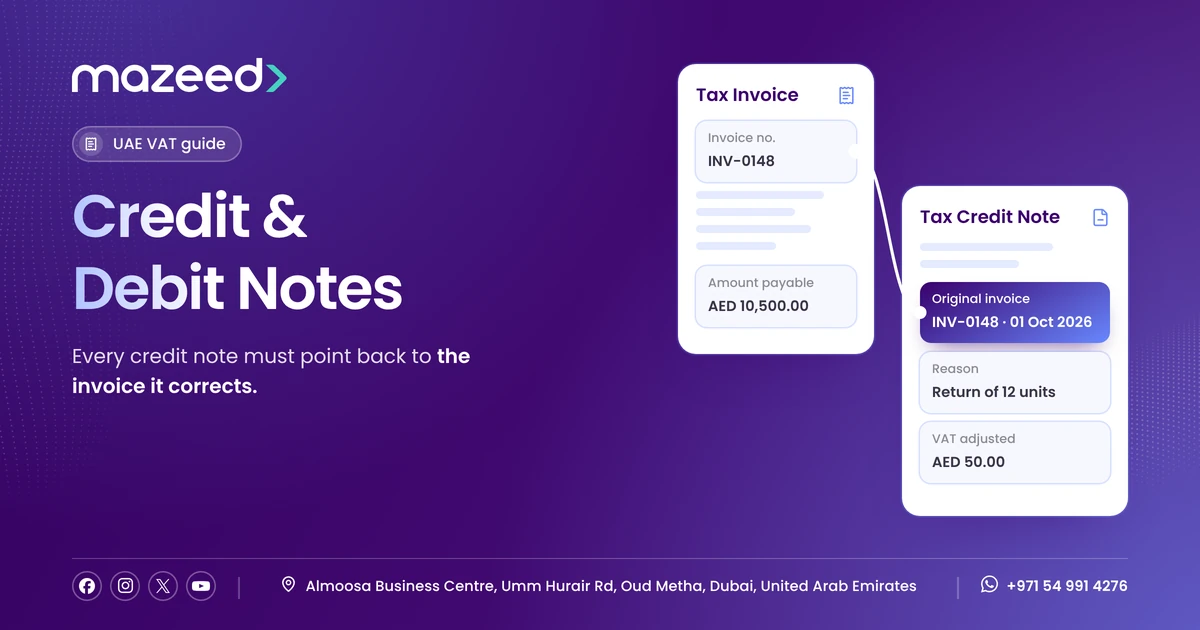
| Tax invoice requirement | No specific tax invoice format required (ordinary invoices and financial records suffice) | VAT-compliant tax invoices must be issued for all standard-rated taxable supplies above AED 10,000 (or simplified tax invoices below that threshold). Invoices must include: supplier and customer name and address, VAT TRN, invoice date and number, description of supply, amount excluding VAT, VAT amount, and total amount including VAT. |
| Audit window | FTA can audit up to 5 years after the tax period end (extended to 15 years in fraud cases under Federal Decree-Law No. 17 of 2025) | FTA can audit up to 5 years after the tax period end (extended in fraud cases) |
Practical Implication: Use the Longer Period for All Records
Since Corporate Tax records must be kept for 7 years while VAT records require only 5 years, a business that retains all records for 7 years automatically satisfies both requirements. Given that many financial records serve both VAT and Corporate Tax purposes (invoices, contracts, bank statements), it is simpler and safer to apply the 7-year Corporate Tax standard to all financial records rather than maintaining separate retention schedules for each tax.
This gap in retention periods is a practical difference between VAT and corporate tax worth building into a records policy.
10. How the FTA Cross-References Corporate Tax and VAT Data
The FTA’s cross-referencing approach makes understanding the difference between VAT and corporate tax essential for accurate reporting.
One of the most significant practical interactions between Corporate Tax and VAT is the FTA’s routine cross-referencing of data from both systems. The FTA has confirmed publicly that it compares the revenue declared in Corporate Tax returns against the output VAT figures declared in VAT returns for the same business and covering the same period.
Material discrepancies between the two without a documented explanation are a primary trigger for FTA enquiries and audits. Common legitimate causes of discrepancy that a business should document in advance include:
- Different revenue recognition bases: Corporate Tax uses accrual-basis revenue (when earned), while VAT uses the tax point (typically when invoiced, paid, or delivered, whichever is earlier). Timing differences between these two bases can cause the same supply to appear in different periods for VAT and Corporate Tax.
- Out-of-scope income: Income not subject to VAT (dividends received, interest income from personal investments, out-of-scope services to overseas recipients) is included in Corporate Tax revenue but may not appear as output VAT on the VAT return. A holding company receiving AED 3 million in dividends has Corporate Tax revenue of AED 3 million but zero VAT output.
- VAT-exempt supplies: Revenue from VAT-exempt supplies (residential property rental, certain financial services) is included in Corporate Tax revenue but generates no output VAT. The Corporate Tax figure will be higher than the VAT figure by the amount of exempt supply revenue.
- Different period boundaries: A business with a financial year ending 31 March files one Corporate Tax return for the 12-month period, but files four quarterly VAT returns covering slightly different date ranges. Matching the totals across the two systems requires careful reconciliation.
Prepare a VAT-to-Corporate Tax Revenue Reconciliation
Every business registered for both Corporate Tax and VAT should prepare a formal reconciliation document showing the relationship between the revenue declared in its Corporate Tax return and the total output VAT reported across its VAT returns for the same period. This reconciliation should identify and explain every material difference. Having this document ready before an FTA enquiry is significantly less stressful and less costly than reconstructing the explanation under audit pressure.
A formal reconciliation process helps businesses manage the difference between VAT and corporate tax reporting bases.
11. When Irrecoverable VAT Becomes a Corporate Tax Deduction
Irrecoverable VAT treatment shows how the difference between VAT and corporate tax can directly affect deductible expenses.
The treatment of input VAT for Corporate Tax purposes depends entirely on whether the VAT is recoverable from the FTA:
- Recoverable input VAT (VAT paid on purchases used to make taxable supplies) is not a cost to the business. The business claims it back through the VAT return. It should not be included as an expense in the Corporate Tax return. Treating recoverable VAT as a Corporate Tax-deductible expense would result in claiming a double benefit: the VAT refund from the FTA and a tax deduction for the same amount.
- Irrecoverable input VAT (VAT paid on purchases related to VAT-exempt supplies, or VAT specifically blocked from recovery, such as VAT on entertainment) is a genuine business cost that cannot be reclaimed. This irrecoverable VAT is a deductible expense for Corporate Tax purposes under Article 28 of the Decree-Law, in the same way as any other business cost incurred for business purposes.
Example: Irrecoverable VAT as a Corporate Tax Expense
Facts: A property management company in Dubai manages residential properties (VAT-exempt supplies). It incurs AED 200,000 in maintenance and repair costs for those properties, plus 5% VAT of AED 10,000.
VAT treatment: Because the maintenance costs relate to exempt supplies (residential property management), the input VAT of AED 10,000 is irrecoverable. The company cannot claim this VAT back on its VAT return.
Corporate Tax treatment: The irrecoverable input VAT of AED 10,000 is a real business cost. It is deductible as a business expense in the company’s Corporate Tax return, in addition to the AED 200,000 maintenance cost. Total deductible expense: AED 210,000.
Key point: If the same maintenance costs related to commercial (standard-rated) properties instead, the AED 10,000 input VAT would be recoverable, and only the AED 200,000 (net of VAT) would be a Corporate Tax deductible expense.
12. Managing Both Taxes on EmaraTax
Managing both taxes on EmaraTax requires clarity on the difference between VAT and corporate tax at every filing stage.
Both Corporate Tax and VAT are managed through the Federal Tax Authority’s EmaraTax portal at eservices.tax.gov.ae. Access requires UAE Pass authentication. Within a single EmaraTax account, a business can see all its registered taxes, file returns, make payments, and manage correspondence.
Key EmaraTax functions by tax type:
| EmaraTax Function | Corporate Tax | VAT |
|---|---|---|
| Registration | Corporate Tax registration module. Separate TRN issued on approval (typically within 20 business days). | VAT registration module. Separate VAT TRN issued. VAT registration can be approved faster for businesses already on the system. |
| Return filing | Annual return form with up to 20 schedules. Adaptive form shows only relevant schedules. | VAT 201 return form. Filed quarterly or monthly. Simpler structure than the Corporate Tax return. |
| Payment method | GIBAN bank transfer (unique GIBAN per taxpayer). Also credit card and e-Dirham. | Same GIBAN mechanism. The GIBAN for VAT and Corporate Tax may be different; confirm which to use before each payment. |
| Voluntary disclosure | Available for Corporate Tax errors. Errors above AED 10,000 impact on taxable income require formal voluntary disclosure. | Available for VAT errors. Errors below AED 10,000 can be corrected in the next VAT return without a formal voluntary disclosure. |
13. Common Misconceptions
These common misconceptions usually stem from businesses overlooking the difference between VAT and corporate tax.
| Misconception | Fact |
|---|---|
| Being VAT-registered means you are also Corporate Tax registered. | VAT and Corporate Tax are separate registrations. A business registered for VAT since 2018 still needs to complete a separate Corporate Tax registration. The FTA links the records but they are distinct legal obligations. |
| Free zone companies are exempt from VAT. | Free zone companies are not automatically exempt from VAT. VAT applies across the UAE including in free zones. Whether supplies within a designated zone are subject to VAT depends on specific rules for each designated zone. QFZP status for Corporate Tax has no bearing on VAT registration obligations. |
| Paying VAT reduces your Corporate Tax liability. | Recoverable input VAT is not a business cost and is not deductible for Corporate Tax. Only irrecoverable VAT (related to exempt supplies or specifically blocked categories) is a Corporate Tax deductible expense. |
| VAT and Corporate Tax revenue thresholds are the same (AED 375,000). | AED 375,000 means different things in each system. For VAT it is a taxable turnover threshold for registration. For Corporate Tax it is a taxable profit threshold above which the 9% rate applies (not a registration trigger for companies). Corporate Tax registration for companies is mandatory with no revenue threshold. |
| If I owe no Corporate Tax, I do not need to file a return. | Filing is mandatory for all registered Corporate Tax persons regardless of whether any tax is owed, including businesses within the 0% income band, QFZPs with all qualifying income, and Small Business Relief electors. The FTA confirmed this in its September 2025 press release. |
| My revenue figure in my Corporate Tax return should match my output VAT figure exactly. | Legitimate differences arise from out-of-scope income (dividends, interest), VAT-exempt supplies, timing differences between the accrual basis used for Corporate Tax and the tax point basis used for VAT. A reconciliation explaining the differences is the recommended approach. |
14. Worked Scenarios
These worked scenarios show the difference between VAT and corporate tax playing out in real business situations.
Scenario 1: Small Business VAT-Registered but Not Yet Corporate Tax Liable
Scenario: Dubai Bakery, Revenue AED 600,000, Profit AED 50,000
Facts: A small bakery in Dubai had AED 600,000 in total sales in 2025 (standard-rated supplies). Total business expenses were AED 550,000. Net profit is AED 50,000.
VAT position: Revenue of AED 600,000 exceeds the AED 375,000 mandatory VAT registration threshold. The bakery must be VAT-registered and charges 5% VAT on its sales. It recovers input VAT on most business purchases. Net VAT position is filed quarterly.
Corporate Tax position: The bakery is a UAE company and must register for Corporate Tax (no revenue threshold for companies). Its taxable income is AED 50,000, which falls entirely within the 0% band. No Corporate Tax is owed. But an annual Corporate Tax return must still be filed by the relevant nine-month deadline.
Key takeaway: The bakery has ongoing VAT obligations (quarterly returns) and ongoing Corporate Tax obligations (annual return), but owes no Corporate Tax. Both are mandatory regardless of profitability.
Scenario 2: Corporate Tax Applies but VAT Does Not
Scenario: UAE Holding Company with Dividend Income Only
Facts: A UAE mainland holding company receives AED 5 million in dividends from UAE subsidiaries and AED 800,000 in dividends from a foreign subsidiary that is a qualifying participation under Article 23.
VAT position: Dividend income is not consideration for a taxable supply and is outside the scope of VAT entirely. The holding company has no output VAT and, because its activities do not constitute a business making taxable supplies, it is likely not required to register for VAT at all (and cannot recover input VAT on its own costs if it is not VAT-registered).
Corporate Tax position: The holding company must register for Corporate Tax as a UAE resident juridical person. The AED 5 million from UAE subsidiaries is exempt under Article 22. The AED 800,000 from the foreign subsidiary is exempt under Article 23 (Participation Exemption), assuming all five conditions are met. Taxable income is therefore close to zero, and no Corporate Tax is owed. An annual return must still be filed.
Key takeaway: The holding company has Corporate Tax obligations (registration and annual return filing) but likely no VAT obligation. The absence of VAT does not reduce or remove the Corporate Tax filing obligation.
Scenario 3: Both Taxes Apply at Significant Scale
Scenario: Consulting Firm, Revenue AED 8 Million, Profit AED 1.5 Million
Facts: A UAE mainland management consulting firm had AED 8 million in fees (all standard-rated for VAT) in the financial year ending 31 December 2025. Allowable business expenses were AED 6.5 million. Taxable income is AED 1.5 million.
VAT obligations: VAT-registered (revenue far exceeds AED 375,000). Files quarterly VAT returns within 28 days of each quarter end. Charges 5% output VAT on all invoices and recovers input VAT on most business expenses. Net VAT payable is approximately 5% of the difference between revenue and VAT-bearing expenses.
Corporate Tax obligations: Must register for Corporate Tax and file one annual return by 30 September 2026. Taxable income is AED 1.5 million: 0% on AED 375,000 plus 9% on AED 1,125,000 = AED 101,250 in Corporate Tax payable by 30 September 2026.
FTA cross-reference check: The firm should reconcile its AED 8 million Corporate Tax revenue against the total output VAT declared across four quarterly VAT returns. Both should sum to AED 8 million (assuming no exempt supplies, no out-of-scope income, and consistent accrual basis). Any difference should be documented before the Corporate Tax return is filed.
This reconciliation step is a direct consequence of the difference between VAT and corporate tax reporting bases.
15. Frequently Asked Questions
These frequently asked questions address common confusion around the difference between VAT and corporate tax.
Can I offset VAT refunds against my Corporate Tax liability?
VAT refunds and Corporate Tax liabilities are managed as separate accounts on EmaraTax. A VAT credit balance does not automatically reduce a Corporate Tax liability. However, a business can apply to the FTA to transfer a VAT credit to its Corporate Tax account through EmaraTax, or it can request a cash refund of the VAT credit separately. The two tax accounts are not automatically netted against each other.
If I am a sole proprietor below AED 1 million business income, do I have any tax obligations?
For Corporate Tax, a natural person whose business income is below AED 1 million in a calendar year is not required to register or file. For VAT, the registration threshold is AED 375,000 in taxable supplies, which is lower. A sole proprietor with AED 500,000 in business revenue has no Corporate Tax obligation (below AED 1 million threshold) but must register for VAT (above AED 375,000 threshold). The two assessments are independent.
Does a business need to show its Corporate Tax TRN on invoices?
No. Corporate Tax registration does not require the Corporate Tax TRN to appear on sales invoices. The VAT TRN, however, is a mandatory element of a VAT-compliant tax invoice for VAT-registered businesses. The two TRNs are different numbers and serve different purposes. Only the VAT TRN must appear on invoices.
My business makes both standard-rated and exempt supplies. How does this affect Corporate Tax?
For VAT, the partial exemption rules apply: you cannot recover the portion of input VAT attributable to your exempt supplies. That irrecoverable input VAT becomes a business cost. For Corporate Tax, all revenue from both standard-rated and exempt supplies is included in gross revenue, with the irrecoverable input VAT deducted as a business expense. The distinction between standard-rated and exempt supplies for VAT purposes does not change the fundamental Corporate Tax treatment of the underlying revenue.
Does forming a VAT Group affect my Corporate Tax position?
VAT grouping (available under the UAE VAT law where entities are under common ownership and control) is completely separate from Corporate Tax Tax Group formation. A VAT group treats its members as a single taxable person for VAT purposes. A Corporate Tax group (under Articles 40-42) treats its members as a single taxable person for Corporate Tax purposes. The two groups operate independently, may have different members, and are governed by different legislation. A business can be in a VAT group, a Corporate Tax Tax Group, both, or neither.
Official References
The following official sources support every point made about the difference between VAT and corporate tax in this guide.
- [1] Federal Decree-Law No. 47 of 2022 on the Taxation of Corporations and Businesses (Corporate Tax Law). Ministry of Finance, UAE. mof.gov.ae
- [2] Federal Decree-Law No. 8 of 2017 on Value Added Tax (VAT Law). Federal Tax Authority, UAE. tax.gov.ae
- [3] Cabinet Decision No. 52 of 2017 (Executive Regulations of the VAT Law) and its amendments. Cabinet of the UAE.
- [4] Cabinet Decision No. 49 of 2023 on Specifying the Categories of Businesses or Business Activities Conducted by a Resident or Non-Resident Natural Person that are Subject to Corporate Tax. Cabinet of the UAE. AED 1 million natural person threshold.
- [5] Cabinet Decision No. 10 of 2024 on Administrative Penalties for Violations Related to Federal Decree-Law No. 47 of 2022. Cabinet of the UAE. Corporate Tax penalties.
- [6] Cabinet Decision No. 129 of 2025 (Amending Cabinet Decision No. 10 of 2024 and revising VAT penalties). Effective 14 April 2026. Cabinet of the UAE.
- [7] FTA Corporate Tax General Guide CTGGCT1. Federal Tax Authority, September 2023. tax.gov.ae
- [8] FTA Corporate Tax Returns Guide CTGTXR1. Federal Tax Authority, November 2024. Confirms FTA cross-referencing of Corporate Tax and VAT revenue. tax.gov.ae
- [9] FTA Public Clarification CTP006: Waiver of Administrative Penalty for Failure to Submit a Corporate Tax Registration Application Within the Specified Deadline. Federal Tax Authority, 17 July 2025. tax.gov.ae
- [10] Federal Tax Authority Press Release: “FTA Urges Submission of Corporate Tax Returns Within Nine Months.” 24 September 2025. tax.gov.ae
- [11] PwC Tax Summaries: United Arab Emirates, Other Taxes (VAT). Current VAT thresholds and registration requirements. taxsummaries.pwc.com
- [12] Articles 45 and 46, Federal Decree-Law No. 8 of 2017 on Value Added Tax (zero-rated and exempt supplies). Federal Tax Authority, UAE.
- [13] Article 56, Federal Decree-Law No. 47 of 2022 (7-year Corporate Tax record retention). Ministry of Finance, UAE.
- [14] Federal Tax Authority VAT Legislation Page. Full index of VAT Decrees, Decisions, and Executive Regulations. tax.gov.ae
At a Glance: CT vs VAT
This quick-reference summary captures the core difference between VAT and corporate tax at a glance.
| CT | VAT | |
|---|---|---|
| Rate | 9% / 0% | 5% / 0% / Exempt |
| Applies to | Net profit | Supply value |
| Filing | Annual | Quarterly |
| Deadline | 9 months after year end | 28 days after period |
| Records | 7 years | 5 years (15 for RE) |
| In force | June 2023 | Jan 2018 |
GET STARTED TODAY
Let mazeed Handle Your Corporate Tax
Join 4,000+ UAE businesses using mazeed to stay compliant and avoid costly mistakes.