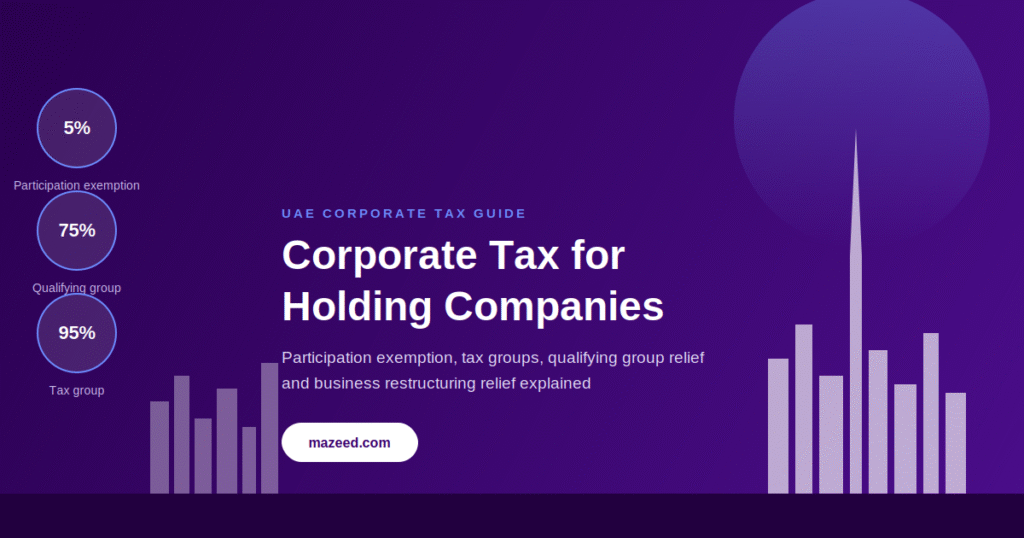
UAE corporate tax applies to every holding company and every member of a corporate group without exception, but the law provides four powerful mechanisms that allow groups to manage their tax position efficiently and legally: the Participation Exemption (Articles 22 and 23), which exempts qualifying dividends and capital gains; Tax Group formation (Articles 40 to 42), which allows a single consolidated return with loss offset across all members; Qualifying Group Relief (Article 26), which enables tax-neutral intra-group asset transfers at 75% ownership; and Business Restructuring Relief (Article 27), which permits mergers and demergers without immediate tax crystallisation. This guide explains each mechanism, its precise conditions, how they interact, and the common pitfalls that cause groups to lose entitlements they expected to have.
This guide focuses on UAE corporate tax for holding companies and the structures and reliefs available to them.
1. Holding Companies Are Within the Scope of UAE Corporate Tax
This scope question is the starting point for understanding UAE corporate tax for holding companies.
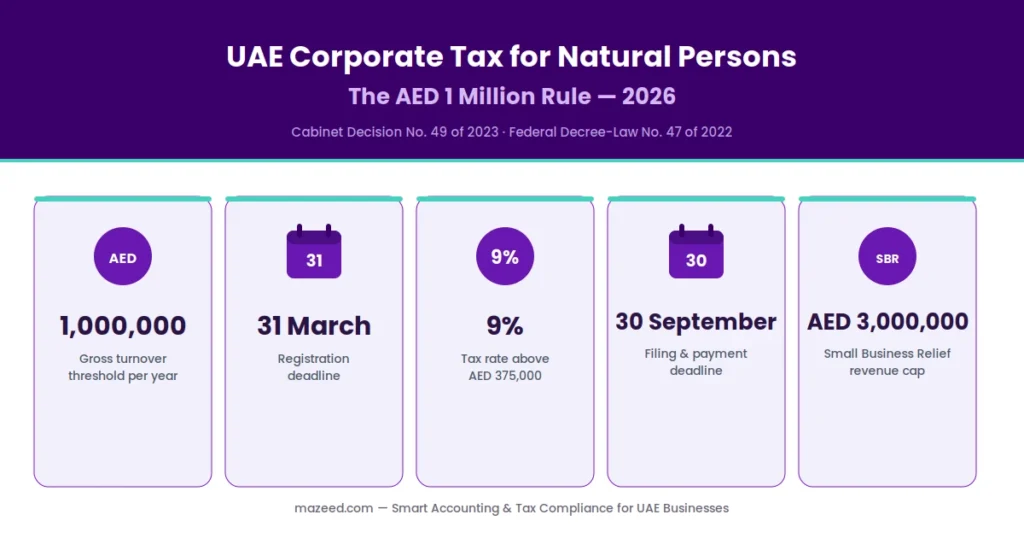
A UAE holding company is a juridical person incorporated in the UAE and is therefore a resident person subject to UAE corporate tax under Article 11 of Federal Decree-Law No. 47 of 2022. There is no carve-out for purely passive holding entities, SPVs, or group treasury companies. Every holding company must register for corporate tax, file an annual return, and pay tax at 9% on taxable income above AED 375,000.
This is one of the clearest illustrations of how UAE corporate tax for holding companies applies from the outset of incorporation.
In practice, a well-structured UAE holding company may have very low or zero corporate tax liability because most of its income, dividends from subsidiaries and capital gains on subsidiary share disposals, is exempt under Articles 22 and 23. But this result is achieved through deliberate qualification for specific exemptions, not through automatic exclusion from the regime. A holding company that has not registered for corporate tax, or that has not assessed whether its dividend and capital gain income meets the exemption conditions, is non-compliant regardless of the fact that it may ultimately owe no tax.
Zero Income Does Not Mean Zero Obligation
A holding company that holds shares, receives no dividends, and generates no other income in a tax period still has a legal obligation to register for corporate tax and file a nil return by the nine-month deadline. The FTA has confirmed in multiple public statements that filing is mandatory for all registered taxable persons. The AED 10,000 penalty for late registration and the AED 500 per month penalty for late filing both apply to holding companies that have not yet registered or filed.
This point is one of the most overlooked filing risks in UAE corporate tax for holding companies.
Software & Experts Together!
New Way to Manage Corporate Tax in UAE
Just scan your invoices and our team will handle all your compliance process inside your mazeed account.
2. Article 22: The Automatic UAE Dividend Exemption
The dividend exemption under Article 22 is one of the most valuable tools available under UAE corporate tax for holding companies.
Article 22 of Federal Decree-Law No. 47 of 2022 provides an automatic exemption for certain categories of dividend income. Unlike the Participation Exemption in Article 23, the Article 22 exemption requires no minimum shareholding, no minimum holding period, and no assessment of the subsidiary’s tax rate. It applies automatically to the following categories:
- Dividends paid by a UAE resident company to another UAE resident company, provided the recipient is a taxable person (not an exempt person) and the dividend is paid in respect of shares or similar ownership interests
- Dividends received by a UAE taxable person from a foreign juridical person in which the UAE taxable person owns at least 5%, where the subsidiary is listed on a recognised stock exchange in a jurisdiction that imposes tax on dividends at a rate of at least 9%
The most practically important application of Article 22 for UAE holding structures is the first category: dividends paid between UAE resident companies are automatically exempt from corporate tax in the hands of the recipient, regardless of the level of ownership held and regardless of whether the paying subsidiary is a Qualifying Free Zone Person or a standard mainland company.
Why Article 22 Matters for UAE Group Structures
In a typical UAE group structure where a mainland holding company owns subsidiaries that are also UAE-resident companies, dividends flowing up from the subsidiaries to the holding company are automatically exempt under Article 22 without any conditions analysis. This substantially simplifies the holding company’s tax position. The Participation Exemption conditions in Article 23 become relevant primarily for dividends received from foreign (non-UAE) subsidiaries, where Article 22 does not automatically apply.
This benefit is a key reason why UAE corporate tax for holding companies rarely results in double taxation on distributed profits.
3. Article 23: The Participation Exemption for Foreign Subsidiaries
The participation exemption is another cornerstone provision shaping UAE corporate tax for holding companies with foreign subsidiaries.
Article 23 of Federal Decree-Law No. 47 of 2022 and Ministerial Decision No. 116 of 2023 on the Participation Exemption establish the conditions under which dividends and capital gains received in respect of a foreign ownership interest are exempt from UAE corporate tax. The FTA published its detailed Corporate Tax Guide on Exempt Income (Dividends and Participation Exemption, CTGPE1) on 16 October 2023, which provides worked examples and clarifications on each condition.
The Participation Exemption applies to both dividends and capital gains arising from the same qualifying ownership interest, referred to in the law as a “Participating Interest.” An ownership interest that meets all five conditions (discussed in Section 4) is a Participating Interest, and all dividends and capital gains arising from it are exempt from UAE corporate tax in the period in which they are received or realised.
This broader scope reflects how UAE corporate tax for holding companies treats both income and capital returns from qualifying investments.
4. The Five Conditions for a Qualifying Participation
Meeting all five conditions is essential to claiming this exemption correctly under UAE corporate tax for holding companies.
All five of the following conditions must be satisfied for an ownership interest to constitute a Participating Interest and therefore qualify for the Participation Exemption under Article 23 and Ministerial Decision No. 116 of 2023:
- Condition 1: Minimum 5% ownership or AED 4 million acquisition cost
- The UAE taxable person must hold at least 5% of the shares, voting rights, profits, or net assets of the subsidiary, or the aggregate acquisition cost of the ownership interest must be at least AED 4 million. The AED 4 million threshold is an alternative to the 5% shareholding test and allows smaller percentage shareholdings in large companies to still qualify where the economic investment is substantial. Under Article 3 of Ministerial Decision No. 116 of 2023, ownership interests held by members of a Qualifying Group in the same subsidiary can be aggregated when testing the 5% threshold, so a group that collectively holds 6% across three entities meets the condition even if no individual entity holds 5%.
- Condition 2: Twelve-month holding period
- The ownership interest must have been held continuously for at least 12 consecutive months, or the taxable person must have the intention to hold it for at least 12 months from the date of acquisition. The 12-month period does not need to fall entirely within the current tax period; holding before the current period counts. For capital gains, the intention test does not apply and the 12-month period must actually have been satisfied at the date of disposal. Article 4 of Ministerial Decision No. 116 of 2023 provides a relaxation on the holding period condition for interests acquired through a qualifying business restructuring under Article 27, where the combined holding period of the transferor and the transferee is aggregated.
- Condition 3: The subsidiary is subject to a qualifying tax at 9% or more
- The subsidiary must be subject to corporate tax or a comparable tax in its jurisdiction of residence at a rate of at least 9%. As confirmed in the FTA’s CTGPE1 guide, this condition is tested by reference to the nominal statutory rate, not the effective tax rate, with one key modification: the actual tax paid as a proportion of accounting profit must not be materially lower than 9% due to specific tax benefits applicable to the subsidiary. Subsidiaries resident in zero-tax or very low-tax jurisdictions do not satisfy this condition, and dividends and capital gains from such subsidiaries are fully taxable in the UAE holding company’s hands. UAE resident subsidiaries subject to the standard 9% rate automatically satisfy this condition. QFZPs require careful analysis since the 0% rate on qualifying income means some of the subsidiary’s income may not be taxed at 9%.
- Condition 4: Not more than 50% of assets consist of UAE immovable property
- The assets of the subsidiary must not consist, directly or indirectly, of more than 50% of immovable property located in the UAE. This condition prevents the use of holding structures to exempt gains that would otherwise be taxable under Article 13 as UAE-sourced income derived from UAE real estate. The 50% test is measured by reference to the fair market value of the subsidiary’s total assets, including assets held through lower-tier subsidiaries.
- Condition 5: At least 5% entitlement to profits and net assets
- The UAE taxable person must be entitled to at least 5% of the profits and net assets of the subsidiary. This is typically satisfied automatically where the 5% ownership condition in Condition 1 is met, but requires separate assessment in structures where different share classes carry different economic entitlements.
The AED 4 Million Cost Threshold Can Be Breached Retrospectively
Under Article 8(6) of Ministerial Decision No. 116 of 2023, if the aggregated acquisition cost of the ownership interest falls below AED 4 million for any continuous uninterrupted period of at least 12 months, any income that was previously exempt under the AED 4 million alternative must be included in taxable income in the period when the threshold was breached. This can happen when the subsidiary makes capital repayments or returns equity. Holding companies that qualified for the Participation Exemption on the basis of the AED 4 million acquisition cost (rather than the 5% ownership percentage) must monitor the carrying value and any return of capital events.
This retrospective nuance is a detail that frequently trips up structuring decisions in UAE corporate tax for holding companies.
5. The Symmetrical Loss Rule
The symmetrical treatment of gains and losses is a further nuance within UAE corporate tax for holding companies.
Article 23 applies a symmetrical treatment to losses on Participating Interests. Under Article 23(3) of the Decree-Law, a loss arising from the disposal of a Participating Interest that would have been exempt as a gain, had it been a gain, is not deductible in calculating taxable income. This prevents groups from claiming tax deductions on share disposal losses where the corresponding gains would have been exempt.
As confirmed in the FTA’s CTGPE1 guide and in the DLA Piper analysis published in October 2023, this symmetry also extends to certain impairment losses and write-downs on Participating Interests, where the economic effect of the impairment is analogous to a disposal at below-cost consideration. Groups should assess whether losses on subsidiary shares are subject to this restriction before claiming them as deductions in the holding company’s corporate tax return.
6. Tax Group Formation: Articles 40 to 42
Tax Group formation is one of the most consequential elections available under UAE corporate tax for holding companies.
Articles 40 to 42 of Federal Decree-Law No. 47 of 2022 and Ministerial Decision No. 125 of 2023 provide the legal framework for Tax Group formation. A Tax Group is an optional regime under which a parent company and its qualifying subsidiaries are treated as a single taxable person for corporate tax purposes. The FTA published the detailed Corporate Tax Guide on Tax Groups (CTGTGR1) in January 2024, which covers the formation process, eligibility, calculation of consolidated taxable income, and exit mechanics.
The key benefits of Tax Group formation are:
- A single consolidated corporate tax return filed by the parent company on behalf of all group members, reducing the total number of returns to one
- Automatic loss offset across all group members in each period, so that a loss in one subsidiary reduces the taxable income of profitable members in the same period without any need for a separate loss transfer mechanism
- Intra-group transactions between Tax Group members are disregarded for corporate tax purposes when calculating consolidated taxable income, which eliminates the need to assess arm’s length pricing on routine group-internal transactions
- A single GIBAN payment for the consolidated tax liability of the entire group
7. Tax Group Eligibility Conditions
These eligibility conditions determine which entities can actually benefit from consolidation under UAE corporate tax for holding companies.
Under Article 40(1) of the Decree-Law, the following conditions must all be satisfied for a Tax Group to be formed:
| Condition | Requirement |
| Legal form | Both the parent company and every subsidiary must be resident juridical persons. Natural persons and non-resident entities cannot be Tax Group members. |
| Ownership threshold | The parent must hold at least 95% of the share capital, 95% of voting rights, and 95% of entitlement to profits and net assets of each subsidiary, directly or indirectly. This is commonly described as requiring near-complete ownership. |
| Exempt persons and QFZPs | Neither the parent nor any subsidiary may be an Exempt Person or a Qualifying Free Zone Person. Including a QFZP in a Tax Group causes that entity to permanently lose its 0% qualifying income rate. |
| Financial year end | All members must share the same financial year end date. A subsidiary with a 31 March year end cannot join a Tax Group where the parent has a 31 December year end without first aligning the subsidiary’s year end. |
| Accounting standards | All members must prepare financial statements using the same accounting standards (either IFRS or IFRS for SMEs, consistently applied across the group). |
| FTA application | The Tax Group is only constituted following a formal application to the FTA. The group does not self-elect; it must apply and receive FTA approval before the benefits apply. The effective date of Tax Group formation is the beginning of the tax period specified in the approved application. |
The 95% Threshold Is Not Approximately 95%
The 95% ownership requirement under Article 40 applies to share capital, voting rights, and profit/net asset entitlement simultaneously. A minority shareholder holding even 6% of a subsidiary in any of these categories means that subsidiary cannot join the Tax Group, regardless of what percentage the parent holds on the other dimensions. A group that includes a subsidiary with an external minority shareholder holding 6% of profit rights, even where the parent holds 94% of shares and 100% of votes, must either buy out the minority investor or leave that subsidiary outside the Tax Group.
8. How a Tax Group Files and Pays
Filing correctly as a consolidated Tax Group is a practical necessity for groups relying on UAE corporate tax for holding companies planning.
Once a Tax Group is formed and approved by the FTA, the parent company acts as the representative member for all corporate tax purposes. The filing and payment mechanics are as follows:
- A single corporate tax return is filed by the parent on behalf of all Tax Group members within nine months of the financial year end. Individual members do not file separate returns during the Tax Group period.
- Consolidated taxable income is calculated by the parent by aggregating the financial results of all members after eliminating intra-group transactions and balances. The parent prepares or commissions audited consolidated financial statements (or special-purpose financial statements) for this purpose.
- The consolidated taxable income includes the losses of loss-making members automatically, offsetting them against the profits of profitable members in the same period. This is the primary economic benefit of Tax Group status for groups with uneven profitability across members.
- The standard 0%/9% rates apply to the consolidated taxable income of the Tax Group as a single entity, not to the income of each member individually. The AED 375,000 zero-rate band applies once to the Tax Group’s consolidated taxable income, not once per member.
- A single tax payment is made by the parent via GIBAN. All Tax Group members are jointly and severally liable for the Tax Group’s tax obligations, so each member carries corporate tax liability exposure regardless of its own individual profitability.
9. Qualifying Group Relief: Article 26
Qualifying Group Relief provides another flexible mechanism within UAE corporate tax for holding companies.
Article 26 of Federal Decree-Law No. 47 of 2022 and Ministerial Decision No. 132 of 2023, with detailed guidance in FTA Corporate Tax Guide CTGQGR1 (April 2024), provide for tax-neutral transfer of assets and liabilities within a Qualifying Group. This is distinct from the Tax Group regime: a Qualifying Group is a lower threshold ownership arrangement (75%, not 95%) that applies specifically to intra-group asset and liability transfers.
The Qualifying Group Definition
Two taxable persons are members of the same Qualifying Group where all of the following conditions are met:
- Both are juridical persons that are UAE resident persons, or non-resident persons with a UAE permanent establishment
- Either one holds a direct or indirect ownership interest of at least 75% in the other, or a third person holds at least 75% in each of them
- Neither is an Exempt Person
- Neither is a Qualifying Free Zone Person
- Both share the same financial year end
How Qualifying Group Relief Works
Where the transferor elects for Qualifying Group Relief, an asset or liability transferred between two Qualifying Group members is treated as transferred at its net book value at the date of transfer. No taxable gain or loss arises on the transfer regardless of whether the asset’s market value differs from its book value. Any accounting gain or loss recognised in the financial statements must be disregarded for corporate tax purposes in both the transferor’s and the transferee’s returns.
The relief applies only to transfers of assets and liabilities held on capital account and recorded on the balance sheet of the transferor. It does not apply to trading stock or other revenue-account items.
The Two-Year Clawback
Qualifying Group Relief is subject to a two-year clawback under Article 26(4). The relief is reversed and the transfer is treated as having occurred at market value if, within two years of the original transfer:
- The transferee disposes of the transferred asset or liability outside the Qualifying Group, or
- Either the transferor or the transferee ceases to be a member of the Qualifying Group (for example, through a sale or restructuring that reduces the ownership percentage below 75%)
As confirmed by the DLA Piper analysis of CTGQGR1 published in April 2024, the clawback is tested on each individual transfer separately. It is therefore possible for a clawback to apply to one transfer in an exchange transaction but not to another.
This clawback risk is an important planning consideration for anyone structuring UAE corporate tax for holding companies transactions.
10. Business Restructuring Relief: Article 27
Business Restructuring Relief addresses a different set of scenarios within UAE corporate tax for holding companies.
Article 27 of Federal Decree-Law No. 47 of 2022 and Ministerial Decision No. 133 of 2023 provide Business Restructuring Relief, which allows a business or part of a business to be transferred from one taxable person to another without triggering an immediate taxable gain. The FTA published Corporate Tax Guide CTGBRR1 on Business Restructuring Relief in April 2024.
How Business Restructuring Relief Differs from Qualifying Group Relief
| Feature | Qualifying Group Relief (Article 26) | Business Restructuring Relief (Article 27) |
| What is transferred | Individual assets or liabilities | A business or part of a business as a going concern |
| Minimum ownership required | 75% | None. Unrelated parties can use this relief for genuine restructurings. |
| Consideration type | Any consideration at net book value | Must be shares or other ownership interests (not cash) |
| Two-year clawback | Two-year clawback on asset disposal or group exit | Two-year clawback if the shares received are sold within two years |
| Tax position | No gain, no loss at net book value | Gain deferred until clawback or subsequent disposal event |
| QFZP exclusion | Not available to QFZPs | Not available to QFZPs |
Conditions for Business Restructuring Relief
- The transfer must be of a business or an identifiable part of a business (not just a single asset in isolation)
- The consideration for the transfer must consist entirely of shares or other ownership interests in the transferee (no cash consideration is permitted, though there is a limited carve-out for immaterial cash amounts)
- The business transfer must be made in accordance with all applicable UAE federal and emirate laws
- Neither the transferor nor the transferee may be an Exempt Person or a Qualifying Free Zone Person
- The recipient must hold the shares or ownership interests received for at least two years after the transfer
Loss Carry-Over in Business Restructuring
An important feature of Business Restructuring Relief confirmed in the CTGBRR1 guide is that unused tax losses of the transferor business can carry over to the transferee entity as part of the restructuring, where the same business is continued by the transferee. This means that restructurings, such as mergers of two loss-making subsidiaries into a profitable entity, can unlock the value of accumulated tax losses that would otherwise be stranded in separate entities indefinitely.
This loss carry-over treatment is a valuable feature for groups relying on UAE corporate tax for holding companies restructuring options.
11. Tax Loss Carry-Forward and the 75% Cap
Loss carry-forward rules add another layer of planning within UAE corporate tax for holding companies.
Under Article 37 of Federal Decree-Law No. 47 of 2022, tax losses can be carried forward indefinitely with no time limit. Unlike many other jurisdictions that restrict loss carry-forward to five or seven years, UAE corporate tax losses do not expire. A loss incurred in 2023 can offset taxable income in 2030, 2035, or any future period, subject to the cap and continuity conditions below.
The 75% Per-Period Offset Cap
Tax losses carried forward can offset a maximum of 75% of taxable income in any single tax period under Article 39. The remaining 25% of taxable income is always subject to tax at the applicable rate. This means a company with a large accumulated loss position can never reduce its current-period tax liability to zero through loss carry-forward alone; there will always be some tax payable on the current year’s profit.
How the 75% Cap Works
Example: A UAE company has accumulated tax losses of AED 4,000,000 from prior periods and current-year taxable income of AED 1,200,000.
Maximum offset (75% of AED 1,200,000): AED 900,000.
Remaining taxable income after offset: AED 300,000 (AED 1,200,000 minus AED 900,000).
Tax liability: 0% on the first AED 300,000 (within the AED 375,000 threshold) = AED 0. (If taxable income after offset exceeds AED 375,000, 9% applies to the excess.)
Remaining carried-forward losses: AED 4,000,000 minus AED 900,000 = AED 3,100,000. These carry forward to the next period indefinitely.
Ownership and Business Continuity Conditions
Loss carry-forward is subject to continuity conditions under Article 39. Where more than 50% of the ownership of a taxable person changes, tax losses incurred before the change can still be carried forward only where the business continues in the same or a similar form after the change in ownership. If the business is fundamentally changed following the ownership change, for example, converting a technology company into a real estate holding vehicle, losses incurred before the change are forfeited. This prevents the acquisition of loss-making entities purely for the purpose of accessing their accumulated tax losses.
These continuity conditions safeguard the integrity of loss relief under UAE corporate tax for holding companies.
12. Transferring Losses Between Group Members
Transferring losses between related entities is a further planning tool within UAE corporate tax for holding companies.
Outside of a formal Tax Group (where losses are automatically consolidated), there is a mechanism under Article 38 of the Decree-Law for the transfer of tax losses between members of a Qualifying Group, provided the following conditions are met:
- Both entities are members of the same Qualifying Group (75% common ownership, same financial year, both resident juridical persons, neither exempt nor a QFZP)
- The loss has been calculated in accordance with the Decree-Law
- The transfer of the loss must be elected by the loss-making entity in its corporate tax return for the relevant period
- The transferee must have sufficient taxable income to utilise the transferred loss in the same period
Under this mechanism, a group that has not formed a formal Tax Group can still achieve some of the economic benefit of group loss relief by transferring losses between Qualifying Group members on a year-by-year basis. The 75% loss transfer mechanism requires more active management than the automatic consolidation within a Tax Group, but it is available at a lower ownership threshold and does not require the same financial year alignment and formal FTA approval process that Tax Group formation requires.
13. The Ownership Percentage Map
Understanding ownership thresholds at a glance is invaluable for anyone navigating UAE corporate tax for holding companies.
One of the most practically useful frameworks for understanding how ownership percentages determine what group tax reliefs are available is the three-threshold ownership map:
| Ownership Percentage | Participation | Details |
| 5% | Participation Exemption | Minimum shareholding (or AED 4M acquisition cost) to qualify for exemption on dividends and capital gains from a foreign subsidiary under Article 23. Plus four additional conditions. Very low bar for passive investment structures. |
| 75% | Qualifying Group | Minimum ownership for: tax-neutral intra-group asset transfers (Article 26), tax loss transfers between group members (Article 38), and aggregation of ownership interests when testing the 5% Participation Exemption threshold. |
| 95% | Tax Group | Minimum ownership to form a formal Tax Group under Article 40. Provides automatic loss consolidation across all members, a single return, and disregard of intra-group transactions. Requires FTA approval and same financial year and accounting standards across all members. |
14. QFZP and Holding Structures: Key Pitfalls
QFZP interactions are a frequent source of costly mistakes within UAE corporate tax for holding companies.
Free zone entities with Qualifying Free Zone Person status occupy a structurally distinctive position in UAE group structures. Several rules interact in ways that create pitfalls for groups that include QFZPs:
QFZPs Cannot Join a Tax Group
A QFZP cannot be a member of a Tax Group under Article 40. Including a QFZP in a Tax Group would cause the entity to lose its QFZP status permanently and be taxed at standard rates for the current period and the four subsequent periods. Every free zone entity’s QFZP status must be confirmed before a Tax Group formation application is submitted.
QFZPs Cannot Use Qualifying Group Relief or Business Restructuring Relief
Neither Article 26 (Qualifying Group Relief) nor Article 27 (Business Restructuring Relief) is available where any party to the transfer is a QFZP or an Exempt Person. A group considering an intra-group asset transfer that involves a QFZP as either the transferor or the transferee cannot use the no gain, no loss treatment of Article 26; the transfer must be assessed at market value.
The Participation Exemption and QFZPs
A UAE mainland holding company that receives dividends from a QFZP subsidiary benefits from the Article 22 automatic exemption for UAE-to-UAE dividends, since the QFZP is a UAE resident person. However, when assessing the Participation Exemption conditions for capital gains on disposal of QFZP shares, Condition 3 (the 9% tax rate test) requires analysis: if the QFZP’s income was predominantly taxed at 0%, the effective tax rate of the subsidiary is below 9%, and dividends from a foreign subsidiary with the same profile would not meet Condition 3. For intra-UAE structures this is addressed by Article 22, but cross-border groups with QFZP entities require careful analysis.
Including a QFZP in a Tax Group Is an Irreversible Error
The consequence of including a QFZP in a Tax Group is immediate and permanent loss of QFZP status for that entity for the current period and the four subsequent periods. All income of the former QFZP in those five periods is taxed at standard rates, including income that would otherwise have been qualifying income at 0%. Given that the Tax Group formation application must be submitted to and approved by the FTA, the identification of QFZP entities in the group should be part of the pre-application due diligence, not discovered after the fact.
15. Worked Examples
These worked examples show how UAE corporate tax for holding companies rules apply in practice.
Example 1: Participation Exemption on Foreign Subsidiary Dividends
Scenario: UAE Holding Company with European Subsidiary
Facts: A UAE mainland holding company holds 20% of a German GmbH (a limited liability company). The GmbH is subject to German corporate income tax at approximately 30%. The holding has been maintained for three years. The UAE parent receives a dividend of AED 2,000,000 from the GmbH in 2025.
Condition 1 (5% or AED 4M): 20% ownership exceeds 5%. Condition met.
Condition 2 (12 months): Three years of continuous holding. Condition met.
Condition 3 (9% tax rate): Germany’s corporate tax rate is approximately 30%. Condition met.
Condition 4 (UAE immovable property): The GmbH is a German operating company; less than 50% of its assets are UAE real estate. Condition met.
Condition 5 (5% entitlement): 20% ownership entitles the parent to 20% of profits and net assets. Condition met.
Result: All five conditions are satisfied. The AED 2,000,000 dividend is exempt from UAE corporate tax under Article 23. The holding company declares this as exempt income in its annual return. No tax is payable on the dividend.
Example 2: Tax Group Consolidating Profitable and Loss-Making Subsidiaries
Scenario: UAE Parent with Two Subsidiaries, One Profitable and One Loss-Making
Facts: A UAE mainland parent company owns 100% of two UAE subsidiaries. Subsidiary A reports taxable income of AED 2,000,000 in 2025. Subsidiary B reports a tax loss of AED 800,000 in 2025. The parent itself has minimal income. All three entities are mainland companies with the same 31 December year end and use IFRS. None is a QFZP.
Without a Tax Group: Subsidiary A pays corporate tax on AED 2,000,000: 0% on AED 375,000 plus 9% on AED 1,625,000 = AED 146,250. Subsidiary B’s loss of AED 800,000 is carried forward within that entity and provides no immediate benefit. Total group tax is AED 146,250.
With an approved Tax Group: The parent consolidates: total group taxable income = AED 2,000,000 minus AED 800,000 = AED 1,200,000. Tax: 0% on AED 375,000 plus 9% on AED 825,000 = AED 74,250. Total group tax is AED 74,250, a saving of AED 72,000 compared to the non-group position, entirely from the automatic loss offset.
Note: No application of the 75% loss carry-forward cap is required here, because within the Tax Group the loss is not being carried forward; it is being used in the same period through consolidation. The 75% cap applies to losses carried forward from prior periods, not to the current-period consolidation mechanism within a Tax Group.
Example 3: Qualifying Group Relief for Intra-Group Property Transfer
Scenario: Transfer of Commercial Property Between Group Members
This worked example demonstrates practical planning under UAE corporate tax for holding companies.
Facts: A UAE parent company owns 90% of a UAE operating subsidiary. The parent owns a commercial building carried at net book value of AED 10,000,000 in its balance sheet, with a current market value of AED 16,000,000. The group wishes to transfer the building to the subsidiary for operational reasons. Both entities are UAE-resident mainland companies sharing a 31 December year end. Neither is a QFZP.
Qualifying Group membership: 90% ownership exceeds 75%. Neither party is a QFZP or Exempt Person. Same financial year end. Qualifying Group conditions are met.
With Qualifying Group Relief: The parent elects for Qualifying Group Relief. The building is transferred at net book value of AED 10,000,000. No taxable gain of AED 6,000,000 (the difference between market value and book value) arises in the parent’s return. The subsidiary takes ownership of the property at the AED 10,000,000 book value and inherits the carrying value for future depreciation and capital gains purposes.
Two-year clawback watch: If the subsidiary sells the building to a third party within two years of the transfer, or if either party exits the Qualifying Group within two years, the original transfer is retrospectively treated as having occurred at market value (AED 16,000,000), and the AED 6,000,000 gain is then taxable in the parent’s hands in the period the clawback is triggered.
16. Frequently Asked Questions
These frequently asked questions address common uncertainties around UAE corporate tax for holding companies.
Can a UAE holding company with only exempt dividend income have zero corporate tax liability?
Yes, provided all dividend income is from qualifying participations under Articles 22 and 23, and the holding company has no other taxable income (such as interest income on cash deposits, management fees, or taxable gains on non-qualifying shareholdings). A holding company in this position still must register, file, and declare its income and the applicable exemptions in each annual return.
What is the difference between a Tax Group and a Qualifying Group?
A Tax Group under Article 40 requires 95% ownership, FTA approval, and same financial year end for all members. It treats the group as a single taxable entity for all purposes. A Qualifying Group under Article 26 requires only 75% ownership and does not require FTA approval; it is a lower-threshold relationship used specifically for the purpose of intra-group asset transfers (Article 26) and loss transfers (Article 38). The two can coexist: a Tax Group at the 95% level is automatically also a Qualifying Group at the 75% level.
If a subsidiary joins the Tax Group mid-year, when does the consolidation begin?
Under Article 41 of the Decree-Law, the effective date of Tax Group formation, or of a new subsidiary joining an existing group, is the beginning of the tax period specified in the FTA-approved application. A subsidiary cannot join mid-period for partial-year consolidation. The group must plan applications to ensure the effective date aligns with the beginning of a full tax period.
Can a Tax Group include a foreign subsidiary?
No. Under Article 40, all Tax Group members must be UAE resident juridical persons. A foreign subsidiary is not a UAE resident person and cannot be a Tax Group member. Foreign subsidiaries can, however, be the subject of a Participation Exemption claim by the UAE holding company under Article 23, allowing dividends and capital gains from them to be exempt even though they are outside the Tax Group.
Does the Participation Exemption apply to gains on UAE company shares?
For capital gains on UAE-incorporated subsidiary shares, the Article 22 automatic exemption for UAE-to-UAE dividends does not extend to capital gains. Capital gains on the disposal of UAE subsidiary shares must be assessed under the Participation Exemption conditions of Article 23. A UAE holding company that sells shares in a UAE subsidiary at a gain must check whether all five Participation Exemption conditions (including the 5% ownership, 12-month holding, and the tax rate condition) are satisfied before treating the gain as exempt.
Official References
The following official sources underpin every rule discussed in this guide to UAE corporate tax for holding companies.
- [1] Articles 22, 23, 26, 27, 37, 38, 39, 40, 41, 42, Federal Decree-Law No. 47 of 2022 on the Taxation of Corporations and Businesses. Ministry of Finance, UAE. mof.gov.ae
- [2] Ministerial Decision No. 116 of 2023 on the Participation Exemption for the Purposes of Federal Decree-Law No. 47 of 2022. Ministry of Finance, UAE.
- [3] FTA Corporate Tax Guide: Exempt Income (Dividends and Participation Exemption), CTGPE1. Federal Tax Authority, 16 October 2023. tax.gov.ae
- [4] Ministerial Decision No. 125 of 2023 on Tax Groups for the Purposes of Federal Decree-Law No. 47 of 2022. Ministry of Finance, UAE.
- [5] FTA Corporate Tax Guide: Tax Groups, CTGTGR1. Federal Tax Authority, January 2024. tax.gov.ae
- [6] Ministerial Decision No. 132 of 2023 on Transfers Within a Qualifying Group. Ministry of Finance, UAE.
- [7] FTA Corporate Tax Guide: Qualifying Group Relief, CTGQGR1. Federal Tax Authority, April 2024. tax.gov.ae
- [8] Ministerial Decision No. 133 of 2023 on Business Restructuring Relief. Ministry of Finance, UAE.
- [9] FTA Corporate Tax Guide: Business Restructuring Relief, CTGBRR1. Federal Tax Authority, April 2024. tax.gov.ae
- [10] DLA Piper Gulf Tax Insights: “Federal Tax Authority Publishes Participation Exemption Guide.” October 2023. Analysis of CTGPE1 including the five conditions and loss symmetry rule. dlapiper.com
- [11] DLA Piper Gulf Tax Insights: “Federal Tax Authority Publishes Guide on Qualifying Group Relief.” April 2024. Analysis of CTGQGR1 including the two-year clawback and exchange transaction rules. dlapiper.com
- [12] PwC Middle East Tax Alert: “UAE Corporate Tax: CT Qualifying Group Relief and Business Restructuring Relief Guides.” April 2024. pwc.com
- [13] KPMG Middle East Tax Insights: “FTA Guide on Qualifying Group Relief.” April 2024. kpmg.com
- [14] Cabinet Decision No. 100 of 2023 on Determining Qualifying Income for the Qualifying Free Zone Person. Cabinet of the UAE. Article 40 QFZP exclusion and interaction with group structures.
- [15] Federal Tax Authority Corporate Tax Legislation Index. Full index of all Cabinet Decisions and Ministerial Decisions under Federal Decree-Law No. 47 of 2022. tax.gov.ae
Ownership Threshold Summary
This quick-reference summary captures the key ownership thresholds relevant to UAE corporate tax for holding companies.
- 5% (or AED 4M cost)
- Participation Exemption on dividends and capital gains (Article 23)
- 75%
- Qualifying Group: intra-group asset transfers (Article 26) and loss transfers (Article 38)
- 95%
- Tax Group: consolidated return, automatic loss offset, intra-group transactions disregarded (Articles 40-42)
QFZP Group Pitfalls
- Cannot join a Tax Group
- Cannot use Qualifying Group Relief
- Cannot use Business Restructuring Relief
- Dividends received from QFZP by UAE parent: exempt under Article 22
GET STARTED TODAY
Let mazeed Handle Your Corporate Tax
Join 4,000+ UAE businesses using mazeed to stay compliant and avoid costly mistakes.