Corporate Tax registration in UAE is a legal obligation for every taxable person operating in the country, whether a mainland company, a free zone entity, or a self-employed individual above the income threshold. This guide covers who must register, all deadlines by entity type, required documents, the step-by-step EmaraTax process, and how to handle the AED 10,000 late registration penalty, including the current waiver rules.
This article covers registration only. For a full overview of UAE corporate tax including rates, filing deadlines, free zone rules, deductions, and how to file your return, see the UAE Corporate Tax 2026: Complete Guide for Businesses.
What Is Corporate Tax Registration in UAE
Corporate Tax registration in UAE is the process of formally enrolling your business with the Federal Tax Authority (FTA) to obtain a Corporate Tax Registration Number, referred to as a Tax Registration Number or TRN. Under Federal Decree-Law No. 47 of 2022 on the Taxation of Corporations and Businesses, every taxable person in the UAE is required to register before filing any Corporate Tax return.
Registration is separate from filing. Completing the process means your business is recognised by the FTA as a taxable entity and is assigned a unique identifier used for all Corporate Tax filings and correspondence. Without registration, you cannot file a return, and without filing, you are in breach of federal tax law regardless of whether any tax is owed.
The entire Corporate Tax registration process in UAE is conducted online through the FTA’s EmaraTax portal at eservices.tax.gov.ae. There is no paper-based alternative. Access requires a UAE Pass account.
Key Fact
According to FTA data published in 2025, more than 651,000 businesses registered for Corporate Tax. The FTA has confirmed that registration is mandatory regardless of income level, profit, or whether any Corporate Tax is ultimately owed.
Who Must Register for Corporate Tax in UAE
The following categories of person are required to complete Corporate Tax registration in UAE under Article 51 of Federal Decree-Law No. 47 of 2022 and the implementing provisions of FTA Decision No. 3 of 2024:
1- UAE Resident Juridical Persons
All companies and legal entities incorporated, established, or recognised under UAE law must register. This includes mainland limited liability companies, private and public joint-stock companies, civil companies, and all entities established under the legislation of any UAE free zone. There are no size or revenue thresholds for juridical persons: registration is mandatory from the first day of operation.
2- Free Zone Entities
Every free zone company must complete Corporate Tax registration in UAE, including entities that qualify for the 0% rate as a Qualifying Free Zone Person under Article 18 of the Decree-Law. The 0% rate is claimed on the annual tax return, not by avoiding registration. A free zone business that does not register cannot demonstrate QFZP eligibility and risks losing its preferential tax treatment entirely.
Common Misconception
Many free zone business owners assume their 0% tax rate means they do not need to register for Corporate Tax. This is incorrect. All free zone entities, including those in DMCC, JAFZA, DIFC, RAKEZ, ADGM, and all other free zones, are required to register without exception.
3- Non-Resident Juridical Persons
Foreign companies and entities that are not incorporated in the UAE but have a taxable presence in the country must also register. This applies to:
- Non-resident persons with a permanent establishment in the UAE as defined under Article 14 of the Decree-Law
- Non-resident persons with a nexus in the UAE as defined under Cabinet Decision No. 56 of 2023
- Non-resident juridical persons that are effectively managed and controlled from the UAE
4- Natural Persons
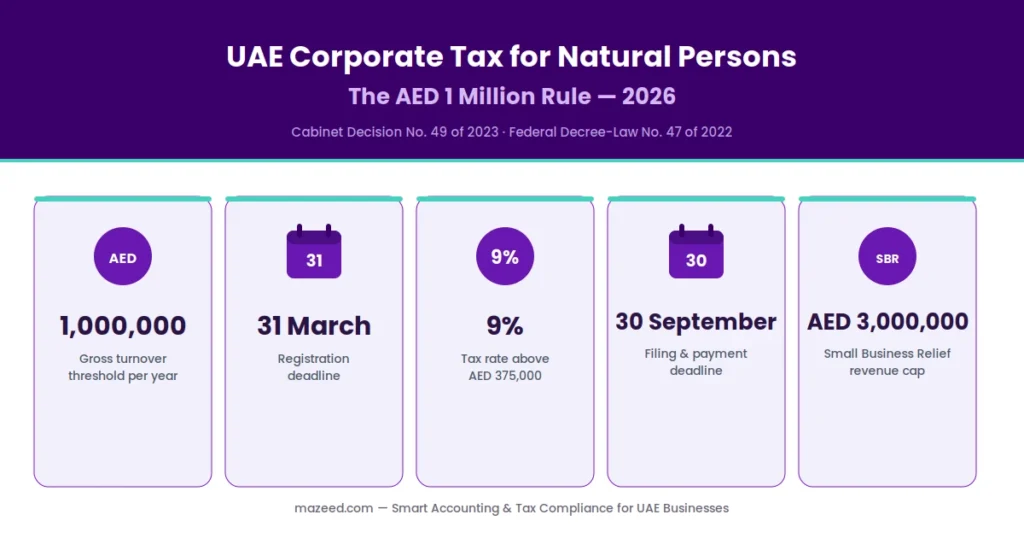
Individuals who conduct business activities in the UAE are required to register for Corporate Tax once their total business income exceeds AED 1 million in a Gregorian calendar year. This threshold applies to gross business turnover, not to net profit. Salary and employment income, personal investment returns, and income from real property held personally and not as part of a business are excluded.
Freelancers, sole proprietors, and self-employed professionals operating under individual trade or professional licences are subject to this rule if they exceed the threshold.
Dormant Companies
Companies that are dormant or have no revenue during a tax period are not exempt from the obligation to register for Corporate Tax in UAE. A dormant entity still registers and subsequently files a nil return. Failure to do so exposes the entity to the AED 10,000 registration penalty.
Software & Experts Together!
New Way to Manage Corporate Tax in UAE
Just scan your invoices and our team will handle all your compliance process inside your mazeed account.
Registration Deadlines by Entity Type
The FTA established specific registration deadlines for different categories of taxable person through FTA Decision No. 3 of 2024, issued on 22 February 2024 and effective from 1 March 2024. The PwC analysis of this decision confirmed that deadlines are tied to the original licence issuance month, irrespective of the year in which the licence was issued.
A- Businesses Incorporated Before 1 March 2024
Resident juridical persons established before 1 March 2024 were assigned staggered registration deadlines in 2024, based on the month in which the earliest trade licence was originally issued. Where a business holds more than one licence, the licence with the earliest original issuance date determines the applicable deadline.
| Trade Licence Issuance Month | Corporate Tax Registration Deadline |
| January or February | 31 May 2024 |
| March or April | 30 June 2024 |
| May | 31 July 2024 |
| June | 31 August 2024 |
| July | 30 September 2024 |
| August | 31 October 2024 |
| September | 31 October 2024 |
| October | 30 November 2024 |
| November | 30 November 2024 |
| December | 31 December 2024 |
All 2024 Deadlines Have Passed
All registration deadlines for businesses established before 1 March 2024 have now passed. Any business in this category that has not yet registered is already exposed to the AED 10,000 administrative penalty. However, a waiver mechanism is available in certain circumstances. See Section 9 for details.
B- Businesses Incorporated On or After 1 March 2024
Resident juridical persons incorporated, established, or recognised on or after 1 March 2024 must complete Corporate Tax registration in UAE within 3 months of the date of incorporation, establishment, or recognition. For example, a company incorporated in April 2026 must register by the end of July 2026.
Non-Resident Juridical Persons
| Entity Category | Registration Deadline |
| Non-resident with permanent establishment in UAE (established before 1 March 2024) | 9 months from the date the PE was established |
| Non-resident with permanent establishment in UAE (established on or after 1 March 2024) | Within 6 months of establishing the PE |
| Non-resident effectively managed and controlled from UAE (incorporated on or after 1 March 2024) | Within 3 months of the end of the financial year |
| Non-resident with nexus in UAE (nexus established before 1 March 2024) | Within 3 months of the effective date of the FTA decision establishing nexus rules |
| Non-resident with nexus in UAE (nexus established on or after 1 March 2024) | Within 3 months of establishing the nexus |
Natural Persons
Natural persons who exceed the AED 1 million business income threshold in a Gregorian calendar year must submit their Corporate Tax registration application by 31 March of the following year. A natural person whose business income exceeded AED 1 million in 2025 must register by 31 March 2026. Non-resident natural persons must register within 3 months from the date they meet the conditions for being subject to UAE Corporate Tax.
Documents Required for Corporate Tax Registration in UAE
The FTA requires the following documents to be uploaded through EmaraTax as part of the Corporate Tax registration process in UAE. All documents must be in PDF format and each file must not exceed 15 MB. Information in the application form must match the submitted documents exactly, as discrepancies are the most common cause of application delays.
1- Valid trade licence
All current trade licences held by the entity, including branch licences. Where multiple licences exist, include all of them. The licence must be current and not expired at the time of registration.
2- Certificate of Incorporation or Memorandum of Association
The constitutional document of the entity. For LLCs, this is the Memorandum of Association. For joint-stock companies, provide both the Memorandum and Articles of Association. For free zone entities, the Free Zone Company Certificate and constitutional documents from the relevant authority.
3- Establishment card
A copy of the company’s establishment card issued by the relevant authority, where applicable.
4- Emirates ID of the authorised signatory
Both sides, clear and valid. The authorised signatory is the individual who will submit the registration application on behalf of the entity.
5- Passport copies of owners and the authorised signatory
Required for all shareholders or partners holding 25% or more ownership, and for the authorised signatory. Clear, full copies in date.
6- Proof of authorisation
A Power of Attorney or a Board Resolution authorising the signatory to act on behalf of the company. Not required if the sole owner is signing personally.
7- Financial year end date
Not a document but a mandatory input. Most UAE businesses use 31 December. This determines your Corporate Tax filing deadline, so confirm the correct date before submitting.
8- VAT TRN (if already VAT registered)
If the business is registered for VAT with the FTA, provide the existing VAT Tax Registration Number. The EmaraTax portal links the records automatically.
Tip: Prepare Before You Log In
The EmaraTax application does not allow partial saves in all circumstances. Collect and verify all documents before starting the registration session. The application takes approximately 30 to 60 minutes to complete with all documents ready. Incomplete submissions result in an “Awaiting Information” status, which adds days or weeks to processing time.
How to Complete Corporate Tax Registration in UAE on EmaraTax
The following steps reflect the EmaraTax portal process for registering for UAE Corporate Tax as of June 2026. The FTA publishes an official EmaraTax Registration User Manual, available for download from the FTA website, which provides screen-by-screen screenshots for each stage.
1- Log in to EmaraTax using UAE Pass
Go to eservices.tax.gov.ae. Select UAE Pass as the login method. UAE Pass is the mandatory authentication method for all FTA portal services. If you do not have a UAE Pass, register for one via the UAE Pass app before attempting to access EmaraTax.
2- Access or create your taxable person profile
If your business is already registered for VAT, an existing taxable person profile will be available in your EmaraTax dashboard. Select the correct entity. For businesses new to the FTA portal, select the option to create a new taxable person and enter your entity’s legal name and trade licence details exactly as they appear on the licence documents.
3- Navigate to Corporate Tax registration
Within your taxable person dashboard, locate the Corporate Tax tile and select “Register.” The system will display the terms and conditions. Read and accept the declaration to proceed to the application form.
4- Enter entity and ownership details
Complete all sections of the form. Entity details include: legal name, trade licence number and issuance date, nature of business activities, registered business address in the UAE, and contact information. Ownership details require the name, nationality, Emirates ID or passport number, and ownership percentage of every shareholder or partner holding 25% or more of the entity. If the entity has branches, all branches must be listed under the same registration.
5- Enter financial year information
Confirm your financial year start and end dates. For most UAE businesses, the financial year runs from 1 January to 31 December. This is a critical input as it determines your Corporate Tax filing and payment deadline, which falls nine months after the financial year end date.
6- Upload all required documents
Upload each document in PDF format, ensuring file sizes do not exceed 15 MB individually. Check that all names, licence numbers, and dates in the uploaded documents match precisely with the information entered in the form fields. Mismatches between the trade licence and the legal name field are the most frequently cited reason for application rejection or delay by the FTA.
7- Review, declare, and submit
Review every section of the completed application before submission. Confirm the accuracy declaration and submit. You will receive an automated confirmation from EmaraTax. Track application progress under the status section of your dashboard, which will show “Pending,” “Awaiting Information,” or “Approved.”
Processing Time
The FTA typically processes Corporate Tax registration applications within 20 business days of a complete submission. Applications where documents are queried by the FTA can take considerably longer. Submitting a complete, accurate application at the outset is the most reliable way to receive your TRN promptly.
GET STARTED TODAY
Let mazeed Handle Your Corporate Tax
Join 4,000+ UAE businesses using mazeed to stay compliant and avoid costly mistakes.
Your Tax Registration Number (TRN)
Upon approval of your Corporate Tax registration in UAE, the FTA issues a digital Corporate Tax Registration Certificate containing your 15-digit Tax Registration Number (TRN). This TRN is the unique identifier for all Corporate Tax correspondence and filings.
Your TRN must be used on all Corporate Tax returns submitted via EmaraTax. If your business is also registered for VAT, note that your VAT TRN and your Corporate Tax TRN may be different numbers. Confirm which TRN to use for each type of return within your EmaraTax dashboard.
The Corporate Tax Registration Certificate is issued digitally through EmaraTax. Download and retain it as part of your compliance records. Records must be maintained for a minimum of seven years from the end of the relevant tax period under the Decree-Law.
Obligations After Corporate Tax Registration in UAE
Completing the registration process is the first step in a series of ongoing compliance obligations. Once your registration is complete, the following ongoing compliance requirements apply:
A- Annual Tax Return Filing
Every registered taxable person must file an annual Corporate Tax return within nine months of the end of the relevant tax period. For businesses with a financial year ending 31 December 2025, the return and payment are both due by 30 September 2026. Filing is mandatory even where no tax is owed, including businesses within the 0% income bracket and those electing Small Business Relief.
B- Record Keeping
All financial records, supporting documents, invoices, and tax returns must be retained for a minimum of seven years from the end of the tax period to which they relate. For Qualifying Free Zone Persons, audited financial statements must be prepared and retained for each tax period regardless of entity size.
C- Notification of Changes
Any material changes to the registered information, including changes to legal name, ownership structure, financial year end, or business activities, must be updated in EmaraTax within the period prescribed by the FTA. Failure to update can affect the accuracy of filings and compliance status.
Penalties for Late Corporate Tax Registration in UAE
Failure to complete Corporate Tax registration in UAE by the prescribed deadline results in an administrative penalty of AED 10,000 under Cabinet Decision No. 10 of 2024 on Administrative Penalties for Violations Related to the Application of Federal Decree-Law No. 47 of 2022.
This penalty applies per taxable entity and is fixed. It is not scaled by revenue or the amount of tax owed. A business earning below the AED 375,000 threshold and therefore owing zero Corporate Tax is still subject to the full AED 10,000 penalty if registration was late. The FTA confirmed in June 2024 through a public clarification that this penalty is applied automatically upon identification of a late registration.
Read more: UAE Corporate Tax Penalties
| Violation | Administrative Penalty | Legal Basis |
| Failure to register for Corporate Tax by the prescribed deadline | AED 10,000 | Cabinet Decision No. 10 of 2024 |
| Failure to file a Corporate Tax return by the deadline | AED 500 per month for the first 12 months; AED 1,000 per month thereafter | Cabinet Decision No. 10 of 2024 |
| Failure to pay Corporate Tax by the deadline | 14% per annum, applied monthly on the outstanding balance (Cabinet Decision No. 129 of 2025, effective 14 April 2026) | Cabinet Decision No. 10 of 2024, as amended |
| Failure to maintain required records | AED 10,000 for first instance; AED 20,000 for a repeat violation within 24 months | Cabinet Decision No. 10 of 2024 |
The AED 10,000 Penalty Waiver
The FTA introduced a temporary administrative waiver for businesses that missed their initial Corporate Tax registration deadline. Under this initiative, the AED 10,000 late registration penalty is waived for an entity that files its first Corporate Tax return or annual declaration within seven months of the end of its first tax period.
For a business with a first tax period ending 31 December 2025, the seven-month waiver deadline falls on 31 July 2026. A business in this position that registers and files its first return before this date may have the AED 10,000 penalty waived or credited to its tax account.
The Waiver Is Not Automatic
The penalty waiver does not apply automatically upon late registration. The business must complete registration on EmaraTax and then file its first Corporate Tax return within seven months of the first tax period end. Simply registering after the deadline without filing does not trigger the waiver. Businesses in this position should seek professional advice to confirm the specific deadlines applicable to their tax period.
Businesses that have already received an AED 10,000 penalty notice can apply for a reconsideration request through the EmaraTax portal. The FTA reviews each case based on the circumstances and the compliance history of the applicant. There is no guarantee of waiver approval outside the specific conditions described above.
Common Mistakes to Avoid During Registration
The following errors are frequently cited as causes of EmaraTax application rejection, delay, or post-registration compliance issues:
- Legal name mismatch: The entity’s legal name in the EmaraTax form must match the trade licence exactly, including punctuation, spacing, and abbreviations such as “LLC” or “L.L.C.” Discrepancies cause automatic rejection.
- Using the wrong licence date: The registration deadline for entities established before 1 March 2024 is based on the original issuance month of the earliest licence held, not the most recent renewal date. Using the renewal date may result in a wrong deadline assessment and an unexpected penalty.
- Omitting branches: All branches and additional licences operating under the same legal entity must be listed in a single registration. Registering a legal entity without its branches is non-compliant.
- Incorrect financial year end: Entering an incorrect financial year end date affects your CT filing deadline. Confirm the financial year with your accountant before submitting.
- Expired documents: Uploading an expired trade licence causes immediate rejection. Renew the licence before beginning the registration process if it is due to expire.
- Missing ownership disclosure: All shareholders holding 25% or more must be disclosed. Failing to disclose an owner can delay the application and trigger a request for further information from the FTA.
- Confusing registration with filing: Registering for Corporate Tax in UAE does not constitute filing a return. A separate annual return must be submitted by the nine-month deadline after each financial year end.
Frequently Asked Questions About Corporate Tax registration in UAE
Who must complete Corporate Tax registration in UAE?
All UAE resident juridical persons, all free zone entities, non-resident persons with a permanent establishment or nexus in the UAE, and natural persons whose business income exceeds AED 1 million in a Gregorian calendar year must complete Corporate Tax registration in UAE under Federal Decree-Law No. 47 of 2022.
Can I register for Corporate Tax in UAE without a trade licence?
No. A valid trade licence is the core document for Corporate Tax registration in UAE for juridical persons. Natural persons can register using their Emirates ID, but a clear record of business activities and income is required.
How long does Corporate Tax registration in UAE take?
The FTA typically processes complete applications within 20 business days. Applications flagged for additional information may take longer. Preparing all required documents before starting the EmaraTax session is the most effective way to avoid delays.
Do I need to register if my business makes no profit?
Yes. Registration is mandatory for all taxable persons regardless of whether they generate profit or owe any tax. A loss-making business or a business with income below the AED 375,000 tax threshold still registers and files a return each year.
Do free zone companies need to register for Corporate Tax in UAE?
Yes. All free zone entities must complete Corporate Tax registration in UAE. This applies to businesses in DMCC, JAFZA, DIFC, RAKEZ, ADGM, and all other UAE free zones. Qualifying Free Zone Persons that benefit from the 0% rate on qualifying income still register and file annual returns. Without registration, QFZP status cannot be confirmed.
What happens if I miss the Corporate Tax registration deadline in UAE?
Missing the registration deadline results in an AED 10,000 administrative penalty under Cabinet Decision No. 10 of 2024. A penalty waiver may be available for businesses that file their first Corporate Tax return within seven months of the end of their first tax period. Businesses in this situation should register as soon as possible and seek professional advice on the waiver mechanism.
Is Corporate Tax registration in UAE the same as VAT registration?
No. VAT registration and Corporate Tax registration are separate obligations administered through the same EmaraTax portal but governed by different legislation. A business may be registered for VAT but not yet registered for Corporate Tax, or vice versa. Both registrations must be completed independently if the business meets the respective thresholds and conditions.
Official References
[1] Federal Decree-Law No. 47 of 2022 on the Taxation of Corporations and Businesses. Ministry of Finance, UAE. mof.gov.ae
[2] FTA Decision No. 3 of 2024 on the Timelines for Registration of Taxable Persons for Corporate Tax Purposes. Federal Tax Authority. Effective 1 March 2024.
[3] Cabinet Decision No. 10 of 2024 on Administrative Penalties for Violations Related to the Application of Federal Decree-Law No. 47 of 2022. Cabinet of the UAE.
[4] Federal Tax Authority: Public Clarification on Registration Timelines for Taxable Persons for Corporate Tax. FTA, 11 June 2024. tax.gov.ae
[5] UAE Corporate Tax Registration page. Federal Tax Authority official services portal. tax.gov.ae
[6] PwC Middle East Tax Alert: UAE CT — FTA Decision No. 3 of 2024 — Registration Timeline. PricewaterhouseCoopers. pwc.com
[7] Cabinet Decision No. 56 of 2023 on the Determination of a Non-Resident Person’s Nexus in the UAE. Cabinet of the UAE.
[8] Federal Tax Authority: Corporate Tax Legislation. Full index of all Cabinet Decisions and Ministerial Decisions issued under Federal Decree-Law No. 47 of 2022. tax.gov.ae
[9] Federal Tax Authority Press Release: “FTA Urges Submission of Corporate Tax Returns and Settlement of Corporate Tax Liabilities Within Nine Months.” 24 September 2025. tax.gov.ae
[10] Ministerial Decision No. 73 of 2023 on Small Business Relief for the Purposes of Federal Decree-Law No. 47 of 2022. Ministry of Finance, UAE.
Disclaimer: This publication is for informational purposes only and should not be considered professional or legal advice. While we strive for accuracy, we make no guarantees regarding completeness or applicability. mazeed, its members, employees, and agents do not accept or assume any liability, responsibility, or duty of care for any actions taken or decisions made based on this content. For official guidance, please refer to the UAE Ministry of Finance and the Federal Tax Authority.