

Yes. E-invoicing is mandatory in the UAE for business-to-business (B2B) and business-to-government (B2G) transactions, phased in by revenue. Businesses with revenue of AED 50 million or more must use the Electronic Invoicing System from 1 January 2027, businesses below AED 50 million from 1 July 2027, and government entities from 1 October 2027. Business-to-consumer (B2C) sales are outside the system until the Minister of Finance decides otherwise, and a short list of transactions is excluded.
What does the law say?
The UAE rules sit in decisions issued by the Ministry of Finance under the Tax Procedures Law:
- Ministerial Decision No. 243 of 2025 sets the scope, exclusions and obligations of the Electronic Invoicing System.
- Ministerial Decision No. 244 of 2025 sets the pilot, the voluntary phase and the mandatory deadlines.
- Ministerial Decision No. 66 of 2026 moved the first ASP appointment deadline to 30 October 2026.
- Ministerial Decision No. 197 of 2026, in force from 1 October 2026, rewrote the exclusions and added the Tax Group exclusion.
Article 3 of Ministerial Decision No. 243 of 2025 applies the system to any person conducting business in the State in respect of every business transaction, except where the person or the transaction is excluded. The test is about carrying on business in the UAE, which is a wider idea than being VAT-registered, so a business that is not VAT-registered should not assume it is outside the system. If that describes you, confirm your position with your ASP or a tax adviser.
When does e-invoicing become mandatory for my business?
Article 5 of Ministerial Decision No. 244 of 2025, as amended, sets three phases. Each has two deadlines: the date by which you must appoint an Accredited Service Provider (ASP), and the date from which you must use the system.
| Who | Appoint an ASP by | Mandatory from |
|---|---|---|
| Businesses with revenue of AED 50 million or more | 30 October 2026 | 1 January 2027 |
| Businesses with revenue below AED 50 million | 31 March 2027 | 1 July 2027 |
| Government entities | 31 March 2027 | 1 October 2027 |
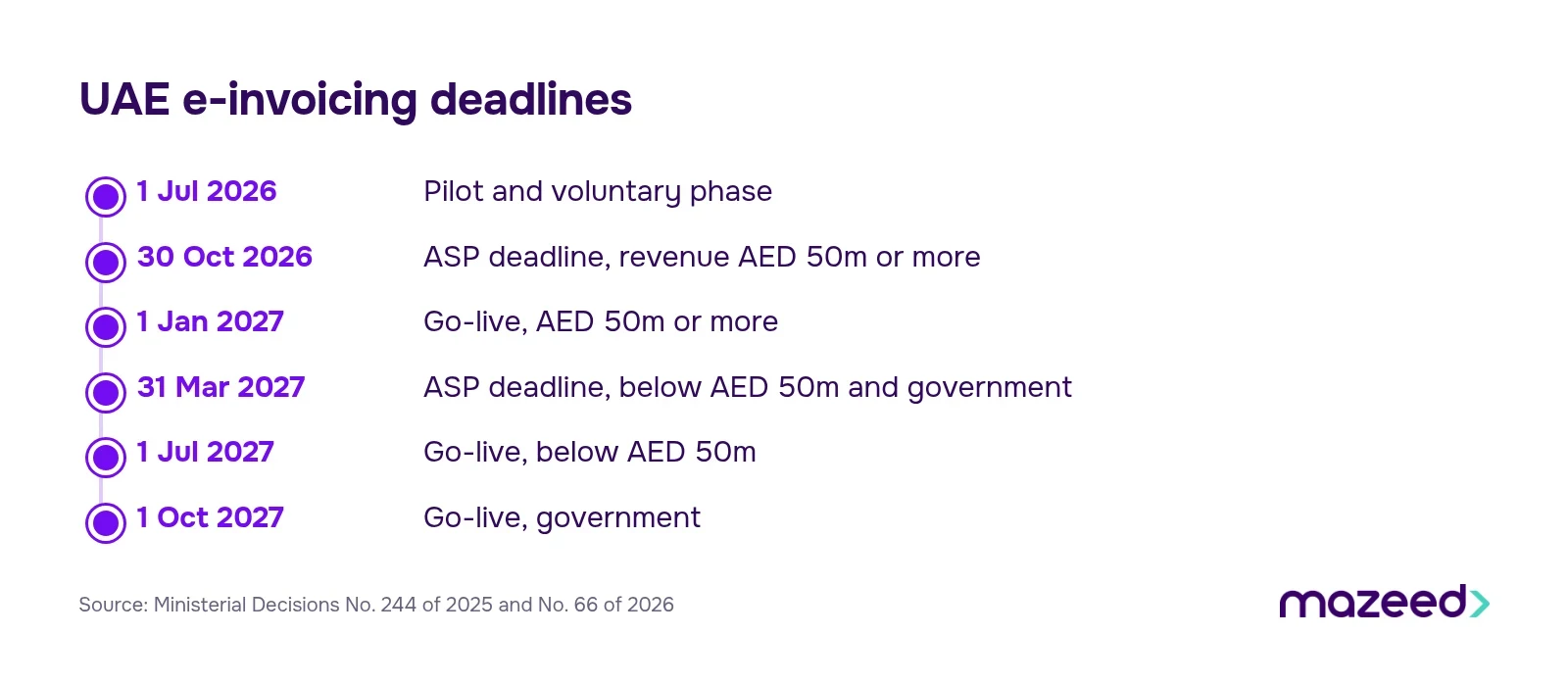
After these phases, any person or government entity that becomes subject to the system must also appoint an ASP and implement it, which covers new businesses formed later.
Two earlier stages started on 1 July 2026. The pilot programme runs with a Taxpayer Working Group selected by the Ministry, and participation needs the business's written agreement. The voluntary phase lets any business implement the system early, as long as it meets the technical requirements.
How is the AED 50 million revenue test measured?
Ministerial Decision No. 244 of 2025 defines revenue as the gross income earned during the most recent accounting period, based on financial statements prepared under UAE law. If no financial statements are available, other documentation acceptable to the Federal Tax Authority can be used.
Two practical points follow. First, the test looks at gross income, not profit and not VAT-taxable supplies. Second, it uses your most recent accounting period, so a company that crossed AED 50 million last year is in the first phase even if this year looks smaller.
Example: A Dubai distributor's audited statements for 2025 show gross income of AED 52.4 million. It falls in the first phase, so it had to appoint an ASP by 30 October 2026 and must issue e-invoices from 1 January 2027. A sister company with AED 18 million of gross income follows the second phase: ASP by 31 March 2027, go-live on 1 July 2027.
Which transactions are excluded from UAE e-invoicing?
Article 4 of Ministerial Decision No. 243 of 2025, as replaced by Ministerial Decision No. 197 of 2026, lists these excluded transactions:
| Excluded transaction | Condition |
|---|---|
| Government entity transactions | Conducted in a sovereign capacity and not in competition with the private sector |
| International passenger air transport | Provided by an airline where an electronic ticket is issued |
| Ancillary airline passenger services | Where an electronic miscellaneous document is issued |
| International air cargo | Where an airway bill is issued; excluded only for 24 months from the date the system becomes effective |
| Financial services | Exempt from VAT or zero-rated under Article 42 of the VAT Executive Regulation |
| Transactions inside a Tax Group | Between members of the same VAT Tax Group, for 24 months from 1 January 2027 |
| Others named later | Any other transaction the Minister determines |
The Tax Group exclusion is new and easy to miss. If your group companies invoice each other and share a single VAT registration, those intra-group invoices do not need to go through the system until the end of 2028. Invoices to customers outside the group are still in scope.
Excluded transactions are not banned from the system. A business can choose to e-invoice them voluntarily; the system rules then apply, but the penalty decisions do not.
Do B2C businesses need e-invoicing?
Not yet. Article 5(2) of Ministerial Decision No. 244 of 2025 says B2C transactions are not subject to the system, and neither is a person engaged exclusively in them, until the Minister issues a decision. A B2C transaction is one with a natural person who is not carrying on business.
The word "exclusively" matters. A restaurant that sells only to walk-in diners is outside the system for now. A restaurant group that also invoices corporate clients for catering is in scope for those B2B invoices, and must still be able to receive e-invoices from its suppliers.
What if I only receive invoices?
E-invoicing works in both directions. Your suppliers will send their invoices to you through the system, so you need an ASP to receive them. Cabinet Decision No. 173 of 2026 makes this concrete: a Recipient that fails to implement the system can be fined AED 5,000 for the first instance and AED 5,000 per month after that, capped at AED 50,000 in any 12 consecutive months. Read the full breakdown in our guide to UAE e-invoicing penalties.
What do in-scope businesses have to do?
Once mandatory, a business must issue and transmit e-invoices and e-credit notes through the system within 14 business days from the date of the business transaction (Article 6(5) of Ministerial Decision No. 243 of 2025, as replaced). It must also keep all e-invoices, e-credit notes and associated data for the period required by the Tax Procedures Law, and be able to produce them to the Federal Tax Authority on request.
In practice that means five steps:
- Confirm your phase from your latest financial statements.
- Appoint an Accredited Service Provider before your appointment deadline.
- Connect your accounting or ERP system to the ASP and map your invoice data.
- Clean customer and supplier master data, especially TRNs and legal names.
- Test with real invoices and credit notes before your mandatory date.
A quick self-check: does UAE e-invoicing apply to me?
| Question | If yes | If no |
|---|---|---|
| Do you carry on business in the UAE? | Continue | The system does not apply |
| Do you sell only to individual consumers? | Outside the system for now, but you may still need to receive e-invoices | Continue |
| Are all your sales in an excluded category? | Those sales are excluded; check the rest | Continue |
| Was your gross income in the last accounting period AED 50 million or more? | Phase 1: mandatory from 1 January 2027 | Phase 2: mandatory from 1 July 2027 |
How mazeed helps
The fastest way to get a clear answer for your business is the free e-invoicing readiness checker, which works out your phase and deadlines from a few questions. When you are ready to implement, mazeed's e-invoicing software issues and receives e-invoices through an accredited provider, so compliance becomes part of everyday invoicing.
This article is general information based on the legislation in force on 16 November 2026. It is not tax or legal advice; for your specific case, speak to a qualified tax adviser.