

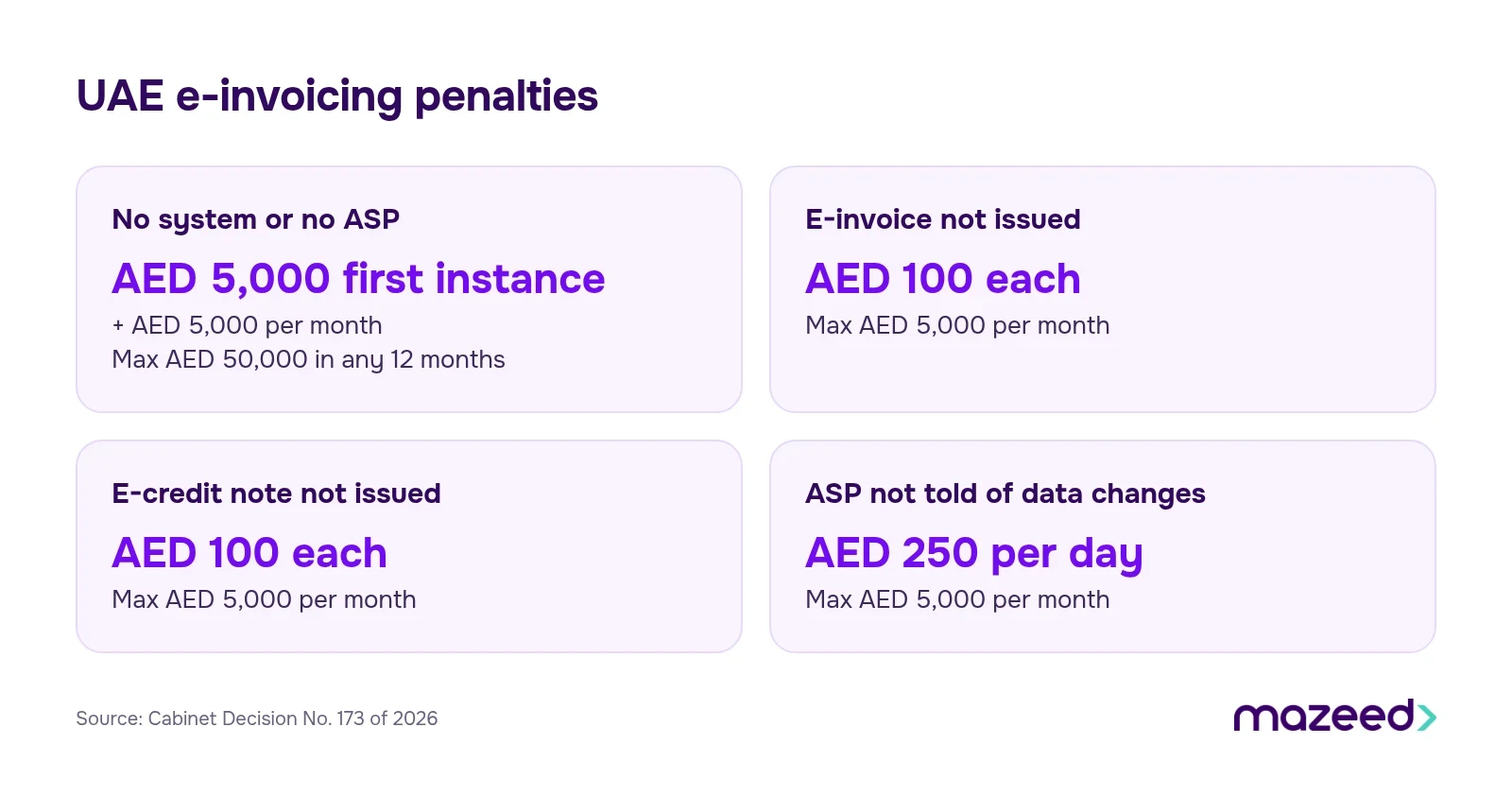
UAE e-invoicing penalties are set by Cabinet Decision No. 173 of 2026, which the Ministry of Finance announced on 30 October 2026 and which repealed the earlier Cabinet Decision No. 106 of 2025. Failing to implement the Electronic Invoicing System, including not appointing an Accredited Service Provider (ASP), costs AED 5,000 for the first instance and AED 5,000 for each further month, capped at AED 50,000 in any 12 consecutive months. Each invoice or credit note not issued through the system costs AED 100, capped at AED 5,000 per calendar month.
What are the current UAE e-invoicing penalties?
The table annexed to Cabinet Decision No. 173 of 2026 lists four violations. The amounts below are taken directly from that table.
| # | Violation | Penalty |
|---|---|---|
| 1 | Issuer or Recipient fails to implement the Electronic Invoicing System, including failing to appoint an ASP; or a Recipient that implemented the system later fails to keep meeting its Recipient obligations | AED 5,000 for the first instance, then AED 5,000 for each month or part of a month the non-compliance continues, up to AED 50,000 in any 12 consecutive months |
| 2 | Issuer fails to issue and transmit an electronic invoice through the system | AED 100 per electronic invoice, up to AED 5,000 per calendar month |
| 3 | Issuer fails to issue and transmit an electronic credit note through the system | AED 100 per electronic credit note, up to AED 5,000 per calendar month |
| 4 | Issuer or Recipient fails to notify its ASP of changes to the data registered with the Federal Tax Authority | AED 250 per day of delay or part of a day, up to AED 5,000 per calendar month |
The decision also contains two protections that matter in practice. Under Article 3(2), if the same business acts as Issuer, Recipient or both for the same violation, it receives only one penalty for that violation. Under Article 2(2), anyone who issues, transmits or reports e-invoices on a voluntary basis is excluded from the decision altogether.
What changed from Cabinet Decision No. 106 of 2025?
The Ministry of Finance said the new decision followed stakeholder feedback and aims to make penalties clear, proportionate and practical. Four changes stand out.
| Area | Cabinet Decision No. 106 of 2025 (repealed) | Cabinet Decision No. 173 of 2026 (current) |
|---|---|---|
| Failure to implement or appoint an ASP | AED 5,000 per month of delay, applied to the Issuer, with no annual cap | AED 5,000 first instance plus AED 5,000 per month, applied to Issuers and Recipients, capped at AED 50,000 per 12 months |
| Not notifying the authority of a system failure | AED 1,000 per day | Removed |
| Not notifying the ASP of changes to registered data | AED 1,000 per day | AED 250 per day, capped at AED 5,000 per month |
| Missing e-invoices and e-credit notes | AED 100 each, capped at AED 5,000 per month | Unchanged |
The removal of the system failure penalty goes together with Ministerial Decision No. 197 of 2026, which deleted the definition of "System Failure" from the main e-invoicing decision with effect from 1 October 2026.
If you read an article or a supplier presentation that still quotes Cabinet Decision No. 106 of 2025, check the date. Many pages written before 30 October 2026 show penalties that no longer apply.
When can e-invoicing penalties start?
Penalties follow the phased timeline in Ministerial Decision No. 244 of 2025, as amended by Ministerial Decision No. 66 of 2026. A business cannot breach a deadline that has not arrived yet. For the full rules on who must comply, read is e-invoicing mandatory in the UAE.
| Group | Appoint an ASP by | Implement the system by |
|---|---|---|
| Revenue of AED 50 million or more | 30 October 2026 | 1 January 2027 |
| Revenue below AED 50 million | 31 March 2027 | 1 July 2027 |
| Government entities | 31 March 2027 | 1 October 2027 |
"Revenue" means gross income in the most recent accounting period, based on your financial statements (Article 1 of Ministerial Decision No. 244 of 2025). If your revenue sits close to AED 50 million, confirm which group you fall into now rather than after a deadline has passed.
For large businesses, the ASP appointment deadline of 30 October 2026 has already passed. If your revenue is AED 50 million or more and you have not appointed an ASP, you are already behind the legal timeline and should act immediately.
How much could a business actually pay? Three worked examples
The caps make the maximum exposure easier to predict. These examples apply the amounts in the Cabinet Decision; they are illustrations, not a calculation of any specific case.
Example 1: a late ASP appointment. A trading company with AED 22 million revenue misses the 31 March 2027 appointment deadline and stays non-compliant for 11 months. The formula gives AED 5,000 for the first instance plus AED 5,000 for each month, which would exceed AED 50,000. Because of the cap, the total for any 12 consecutive months cannot go above AED 50,000.
Example 2: invoices sent outside the system. After go-live, a services firm emails 80 PDF invoices and 12 credit notes in one month instead of sending them through its ASP. Invoices: 80 x AED 100 = AED 8,000, capped at AED 5,000. Credit notes: 12 x AED 100 = AED 1,200, under its own cap. Total for the month: AED 6,200.
Example 3: an address change not shared with the ASP. A company moves office and updates its details with the Federal Tax Authority but forgets to tell its ASP for 25 days. 25 x AED 250 = AED 6,250, capped at AED 5,000 for the month.
The bigger cost is usually not the fine. Invoices that are not exchanged through the system can delay customer payments, because buyers in scope will expect to receive a valid e-invoice before they process payment.
Who can be penalized: the Issuer, the Recipient, or both?
Cabinet Decision No. 173 of 2026 defines an Issuer as any person obliged to issue, transmit, share and exchange electronic invoices and credit notes through the system, and a Recipient as any person who receives them through the system.
The first violation covers both roles, so a business that only buys from in-scope suppliers still needs to be set up to receive e-invoices through an ASP. Violations 2 and 3 apply only to Issuers, and violation 4 applies to both.
Do penalties apply to voluntary users and excluded transactions?
No. Article 2(2) of Cabinet Decision No. 173 of 2026 excludes anyone who issues, transmits, shares, exchanges or reports e-invoices voluntarily. Ministerial Decision No. 197 of 2026 confirms the same for excluded transactions: a business may e-invoice them voluntarily, and all system rules then apply to it, except the decisions on violations and administrative penalties.
This makes the voluntary phase that opened on 1 July 2026 a low-risk window to test your process before your mandatory date.
How to avoid UAE e-invoicing penalties
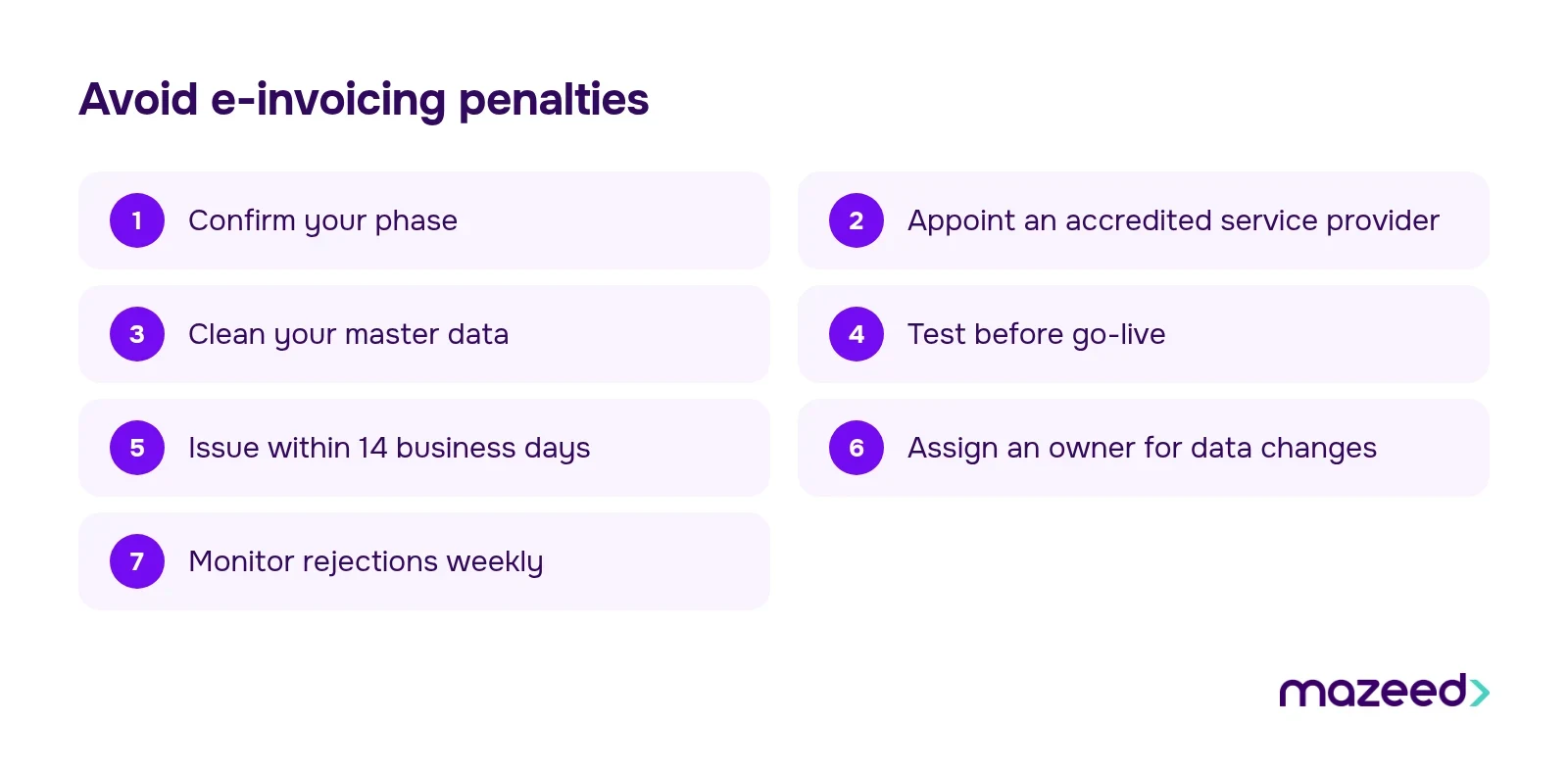
- Confirm your phase. Calculate revenue from your latest financial statements and note your two dates: ASP appointment and go-live.
- Appoint an Accredited Service Provider. Use only providers accredited by the Ministry of Finance; appointment is a legal obligation, not just a technical step.
- Clean your master data. Customer and supplier names, TRNs, addresses and identifiers must match what is registered, or invoices will be rejected.
- Test before go-live. Run real invoices and credit notes through your ASP during the voluntary period, including edge cases such as partial credit notes.
- Respect the issuing deadline. Under Ministerial Decision No. 197 of 2026, e-invoices and e-credit notes must be issued and transmitted within 14 business days from the date of the business transaction.
- Assign an owner for data changes. Whoever updates your FTA registration should also update your ASP the same day.
- Monitor rejections weekly. A rejected invoice that is never corrected can become an invoice that was never issued through the system.
How mazeed helps
mazeed's e-invoicing software issues invoices and credit notes in the structured format the UAE system requires and sends them through an accredited provider, so the steps above happen as part of your normal invoicing. Not sure where you stand? Use the free e-invoicing readiness checker to see your phase, your deadlines and the gaps to close.
This article is general information based on the legislation in force on 16 November 2026. It is not tax or legal advice; for your specific case, speak to a qualified tax adviser.