UAE corporate tax filing is a mandatory annual obligation for every registered taxable person, whether any tax is owed or not. The Federal Tax Authority requires all registered businesses to file through the EmaraTax portal at eservices.tax.gov.ae. This guide covers every step of the corporate tax filing process: who must file, the 30 September 2026 deadline and how it is calculated, the documents required, how to calculate taxable income, navigating the 20-schedule adaptive return form, completing the Transfer Pricing Disclosure Form, paying via GIBAN, and correcting errors through voluntary disclosure. All guidance is based on the FTA’s Corporate Tax Returns Guide CTGTXR1 (November 2024) and subsequent official clarifications.
This article covers UAE corporate tax filing in full detail. For a complete overview of corporate tax including rates, registration, free zone rules, small business relief, and deductions, read the UAE Corporate Tax 2026.
Who Must Complete UAE Corporate Tax Filing
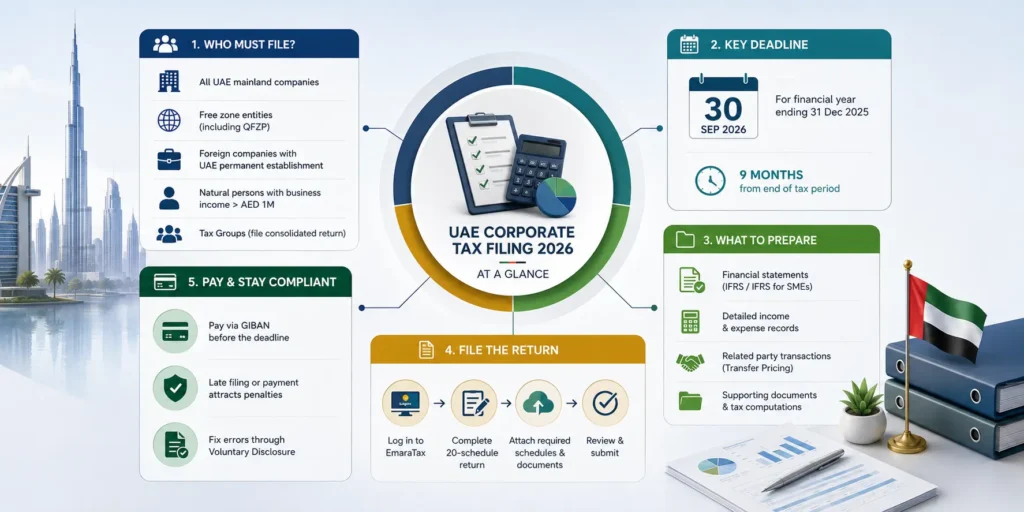
Under Article 53 of Federal Decree-Law No. 47 of 2022, every registered taxable person must complete corporate tax filing for each tax period. The FTA’s Corporate Tax Returns Guide CTGTXR1 (November 2024) confirms that corporate tax filing is mandatory for all of the following:
- UAE mainland companies: All juridical persons incorporated under UAE law, including LLCs, joint-stock companies, civil companies, and branches of foreign companies registered in the UAE
- Free zone entities: All free zone companies regardless of QFZP status or income level, including those benefiting from the 0% qualifying income rate
- Foreign companies with a UAE permanent establishment: Non-resident juridical persons that have a fixed place of business or are otherwise deemed to have a permanent establishment in the UAE
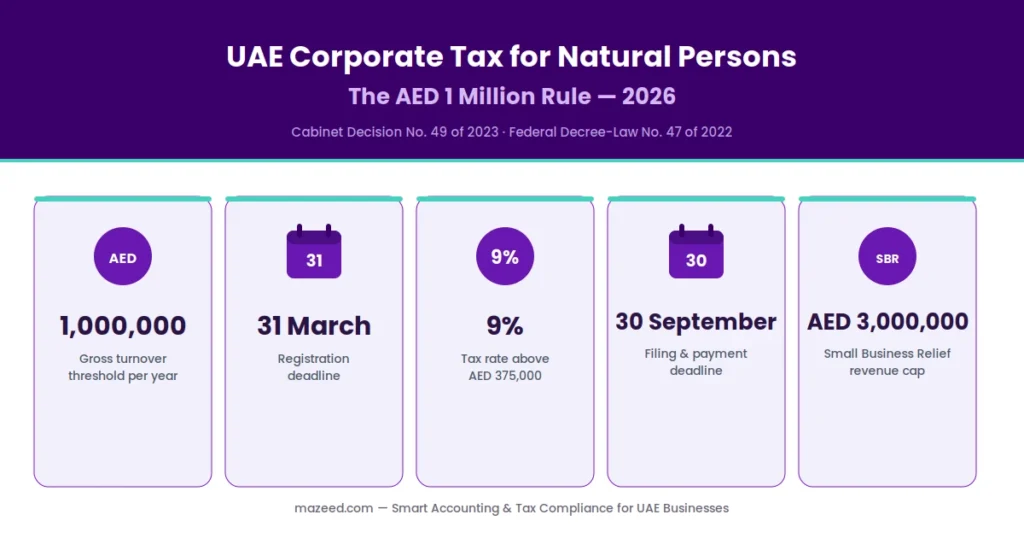
- Natural persons conducting business: Individuals whose total business income exceeded AED 1 million in the relevant Gregorian calendar year
- Tax Groups: An approved Tax Group files a single consolidated return through the representative member, covering all group members for the tax period
Zero Tax Does Not Mean Zero Corporate Tax Filing Obligation
The FTA’s September 2025 press release specifically reminded all registered taxable persons that this obligation is mandatory regardless of income level, tax liability, or QFZP status. A business that owes zero corporate tax because its income falls below AED 375,000, or because it has elected Small Business Relief, or because it is a QFZP with all qualifying income, must still file and submit their return by the nine-month deadline. Administrative penalties for late filing begin accruing from the day after the deadline.
Entities Not Required to File
The following categories are exempt from corporate tax and therefore not required to file a corporate tax return, provided they have not made any business income during the period:
- UAE government entities and government-controlled entities exempt under Article 4 of Federal Decree-Law No. 47 of 2022
- Qualifying public benefit entities listed under Cabinet Decision No. 37 of 2023
- Qualifying investment funds meeting the conditions under Article 10 of the Decree-Law
- Businesses engaged exclusively in the extraction of UAE natural resources subject to emirate-level taxation
GET STARTED TODAY
Let mazeed Handle Your Corporate Tax
Join 4,000+ UAE businesses using mazeed to stay compliant and avoid costly mistakes.
UAE Corporate Tax Filing Deadlines for 2026
The UAE corporate tax filing deadline is nine months from the end of the relevant tax period under Article 53 of the Decree-Law. The same date applies to both the return submission and the tax payment. The FTA does not offer general extensions to this deadline.
| Deadline | Financial Year | Details |
| 30 September 2026 | Ending 31 December 2025 | Applies to most UAE businesses. Both return and payment due on this date. This is the deadline for the largest volume of corporate tax returns filed in the UAE’s history. |
| 31 December 2026 | Ending 31 March 2026 | For businesses with a March financial year end. |
| 31 March 2026 | Ending 30 June 2025 | For businesses with a June financial year end. This deadline has already passed as of June 2026. |
| 30 June 2026 | Ending 30 September 2025 | For businesses with a September financial year end. This deadline has passed. |
How the Nine-Month Rule Works for Non-Standard Periods
A taxable person can apply to the FTA to change their tax period, subject to conditions. Where a tax period is shorter or longer than 12 months as a result of an approved change, the nine-month countdown still runs from the end of that period, regardless of its length. The FTA Corporate Tax Returns Guide CTGTXR1 confirms this. The tax period will be pre-populated in EmaraTax based on the taxpayer’s registration data; this pre-populated date should be verified before proceeding with the return.
Payment Must Arrive by the Deadline, Not Just Be Initiated
The FTA treats the payment deadline as the date cleared funds arrive in the authority’s account, not the date a bank transfer is initiated. Bank transfers from UAE banks typically clear within one business day. International transfers can take three to five business days. The FTA’s published guidance recommends initiating payment at least one week before the deadline to allow for processing time and to resolve any payment errors through EmaraTax before the date passes.
Pre-Filing Preparation for UAE Corporate Tax Filing
Attempting to file without complete preparation is the single most common cause of errors, missed deductions, and FTA queries. The FTA’s Corporate Tax Returns Guide CTGTXR1 advises taxable persons to review their EmaraTax account information carefully before opening a return, because inaccurate registration data causes errors in the pre-populated fields of the return form that are difficult to correct mid-filing.
Documents to Prepare Before Starting
- Finalised financial statements: Prepared under IFRS or IFRS for SMEs for the relevant tax period. Must be finalised and reconciled. QFZPs, entities with revenue above AED 50 million, and Tax Group members must have audited accounts. Financial statements are a mandatory attachment to the corporate tax return on EmaraTax.
- Corporate Tax Registration Certificate (TRN): Confirm the TRN is active. Verify that the registered financial year end date matches the actual year end in the financial statements.
- Schedule of all income adjustments: A reconciliation of accounting profit to taxable income, showing each add-back and deduction with supporting references. This is prepared offline before logging into EmaraTax.
- Details of all related party transactions: The name, TRN, jurisdiction, transaction type, aggregate value, and transfer pricing method for each related party, categorised by transaction type (goods, services, IP, interest, assets, liabilities). Required if aggregate related party transactions exceed AED 40 million.
- Tax loss carry-forward schedule: A record of all tax losses from prior periods that remain available for offset, together with the returns in which they were declared. Subject to the 75% cap on taxable income per period under Article 37 of the Decree-Law.
- Elections record: A note of all elections to be made on this return, including Small Business Relief election, Participation Exemption claims, Realisation Basis elections, and QFZP confirmation, with the legal basis for each election confirmed before filing.
- WPS salary records: The FTA has confirmed it cross-references salary expenses claimed on corporate tax returns against Wages Protection System payment data. Ensure WPS records are consistent with the salary expense declared in the return.
Verify Your EmaraTax Account Before Opening the Return
The FTA Corporate Tax Returns Guide CTGTXR1 specifically advises taxable persons to check their EmaraTax account information before starting. This includes verifying the taxable person type (mainland, free zone, foreign PE, natural person), the registered financial year end date, and the activity codes. Many schedules are triggered or suppressed based on this data. An incorrectly classified taxpayer type causes entire schedules to be missing from the return, leading to a materially incomplete submission.
Software & Experts Together!
New Way to Manage Corporate Tax in UAE
Just scan your invoices and our team will handle all your compliance process inside your mazeed account.
Calculating Taxable Income Before UAE Corporate Tax Filing
UAE corporate tax uses a self-assessment basis under Article 20 of the Decree-Law. Taxable income is calculated by starting from the accounting net profit or loss in the IFRS financial statements and applying the adjustments required under the Decree-Law and its implementing Ministerial Decisions.
| Step | Item | Treatment | Legal Basis |
| 1 | Accounting net profit (or loss) per IFRS financial statements | Starting point | Article 20, Decree-Law No. 47/2022 |
| 2 | Government fines and penalties | ADD BACK | Article 33 |
| 3 | Bribes and illegal payments | ADD BACK | Article 33 |
| 4 | 50% of qualifying entertainment expenditure (client/supplier) | ADD BACK 50% | Article 32, MD 134/2023 |
| 5 | Related party costs above arm’s length value | ADD BACK excess | Article 34 |
| 6 | Net interest expenditure above the deduction limit (AED 12M or 30% EBITDA) | ADD BACK excess | MD 126/2023 |
| 7 | Dividends qualifying for Participation Exemption | DEDUCT | Article 23 |
| 8 | Capital gains qualifying for Participation Exemption | DEDUCT | Article 23 |
| 9 | Income of a foreign permanent establishment (if PE exemption elected) | DEDUCT | Article 24 |
| 10 | Qualifying IP income (nexus approach) — Qualifying Free Zone Persons only | Taxed at 0% as Qualifying Income of a QFZP; not a deduction available to mainland businesses | Article 7, Cabinet Decision No. 100 of 2023; Article 4, MD 229/2025 |
| 11 | Small Business Relief (if elected and eligible) | TREATED AS ZERO | Article 21, MD 73/2023 |
| 12 | Tax losses from prior periods (up to 75% of current taxable income) | OFFSET up to 75% | Article 37 |
| 13 | Taxable Income | Taxed at 0% up to AED 375,000; 9% above | Article 3 |
Tip: Prepare the Adjustment Schedule Offline First
The EmaraTax return does not allow you to save and return to a partially completed section in all circumstances. Preparing the complete income adjustment schedule in a spreadsheet before logging in ensures that all required figures are ready when the portal prompts for them. This significantly reduces the risk of errors caused by time pressure or interruptions during the filing session.
Step-by-Step: UAE Corporate Tax Filing on EmaraTax
The following steps reflect the EmaraTax process as described in the FTA’s Corporate Tax Returns Guide CTGTXR1 (November 2024) and the FTA’s EmaraTax Tax Return User Manual.
1- Log in to EmaraTax via UAE Pass
Access the portal at eservices.tax.gov.ae. Log in using UAE Pass. UAE Pass is the mandatory authentication method for all FTA portal access. Confirm your account gives access to the correct taxable person entity before proceeding.
2- Navigate to the Corporate Tax module
From the EmaraTax dashboard, select the Corporate Tax tile. The portal will display all registered tax periods for your entity. Select the tax period for which you are filing. Verify that the pre-populated financial year start and end dates are correct. The KPMG analysis of the CTGTXR1 guide noted that an incorrect financial year end in the registration data is one of the most common causes of errors in the pre-populated return fields. Contact the FTA to correct any registration data discrepancies before proceeding.
3- Complete the return introduction and entity confirmation
Confirm the taxable person type (mainland company, free zone entity, foreign PE, natural person, Tax Group representative member). The type selected here determines which schedules appear throughout the rest of the return. Confirm the accounting basis (IFRS or IFRS for SMEs) and confirm whether audited financial statements have been prepared. Answering this question incorrectly suppresses or triggers additional schedules.
4- Enter revenue and income details
Declare total revenue for the tax period as reported in the financial statements. For QFZPs, this section requires separate entry of qualifying income and non-qualifying income. For Tax Groups, the consolidated revenue of all members for the period is entered. Revenue should exclude VAT collected on behalf of the government.
5- Declare exempt income and apply adjustments
Work through the income adjustment section, entering each item of exempt income (qualifying dividends, Participation Exemption gains, foreign PE income where exemption elected) and each add-back (non-deductible expenses). The portal guides through each category in sequence. The adjustment schedule prepared in Step 4 of the pre-filing preparation (Section 3 of this guide) is used to populate this section accurately.
6- Make all applicable elections
The Elections section is where all one-off and recurring elections are formally recorded. This includes the Small Business Relief election, the Realisation Basis election for gains and losses, and QFZP confirmation. Elections that apply to more than one tax period, as noted in the KPMG analysis of CTGTXR1, remain effective without needing to be re-made each year, but must be confirmed in each return. Missing an election in this section means the election is not recorded for that period even if it was made in a prior period.
7- Apply tax loss carry-forwards
Declare any tax losses brought forward from prior periods and apply them against taxable income. The maximum offset in any single period is 75% of taxable income for that period under Article 37 of the Decree-Law. Any remaining loss balance is available for carry-forward to subsequent periods indefinitely, subject to the ownership continuity conditions in Article 39.
8- Complete required schedules
EmaraTax directs taxpayers through only the schedules applicable to their situation. Complete each prompted schedule before returning to the main return. Section 6 of this guide explains the structure of the 20-schedule return form and which schedules apply to different types of taxpayers.
9- Upload financial statements and attachments
Upload the IFRS financial statements as a mandatory attachment. The FTA’s CTGTXR1 guide confirms that financial statements must be attached to every corporate tax return, regardless of entity size, unless the business has elected Small Business Relief (Section 22.4 of the Guide). Additional supporting documents such as evidence of the foreign tax where a Foreign Tax Credit is claimed, or a foreign tax residency certificate, may be attached as supplementary files.
10- Review the return summary and submit
Review the complete return summary before submission. All schedules must show as completed. Verify the tax liability figure is consistent with the offline calculation prepared in advance. Confirm the accuracy declaration and submit. EmaraTax issues a confirmation reference number immediately upon submission. Save or print this confirmation. The return cannot be withdrawn after submission; corrections require a voluntary disclosure (see Section 11).
The 20-Schedule UAE Corporate Tax Filing Form Explained
The FTA’s Corporate Tax Returns Guide CTGTXR1 confirmed that the UAE corporate tax filing form contains 20 schedules. The form operates as an adaptive system: EmaraTax directs taxpayers only to the schedules relevant to their specific situation, based on their taxpayer type and the answers provided during return completion. A simple mainland company with no related party transactions above the threshold will complete significantly fewer than 20 schedules.
As KPMG’s tax alert on the CTGTXR1 guide noted, the accuracy of information in the EmaraTax taxpayer profile is therefore critical: if the profile incorrectly classifies the entity type or omits certain activities, required schedules may not appear in the return, resulting in an incomplete submission.
| Always Required | Main return form: revenue, exempt income, taxable income, tax liability |
| Always Required | Financial statements attachment: mandatory for all filers |
| If Applicable | Free Zone Schedule: qualifying vs non-qualifying income split, average FTE count |
| If Applicable | Tax Group Schedule: consolidated taxable income, member allocations |
| If Applicable | Related Party Transaction Schedule: if aggregate RPTs exceed AED 40 million |
| If Applicable | Connected Persons Schedule: if aggregate transactions with any one CP exceed AED 500,000 |
| If Applicable | Participation Exemption Schedule: qualifying shareholding details |
| If Applicable | Foreign PE Schedule: income and expenses attributable to the foreign PE |
| If Applicable | Interest Deduction Limitation Schedule: net interest, EBITDA, limit calculation |
| If Applicable | Tax Loss Schedule: losses brought forward, losses utilised, losses carried forward |
| If Applicable | Small Business Relief Election: revenue declaration, eligibility confirmation |
| If Applicable | Qualifying IP Income Schedule: nexus ratio calculation for IP income |
Free Zone Entities Must Report Average FTE Count
As confirmed by the KPMG analysis of CTGTXR1, free zone entities filing as QFZPs are required to report the average number of full-time equivalent employees in the free zone, calculated as the average of FTE at the beginning and end of the tax period. This figure is used by the FTA to assess whether the entity satisfies the adequate substance condition required for QFZP status. Entities with zero UAE-based employees are likely to trigger an FTA enquiry into substance.
Elections to Make During UAE Corporate Tax Filing
Several elections under UAE corporate tax law are made on the annual return rather than as standalone applications. The FTA’s CTGTXR1 guide notes that elections which apply to more than one tax period remain in force without being remade, but must still be confirmed in each return. The most significant elections are:
| Election | Effect | Revocable | Legal Basis |
| Small Business Relief | Treated as having zero taxable income for the period. Tax losses and disallowed interest for that period are permanently forfeited. | No. Once submitted, irrevocable for that period. | Article 21, MD 73/2023 |
| Realisation Basis for gains and losses | Unrealised gains and losses on assets measured at fair value under IFRS are excluded from taxable income until actually realised. This is the default for businesses using IFRS. | No. Once made, applies to all subsequent periods. | MD 134/2023 |
| Foreign PE exemption | Income and losses attributable to a foreign permanent establishment are excluded from UAE taxable income. Losses cannot then be offset against UAE profits. | No. Irrevocable once made. | Article 24 |
| Participation Exemption | Qualifying dividends and capital gains from a qualifying shareholding are exempt from corporate tax. Not available on an automatic basis; the qualifying conditions must be actively assessed each period. | Yes. Assessed each period. | Article 23 |
| Standard rate election (free zone entities only) | Irrevocable election to be taxed at standard mainland rates (0% / 9%) rather than as a QFZP. Almost never beneficial; made only in very specific circumstances. | No. Permanent and irrevocable. | Article 19 |
Transfer Pricing Disclosure Form in UAE Corporate Tax Filing
The Transfer Pricing Disclosure Form (TPDF) is a mandatory part of UAE corporate tax filing for businesses that meet the relevant thresholds. It is completed within EmaraTax as part of the return, not as a separate submission. The FTA’s detailed guidance on the TPDF was confirmed in the CTGTXR1 guide and analysed by Deloitte Middle East in their November 2024 alert on transfer pricing disclosures in UAE corporate tax returns.
When the Transfer Pricing Disclosure Form Is Required
| Trigger | Threshold | What Must Be Disclosed |
| Related Party Transaction (RPT) Schedule | Aggregate RPTs exceed AED 40 million AND individual transaction categories exceed AED 4 million | For each qualifying category (goods, services, IP, interest, assets, liabilities): name and TRN of related party, jurisdiction, transaction type, gross income/expense, arm’s length value, transfer pricing method used |
| Connected Persons (CP) Schedule | Aggregate transactions with any one connected person (and their related parties) exceed AED 500,000 | For each qualifying payment or benefit to a connected person: name, nature of payment, amount, market value, whether the amount is deductible |
| Master File and Local File | Standalone revenue above AED 200 million in the tax period, OR part of an MNE Group with consolidated group revenue above AED 3.15 billion | Not filed with the return but must be available for submission within 30 days of an FTA request. Master File covers global group structure and TP policy. Local File covers UAE-specific transactions, functional analysis, and economic comparables. |
| Country-by-Country Report | Part of an MNE Group with consolidated revenue above AED 3.15 billion | Filed separately under the CBC regime. Not part of the standard corporate tax return. |
TP Adjustments Reducing Taxable Income Require FTA Pre-Approval
As confirmed in the FTA’s CTGTXR1 guide, any transfer pricing adjustment that reduces taxable income (a downward adjustment) requires pre-approval from the FTA before it can be claimed in the return. Upward adjustments (which increase taxable income) do not require pre-approval. This means a business that has identified a potential downward TP adjustment must apply to the FTA for an Advance Pricing Agreement or formal confirmation before reflecting it in the return, not after. Filing a return with an unapproved downward TP adjustment risks rejection of the adjustment and potentially a penalty for an incorrect return.
Paying After UAE Corporate Tax Filing: GIBAN Payment Guide
Every registered taxable person is assigned a GIBAN (Government IBAN), a unique bank account number generated by EmaraTax for receiving corporate tax payments. The GIBAN is visible in the EmaraTax dashboard and is referenced on the tax assessment generated after the return is submitted.
Payment Methods
- Bank transfer to GIBAN: The standard payment method for all corporate tax liabilities. Transfer directly from a UAE or international bank account to the GIBAN number displayed in EmaraTax. The transfer reference must include the taxpayer’s TRN to allow the payment to be matched automatically. Funds must reach the FTA account by the filing deadline.
- Credit card through EmaraTax: Available for smaller payment amounts. Subject to a processing fee charged by the payment gateway. Confirm the fee before selecting this option.
- e-Dirham: The UAE government prepaid card system. Available in EmaraTax for tax payments. Less commonly used for corporate tax given the payment amounts involved.
International Payments
Businesses making payment from a non-UAE bank account can transfer to the GIBAN using standard international wire transfer. The GIBAN functions as a UAE IBAN. SWIFT transfer times from most international banking jurisdictions are three to five business days. Businesses paying from overseas should initiate transfer at least seven business days before the deadline to ensure cleared funds arrive on time.
Overpayments
Where a taxable person pays more than the assessed liability, the excess creates a credit balance on the EmaraTax account. This credit can be applied against future tax liabilities (VAT, excise, or corporate tax) or claimed as a cash refund through EmaraTax. The refund process is governed by Federal Decree-Law No. 28 of 2022 on Tax Procedures and the updated procedures under Federal Decree-Law No. 17 of 2025, which refined refund timelines and voluntary disclosure rules effective from 1 January 2026.
After UAE Corporate Tax Filing: Records and FTA Audits
Record Keeping Obligations
Under Article 56 of the Decree-Law, all financial records, corporate tax returns, supporting schedules, transfer pricing documentation, contracts, board minutes, and FTA correspondence must be retained for a minimum of seven years from the end of the tax period to which they relate. For QFZPs, audited financial statements must also be retained for this period.
The FTA operates a risk-based audit programme. An audit can be initiated within five years of the relevant tax period, extended to fifteen years in cases involving fraud or tax evasion under Federal Decree-Law No. 17 of 2025. Adequate record keeping is the primary defence in an FTA audit.
FTA Risk-Based Audit Programme
The FTA confirmed in early 2026 press statements that its corporate tax audit programme, which began operating in 2025, focuses on high-risk areas including: transfer pricing compliance, QFZP substance and qualifying income classification, entertainment expense deductions, and consistency between corporate tax return figures and VAT return data for the same period. The FTA cross-references VAT return revenue figures against corporate tax return revenue declarations as a routine audit step.
Correcting UAE Corporate Tax Filing Errors: Voluntary Disclosure
Once the return is submitted on EmaraTax, it cannot be withdrawn or amended directly. Corrections are made through two mechanisms depending on the size of the error:
- Small error correction (AED 10,000 or less impact on taxable income): An error in a previously filed return that has an impact of AED 10,000 or less on taxable income can be corrected as an adjustment in the current period return. This avoids the need for a formal voluntary disclosure submission.
- Voluntary disclosure (impact above AED 10,000): A formal voluntary disclosure must be submitted through EmaraTax for any error that reduces or increases taxable income by more than AED 10,000. The voluntary disclosure is reviewed by the FTA and, if accepted, results in an amended assessment.
Penalty Implications of Voluntary Disclosure
Cabinet Decision No. 75 of 2023, as amended by Cabinet Decision No. 10 of 2024, and the updated Tax Procedures Law (Federal Decree-Law No. 17 of 2025), the penalty for a voluntary disclosure submitted proactively before the FTA initiates an audit is significantly lower than the penalty for errors identified by the FTA directly. A proactive voluntary disclosure carries a monthly penalty of 1% of the Tax Difference for each month or part thereof, applied from the day following the due date of the relevant tax return until the disclosure is submitted. Where the taxable person fails to disclose before being notified of a tax audit, a fixed penalty of 15% of the Tax Difference applies in addition to the 1% monthly penalty.
File a Voluntary Disclosure Before the FTA Contacts You
If a business identifies a material error in a previously filed return, the correct course is to submit a voluntary disclosure promptly rather than wait to see whether the FTA identifies it. The penalty for a proactive voluntary disclosure is consistently lower than the penalty for an FTA-initiated audit finding. Under Federal Decree-Law No. 17 of 2025, which took effect from 1 January 2026, voluntary disclosure procedures have been streamlined with clearer timelines for FTA response.
Penalties for Late UAE Corporate Tax Filing and Late Payment
Administrative penalties for non-compliance with corporate tax obligations are established under Cabinet Decision No. 75 of 2023, as amended by Cabinet Decision No. 10 of 2024. Late filing and late payment penalties are independent and accumulate separately.
| Violation | Penalty | Legal Basis |
| Failure to file corporate tax return by the deadline | AED 500 per month for months 1 to 12; AED 1,000 per month from month 13 onwards. Penalties accumulate until the return is filed. | Clause 7, Cabinet Decision No. 75 of 2023 (as amended) |
| Failure to pay corporate tax by the deadline | A monthly penalty of 14% per annum, for each month or part thereof, on the unsettled tax amount from the day following the due date of payment. | Clause 8, Cabinet Decision No. 75 of 2023 (as amended) |
| Submission of an incorrect return | AED 500, unless the return is corrected before the filing deadline expires. Where the error is not voluntarily disclosed before notification of a tax audit, a fixed 15% penalty on the Tax Difference plus a 1% monthly penalty apply, in addition to recovery of the tax itself. | Clauses 9 and 11, Cabinet Decision No. 75 of 2023 (as amended) |
| Failure to maintain required records | AED 10,000 for the first instance; AED 20,000 for a repeat violation within 24 months. | Clause 1, Cabinet Decision No. 75 of 2023 (as amended) |
| Failure to submit Transfer Pricing Disclosure Form | AED 500 per month for the first 12 months; AED 1,000 per month thereafter — the disclosure under Article 55(1) of the Corporate Tax Law is a “Declaration” penalised under Clause 13. | Clause 13, Cabinet Decision No. 75 of 2023 (as amended) |
Read more: UAE Corporate Tax Penalties
Most Common UAE Corporate Tax Filing Errors
The following errors are the most frequently observed across the first wave of UAE corporate tax returns filed in 2024 and 2025, based on analysis from KPMG, PwC, and Deloitte Middle East, and guidance from the FTA’s CTGTXR1 guide.
- Incorrect taxpayer type in EmaraTax causing missing schedules: Classifying a free zone entity as a mainland company (or vice versa) causes the Free Zone Schedule and QFZP-specific fields to be absent from the return. The filing is then technically incomplete for a QFZP. Verify the taxpayer type before opening a return.
- Failing to make the Small Business Relief election in the Elections section: SBR is not applied automatically. An eligible business that omits the election in the Elections section is assessed on actual taxable income at standard rates. The election cannot be added retrospectively without a voluntary disclosure.
- Revenue inconsistency with VAT returns: The FTA cross-references corporate tax return revenue with VAT return supplies for the same period. Material discrepancies without a documented explanation are an audit trigger. Common causes include different revenue recognition bases (accrual for CT, tax point for VAT), out-of-scope income (dividends, interest) included in CT but not VAT, and timing differences across financial year and VAT periods.
- Applying the 75% tax loss cap incorrectly: Tax losses from prior periods can offset up to 75% of taxable income in the current period under Article 37. Some businesses apply losses to 100% of taxable income, incorrectly reducing their tax liability to zero when a small liability should remain. Others fail to apply available losses at all. Both produce incorrect returns.
- Entertainment expenses claimed at 100% rather than 50%: Client and supplier entertainment is deductible at 50% under Article 32. Many businesses claim 100%, overstating deductions and understating taxable income. Employee entertainment (meals, team events) remains fully deductible.
- Filing without audited accounts for QFZP entities: QFZPs claiming the 0% rate must attach audited financial statements. Filing with management accounts instead of audited accounts exposes the QFZP status claim to challenge during an FTA audit and may result in the 0% rate being withdrawn for the period.
- Omitting the Transfer Pricing Disclosure Form when thresholds are met: Businesses that meet the AED 40 million aggregate related party transaction threshold must complete the Related Party Transaction Schedule. Failing to do so incurs a monthly penalty of AED 500 for the first 12 months and AED 1,000 per month thereafter, and is also treated as an incomplete return triggering late filing penalties.
- Payment initiated but not received by the deadline: Initiating a GIBAN transfer on the day of the deadline without allowing for bank processing time results in a late payment even where the transfer instruction was given on time. The late payment penalty of 14% per annum, applied monthly, begins accruing from the day after the deadline on any outstanding balance.
Frequently Asked Questions About UAE Corporate Tax Filing
Can I complete corporate tax filing if my accounts are not yet finalised?
No. The FTA requires financial statements to be attached to every corporate tax filing as a mandatory document. A return submitted without financial statements is incomplete. If accounts cannot be finalised before the deadline, the business should contact the FTA to understand the available options. Filing with estimated figures and subsequently amending through voluntary disclosure is technically possible but carries late filing penalty risk if the amendment materially affects the tax liability.
What is the difference between the tax period and the corporate tax filing deadline?
The tax period is the financial year for which tax is calculated, typically 12 months ending on the business’s chosen financial year-end date. The corporate tax filing deadline is the date by which the return and payment must both be submitted, which is nine months after the end of the tax period. For a business with a financial year ending 31 December 2025, the tax period is 1 January 2025 to 31 December 2025, and the corporate tax filing deadline is 30 September 2026.
Does completing corporate tax filing confirm QFZP status?
A return in which QFZP status is declared is not the same as the FTA formally confirming that status. The FTA may subsequently audit the QFZP conditions, including substance, qualifying income classification, and audited accounts, and can disallow the 0% rate if the conditions are found not to have been met. QFZP status should be thoroughly assessed before corporate tax filing, not relied upon solely on the basis of a submitted return that has not yet been audited.
How does a Tax Group handle corporate tax filing?
An FTA-approved Tax Group submits a single consolidated return through the nominated representative member. The filing covers all Tax Group members for the period and reflects consolidated taxable income after intra-group eliminations. Individual members do not submit separate returns while the Tax Group is active. The return includes a schedule detailing each member’s contribution to the consolidated position.
Is the corporate tax filing form available in Arabic?
The EmaraTax portal supports both English and Arabic interfaces. Taxable persons can switch between languages within the portal. Financial statements attached to the return may be in English or Arabic, provided they are prepared under IFRS or IFRS for SMEs.
→ Related: UAE Corporate Tax Registration: You must be registered before you can file. Covers who must register, all deadlines, required documents, and the EmaraTax registration process.
Official References
[1] Articles 20, 39, 53, 56, Federal Decree-Law No. 47 of 2022 on the Taxation of Corporations and Businesses. Ministry of Finance, UAE. mof.gov.ae
[2] FTA Corporate Tax Returns Guide CTGTXR1 (Tax Returns Corporate Tax Guide). Federal Tax Authority. Published 11 November 2024. tax.gov.ae
[3] Cabinet Decision No. 75 of 2023 on the Administrative Penalties for Violations Related to the Application of Federal Decree-Law No. 47 of 2022 on the Taxation of Corporations and Businesses, as amended by Cabinet Decision No. 10 of 2024. Cabinet of the UAE.
[4] Ministerial Decision No. 134 of 2023 on General Rules for Determining Taxable Income. Ministry of Finance, UAE.
[5] Ministerial Decision No. 126 of 2023 on the General Interest Deduction Limitation Rule. Ministry of Finance, UAE.
[6] Ministerial Decision No. 73 of 2023 on Small Business Relief. Ministry of Finance, UAE.
[7] Ministerial Decision No. 97 of 2023 on Transfer Pricing Documentation Requirements (Master File and Local File). Ministry of Finance, UAE.
[8] Federal Decree-Law No. 17 of 2025 Amending Federal Decree-Law No. 28 of 2022 on Tax Procedures. Effective 1 January 2026. Ministry of Finance, UAE.
[9] KPMG Middle East Tax Alert: “Tax Guide on Corporate Tax Returns.” November 2024. Analysis of FTA CTGTXR1. kpmg.com
[10] KPMG Middle East Tax Alert: “Tax Guide on Corporate Tax Returns: Further Insights.” November 2024. Transfer pricing schedules analysis. kpmg.com
[11] PwC Middle East Tax Alert: “UAE Corporate Tax: Tax Returns Guide.” November 2024. pwc.com
[12] Deloitte Middle East Tax Alert: “UAE Transfer Pricing Disclosures in Tax Return.” November 2024. deloitte.com
[13] FTI Consulting: “UAE Transfer Pricing Essentials.” 2025. AED 40 million threshold confirmation. fticonsulting.com
[14] Federal Tax Authority Press Release: “FTA Urges Submission of Corporate Tax Returns Within Nine Months.” 24 September 2025. tax.gov.ae
[15] Article 37, Federal Decree-Law No. 47 of 2022 (75% tax loss offset cap; Article 39 governs the carry-forward conditions). Ministry of Finance, UAE.
Disclaimer: This publication is for informational purposes only and should not be considered professional or legal advice. While we strive for accuracy, we make no guarantees regarding completeness or applicability. mazeed, its members, employees, and agents do not accept or assume any liability, responsibility, or duty of care for any actions taken or decisions made based on this content. For official guidance, please refer to the UAE Ministry of Finance and the Federal Tax Authority.