

A commercial invoice is the document a seller issues for an international shipment of goods, describing what is being shipped, its value, its origin and the terms of sale. Customs authorities use it to classify the goods and calculate duty and import VAT. In the UAE, a commercial invoice for imported goods valued at AED 10,000 or more must generally be attested electronically by the Ministry of Foreign Affairs, and it is a different document from the tax invoice required for local VAT purposes.
What is a commercial invoice used for?
The commercial invoice travels with the shipment and its paperwork. It is used to:
- Clear customs. Customs officers check the declared value and description against the invoice. The GCC Common Customs Law requires a customs declaration to be accompanied by a detailed original invoice.
- Calculate duty and import VAT. Most goods entering the UAE pay 5% customs duty on the CIF value, and import VAT is calculated on the value including duty.
- Get paid under trade finance. Banks check the invoice against a letter of credit before releasing payment.
- Prove an export. For VAT, the exporter keeps it as commercial evidence that goods were exported.
- Support insurance claims if goods are lost or damaged in transit.
What must a UAE commercial invoice include?
There is no single government template, but customs, banks and freight forwarders expect these fields:
| Field | Why it matters |
|---|---|
| Seller (exporter) name and address | Identifies who is selling |
| Buyer (importer) name and address, and consignee if different | Identifies who is buying and who receives the goods |
| Importer's customs code or trade licence number | Links the shipment to the UAE importer |
| Invoice number and date | Unique reference for customs and payment |
| Detailed description of each item | Allows correct classification |
| HS code for each item | Determines the duty rate and any restrictions |
| Country of origin | Affects duty, preferential treatment and restrictions |
| Quantity and unit of measure | Checked against the packing list |
| Unit price and total value | The basis for customs valuation |
| Currency | Converted for duty and VAT |
| Incoterms (for example FOB Jebel Ali, CIF Dubai) | Shows who pays freight and insurance, which affects the customs value |
| Payment terms | Needed by banks and buyers |
| Number of packages, gross and net weight | Checked against the bill of lading or airway bill |
| Shipping details | Vessel or flight, port of loading and discharge |
| Signature or stamp of the seller | Confirms the document is genuine |
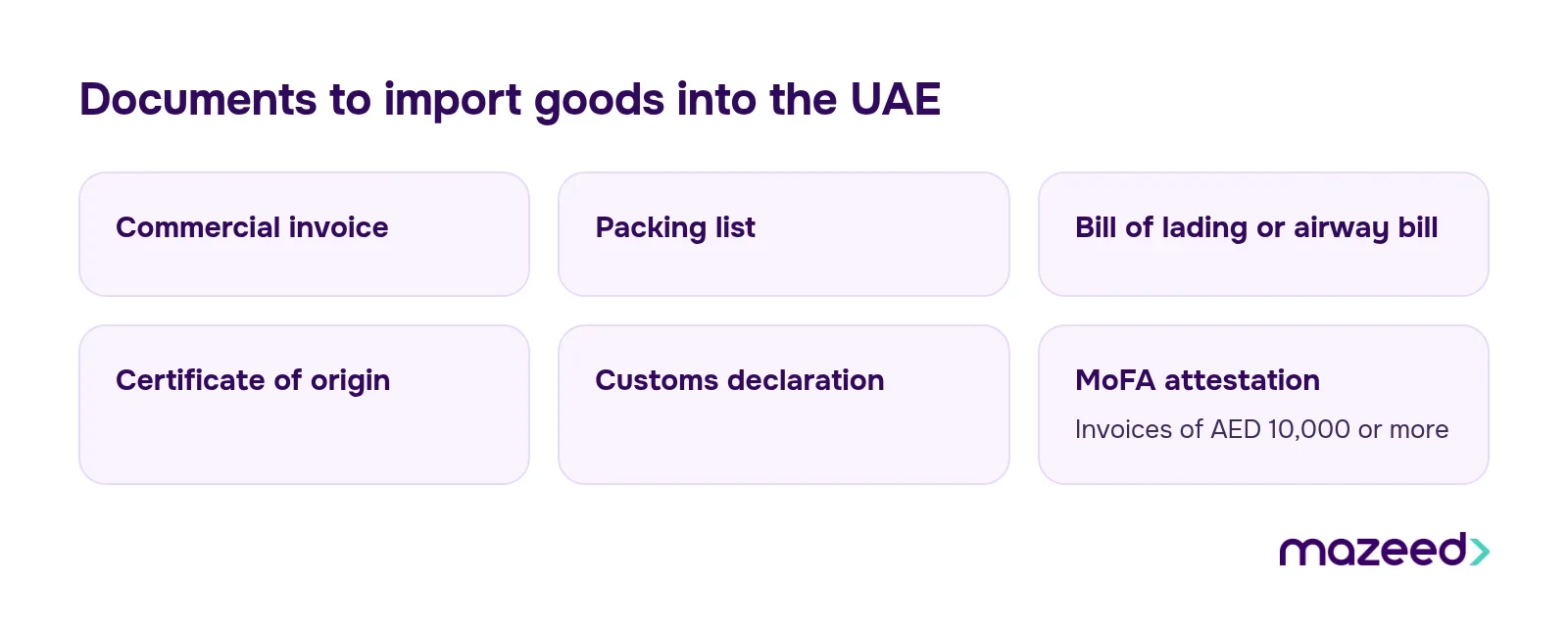
Keep the commercial invoice consistent with the packing list, bill of lading or airway bill, and certificate of origin. Mismatches are the most common cause of clearance delays.
Does a commercial invoice need attestation in the UAE?
For imports, usually yes. Under Cabinet Resolution No. 38 of 2022, commercial invoices for goods imported into the UAE with a value of AED 10,000 or more must be attested electronically by the Ministry of Foreign Affairs through its eDAS service. The published fee is AED 150 per invoice. The attestation is done after the customs declaration, and a further fine applies if it is not completed within the grace period, so build it into your import routine rather than leaving it to the end of the month.
Invoices below AED 10,000 are outside the requirement, and some categories of shipments are exempt. Always check the current rules on the Ministry of Foreign Affairs eDAS service before relying on an exemption.
Commercial invoice vs tax invoice vs proforma invoice
| Commercial invoice | UAE tax invoice | Proforma invoice | |
|---|---|---|---|
| Main purpose | Customs clearance and international trade | Record a taxable supply for UAE VAT | Confirm terms and request approval or payment before a sale |
| Legal basis | Customs legislation and trade practice | VAT Decree-Law and Article 59 of the VAT Executive Regulation | None; a commercial document |
| When issued | When goods are shipped internationally | Within 14 days of the date of supply | Before the supply |
| Shows VAT | Not necessarily | Yes, with TRNs and VAT amounts in AED | Often as an estimate |
| Lets the buyer recover input VAT | No | Yes | No |
For domestic sales between UAE businesses, you need a tax invoice, not a commercial invoice; see the full field list in our guide to the UAE tax invoice format. A proforma invoice usually comes first in an export deal and the commercial invoice follows once the goods ship.
How do commercial invoices work for UAE exports and VAT?
Exports of goods from the UAE are generally zero-rated for VAT, provided the exporter keeps official and commercial evidence that the goods left the country within the period set by the VAT Executive Regulation. The commercial invoice is part of the commercial evidence, alongside the bill of lading or airway bill and the exit customs declaration. Read more in our guide to zero-rated supplies in the UAE.
A VAT-registered exporter still has invoicing obligations for the zero-rated supply. In practice, many exporters issue one document that serves as both commercial invoice and tax invoice by including the tax invoice particulars from Article 59 of the VAT Executive Regulation: the words "Tax Invoice", the supplier's TRN, a sequential number, and the VAT rate and amount (zero) in AED.
What about e-invoicing?
Under the Ministry of Finance e-invoicing guidelines, export invoices from businesses in scope go through the Electronic Invoicing System once the business is live. If the foreign buyer has no Peppol ID, the supplier uses the predefined address 0235:9900000099; our guide to the Peppol ID explains how this works. The commercial invoice for customs is still needed alongside it.
Worked example: an import into Dubai
A Dubai electronics retailer imports 200 tablets from a supplier in Shenzhen at USD 180 each, on CIF Jebel Ali terms.
| Item | Amount |
|---|---|
| Invoice value | USD 36,000 |
| Approximate value in AED (at 3.6725) | AED 132,210 |
| MoFA attestation needed? | Yes, the value is above AED 10,000 |
| Customs duty at 5% of CIF value | AED 6,610.50 |
| Import VAT at 5% of (CIF value + duty) | AED 6,941.03 |
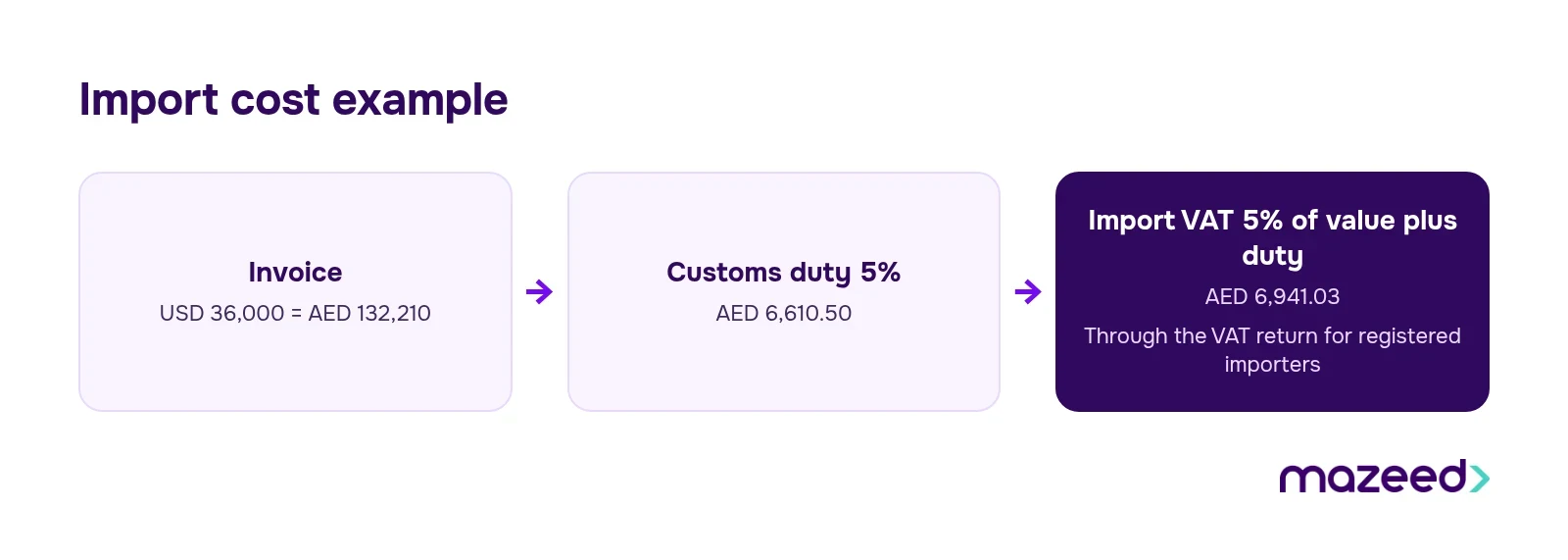
The retailer files the customs declaration with the commercial invoice, packing list, bill of lading and certificate of origin, attests the invoice through eDAS, and pays duty. If it is VAT-registered, it accounts for import VAT through its VAT return under the reverse charge, so it usually does not pay the VAT in cash at the border.
Common commercial invoice mistakes
- Vague descriptions such as "electronics" or "spare parts" instead of model and material details.
- Wrong or missing HS codes, which lead to the wrong duty rate or a customs query.
- Values that do not match the payment, which can trigger a valuation review.
- Missing Incoterms, leaving customs unsure whether freight and insurance are included.
- Forgetting attestation for imports of AED 10,000 or more.
- Treating it as a tax invoice for a local sale.
How mazeed helps
With mazeed's invoicing software, you can issue export invoices that carry both the trade details customs needs and the tax invoice particulars the FTA requires, with multi-currency amounts and the AED VAT figure calculated automatically. Pair it with a delivery note template for the goods themselves.
This article is general information based on rules in force on 16 November 2026. Customs requirements vary by emirate and goods; confirm with your customs broker or freight forwarder before shipping.