

Management accounts are internal financial reports prepared, usually every month, to help owners and managers run the business. A typical pack includes a profit and loss statement compared with budget, a balance sheet, a cash flow summary or forecast, key performance indicators and short commentary explaining what changed. Unlike statutory financial statements, they have no fixed legal format and are not filed with any authority; their only job is to support better and faster decisions.
Management accounts vs financial statements
| Management accounts | Statutory financial statements | |
|---|---|---|
| Audience | Owners, managers, sometimes lenders | Shareholders, auditors, the FTA, banks, regulators |
| Frequency | Monthly or quarterly | Annually |
| Format | Whatever helps decisions | IFRS or IFRS for SMEs |
| Audit | Not audited | Audited where required |
| Content | Detailed by product, branch or project; includes budgets and forecasts | Summarised; historical only |
| Deadline | Days after month end | Months after year end |
In the UAE, Ministerial Decision No. 114 of 2023 sets IFRS (or IFRS for SMEs for revenue up to AED 50 million) for financial statements used for Corporate Tax, and Ministerial Decision No. 82 of 2023 requires audited financial statements for businesses with revenue above AED 50 million and for qualifying free zone persons. Management accounts are separate from these, but if they are built from the same ledger and closed properly each month, the year-end statements become mostly a formality.
What should a monthly management accounts pack include?
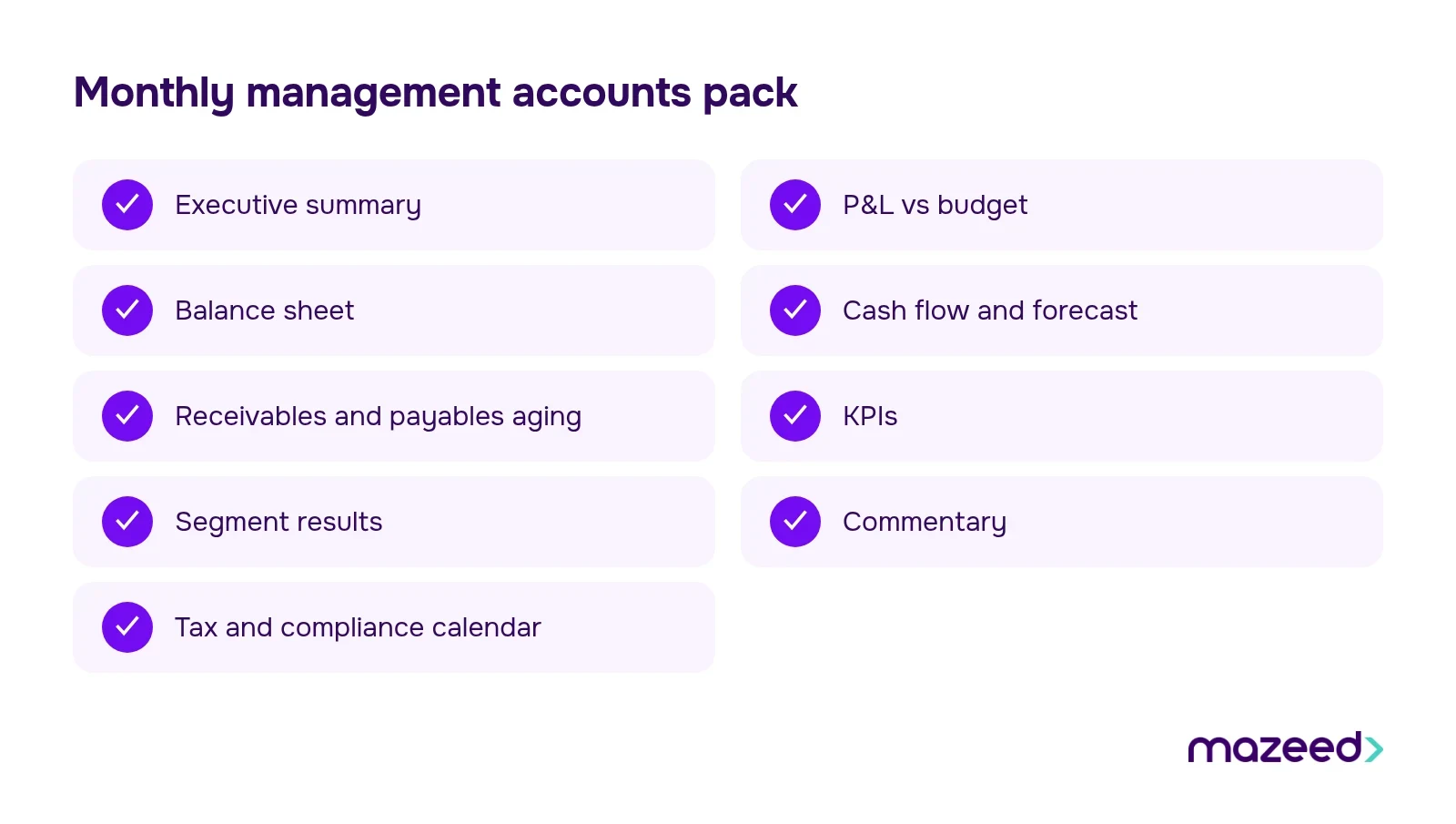
- Executive summary. Five or six bullet points: revenue, gross margin, net profit, cash and any issue needing a decision.
- Profit and loss vs budget and last year. For the month and year to date, with variances in AED and %. A budget vs actual report is the backbone of this page, built from your profit and loss statement.
- Balance sheet. Current month against last month, highlighting movements in cash, receivables, inventory and payables.
- Cash flow and forecast. Where cash came from and went, and the 13-week outlook; see our guide to the cash flow forecast.
- Receivables and payables aging. Top overdue customers and upcoming supplier payments, taken from the aging report.
- KPIs. The handful of measures that drive your business.
- Segment reporting. Results by branch, product line, project or salesperson, where relevant.
- Commentary. What happened, why, and what the team will do about it.
- Tax and compliance calendar. Upcoming VAT returns, Corporate Tax dates, licence renewals and, from your go-live date, e-invoicing exceptions.
Sample KPI dashboard
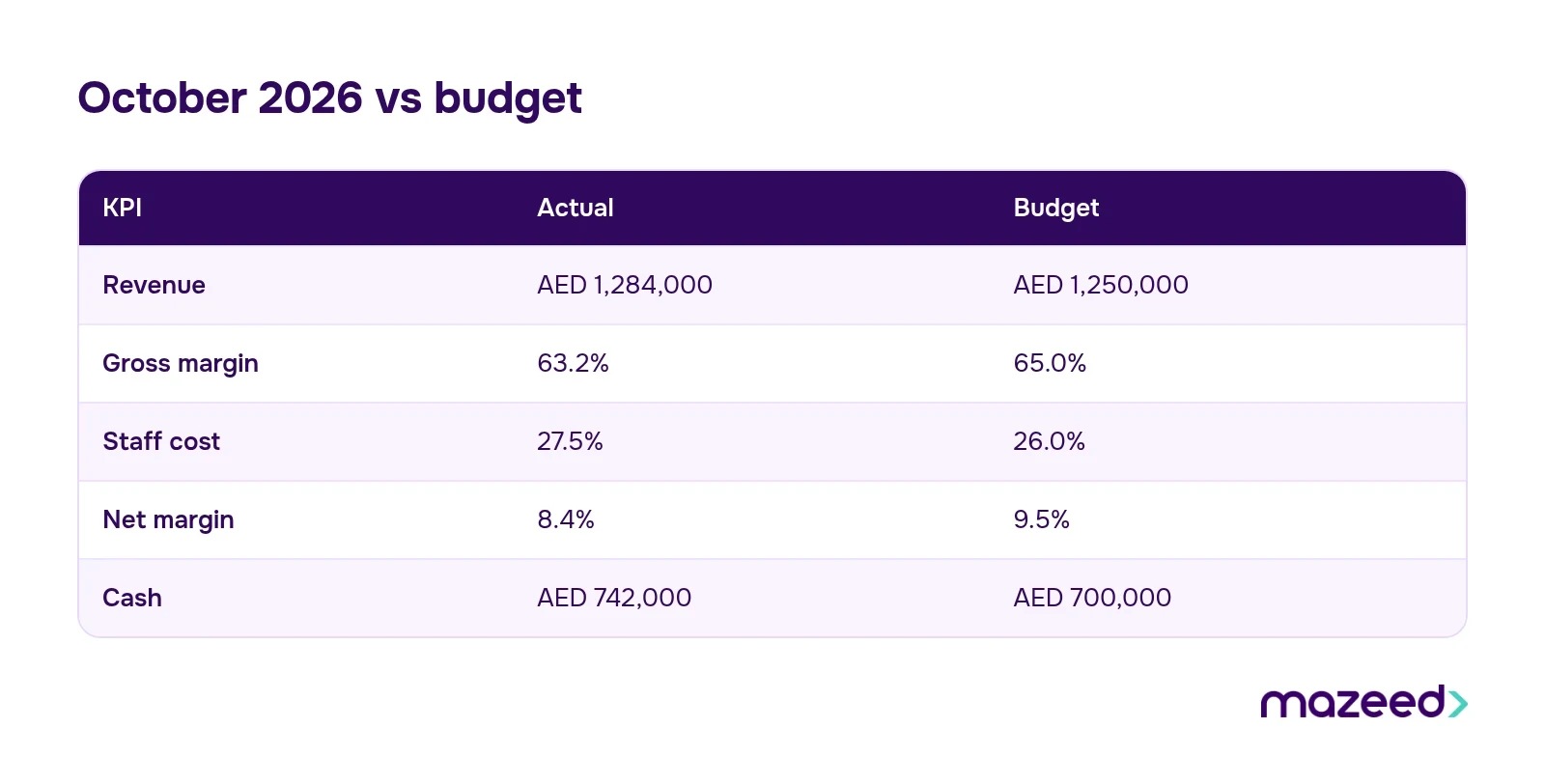
A Dubai F&B group with three outlets reports these KPIs for October 2026:
| KPI | October | Budget | Last year | Comment |
|---|---|---|---|---|
| Revenue (AED) | 1,284,000 | 1,250,000 | 1,108,000 | New outlet ahead of plan |
| Gross margin | 63.2% | 65.0% | 64.8% | Higher dairy and meat prices |
| Staff cost as % of revenue | 27.5% | 26.0% | 28.1% | Overtime at the new outlet |
| Net profit margin | 8.4% | 9.5% | 7.9% | Margin squeeze offset by volume |
| Cash at bank (AED) | 742,000 | 700,000 | 515,000 | Healthy |
| Days payables outstanding | 41 | 45 | 38 | Paying suppliers slightly faster |
| Average spend per cover (AED) | 118 | 115 | 112 | Menu price change effective |
The commentary would focus on one decision: whether to renegotiate supplier prices or adjust the menu to recover the 1.8-point margin gap. That is the difference between management accounts and a set of numbers.
How to prepare management accounts, step by step
- Close the books. Post all transactions, reconcile bank accounts, and post accruals, prepayments, depreciation and the end of service provision.
- Run the adjusted trial balance and check control accounts.
- Map accounts to the report lines your managers care about, by department or location.
- Compare with budget and last year, and calculate KPIs.
- Investigate big variances. Talk to the managers who own them.
- Write the commentary. Lead with what matters most, in plain language.
- Review and send on a fixed day each month.
A realistic 10-working-day calendar
| Working day | Task | Owner |
|---|---|---|
| 1 to 2 | Cut-off: last sales invoices, supplier bills and expense claims posted | Accounts team |
| 3 | Bank reconciliations; receivables and payables aging reviewed | Accounts team |
| 4 to 5 | Accruals, prepayments, depreciation, end of service provision, inventory adjustments | Senior accountant |
| 6 | Adjusted trial balance; control accounts and VAT accounts reconciled | Senior accountant |
| 7 | Report pack generated; KPIs calculated | Finance manager |
| 8 | Variance questions sent to department heads | Finance manager |
| 9 | Commentary written; pack reviewed | Finance manager or CFO |
| 10 | Pack sent and discussed with the owners | CFO |
If your accounting system posts invoices, bills and bank transactions in real time, days 1 to 3 shrink to a few hours, and the pack can be ready within a week.
Inventory-heavy businesses often add a stock analysis; an ABC analysis highlights the items that tie up the most cash.
Why management accounts matter for UAE businesses
- Faster decisions. Spotting a margin drop in October beats discovering it in the audit next June.
- Better financing. UAE banks often ask for recent management accounts, not just last year's audited statements, when reviewing facilities.
- Smoother Corporate Tax. Monthly closes mean tax adjustments, such as the 50% limit on client entertainment, are tracked as they happen.
- Cleaner VAT. Monthly reconciliations catch VAT errors before a return is filed.
- Investor confidence. Partners and investors expect regular, reliable reporting.
Common management accounts mistakes
- Too late to be useful. A pack that arrives six weeks after month end gets read once, if at all.
- Too long. Forty pages of tables hide the three numbers that matter.
- No budget. Without a target, a number is just a number.
- Cash basis by accident. Missing accruals make some months look great and others terrible.
- No owner for actions. Every issue in the commentary needs a name and a date.
Should you prepare them in-house or outsource?
Small teams often struggle to close the books and analyse them every month. Outsourcing the close and the reporting pack to a finance team that does it daily is often cheaper than hiring a senior accountant; our guide on why to outsource accounting covers the trade-offs.
Which KPIs should your business track?
The right KPIs depend on how your business makes money. Pick four to six from the list for your sector and track them every month against budget and last year.
| Business type | KPIs worth tracking |
|---|---|
| Trading and distribution | Gross margin by product line, inventory days, days sales outstanding, top 10 customer concentration |
| Professional services | Billable utilisation, revenue per employee, work in progress not yet invoiced, days sales outstanding |
| Restaurants and F&B | Food cost %, staff cost %, average spend per cover, revenue per outlet |
| Construction and contracting | Project margin against estimate, retention receivable, certified but unpaid claims, cash cover in months |
| E-commerce | Customer acquisition cost, average order value, return rate, contribution margin after delivery |
Whatever the sector, always include cash at bank and a short cash outlook. A business can hit every profit target and still struggle if collections slow down.
How mazeed helps
If you want management accounts without building the pack yourself, our CFO services in Dubai team closes your books, prepares a monthly pack with KPIs and commentary, and walks you through it. If you prefer to do it in-house, mazeed's management accounting software produces P&L, balance sheet and budget comparisons by branch or department straight from your ledger.
This article is general information. It is not accounting, tax or legal advice; for your specific case, speak to a qualified adviser.