
A cash flow forecast estimates how much cash will come into and go out of your business over a future period, usually week by week for the next 13 weeks or month by month for the next 12 months. It starts from today's bank balance, adds expected receipts, deducts expected payments, and shows the closing balance for each period. Its job is simple: to warn you about a cash shortfall early enough to do something about it.
Cash flow forecast vs cash flow statement
| Cash flow forecast | Cash flow statement | |
|---|---|---|
| Time direction | Future | Past |
| Purpose | Plan and avoid shortfalls | Report how cash moved |
| Format | Flexible, usually receipts and payments | Set by accounting standards: operating, investing and financing activities |
| Audience | Management, lenders | Shareholders, auditors, lenders |
| Frequency | Weekly or monthly | With the financial statements |
If you need the backward-looking report, read our guide to what a cash flow statement is.
Why do profitable UAE businesses still run out of cash?
Profit and cash are not the same thing. A company can show a healthy profit and loss statement while its bank balance falls, for reasons that are common in the UAE:
- Long payment cycles. Large customers and government-linked entities often pay in 60 to 120 days.
- Post-dated cheques. A cheque received today may not be cashable for months.
- Lumpy rent. Office and warehouse rent is often paid in one to four cheques a year, not monthly.
- Inventory build-up. Cash is tied up in stock before the sale happens.
- Tax timing. VAT collected from customers must be paid over after each tax period, and Corporate Tax becomes payable after the year end.
- Annual renewals. Trade licence, visas, insurance and Emirates ID costs often fall in the same month.
A forecast makes all of these visible in one place.
How to build a 13-week cash flow forecast
- Start with today's cash. Use the reconciled bank balance across all accounts.
- List expected receipts by week. Use your customer aging report and each customer's real payment habits. If a customer usually pays 20 days late, forecast it 20 days late.
- Add post-dated cheques in the week they become cashable, not the week you received them. Our guide to PDC journal entries explains how to record them.
- List fixed payments. Salaries through WPS, rent cheques, loan instalments, subscriptions.
- List variable payments. Supplier bills based on their due dates and your purchase plans.
- Add tax payments. VAT for the quarter that ends, and Corporate Tax when it falls due.
- Add one-offs. Licence renewals, visa costs, equipment, gratuity for leavers, dividends.
- Calculate the closing balance for each week: opening cash plus receipts minus payments.
- Set a minimum cash buffer, for example one month of fixed costs, and highlight any week that falls below it.
- Update weekly. Replace forecast numbers with actuals and roll the forecast forward one week.
Example: a 13-week forecast, summarised by month
A Dubai facilities management company with monthly fixed costs of about AED 420,000 builds a forecast on 1 January 2027, in AED.
| January | February | March | |
|---|---|---|---|
| Opening cash | 610,000 | 384,000 | 452,000 |
| Customer receipts | 520,000 | 640,000 | 590,000 |
| PDCs maturing | 60,000 | 0 | 120,000 |
| Total receipts | 580,000 | 640,000 | 710,000 |
| Salaries (WPS) | (310,000) | (310,000) | (310,000) |
| Suppliers | (148,000) | (162,000) | (155,000) |
| Rent cheque (quarterly) | (95,000) | 0 | 0 |
| VAT for October to December quarter | (68,000) | 0 | 0 |
| Trade licence and visa renewals | (85,000) | 0 | 0 |
| End of service payout | (50,000) | 0 | 0 |
| Other operating costs | (50,000) | (100,000) | (40,000) |
| Total payments | (806,000) | (572,000) | (505,000) |
| Closing cash | 384,000 | 452,000 | 657,000 |
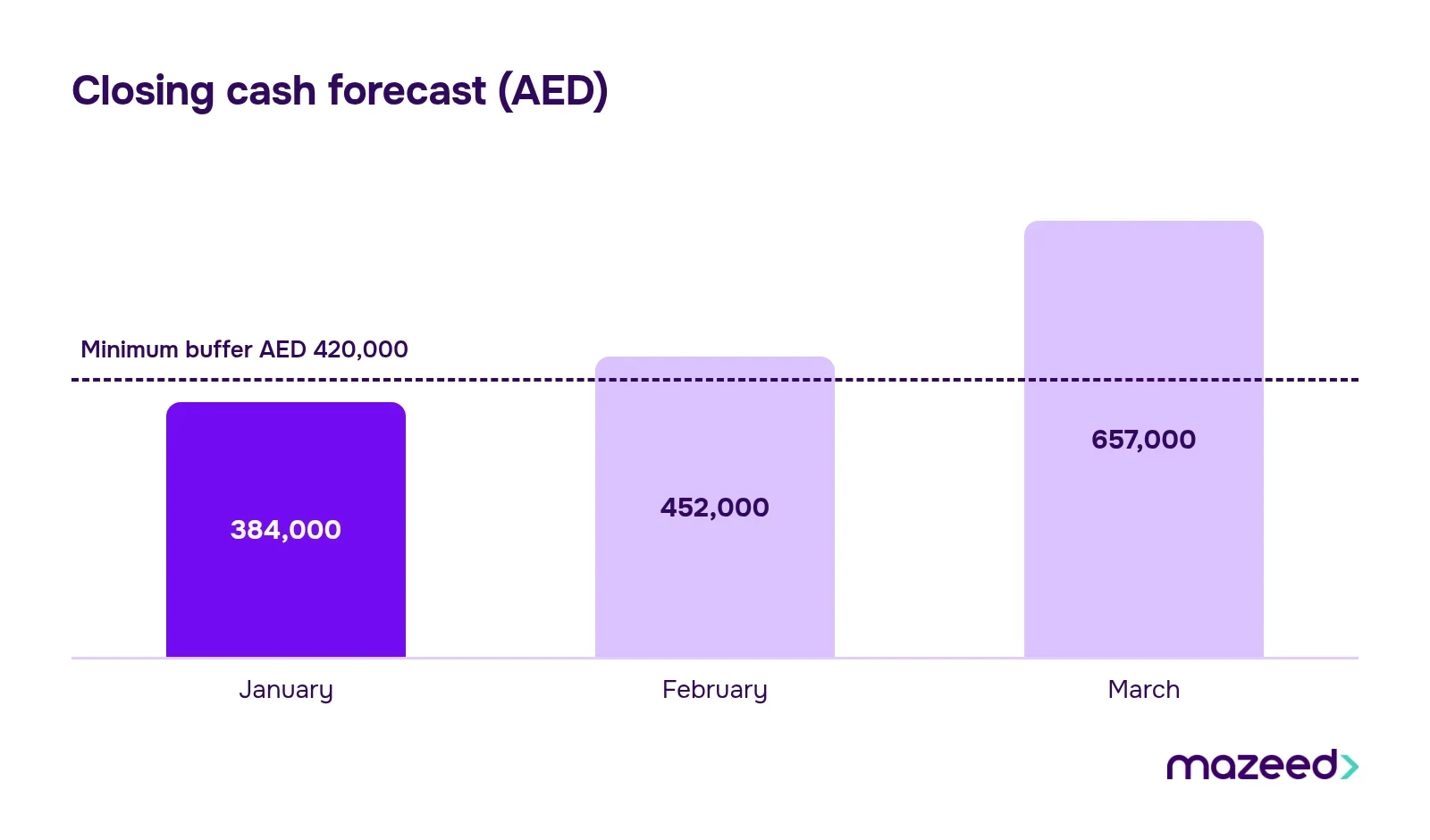
The forecast shows January dipping below the company's AED 420,000 buffer because the rent cheque, the VAT payment, licence renewals and a gratuity payout all land in the same month. Knowing this in December, the finance team can chase two large receivables early, ask the landlord to move the cheque date, or arrange a short-term facility, instead of discovering the problem when a cheque bounces.
Plan for more than one outcome
A single forecast hides risk. Run three versions of the same model by changing only a few assumptions:
| Scenario | Typical assumptions | What it tells you |
|---|---|---|
| Base case | Customers pay as they usually do; costs as budgeted | Your expected cash position |
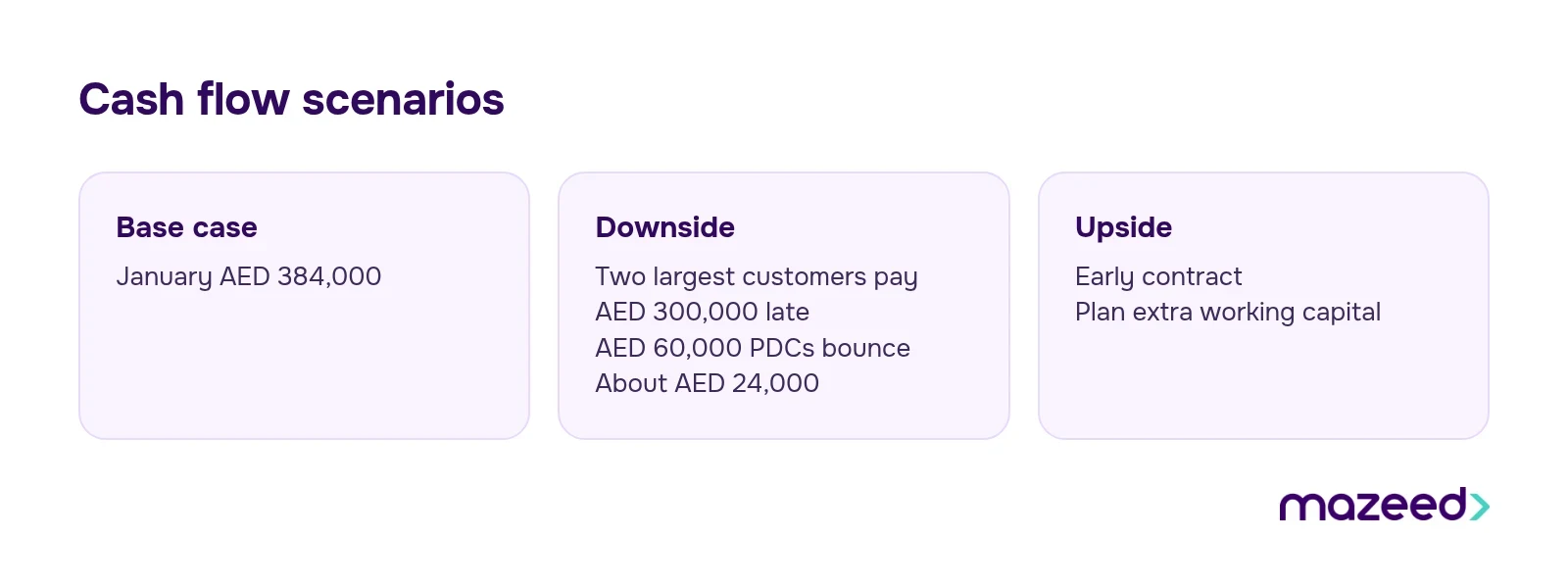
| Downside case | Your two largest customers pay 30 days late; one PDC bounces; sales 15% lower | How long your cash lasts under pressure, and when to act |
| Upside case | A large contract starts early; collections improve | Whether you need extra working capital to fund growth |
In the facilities management example, if the two largest customers paid AED 300,000 a month late and the January PDCs bounced, January would close near AED 24,000. That single insight justifies agreeing an overdraft or invoice finance line in advance, when the bank sees a well-run business, rather than in a hurry when cash is already short.
UAE tax dates to put in every forecast
| Tax | When cash leaves | Source |
|---|---|---|
| VAT | With the VAT return, by the 28th day after the end of each tax period (usually quarterly or monthly) | VAT Decree-Law and its Executive Regulation |
| Corporate Tax | With the Corporate Tax return, within nine months after the end of the tax period | Corporate Tax Law (Federal Decree-Law No. 47 of 2022) |
| Import VAT | Through the VAT return for registered importers; at the border for others | VAT legislation and customs rules |
For a company with a calendar year end, Corporate Tax for 2026 is due by 30 September 2027. It is easy to forget a payment that far out, so add it to the 12-month forecast as soon as the year closes. Read more in our guide to UAE Corporate Tax.
Direct and indirect forecasting methods
- Direct method: forecast actual receipts and payments line by line, as in the example. Best for the short term because it reflects real timing.
- Indirect method: start from forecast profit and adjust for non-cash items and working capital changes. Best for 12-month planning and lender models, because it links to the budgeted P&L and balance sheet.
Many finance teams use the direct method for the next 13 weeks and the indirect method beyond that.
How to make the forecast accurate
- Measure forecast accuracy weekly. Compare forecast and actual receipts. If you keep overestimating, adjust your assumptions.
- Forecast customers individually if a few customers make up most of your revenue.
- Be conservative with receipts and complete with payments. Surprises should be positive.
- Link to your budget. A budget vs actual report explains why the 12-month forecast moved.
- Share it. A forecast nobody reads does not prevent a shortfall. Include it in your monthly management accounts.
How mazeed helps
A forecast is only as good as the data behind it. mazeed keeps receivables, payables, bank balances and tax liabilities up to date in one place, which is the raw material for an accurate forecast. If you would rather have an expert build and run it, our CFO services in Dubai team prepares 13-week and 12-month forecasts, reviews them with you each month, and helps arrange financing before a gap opens.
This article is general information. It is not financial, tax or legal advice; for your specific case, speak to a qualified adviser.