
Every VAT-registered business in the UAE must file a periodic VAT return with the Federal Tax Authority (FTA) — quarterly for most businesses, monthly for those with turnover above AED 150 million. The return is due 28 days after the end of your tax period, and late submission carries a penalty.
This guide covers the seven steps to filing correctly, how to choose a payment method, the accuracy checks worth running before you submit, and the mistakes that cause most filing problems.
Understanding VAT in the UAE
Value Added Tax is a consumption tax applied at each stage of the supply chain. Businesses collect it on sales (output VAT) and pay it on purchases (input VAT), then report the difference to the FTA.
Three things determine your filing obligations:
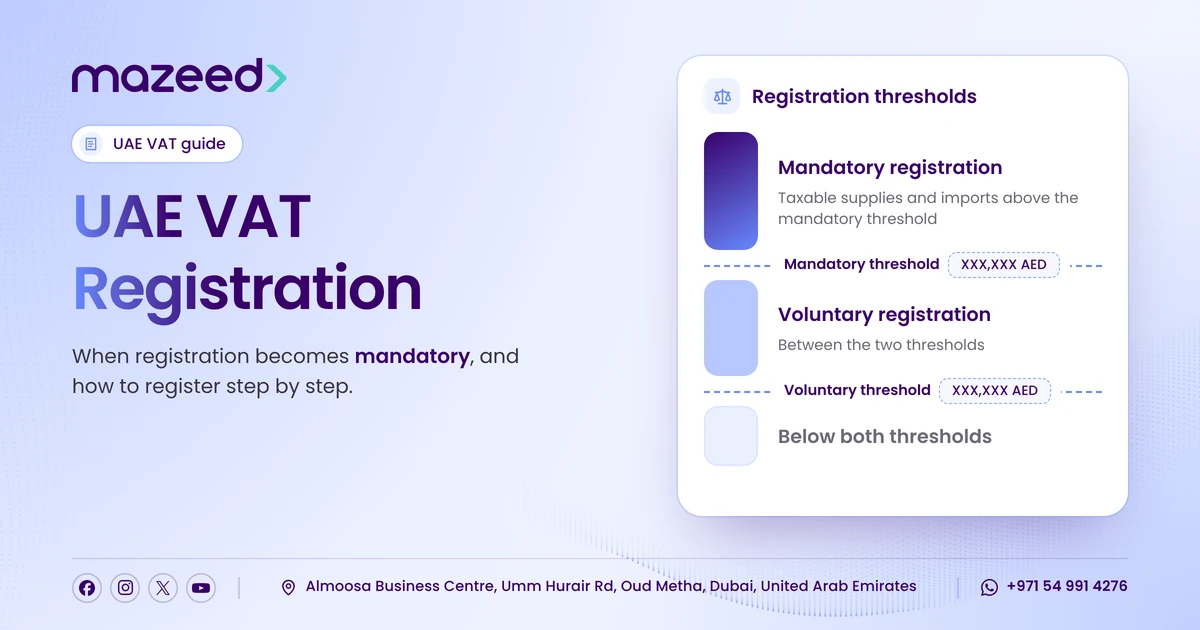
- Your registration status — registration is mandatory above AED 375,000 in annual taxable supplies, and voluntary from AED 187,500
- Your tax period — quarterly or monthly, assigned by the FTA based on turnover
- Your TRN — your Tax Registration Number must be active and your business details current before you file
Read more: What is a TRN in the UAE? · How to Register for VAT in the UAE
How to File a VAT Return in the UAE: 7 Steps
The process runs entirely through the FTA’s e-Services portal using the VAT201 form.
1. Gather your documentation
Before you start, collect:
- Sales and purchase invoices for the period
- Expense receipts and bank statements
- Detailed records of input and output VAT
- Import and export documentation, where applicable
2. Verify your VAT registration
Run a TRN check on the FTA portal to confirm your registration number is active and your business details are current. A lapsed or incorrect TRN will block the filing.
3. Confirm your filing date
Your tax period determines the deadline. The return and any payment are both due 28 days after the period ends.
| Annual Turnover | Tax Period | Filing Deadline |
|---|---|---|
| Above AED 150 million | Monthly | 28 days after month end |
| Below AED 150 million | Quarterly | 28 days after quarter end |
Put the dates in a shared calendar with a named owner. Missed deadlines are almost never a knowledge problem — they are an ownership problem.
4. Calculate your VAT liability
Subtract the input VAT on your purchases from the output VAT collected on sales. A positive figure is payable to the FTA; a negative figure carries forward or can be claimed as a refund.
Read more: UAE VAT Calculation: A Step-by-Step Guide · Input VAT and Output VAT Explained
5. Choose your payment method
| Method | Best For | Consideration |
|---|---|---|
| Online portal (e-Dirham / card) | Quick, one-off payments | Fastest to clear |
| Bank transfer via GIBAN | Larger amounts | Secure but may take longer to reflect |
| Direct debit | Businesses with recurring liabilities | Removes the risk of forgetting |
Whichever you choose, allow time for the payment to clear before the deadline — the obligation is met when the FTA receives the funds, not when you initiate the transfer.
6. Submit the VAT201 form
Log into the FTA portal and complete every field. The form requires your taxable supplies, exempt supplies, recoverable input VAT, and any adjustments for prior-period corrections.
7. Keep the confirmation
After submission, check your email and the portal for confirmation. This is your proof of filing — retain it alongside your supporting records for the period required by the FTA.
Use mazeed: The Fastest Way to Create and File Your VAT Return
Accuracy Checks Before You Submit
Most filing problems are caught in review rather than discovered by the FTA. Run these checks every period:
- TRN verification — confirm your registration number is active and your business details are current
- Invoice completeness — every input VAT claim needs a valid tax invoice showing the supplier’s TRN behind it
- Figure matching — total your input VAT against purchase invoices, and output VAT against sales records
- Date cross-reference — confirm transactions fall inside the correct tax period, not the one either side of it
- Adjustment review — check any corrections from prior periods are entered in the right box
Read more: VAT Audit Report in UAE
Common Filing Challenges and How to Handle Them
| Challenge | What Goes Wrong | How to Handle It |
|---|---|---|
| Complex VAT calculations | Mixing standard-rated, zero-rated and exempt supplies in one return without separating them correctly | Split the VAT treatment at line level in your accounting system, so the return is built from data rather than reconstructed |
| Missed deadlines | The return or payment slips past the 28-day window | A shared calendar with a named owner and a reminder two weeks out. Filing and payment carry separate penalties |
| Errors in the VAT201 form | Figures entered in the wrong box, or adjustments omitted | A second-person review before submission. Errors found before filing are adjustments; found after, they are corrections |
| Incomplete records | Input VAT claimed without a valid supporting tax invoice | Reconcile monthly rather than at filing time — the backlog is what makes errors expensive |
Best Practices for Smooth VAT Compliance
Data accuracy
- Keep financial data current rather than catching up at period end
- Reconcile accounts against invoices and receipts regularly
- Treat accurate records as the foundation — everything downstream depends on them
Technology integration
- Use accounting software that integrates with the FTA’s e-portal
- Automation reduces manual entry error, which is the most common source of filing mistakes
- Digital record-keeping makes an FTA review a retrieval exercise rather than a reconstruction
Staff training
- Train your finance team on current FTA guidelines, not the version from when they joined
- Make sure more than one person understands the filing process
- Refresh training when regulations change — not annually by default
What If You’ve Overpaid VAT?
If your input VAT exceeds your output VAT for the period, you are in a refund position. You can either carry the balance forward against future output VAT, or apply to the FTA for a refund through the portal.
The refund process is separate from your regular filing and has its own requirements. See our guide to claiming a VAT refund in the UAE for the full process.
Where VAT Compliance Is Heading
The filing landscape is changing as the FTA expands its digital infrastructure:
- Increased automation in return preparation and submission
- AI-assisted data validation to catch errors before submission rather than after
- Enhanced FTA portal functionality for the VAT201 form
- E-invoicing — the UAE is phasing in mandatory structured electronic invoicing, which will change how transaction data reaches the FTA. See the e-invoicing implementation timeline
Businesses already on a connected accounting platform will find these changes largely invisible. Those still filing from spreadsheets will feel each one.
Filing a VAT return in the UAE is a routine process once your records are in order. The difficulty is almost never the form itself — it is whether the underlying data is accurate and whether someone owns the deadline.
Get those two things right and the return takes minutes. Get them wrong and every filing becomes a reconstruction exercise under time pressure.
Disclaimer: This publication is for informational purposes only and should not be considered professional or legal advice. While we strive for accuracy, we make no guarantees regarding completeness or applicability. mazeed, its members, employees, and agents do not accept or assume any liability, responsibility, or duty of care for any actions taken or decisions made based on this content. For official guidance, please refer to the UAE Ministry of Finance and the Federal Tax Authority