

Accrual for expenses means recording a cost in the period you incur it, even when the invoice has not arrived and no payment has left your account. You debit the expense and record an accrued expenses liability, then reverse or settle it next period. This keeps your profit and loss accurate.
This guide covers the expense side only. For the income side, see our guide to accrued income journal entries.
What should a month-end accrual checklist for UAE SMEs include?
- Review last month's accruals and confirm each one was reversed Review last month's accruals and confirm each one was reversed.
- List recurring suppliers List recurring suppliers: utilities, rent, telecom, payroll, professional fees and contractors.
- Check which invoices for the month have not arrived Check which invoices for the month have not arrived.
- Estimate each unbilled amount using a contract, meter reading, timesheet or recent bill Estimate each unbilled amount using a contract, meter reading, timesheet or recent bill.
- Post Dr Expense, Cr Accrued expenses for each item, net of VAT Post Dr Expense, Cr Accrued expenses for each item, net of VAT.
- Schedule the reversal for the first day of the next month Schedule the reversal for the first day of the next month.
- Keep supporting documents for each estimate with your accounting records Keep supporting documents for each estimate with your accounting records.
- Compare estimates with actual invoices next month and refine your method Compare estimates with actual invoices next month and refine your method.
What is accrual for expenses?
Accrual for expenses is the practice of recording a cost in the month you used the goods or services, before you receive the supplier's invoice. The amount owed sits in a liability account called accrued expenses until the invoice arrives and is paid.
This follows the matching principle. Costs are recorded in the same period as the revenue they help earn. If your office used electricity in December, that cost belongs in December's results, even if the bill arrives in January.
What is the difference between accrual basis and cash basis?
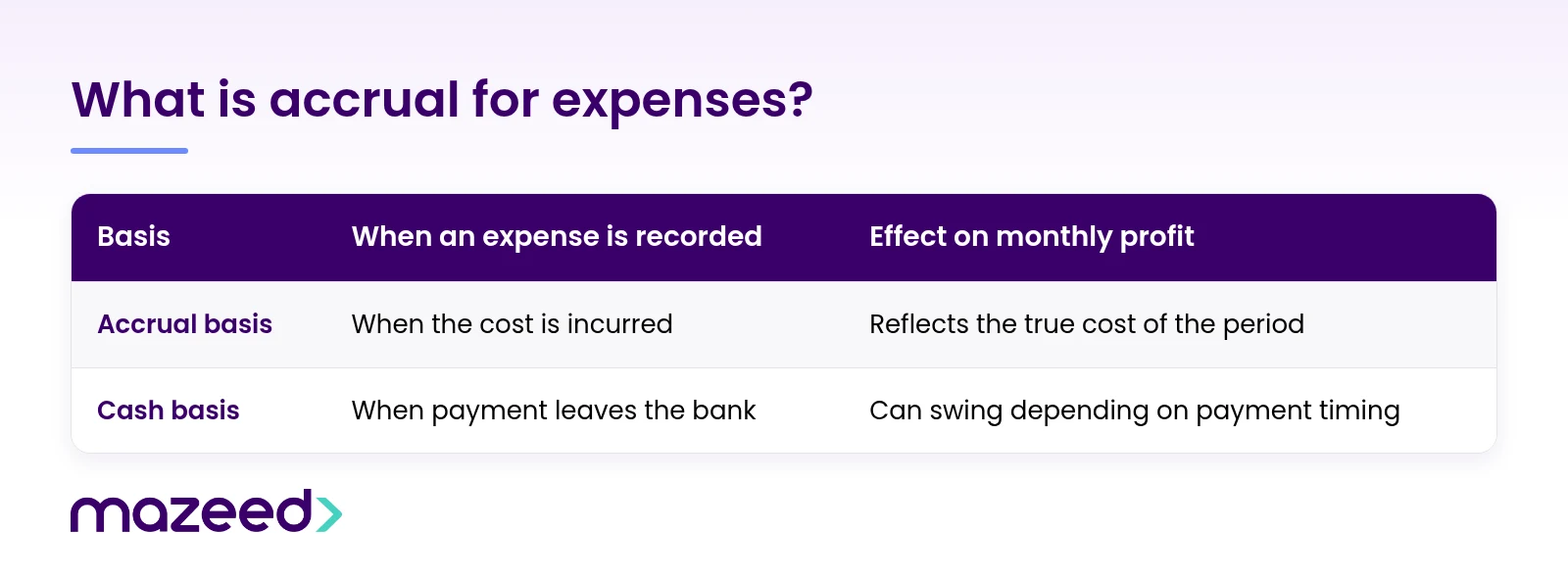
Under the accrual basis, income and expenses are recorded when they are earned or incurred. Under the cash basis, they are recorded only when cash is received or paid.
| Basis | When an expense is recorded | Effect on monthly profit |
|---|---|---|
| Accrual basis | When the cost is incurred | Reflects the true cost of the period |
| Cash basis | When payment leaves the bank | Can swing depending on payment timing |
Why do UAE businesses need to accrue expenses?
Accruals give you an accurate monthly profit, make your books ready for audit, and support correct tax reporting. Without them, a month with late bills looks more profitable than it really was.
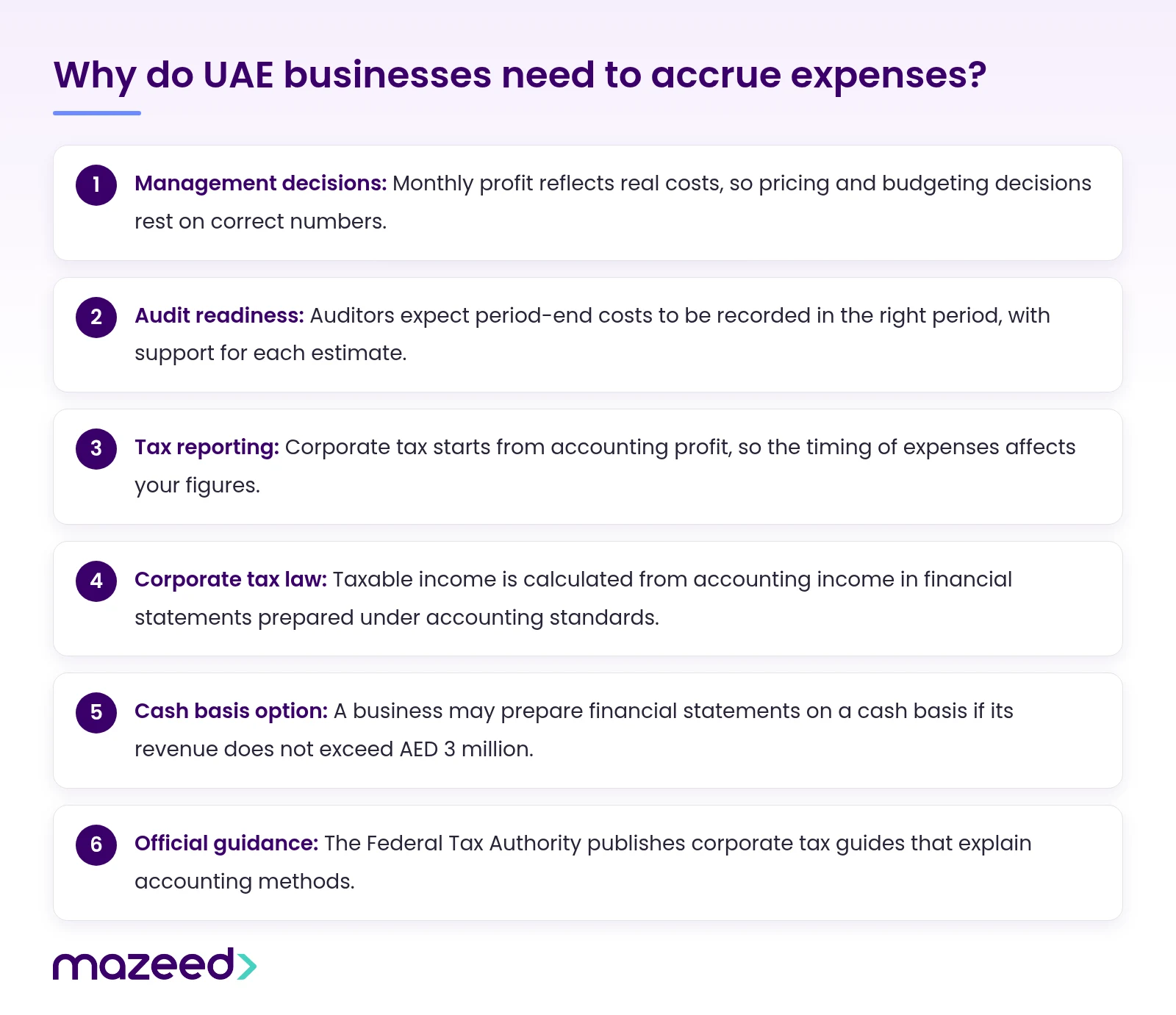
Accurate accruals help in three practical ways:
- Management decisions: Monthly profit reflects real costs, so pricing and budgeting decisions rest on correct numbers.
- Audit readiness: Auditors expect period-end costs to be recorded in the right period, with support for each estimate.
- Tax reporting: Corporate tax starts from accounting profit, so the timing of expenses affects your figures (see below).
If you prefer to have a team handle month-end closing, mazeed offers accounting and bookkeeping services for UAE businesses that include accruals and reversals.
Is accrual accounting required in the UAE?
For corporate tax, accrual basis is the general rule, with a cash basis option for smaller businesses that meet set conditions. Confirm your position against the official rules before choosing a method.
- Corporate tax law: Taxable income is calculated from accounting income in financial statements prepared under accounting standards accepted in the UAE, under Federal Decree-Law No. 47 of 2022 on the Taxation of Corporations and Businesses.
- Cash basis option: A business may prepare financial statements on a cash basis if its revenue does not exceed AED 3 million (as of November 2026), or in exceptional circumstances approved by the Federal Tax Authority.
- Official guidance: The Federal Tax Authority publishes corporate tax guides that explain accounting methods.
Even if you qualify for the cash basis, many businesses still accrue expenses for management reporting, because it shows the real cost of each month.
What is the journal entry for accrued expenses?
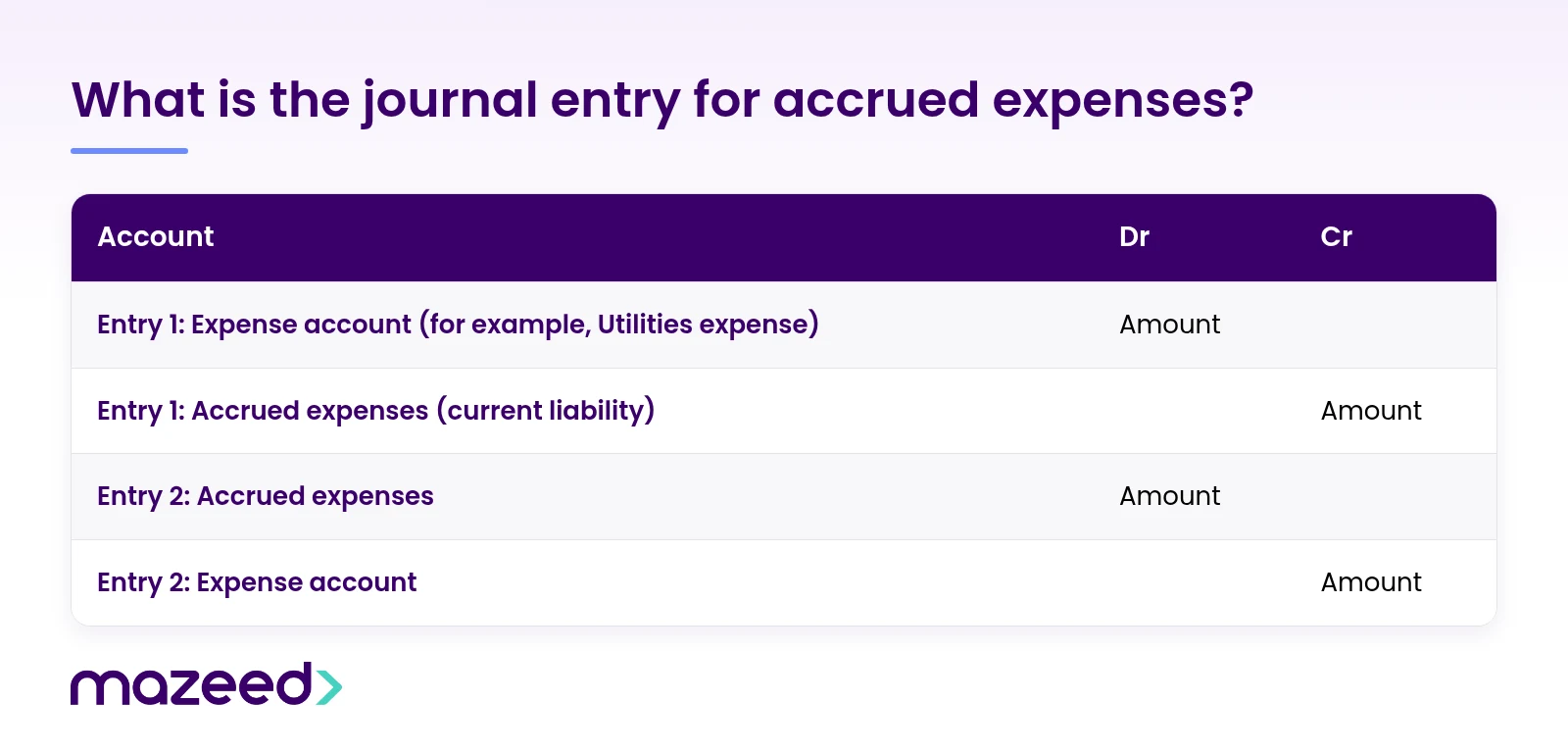
The journal entry for an accrued expense is Dr Expense and Cr Accrued expenses. You post it at period end, reverse it on the first day of the next period, and then record the actual invoice when it arrives.
"Dr" and "Cr" are standard bookkeeping notation for the two sides of a ledger entry. These entries post to your accounts in the general ledger, where every transaction is recorded. If you need an account code for accrued expenses, use the current liabilities range in your chart of accounts for UAE businesses.
What entry do you post when the period ends?
At period end, record the estimated cost as an expense and as a liability. Base the estimate on a meter reading, contract, timesheet or the previous bill.
| Account | Dr | Cr |
|---|---|---|
| Expense account (for example, Utilities expense) | Amount | |
| Accrued expenses (current liability) | Amount |
What is a reversal entry and when do you post it?
A reversal entry is the exact opposite of the accrual, posted on the first day of the next period. It clears the liability so that when the real invoice arrives, you can book it normally without counting the cost twice.
| Account | Dr | Cr |
|---|---|---|
| Accrued expenses | Amount | |
| Expense account | Amount |
After the reversal, the expense account shows a temporary negative balance in the new month. It returns to zero (or to the small difference between estimate and actual) once the invoice is booked.
What entry do you post when the invoice is paid?
When the invoice arrives, record the expense and the payment as usual. The reversal already removed the accrual, so this entry does not duplicate the cost.
| Account | Dr | Cr |
|---|---|---|
| Expense account | Net amount | |
| VAT recoverable (input tax) | VAT amount | |
| Bank (or accounts payable if not yet paid) | Gross amount |
If you do not use reversals, you can instead clear the accrual directly: Dr Accrued expenses, Cr Bank (or Accounts payable). Pick one method and use it consistently.
What are examples of accrued expenses?
Common accrued expenses are costs you use during a month but are billed for later. The most frequent ones for UAE SMEs are utilities, salaries, rent and professional fees.
| Expense | Why it is accrued | Typical basis for the estimate |
|---|---|---|
| Utilities (electricity, water, cooling) | Bill arrives after month end | Meter reading or average of recent bills |
| Salaries and wages | Work done in the month, paid early next month | Payroll register |
| Rent | Landlord invoices after the period | Tenancy contract |
| Audit and professional fees | Work performed before year end, billed later | Engagement letter |
| Telecom and internet | Billing cycle does not match month end | Contract or last bill |
| Contractor and freelancer fees | Services delivered, invoice pending | Timesheets or purchase order |
To catch unbilled costs like these, it helps to have a routine for tracking expenses in a small UAE business.
Can you show an accrual for expenses example in AED?
Yes. A Dubai company uses about AED 4,200 of electricity in December 2026 (before VAT), and the bill arrives in January 2027.
- 31 December 2026: post the accrual. Record December's estimated electricity cost as an expense and a liability.
- 1 January 2027: post the reversal. Remove the accrual so the January invoice is not double counted.
- January 2027: record the bill and payment. Book the net cost, the VAT and the bank payment.
| Date | Entry | Dr (AED) | Cr (AED) |
|---|---|---|---|
| 31 Dec 2026 | Utilities expense | 4,200 | |
| 31 Dec 2026 | Accrued expenses (liability) | 4,200 | |
| 1 Jan 2027 | Accrued expenses (reversal) | 4,200 | |
| 1 Jan 2027 | Utilities expense (reversal) | 4,200 | |
| Jan 2027 (bill received and paid) | Utilities expense | 4,200 | |
| Jan 2027 (bill received and paid) | VAT recoverable (input tax) | 210 | |
| Jan 2027 (bill received and paid) | Bank | 4,410 |
Result: December carries AED 4,200 of electricity cost. January shows a net utilities cost of zero for December's usage, because the reversal and the invoice cancel out.
VAT note: The 5% VAT (AED 210) is recorded only when a valid tax invoice exists, not at the accrual stage.
If the actual bill differs: Suppose the bill is AED 4,350. After the reversal and the invoice entry, January shows AED 150 of utilities expense. This small difference is normal, and it is the reason estimates should be reasonable and documented.
What is the difference between accrued expenses, accounts payable and prepaid expenses?
Accrued expenses are costs incurred but not yet invoiced. Accounts payable are costs already invoiced but not yet paid. Prepaid expenses are costs paid in advance for a future period.
| Feature | Accrued expenses | Accounts payable | Prepaid expenses |
|---|---|---|---|
| Invoice received? | No | Yes | Usually yes |
| Cash paid? | No | No | Yes, in advance |
| Balance sheet type | Current liability | Current liability | Current asset |
| Amount | Estimated | Exact, per invoice | Exact, released over time |
| Example | December electricity billed in January | Supplier invoice due in 30 days | Annual insurance paid in January |
An accrued expense often becomes an account payable once the invoice arrives. For how the income side mirrors this, our post on recording accrued income shows the opposite entries.
How are accrued expenses shown in the financial statements?
Accrued expenses appear as a current liability on the balance sheet, and the related cost appears as an expense on the profit and loss statement for the period.
- Balance sheet: Shown under current liabilities, usually as "Accruals" or "Accrued expenses", because they are normally settled within 12 months.
- Profit and loss statement: The cost sits in the relevant expense line, such as utilities or salaries, in the month it was incurred.
To see where these costs land in your results, read our profit and loss statement format and example.
How does VAT work on an accrued expense?
You record the accrual at the net amount without VAT, and you recover input tax only once you hold a valid tax invoice and meet the recovery conditions. Input tax is the VAT you pay on business purchases that you may recover in your VAT return.
- Rate: The standard VAT rate is 5% (as of November 2026).
- Tax invoice: Input tax recovery depends on holding a valid tax invoice, the document that meets the FTA's content requirements.
- Timing: The VAT period in which you can recover input tax depends on the date of supply and when you receive the tax invoice.
In practice, keep the accrual at the net amount. Book the VAT when the invoice arrives, as shown in the AED example above.
What should a month-end accrual checklist for UAE SMEs include?
A month-end accrual checklist should list every recurring cost that may be unbilled at period end, with an estimate, its basis, and the reversal date.
- Review last month's accruals and confirm each one was reversed.
- List recurring suppliers: utilities, rent, telecom, payroll, professional fees and contractors.
- Check which invoices for the month have not arrived.
- Estimate each unbilled amount using a contract, meter reading, timesheet or recent bill.
- Post Dr Expense, Cr Accrued expenses for each item, net of VAT.
- Schedule the reversal for the first day of the next month.
- Keep supporting documents for each estimate with your accounting records.
- Compare estimates with actual invoices next month and refine your method.
| Item | Supplier | Estimated amount (AED) | Basis of estimate | Reversal date |
|---|---|---|---|---|
| Electricity | Meter reading / average bill | |||
| Office rent | Tenancy contract | |||
| Salaries | Payroll register | |||
| Audit fee | Engagement letter | |||
| Internet and phone | Contract |
What are common mistakes with accrued expenses?
The most common mistakes are double counting, forgetting to reverse, and confusing accruals with accounts payable.
- Double counting after the invoice arrives: Booking the invoice without reversing or clearing the accrual records the cost twice.
- Forgetting to reverse: An old accrual left on the balance sheet overstates liabilities and distorts the next month's profit.
- Mixing up accrued expenses and accounts payable: Once an invoice arrives, the amount belongs in accounts payable, not accruals.
- Recording VAT at the accrual stage: Input tax should follow the tax invoice, not the estimate.
- Undocumented estimates: An accrual without support is hard to defend during an audit or tax review.
How can mazeed help with accruals?
mazeed can handle your month-end accruals for you, or give you software to manage them yourself.
Want month-end accruals handled for you? Share your details and the mazeed accounting team will get in touch. Request a call about mazeed's bookkeeping services
- Name
- Mobile
- Service
Prefer to do it in-house? Track accruals and reversals in one place with mazeed accounting software.