

The general ledger (GL) is the complete record of every financial transaction in a business, organised by account. Each account, such as cash, sales, rent or VAT payable, has its own page showing every debit and credit posted to it and the running balance. The general ledger is the single source from which the trial balance, balance sheet and profit and loss statement are produced, and in the UAE it is the core accounting record the Federal Tax Authority can ask to see.
How does the general ledger work?
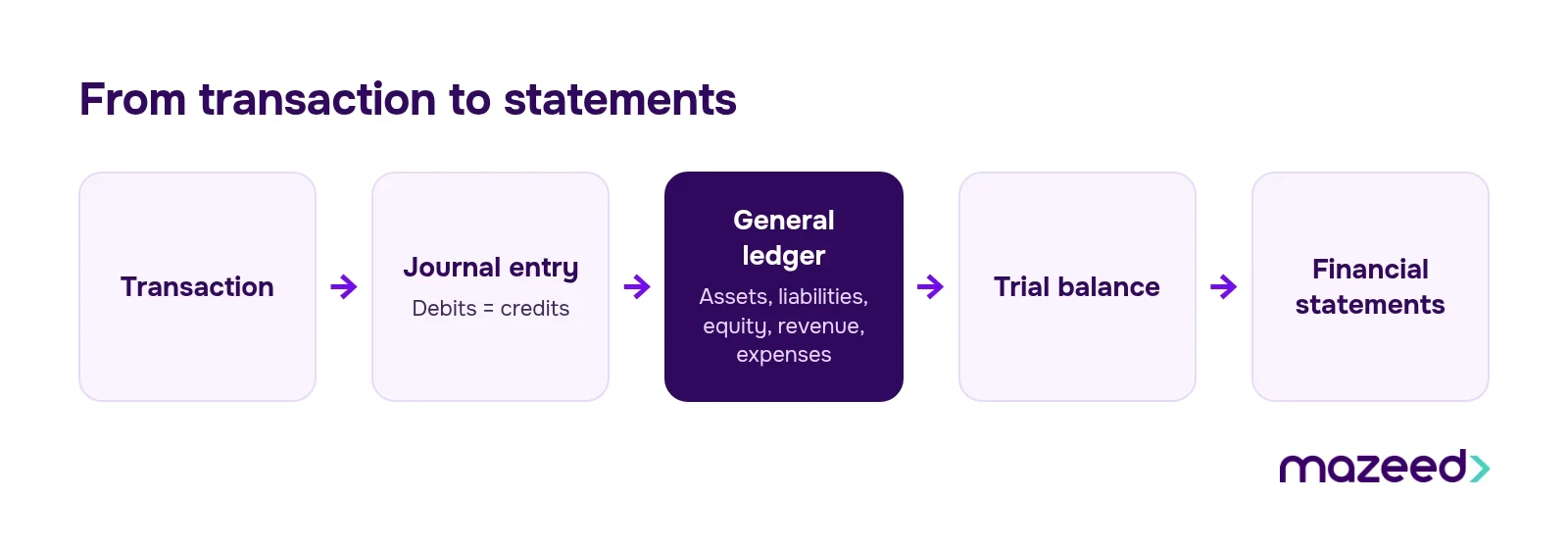
Accounting follows a simple flow:
- A transaction happens. You issue an invoice, pay rent or receive a payment.
- It is recorded as a journal entry, with at least one debit and one credit of equal value.
- The entry is posted to the general ledger, to each account it affects.
- Balances are summarised in the trial balance.
- Financial statements are prepared from the adjusted trial balance.
The accounts in the ledger come from your chart of accounts, grouped into five types:
| Account type | Normal balance | UAE examples |
|---|---|---|
| Assets | Debit | Cash at bank, trade receivables, inventory, input VAT recoverable, equipment |
| Liabilities | Credit | Trade payables, output VAT payable, Corporate Tax payable, end of service provision |
| Equity | Credit | Share capital, retained earnings |
| Revenue | Credit | Sales, service income |
| Expenses | Debit | Salaries, rent, utilities, depreciation |
General ledger example with UAE VAT
A Dubai consultancy records four transactions in March 2027.
1. 3 March: issues a tax invoice for consulting, AED 40,000 plus 5% VAT.
| Account | Debit | Credit |
|---|---|---|
| Trade receivables | 42,000 | |
| Consulting revenue | 40,000 | |
| Output VAT payable | 2,000 |
2. 5 March: pays the next quarter's office rent of AED 30,000 in advance. Commercial rent is standard-rated, so the landlord charges AED 1,500 VAT.
| Account | Debit | Credit |
|---|---|---|
| Prepaid rent | 30,000 | |
| Input VAT recoverable | 1,500 | |
| Bank | 31,500 |
3. 25 March: pays salaries of AED 24,000 through WPS.
| Account | Debit | Credit |
|---|---|---|
| Salaries expense | 24,000 | |
| Bank | 24,000 |
4. 28 March: the client pays the March invoice in full.
| Account | Debit | Credit |
|---|---|---|
| Bank | 42,000 | |
| Trade receivables | 42,000 |
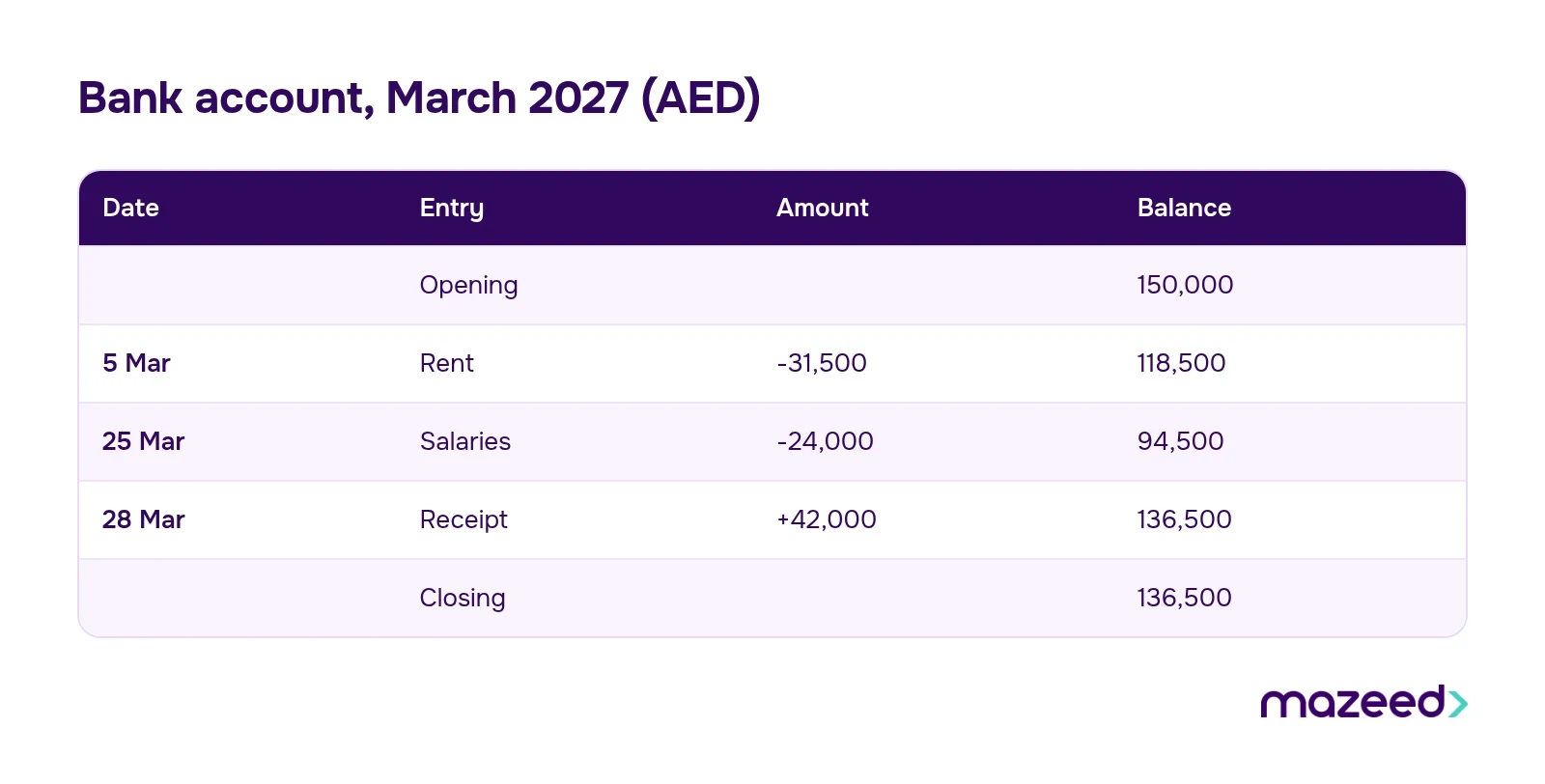
After posting, the Bank account in the general ledger looks like this (opening balance AED 150,000):
| Date | Description | Debit | Credit | Balance |
|---|---|---|---|---|
| 1 Mar | Opening balance | 150,000 | ||
| 5 Mar | Office rent, next quarter (incl. VAT) | 31,500 | 118,500 | |
| 25 Mar | March salaries | 24,000 | 94,500 | |
| 28 Mar | Receipt from client, INV-0312 | 42,000 | 136,500 |
And the Output VAT payable account shows a credit balance of AED 2,000, which will be offset against the AED 1,500 input VAT in the VAT return for the period. Each of the other accounts has its own page in the same format. Accruals and prepayments, such as releasing one month of the prepaid rent to rent expense at month end, follow the same pattern; see our guide to accrual accounting journal entries.
General ledger vs journal vs sub-ledger
| Journal | General ledger | Sub-ledger | |
|---|---|---|---|
| Organised by | Date (chronological) | Account | Customer, supplier or asset |
| Purpose | Record each transaction with its debits and credits | Show the full history and balance of each account | Hold detail behind one control account |
| Example | 3 March: Dr Receivables 42,000; Cr Revenue 40,000; Cr VAT 2,000 | The full trade receivables account for the year | Receivables per customer |
Sub-ledgers keep the general ledger readable. Instead of one receivables account with thousands of lines per customer, each customer has its own sub-ledger, and only the total flows to the trade receivables control account in the GL. At month end, the sub-ledger total must equal the control account balance.
How do you reconcile the general ledger?
Reconciliation proves that ledger balances match reality. At least monthly, check:
- Bank accounts: the GL bank balance matches the bank statement after timing differences.
- Receivables: the control account equals the customer aging total.
- Payables: the control account equals supplier balances, ideally confirmed against supplier statements.
- VAT: output and input VAT accounts agree with the VAT working for the period and with the last return.
- Fixed assets: cost and depreciation agree with the fixed asset register.
- Suspense and clearing accounts: these should be cleared to zero, not left to grow.
If you see entries that move money between cash and bank, you may find our guide to contra entries useful.
Common general ledger errors and how to spot them
| Error | Example | How to spot it |
|---|---|---|
| VAT posted gross | A AED 1,050 purchase booked entirely to office supplies, so the AED 50 input VAT is never claimed | Input VAT in the ledger is lower than the VAT on purchase invoices for the period |
| Wrong period | A December supplier bill entered in January | Unusual swings between months in the same expense account |
| Duplicate posting | The same supplier invoice entered twice, once from email and once from paper | Supplier statement shows a lower balance than the ledger |
| Personal spending in business accounts | An owner's personal purchase on the company card | Expenses without a clear business purpose in the description |
| Unreconciled suspense account | Unidentified bank receipts parked and forgotten | A suspense balance that grows every month |
| Wrong exchange rate | A USD invoice converted at an old rate | AED values that do not match the Central Bank rate on the transaction date |
Most of these are caught by the monthly reconciliations above. The earlier they are found, the cheaper they are to fix, especially before a VAT return is filed.
What does UAE law require for ledger records?
The UAE does not prescribe a ledger layout, but it does require records:
- Tax Procedures Law. Federal Decree-Law No. 28 of 2022 on Tax Procedures requires taxable persons to keep accounting records and commercial books, and to retain them for the period set out in the law, generally at least five years after the end of the relevant tax period.
- Corporate Tax. The Corporate Tax Law requires records to be kept for seven years after the end of the tax period, and financial statements follow IFRS or IFRS for SMEs under Ministerial Decision No. 114 of 2023.
- VAT. Under Article 69 of the VAT Decree-Law, invoices in foreign currency must show the amount converted into AED at the exchange rate approved by the UAE Central Bank on the date of supply, so your ledger needs reliable AED values for foreign currency transactions.
- E-invoicing. From your e-invoicing go-live date, e-invoices and e-credit notes and their data must also be retained and produced to the FTA on request.
Best practices for a clean general ledger
- Keep the chart of accounts lean. Too many accounts make reporting harder, not better.
- Write clear descriptions on every entry, with invoice or reference numbers.
- Limit manual journals and require approval for them.
- Never delete posted entries. Correct them with reversing entries so the audit trail stays intact.
- Lock closed periods so back-dated changes cannot alter filed VAT returns.
- Reconcile monthly, not only at year end.
For a broader view of the core records every business needs, see the basic tools of accounting.
How mazeed helps
In mazeed, every invoice, bill, expense and bank transaction posts to the general ledger automatically with balanced debits and credits, VAT accounts update in real time, and closed periods can be locked. Our FTA compliant accounting software keeps the full audit trail that UAE record-keeping rules expect.
This article is general information. It is not accounting, tax or legal advice; for your specific case, speak to a qualified accountant.