
A financial statement of position, also called a statement of financial position or balance sheet, lists what a business owns (assets), what it owes (liabilities) and what is left for owners (equity) on one date. Read it by checking that assets equal liabilities plus equity, then comparing current assets with current liabilities.
Many UAE owners only see this report at year end, when an auditor or tax adviser asks for it. If you want it prepared correctly every period, our accounting services in the UAE can handle the bookkeeping behind it. The rest of this guide explains what the statement contains and how to read it in a few minutes.
How do you read a statement of financial position?
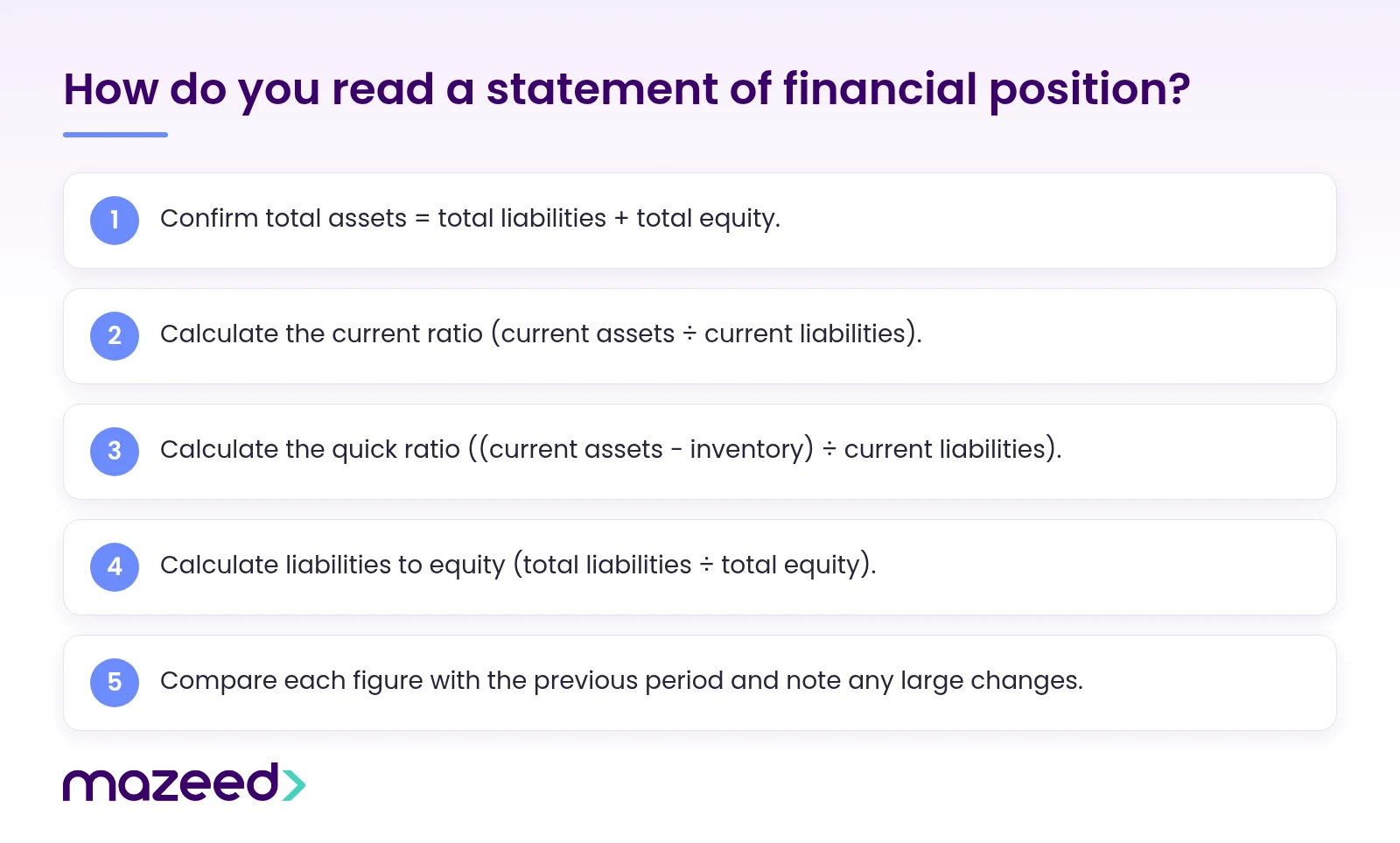
- Confirm total assets = total liabilities + total equity Confirm total assets = total liabilities + total equity.
- Calculate the current ratio (current assets ÷ current liabilities) Calculate the current ratio (current assets ÷ current liabilities).
- Calculate the quick ratio ((current assets − inventory) ÷ current liabilities) Calculate the quick ratio ((current assets − inventory) ÷ current liabilities).
- Calculate liabilities to equity (total liabilities ÷ total equity) Calculate liabilities to equity (total liabilities ÷ total equity).
- Compare each figure with the previous period and note any large changes Compare each figure with the previous period and note any large changes.
What is a financial statement of position?
A financial statement of position is a snapshot of a business's assets, liabilities and equity on a single date, such as 31 December. It shows what the business controls, what it owes and the owners' remaining stake at that moment.
"Statement of financial position" is the formal name used under International Financial Reporting Standards (IFRS), the accounting framework widely applied in the UAE. "Financial statement of position" is a common search variant of the same term.
Is a financial statement of position the same as a balance sheet?
Yes. The balance sheet, the statement of financial position and the financial statement of position are the same report under different names. "Balance sheet" is the traditional term, while "statement of financial position" is the IFRS name you will see in audited accounts.
Is a statement of financial position the same as a statement of account?
No. A statement of account lists transactions between your business and one customer or supplier, while a statement of position covers the whole business.
Statement of position is not a statement of account. A statement of account (SOA) is a ledger extract showing invoices, payments and the balance with a single customer or supplier. A statement of financial position summarises all assets, liabilities and equity of the business on one date. For the customer-level report, see our guide to statements of account in accounting.
What does a statement of financial position include?
It includes three building blocks: assets, liabilities and equity. These are tied together by the accounting equation, so the two sides of the statement must always be equal.
What are assets on a statement of financial position?
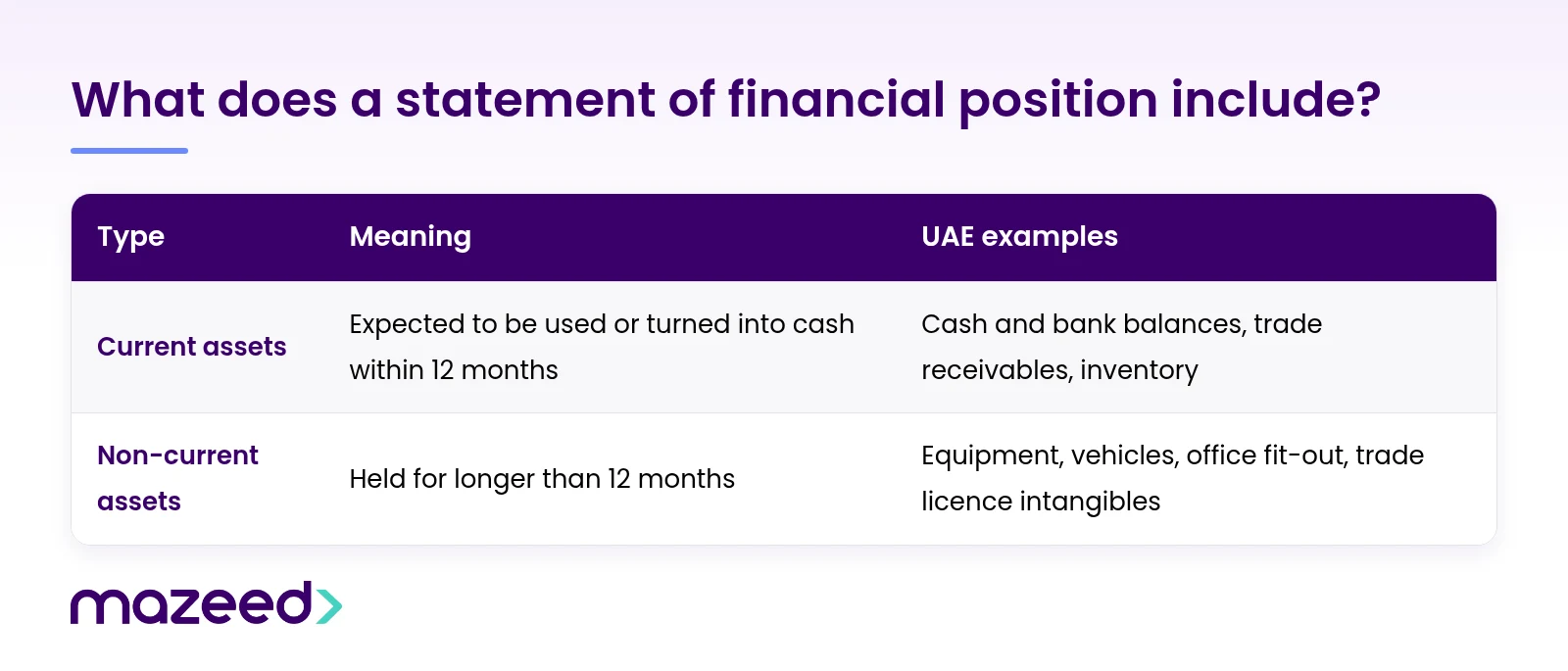
Assets are resources the business owns or controls that are expected to bring future economic benefit. They are split by how quickly they turn into cash or are used up.
| Type | Meaning | UAE examples |
|---|---|---|
| Current assets | Expected to be used or turned into cash within 12 months | Cash and bank balances, trade receivables, inventory, prepaid rent |
| Non-current assets | Held for longer than 12 months | Equipment, vehicles, office fit-out, trade licence intangibles |
Non-current assets such as equipment are shown "net of depreciation", meaning their original cost minus the portion already expensed through use.
What are liabilities on a statement of financial position?
Liabilities are amounts the business owes to others. Like assets, they are split into current (due within 12 months) and non-current (due later).
Two liabilities appear on almost every UAE company's statement and are often missed in generic guides:
- VAT payable: the output VAT collected on sales minus recoverable input VAT, owed to the Federal Tax Authority until the return is paid.
- End-of-service gratuity provision: the amount the business expects to pay employees when their service ends, built up over each year of employment. It is usually shown as non-current because most of it is not payable within 12 months.
Other common liabilities include trade payables (amounts owed to suppliers) and accrued expenses (costs incurred but not yet invoiced, such as utilities or staff bonuses).
What is equity on a statement of financial position?
Equity is the owners' stake in the business after all liabilities are deducted from assets. It usually consists of share capital, which is the amount owners put in, and retained earnings, which are accumulated profits not yet distributed.
What is the formula for the statement of financial position?
The formula is Assets = Liabilities + Equity. Every transaction keeps this equation in balance, which is why the report is often called a balance sheet.
You can rearrange it to find equity directly: Equity = Assets − Liabilities. If the totals do not match, there is an error in the underlying records. The basic tools of accounting explain the bookkeeping foundations that keep these figures accurate.
How do you read a statement of financial position?
Read it with a five-step routine: confirm it balances, test short-term coverage, check asset quality, see how much is owner-funded, and compare with the prior period. Each step takes about a minute.
Step 1: Does it balance?
Check that total assets equal total liabilities plus equity. A mismatch means the statement is incomplete or contains an error, so stop and fix it before drawing conclusions.
Step 2: Can current assets cover current liabilities?
Divide total current assets by total current liabilities to get the current ratio. A result above 1 means short-term assets exceed short-term obligations.
As a general rule of thumb, many businesses aim for a current ratio between about 1.5 and 2, although the right level depends on your industry and trading cycle. A very high ratio can also signal idle cash or slow-moving stock.
Step 3: How good are the receivables and inventory?
Not every current asset turns into cash quickly. Check how much of your current assets sit in trade receivables and inventory, and ask how long customers take to pay and how fast stock sells.
A useful test is the quick ratio: (current assets − inventory) ÷ current liabilities. It shows whether you could meet short-term obligations without relying on selling stock.
Step 4: How much is funded by owners versus owed to others?
Divide total liabilities by total equity to get the liabilities-to-equity ratio. A lower figure means owners fund more of the business, which gives it more room to absorb a difficult period.
You can also express this as the equity share of total assets: total equity ÷ total assets.
Step 5: How does it compare with the prior period?
Place this period's statement next to the last one. Rising receivables with flat sales, growing payables or falling equity are early warning signs worth investigating.
Your 5-minute checklist:
- Confirm total assets = total liabilities + total equity.
- Calculate the current ratio (current assets ÷ current liabilities).
- Calculate the quick ratio ((current assets − inventory) ÷ current liabilities).
- Calculate liabilities to equity (total liabilities ÷ total equity).
- Compare each figure with the previous period and note any large changes.
What does a worked example look like for a Dubai trading company?
Below is an illustrative statement for a small Dubai trading company, with VAT payable and an end-of-service gratuity provision included. All figures are illustrative and do not represent a real business.
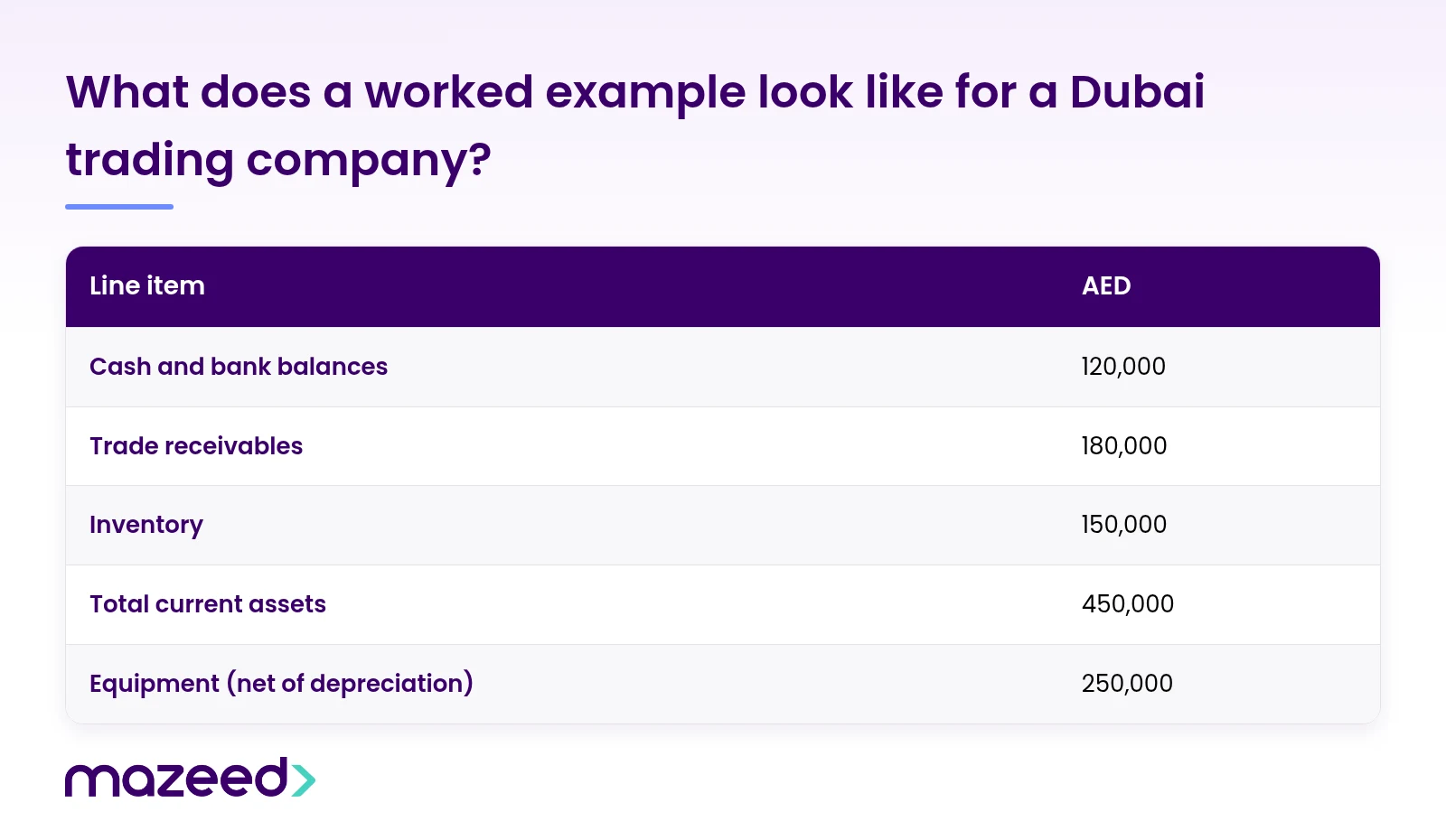
Statement of financial position, sample UAE trading company, as at 31 December 2026 (illustrative figures, AED)
| Line item | AED |
|---|---|
| Cash and bank balances | 120,000 |
| Trade receivables | 180,000 |
| Inventory | 150,000 |
| Total current assets | 450,000 |
| Equipment (net of depreciation) | 250,000 |
| Total assets | 700,000 |
| Trade payables | 170,000 |
| VAT payable | 30,000 |
| Accrued expenses | 20,000 |
| Total current liabilities | 220,000 |
| End-of-service gratuity provision | 80,000 |
| Total liabilities | 300,000 |
| Share capital | 100,000 |
| Retained earnings | 300,000 |
| Total equity | 400,000 |
| Total liabilities and equity | 700,000 |
How to read this example:
| Check | Calculation | Result | What it means |
|---|---|---|---|
| Does it balance? | 300,000 + 400,000 | 700,000 | Yes, matches total assets |
| Current ratio | 450,000 ÷ 220,000 | About 2.05 | Short-term assets comfortably cover short-term obligations |
| Quick ratio | (450,000 − 150,000) ÷ 220,000 | About 1.36 | Obligations are covered even without selling stock |
| Liabilities to equity | 300,000 ÷ 400,000 | 0.75 | Owners fund more than outsiders |
| Equity share of assets | 400,000 ÷ 700,000 | About 57% | More than half the business is owner-funded |
| Receivables share | 180,000 ÷ 450,000 | 40% | A large share, so check how quickly customers pay |
Overall, this company looks stable in the short term. The main point to watch is receivables: if customers pay slowly, the healthy current ratio may not translate into cash in the bank.
How is it different from the income statement and cash flow statement?
The statement of financial position shows position on one date, the income statement shows performance over a period, and the cash flow statement shows cash movements over a period. You need all three for a full picture.
| Statement | Question it answers | Time frame | Key output |
|---|---|---|---|
| Statement of financial position | What do we own and owe? | One date | Equity |
| Income statement | Did we make a profit? | A period (month, quarter, year) | Net profit or loss |
| Cash flow statement | Where did cash come from and go? | A period | Net change in cash |
The three are linked. Profit from the income statement adds to retained earnings on the statement of position, and the closing cash figure matches the cash line. For a full explanation of the third report, read our guide on how a cash flow statement works for UAE businesses.
Does a UAE business need to prepare a statement of financial position?
In most cases, yes. UAE companies are expected to keep proper accounting records and prepare annual financial statements under company law, and Corporate Tax rules link tax filing to financial statements. The specific duties depend on your entity type and revenue.
Under the Commercial Companies Law, companies are required to keep accounting records and prepare annual financial statements. Free zone entities may also have reporting rules set by their free zone authority.
How does corporate tax relate to financial statements?
Taxable income for UAE Corporate Tax is calculated starting from the accounting profit in your financial statements, so a reliable statement of financial position supports an accurate tax return. The Corporate Tax Law allows the Federal Tax Authority to request financial statements.
Key thresholds to check with official sources:
| Item | Threshold (as of November 2026) | Source |
|---|---|---|
| Audited financial statements required | Revenue above AED 50 million, or qualifying free zone persons | |
| Accounting standards for taxable persons | IFRS, with IFRS for SMEs permitted below AED 50 million revenue | |
| Corporate Tax 0% band | Taxable income up to AED 375,000 (9% on taxable income above AED 375,000) | Cabinet Decision No. 116 of 2022 and Ministry of Finance confirmation |
| Small business relief | Resident persons with revenue of AED 3 million or less in the tax period and every previous tax period, subject to conditions and time limits; not available to Qualifying Free Zone Persons or members of large multinational groups; end date: | Article 21 of Federal Decree-Law No. 47 of 2022 and Ministerial Decision No. 73 of 2023 |
Confirm the exact thresholds that apply to your business before filing, as rules and relief periods can change.
How long do you need to keep records?
UAE Corporate Tax rules require businesses to keep accounting records and supporting documents for 7 years after the end of the tax period they relate to. VAT records are subject to their own retention rules.
How often should a UAE business prepare one?
At minimum, once a year at the financial year end, for your annual accounts and tax return. Many businesses also prepare it monthly or quarterly to track working capital and spot problems early. Monthly statements pair well with a budget vs actual report for tighter management control.
What are the most common mistakes when preparing or reading it?
Most errors come from misclassified items and missing balances rather than complex accounting. Fixing these five issues makes the statement far more reliable.
- Mixing up current and non-current items. Placing the full gratuity provision or long-term deposits in the wrong section distorts the current ratio.
- Missing accruals. Unbilled utilities, rent or staff costs understate liabilities and overstate equity.
- Ignoring VAT balances. Forgetting VAT payable or recoverable input VAT misstates what you owe the Federal Tax Authority.
- Not updating the gratuity provision. The provision should grow as employees build up service, and be adjusted when staff leave.
- Unreconciled bank balances. If the cash figure does not match bank statements, every ratio built on it is unreliable.
Once your statement is accurate, a cash flow forecast for your UAE business is a natural next step for planning ahead.
How can mazeed help with your statement of financial position?
mazeed prepares accurate, reconciled financial statements for UAE businesses and offers accounting software to keep your books current between reporting dates.
Want your statement of financial position prepared correctly? Talk to the mazeed accounting team.
Share three details and our team will contact you:
- Name
- Mobile number
- Service needed
Request a call from mazeed's bookkeeping experts
Keep your books ready for every reporting date with mazeed accounting software.