

A profit and loss statement (P&L, also called the income statement or statement of profit or loss) shows a business's revenue, expenses and resulting profit or loss over a period, such as a month, quarter or year. It starts with revenue, deducts the cost of what was sold to reach gross profit, deducts operating expenses to reach operating profit, then deducts finance costs and tax to arrive at net profit. In the UAE, the year-end P&L is also the starting point for calculating Corporate Tax.
What does a profit and loss statement show?
The P&L answers one question: did the business make money in this period, and how? It shows:
- Revenue: income from selling goods or services, excluding VAT collected for the government.
- Cost of sales: the direct cost of what was sold, such as purchased goods or direct labour.
- Gross profit: revenue minus cost of sales.
- Operating expenses: salaries, rent, utilities, marketing, depreciation and other running costs.
- Operating profit: gross profit minus operating expenses.
- Finance costs: interest on loans and leases.
- Profit before tax, then income tax, then net profit.
It is built from the income and expense accounts in your adjusted trial balance, and the net profit flows into retained earnings on the balance sheet.
Profit and loss statement example
This is the P&L of the Dubai trading company used in our trial balance and balance sheet examples, for the year ended 31 December 2026, in AED.
| Statement of profit or loss | AED |
|---|---|
| Revenue | 1,240,000 |
| Cost of goods sold | (742,000) |
| Gross profit | 498,000 |
| Salaries and wages | (228,000) |
| Rent | (84,000) |
| Utilities and telecom | (21,600) |
| Marketing | (15,000) |
| Depreciation | (15,000) |
| Bank charges | (3,750) |
| Operating profit | 130,650 |
| Finance costs | 0 |
| Profit before tax | 130,650 |
| Corporate Tax | 0 |
| Net profit for the year | 130,650 |
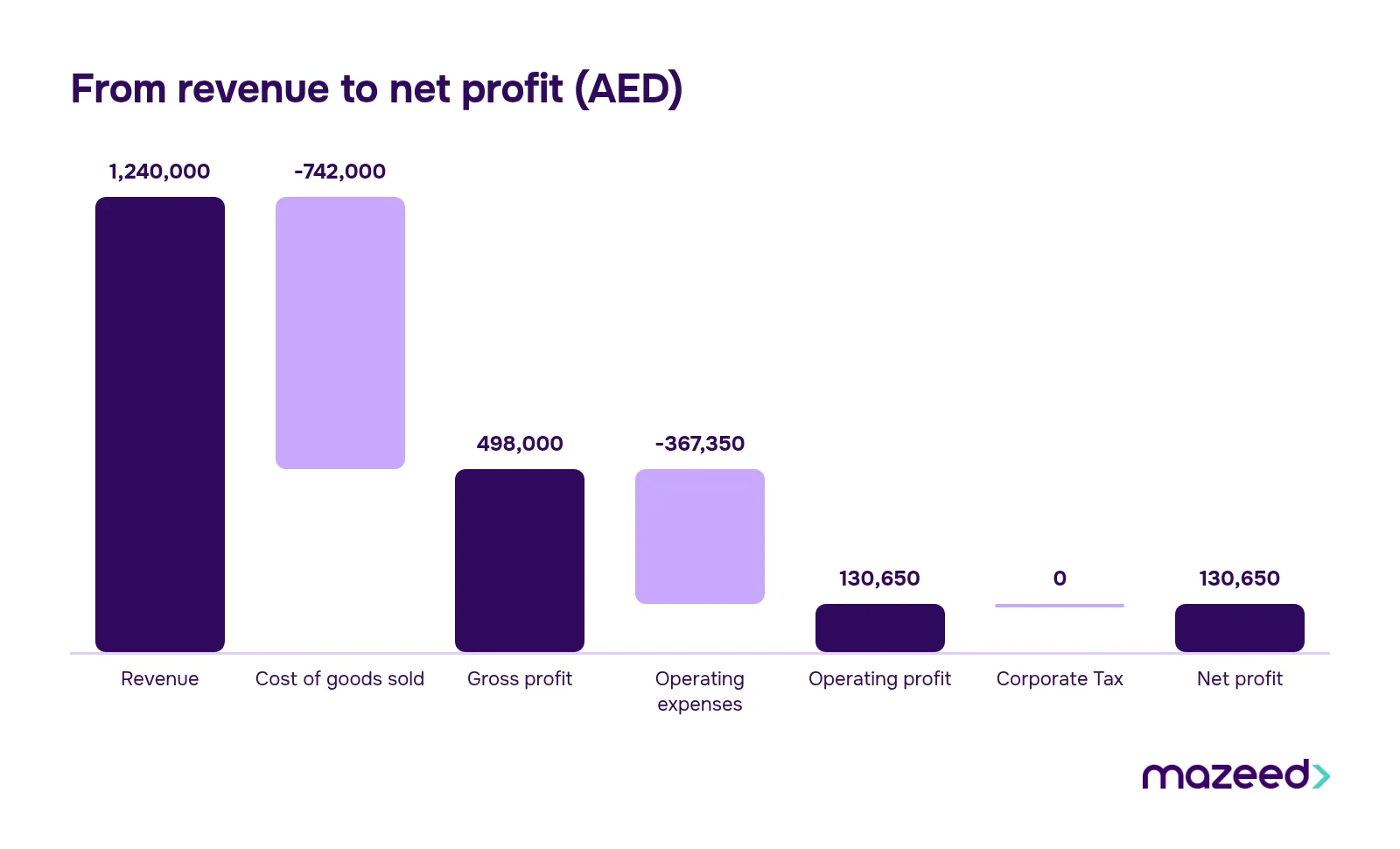
Gross margin is 40.2% (498,000 / 1,240,000) and net margin is 10.5%. No Corporate Tax is due because taxable income, assuming no adjustments, is below the AED 375,000 band taxed at 0%.
How is a P&L laid out?
IFRS allows two ways of analysing expenses:
| Method | How expenses are grouped | Common in |
|---|---|---|
| By function | Cost of sales, selling, administrative, distribution | Trading and manufacturing companies |
| By nature | Purchases, staff costs, depreciation, rent | Service businesses and small companies |
The example above mixes the two, which is common in small company reporting. Under IFRS 18 a company must pick the presentation that gives the most useful summary and, if it presents by function, disclose certain expenses by nature in the notes.
Cash basis or accrual basis: which P&L do you need?
Most P&Ls are prepared on the accrual basis: revenue is recorded when it is earned and expenses when they are incurred, whether or not cash has moved. A sale invoiced on 28 December but paid in February is December revenue.
Under Ministerial Decision No. 114 of 2023, a business with revenue not exceeding AED 3 million may prepare its financial statements for Corporate Tax on the cash basis, recording income when received and expenses when paid. It is a choice, not an obligation.
| Accrual basis | Cash basis | |
|---|---|---|
| Revenue recorded | When earned and invoiced | When the customer pays |
| Expenses recorded | When incurred | When paid |
| Shows unpaid invoices and bills | Yes | No |
| Available for UAE Corporate Tax | All businesses | Revenue up to AED 3 million (or with FTA approval in exceptional cases) |
| Best for | Understanding true performance | Very small businesses with simple, mostly immediate transactions |
Even small businesses that could use the cash basis often keep accrual books, because banks, investors and buyers expect them, and switching later means restating history.
What changes under IFRS 18?
The IFRS Foundation issued IFRS 18 Presentation and Disclosure in Financial Statements in April 2024. It replaces IAS 1 for annual periods beginning on or after 1 January 2027 and is the biggest change to the P&L in decades. Three changes matter most:
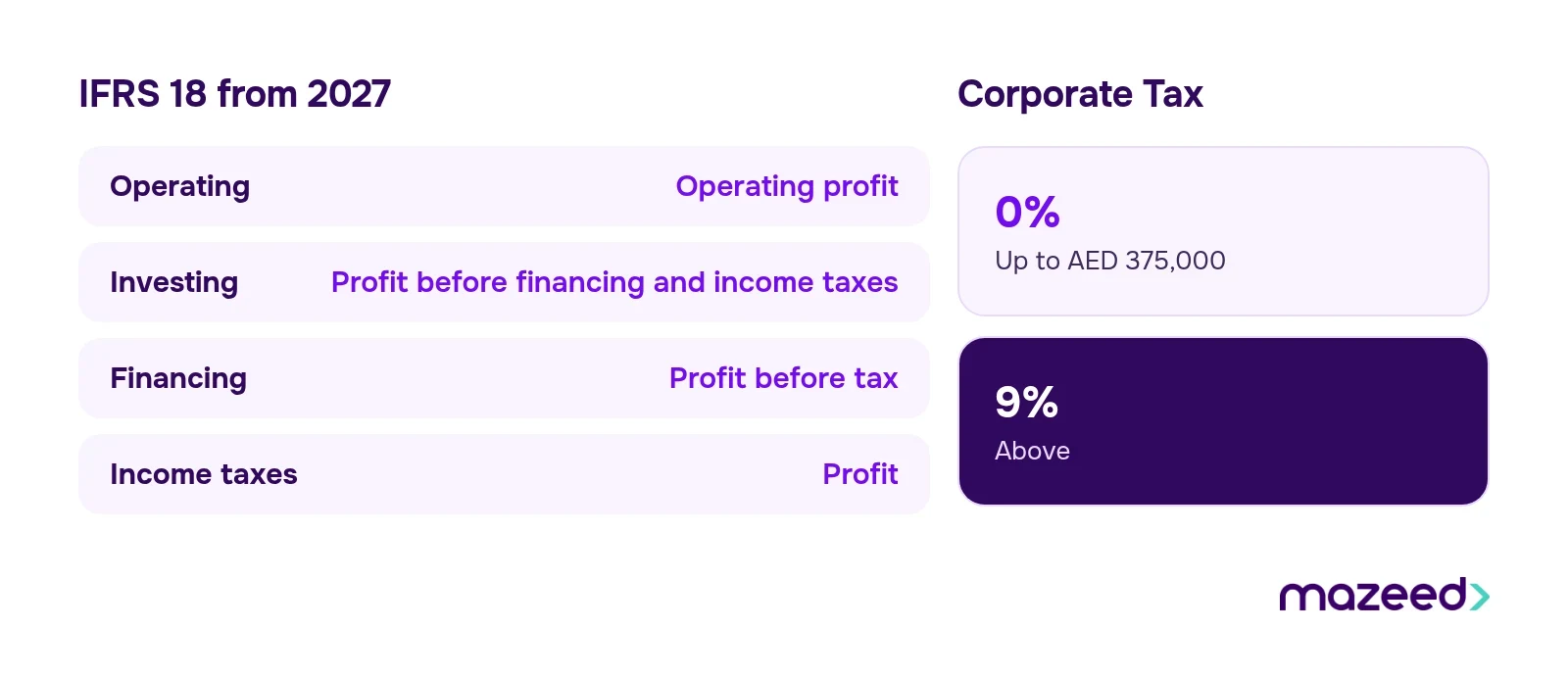
- Five categories. Income and expenses are classified as operating, investing, financing, income taxes or discontinued operations.
- Two required subtotals. Every P&L must show operating profit and profit before financing and income taxes.
- Management-defined performance measures. If a company publishes its own measures, such as adjusted EBITDA, in public communications, it must explain and reconcile them in the notes.
Here is how a larger company's P&L could look under IFRS 18:
| Line | Category | AED |
|---|---|---|
| Revenue | Operating | 8,400,000 |
| Cost of sales | Operating | (5,460,000) |
| Selling and administrative expenses | Operating | (1,820,000) |
| Operating profit | Subtotal | 1,120,000 |
| Dividend income from investments | Investing | 30,000 |
| Profit before financing and income taxes | Subtotal | 1,150,000 |
| Interest on bank loan and leases | Financing | (150,000) |
| Profit before tax | 1,000,000 | |
| Corporate Tax | Income taxes | (56,250) |
| Profit for the year | 943,750 |
IFRS for SMEs has its own presentation rules, so smaller companies using it should check the version that applies to them. For a calendar-year company, 2027 is the first IFRS 18 year, with 2026 comparatives restated.
How does the P&L connect to UAE Corporate Tax?
Under the Corporate Tax Law (Federal Decree-Law No. 47 of 2022), taxable income starts from the accounting profit in financial statements prepared under the standards set by Ministerial Decision No. 114 of 2023. That profit is then adjusted for items the law treats differently, for example:
- Client entertainment, which is only 50% deductible
- Fines and penalties, which are not deductible
- Donations to non-qualifying organisations, which are not deductible
- Interest expense above the general interest deduction limit
Corporate Tax is charged at 0% on taxable income up to AED 375,000 and 9% above that. In the larger example, taxable income of AED 1,000,000 gives tax of 9% x (1,000,000 - 375,000) = AED 56,250. For the full rules, see our guide to UAE Corporate Tax.
How should you use your P&L month to month?
A year-end P&L is for compliance. A monthly P&L is for running the business:
- Compare to budget. A budget vs actual report shows where revenue or costs drifted.
- Track gross margin. A falling gross margin often signals supplier price increases or discounting before it shows in cash.
- Watch fixed costs. Rent and salaries rarely fall on their own; know your break-even revenue.
- Read it with cash flow. A profitable month can still be a cash-poor month if customers pay slowly.
Many owners combine the monthly P&L with balance sheet highlights and key ratios into a short pack of management accounts.
Common P&L mistakes
- Including VAT in revenue. VAT collected is a liability, not income.
- Booking owner withdrawals as expenses. Drawings and dividends are not business expenses.
- Expensing assets. Equipment that lasts more than a year should be capitalised and depreciated.
- Missing accruals. Electricity, telecom and professional fees often arrive after month end and must be accrued.
- Forgetting the end of service charge. The gratuity expense builds up monthly, not only when someone leaves.
How mazeed helps
mazeed's financial reporting software produces profit and loss reports by month, quarter or year, with prior-period and budget comparisons, straight from your ledger. Your P&L is ready the moment the month is closed.
This article is general information. It is not accounting, tax or legal advice; for your specific case, speak to a qualified accountant.