

An accredited service provider (ASP) is a company accredited by the UAE Ministry of Finance to exchange e-invoices and report invoice data to the Federal Tax Authority on your behalf. Businesses with revenue of AED 50 million or more go live on 1 January 2027 (as of November 2026), so verify your provider on the official list now.
How do I check that a provider is officially accredited?
- Open the Ministry of Finance e-invoicing page directly, not through a vendor link Open the Ministry of Finance e-invoicing page directly, not through a vendor link.
- Find the accredited service provider list and note its publication or update date Find the accredited service provider list and note its publication or update date.
- Search for the provider's exact legal name, not its brand name Search for the provider's exact legal name, not its brand name.
- Save a dated copy or screenshot for your compliance file Save a dated copy or screenshot for your compliance file.
- Recheck before signing and again before go-live Recheck before signing and again before go-live.
What is an accredited service provider in UAE e-invoicing?
An accredited service provider is a company the UAE Ministry of Finance has accredited to sit between your business and the national e-invoicing system. It receives your invoice data, exchanges e-invoices with your customer's provider, and reports the required tax data to the Federal Tax Authority (FTA).
In this article, an e-invoice means an invoice issued, sent and received in a structured electronic format through the national system, not a PDF sent by email. The UAE model is described as a five-corner model, in which the supplier's ASP and the buyer's ASP exchange the invoice and the tax data goes to the FTA.
What does an ASP actually do for my invoices?
Your ASP converts and validates your invoice data in the required format, delivers it to your customer's ASP, and sends the tax data to the FTA on your behalf. It also receives e-invoices from your suppliers through their ASPs.
In practice, your ASP is the gateway. If an invoice fails validation, the ASP is usually the first place the error appears. That is why the contract must say who fixes rejected invoices and how fast.
Is an ASP the same as my accounting software?
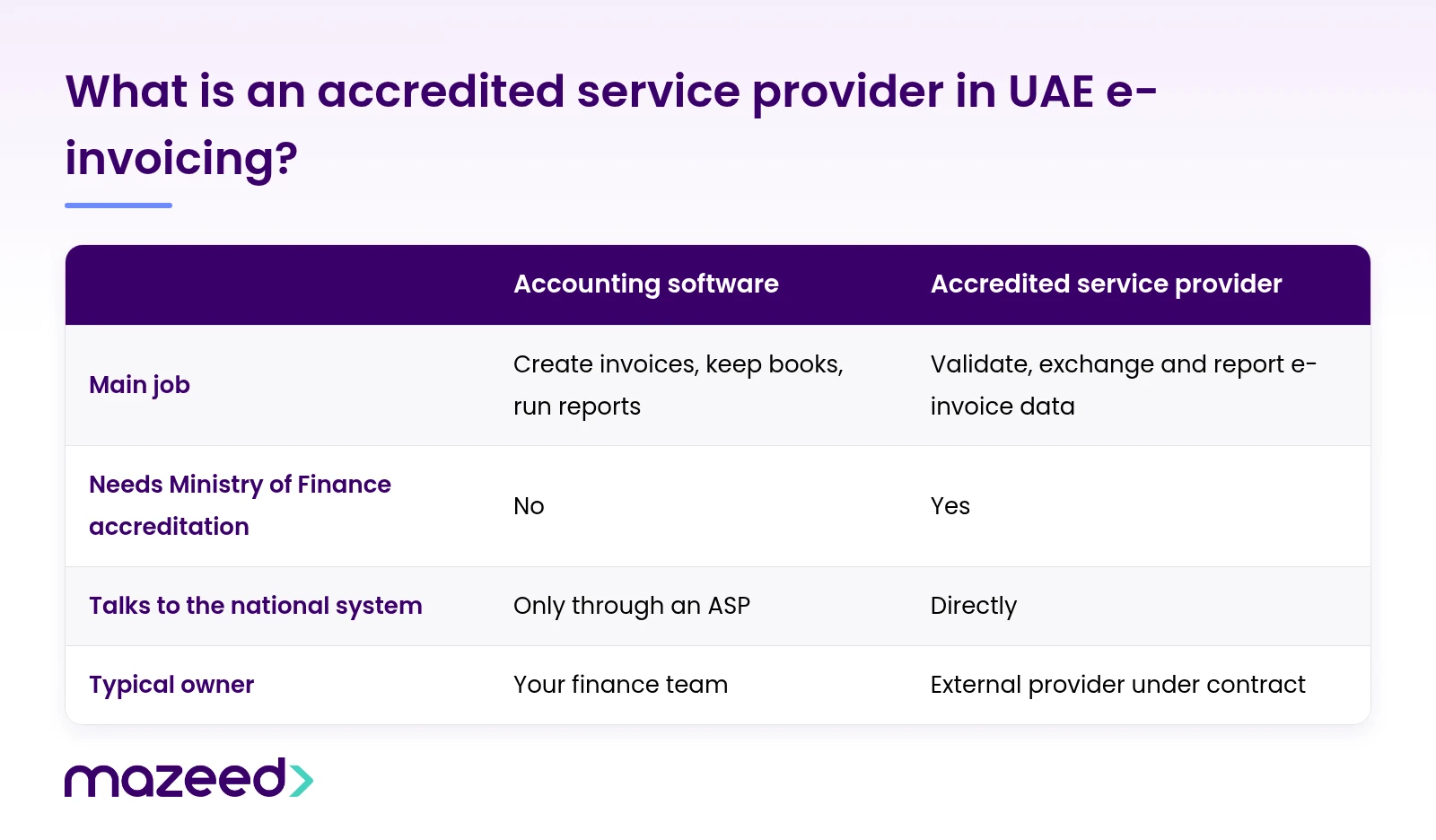
No. Your accounting software creates and records invoices. The ASP connects those invoices to the national system. Some vendors offer both, but accreditation applies to the ASP service, not to the software in general.
| Accounting software | Accredited service provider | |
|---|---|---|
| Main job | Create invoices, keep books, run reports | Validate, exchange and report e-invoice data |
| Needs Ministry of Finance accreditation | No | Yes |
| Talks to the national system | Only through an ASP | Directly |
| Typical owner | Your finance team | External provider under contract |
Who has to appoint one, and by when?
Businesses in scope of UAE e-invoicing must appoint an ASP before their phase's go-live date. The phases depend on revenue and entity type, and the dates below are as of November 2026. If you want help mapping your own dates, our e-invoicing mandate and deadlines support walks you through it.
| Group | Appoint an ASP by | Go live by | Status as of November 2026 |
|---|---|---|---|
| Businesses with revenue of AED 50 million or more | 31 July 2026 | 1 January 2027 | Appointment date passed |
| Businesses with revenue under AED 50 million | 31 March 2027 | 1 July 2027 | Upcoming |
| Government entities | 31 March 2027 | 1 October 2027 | Upcoming |
What applies to businesses with revenue of AED 50 million or more?
These businesses must be live on the e-invoicing system from 1 January 2027, as of November 2026. Their ASP appointment date fell earlier, so most should already have a signed provider.
If you are in this group, your focus now is testing. Confirm that your invoice data flows correctly to your ASP and that rejected invoices come back to a named person on your team.
What applies to smaller businesses?
Businesses with revenue under AED 50 million fall into a later phase, with appointment and go-live dates in 2027 as of November 2026. This gives more time, but provider onboarding still takes weeks.
How revenue is measured against the AED 50 million threshold, and for which period, should be confirmed from the official text.
What if I have missed the appointment date?
Act now. Appoint an accredited provider immediately and check the official guidance on penalties and next steps. Waiting does not reduce your exposure.
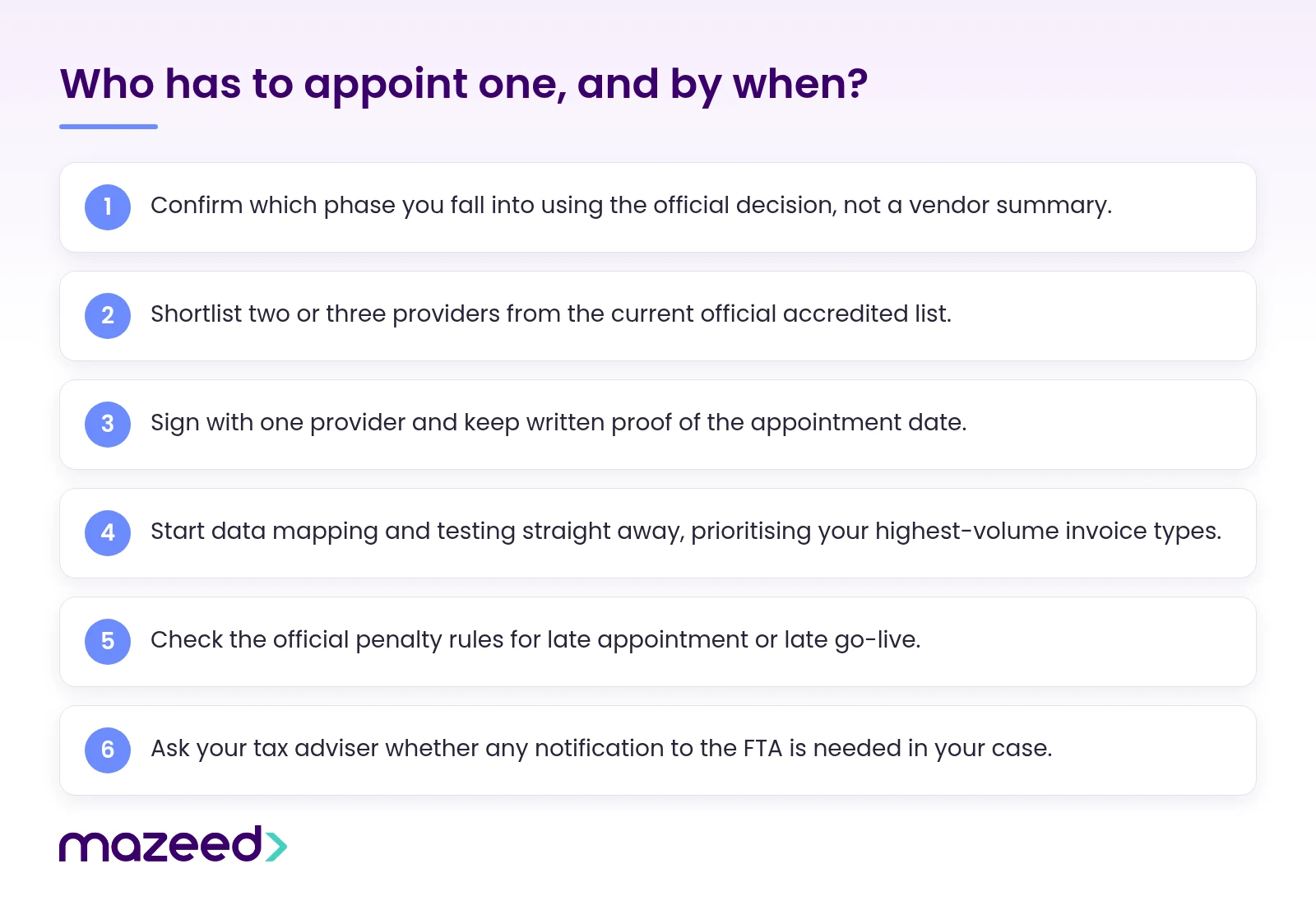
- Confirm which phase you fall into using the official decision, not a vendor summary.
- Shortlist two or three providers from the current official accredited list.
- Sign with one provider and keep written proof of the appointment date.
- Start data mapping and testing straight away, prioritising your highest-volume invoice types.
- Check the official penalty rules for late appointment or late go-live. Do not rely on penalty amounts quoted by vendors.
- Ask your tax adviser whether any notification to the FTA is needed in your case.
How do I check that a provider is officially accredited?
Use the official Ministry of Finance list only. A provider's website, sales deck or "approved" badge is not proof of accreditation.
Where is the official list published?
The Ministry of Finance publishes the list of accredited service providers on its e-invoicing pages. Check the list date each time you look, because providers can be added or removed.
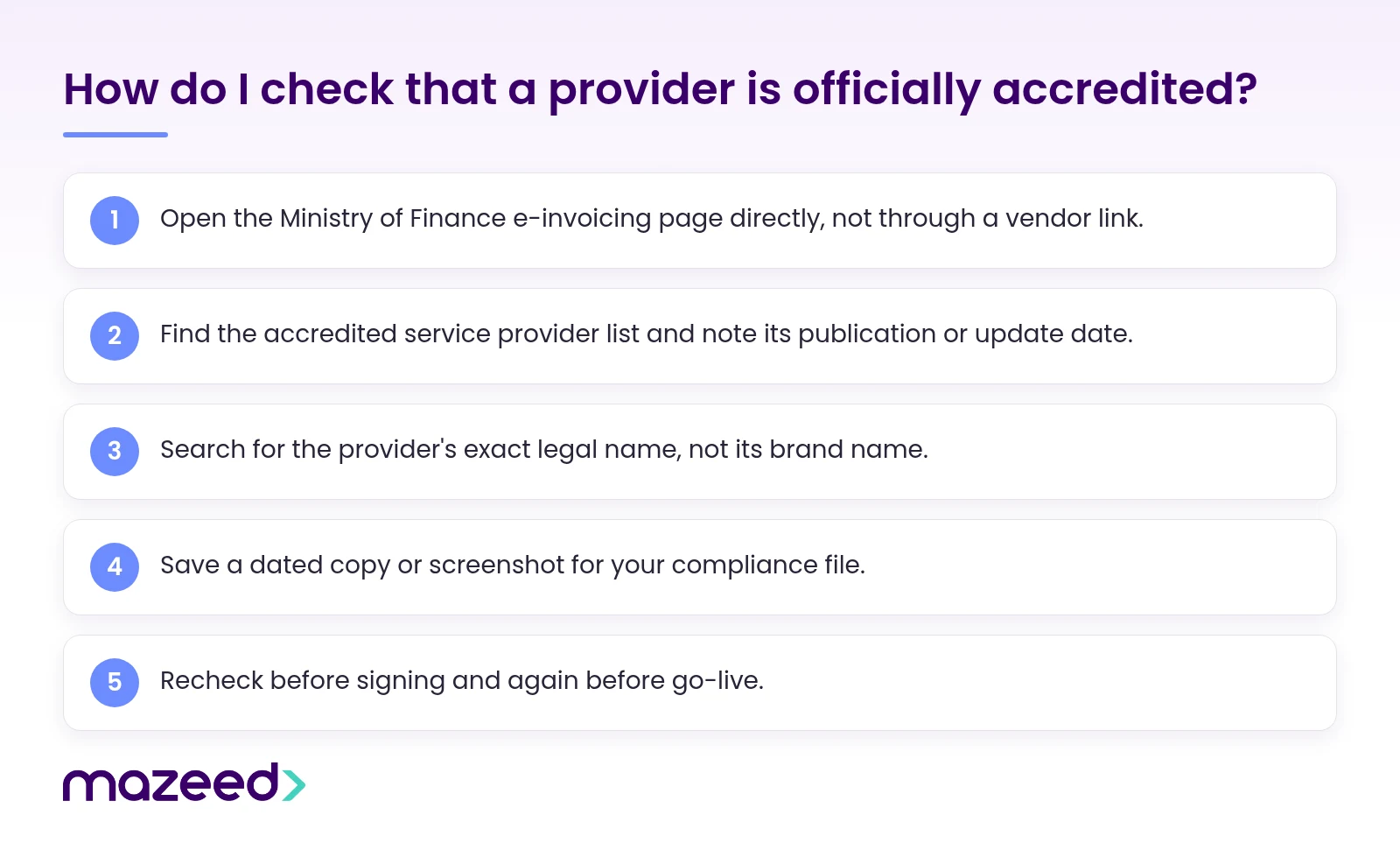
- Open the Ministry of Finance e-invoicing page directly, not through a vendor link.
- Find the accredited service provider list and note its publication or update date.
- Search for the provider's exact legal name, not its brand name.
- Save a dated copy or screenshot for your compliance file.
- Recheck before signing and again before go-live.
We do not state how many providers are on the list here, because the number changes. Read the current figure directly from the official page.
What if a vendor says "approved" or "pre-approved"?
Confirm the exact status on the official list. Official terms may distinguish between providers that are pre-approved and those that are fully accredited, and only the official wording counts.
If the vendor's claim does not match the list, ask them in writing to explain the difference. A reputable provider will point you to the official page.
How do I choose between accredited providers?
Choose on fit, not on badges. Every provider on the official list has met the accreditation criteria, so the difference lies in integration, support, error handling and contract terms. We do not rank providers.
What should I ask before signing?
Use this checklist with every shortlisted provider and keep the answers on file.
| Question to ask | Why it matters | Where to confirm |
|---|---|---|
| Is the provider on the official accredited list today? | Status can change | Ministry of Finance list |
| Does it integrate with your accounting system? | Avoids manual re-entry | Provider demo and your accountant |
| Who handles rejected or failed invoices? | Operational risk | Contract and service terms |
| What are support hours and languages? | Deadline pressure | Contract |
| Can you export your data and exit? | Avoids lock-in | Contract |
| How is pricing structured (per invoice, per year)? | Budget clarity | Written quote |
How does it connect to my accounting system?
Integration decides how much manual work you keep. Ask whether the provider has a ready connector for your accounting system, or whether you need a custom build.
Then ask about data mapping: which fields in your invoices map to which fields in the required format, and who maintains that mapping when rules change. Finally, confirm who fixes a rejected invoice, how you are alerted, and the target response time.
What about support, Arabic and English, and exit terms?
Support and exit terms matter most when something goes wrong. Ask for support hours, response times, and whether help is available in both Arabic and English.
On exit, ask how you get a full export of your invoice data, in what format, and how long the provider keeps it after the contract ends. Record retention rules under UAE tax law still apply to you, whoever your provider is.
Worked example: a Dubai trading company
All figures below are illustrative only.
A Dubai trading company with illustrative annual revenue of AED 80 million issues about 1,200 sales invoices and receives about 400 supplier invoices a month. It falls into the AED 50 million or more phase.
- The finance manager downloads the current official list and shortlists two providers.
- Both are asked the six checklist questions in writing.
- Provider A has a ready connector for the company's accounting system. Provider B needs a custom integration.
- Provider A offers support in Arabic and English with a defined response time for rejected invoices. Its contract allows a full data export on exit.
- The company signs with Provider A, saves a dated copy of the official list, and maps its three main invoice types: standard tax invoices, simplified invoices and export invoices.
- It runs test invoices through the ASP and fixes data gaps in customer records before 1 January 2027.
Trading businesses often have large customer lists, so data clean-up takes longer than expected. Our guide on accounting software built for UAE trading companies covers how to keep that data organised.
Can I switch providers later?
Usually yes, but check your contract and the official rules first. The practical risk is losing data or having a gap in invoice exchange during the move.
- Read the notice period and exit clauses in your current contract.
- Request a full export of your invoice data in a usable format.
- Confirm the new provider is on the current official list.
- Agree a cut-over date so no invoice falls between the two providers.
- Test with the new provider before ending the old contract.
- Complete any official notification that applies.
What should I prepare internally before I appoint one?
Clean data first. An ASP can only send what your systems give it, so incorrect customer details or missing tax registration numbers will cause rejections.
A Tax Registration Number (TRN) is the number the FTA issues to each VAT-registered business. Invoice content requirements come from Federal Decree-Law No. 8 of 2017 on Value Added Tax and its Executive Regulation.
- Check every customer and supplier record for the correct legal name, address and TRN.
- List every invoice type you issue and receive.
- Confirm who in your team owns e-invoicing and rejected-invoice follow-up.
- Make sure your books are up to date before go-live.
For the full preparation process, follow our 7-step e-invoicing readiness plan. To sort your documents correctly, see how invoices and receipts differ for UAE businesses and when a commercial invoice is needed and what it contains. If your records need work first, read about what makes bookkeeping services work in the UAE.
Next step
Not sure where you stand on the e-invoicing deadline?
Tell us and we will call you. Our team will help you confirm your phase, review your readiness and plan your next steps with your provider.
Request a call
- Name
- Mobile
- Service: E-invoicing mandate and deadlines
Book your e-invoicing deadline review
Keep your invoices and books in one place
mazeed accounting software keeps your invoices, customers, suppliers and books together, so the data you send to your ASP is clean and consistent.