The standard balance sheet format shows a company's assets, liabilities and equity at a single date, arranged so that total assets equal total liabilities plus equity. Under IFRS, which UAE companies use for Corporate Tax, it is called the statement of financial position, and assets and liabilities are split into current and non-current. A typical UAE balance sheet also shows items such as VAT receivable or payable, the end of service benefits provision and, where relevant, Corporate Tax payable.
What is a balance sheet?
A balance sheet is a snapshot of what a business owns and owes on a specific date, usually the last day of the month or financial year. Together with the profit and loss statement and the cash flow statement, it is one of the core financial statements.
Banks read it to judge whether a company can repay a facility. Investors use it to understand financial strength. In the UAE, it is also part of the financial statements that support your Corporate Tax return; Ministerial Decision No. 114 of 2023 sets IFRS as the accounting standard for Corporate Tax, with IFRS for SMEs available for businesses with revenue up to AED 50 million. For more on which standard applies to you, see accounting standards in the UAE.
Who reads your balance sheet in the UAE?
| Reader | What they look for |
|---|---|
| Banks and lenders | Liquidity, existing borrowings and equity before approving facilities or trade finance |
| Auditors | That every balance is supported by evidence, from bank confirmations to inventory counts |
| Federal Tax Authority | Financial statements that support the Corporate Tax return, audited where revenue exceeds AED 50 million or the company is a qualifying free zone person |
| Free zone authorities | Many ask for audited financial statements when a licence is renewed |
| Investors and buyers | Net assets, working capital and hidden liabilities such as end of service obligations |
| Management | Whether cash, receivables and payables are moving in the right direction month to month |
Because so many parties rely on it, a balance sheet that is late, inconsistent with the trial balance or missing obvious UAE items quickly erodes trust.
What is the standard balance sheet format?
IFRS does not prescribe a single fixed template, but it requires certain line items and a clear split between current and non-current items. Most UAE companies use this layout:
Assets
- Non-current assets: property, plant and equipment; right-of-use assets (leases); intangible assets; long-term investments
- Current assets: inventory; trade receivables; prepayments and advances; VAT recoverable; cash and bank balances
Liabilities
- Non-current liabilities: long-term loans; lease liabilities; provision for employees' end of service benefits
- Current liabilities: trade payables; accruals; VAT payable; Corporate Tax payable; short-term borrowings; current portion of loans and leases
Equity
- Share capital
- Reserves
- Retained earnings
What counts as current?
An asset is current if you expect to realize it, sell it or use it within 12 months after the reporting date, or it is cash. A liability is current if it is due within 12 months, or if you do not have the right to defer settlement for at least 12 months. Everything else is non-current.
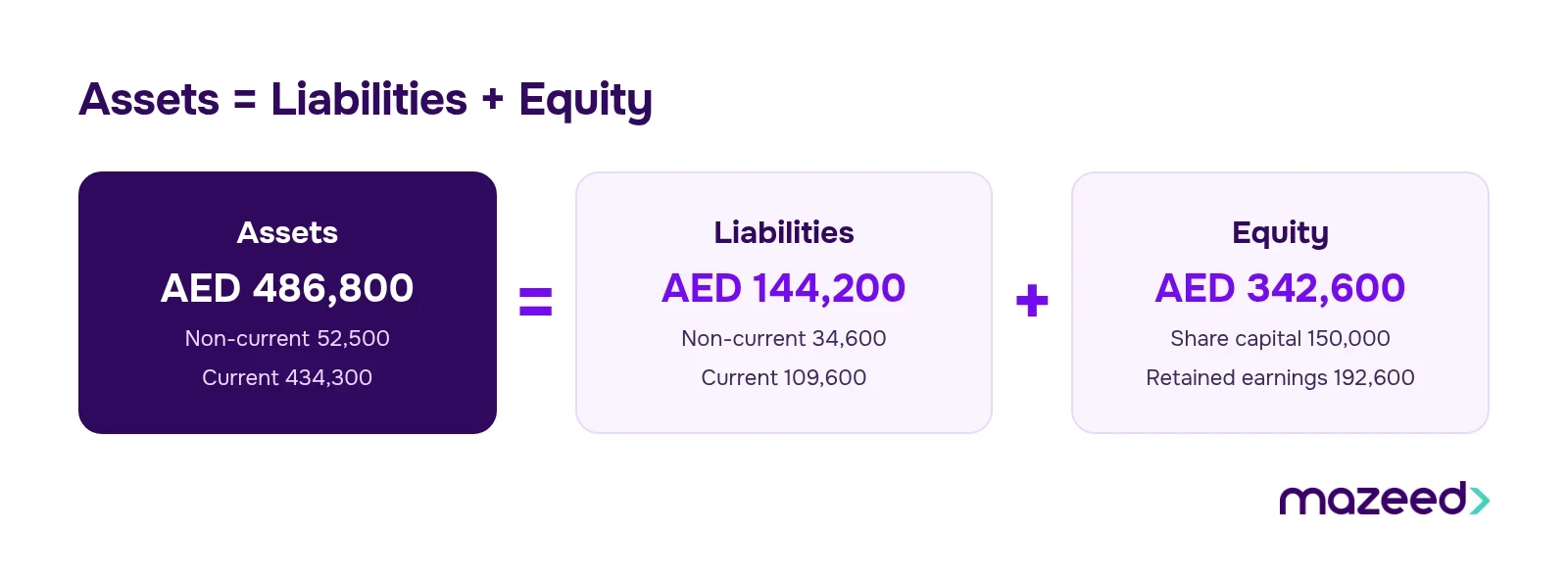
Balance sheet example for a UAE company
This is the balance sheet of the same Dubai trading company used in our trial balance example, at 31 December 2026, in AED. Profit for the year of AED 130,650 has been added to retained earnings.
| Statement of financial position at 31 December 2026 | AED |
|---|---|
| Non-current assets | |
| Office equipment, at cost | 75,000 |
| Less accumulated depreciation | (22,500) |
| Total non-current assets | 52,500 |
| Current assets | |
| Inventory | 98,300 |
| Trade receivables | 142,750 |
| VAT recoverable | 6,850 |
| Cash and bank balances | 186,400 |
| Total current assets | 434,300 |
| Total assets | 486,800 |
| Non-current liabilities | |
| Provision for end of service benefits | 34,600 |
| Current liabilities | |
| Trade payables | 91,200 |
| VAT payable | 18,400 |
| Total current liabilities | 109,600 |
| Total liabilities | 144,200 |
| Equity | |
| Share capital | 150,000 |
| Retained earnings (61,950 opening + 130,650 profit) | 192,600 |
| Total equity | 342,600 |
| Total liabilities and equity | 486,800 |
Total assets of AED 486,800 equal total liabilities and equity of AED 486,800, so the balance sheet balances.
Two UAE details are worth pointing out. First, there is no Corporate Tax payable: the company's profit is below AED 375,000, the band taxed at 0% under the Corporate Tax Law, assuming no tax adjustments push it higher. Second, many companies show VAT as a single net figure (here AED 11,550 payable) rather than gross recoverable and payable lines, because the two are settled together in one VAT return.
Free balance sheet template
Copy this structure into your spreadsheet or reporting tool:
| Line | Current year (AED) | Prior year (AED) |
|---|---|---|
| Property, plant and equipment | ||
| Right-of-use assets | ||
| Intangible assets | ||
| Total non-current assets | ||
| Inventory | ||
| Trade and other receivables | ||
| Prepayments and advances | ||
| VAT recoverable | ||
| Cash and bank balances | ||
| Total current assets | ||
| Total assets | ||
| Borrowings (non-current) | ||
| Lease liabilities (non-current) | ||
| Provision for end of service benefits | ||
| Total non-current liabilities | ||
| Trade and other payables | ||
| VAT payable | ||
| Corporate Tax payable | ||
| Borrowings and lease liabilities (current) | ||
| Total current liabilities | ||
| Total liabilities | ||
| Share capital | ||
| Reserves | ||
| Retained earnings | ||
| Total equity | ||
| Total liabilities and equity |
IFRS requires comparative figures for the previous year, which is why the template has two columns.
What changes with IFRS 18 in 2027?
The IFRS Foundation issued IFRS 18 Presentation and Disclosure in Financial Statements in April 2024. It replaces IAS 1 for annual reporting periods beginning on or after 1 January 2027, with earlier application permitted. For a company with a calendar year end, the first full year under IFRS 18 is 2027, with 2026 comparatives restated.
For the balance sheet, the impact is modest; IFRS 18 carries forward many IAS 1 requirements. The bigger changes are in the profit and loss statement, which gets new categories and subtotals. IFRS 18 also brings stronger rules on grouping information, so very large "other" lines will need more breakdown.
How to read a balance sheet: four quick checks
| Check | Formula | Example figure |
|---|---|---|
| Current ratio | Current assets / current liabilities | 434,300 / 109,600 = 3.96 |
| Quick ratio | (Current assets minus inventory) / current liabilities | 336,000 / 109,600 = 3.07 |
| Debt to equity | Total liabilities / total equity | 144,200 / 342,600 = 0.42 |
| Working capital | Current assets minus current liabilities | AED 324,700 |
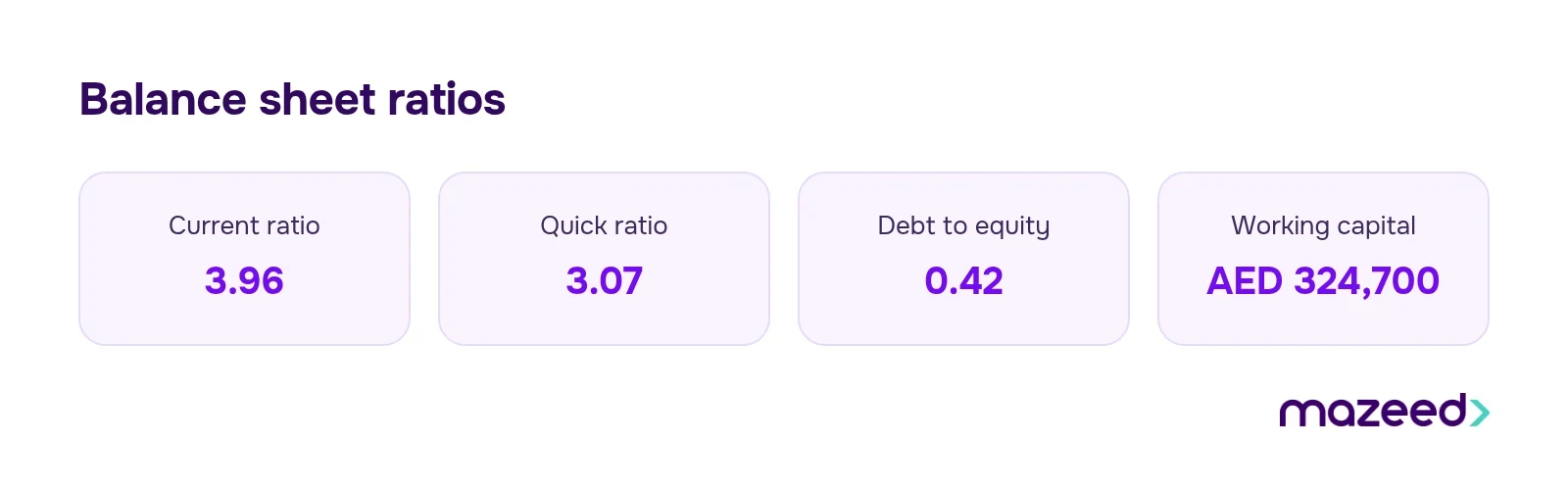
A current ratio well above 1 suggests the company can cover its short-term obligations. The figures above show a business with strong liquidity and low leverage.
Common balance sheet mistakes
- Missing the end of service provision. UAE employers build up gratuity obligations every month; leaving them off understates liabilities.
- Not reconciling VAT accounts. VAT balances should agree with the latest VAT return and payments.
- Ignoring leases. Office and warehouse leases usually create right-of-use assets and lease liabilities under IFRS 16.
- Out-of-date fixed assets. Keep a fixed asset register so disposals and depreciation are reflected.
- Netting things that should be gross. Bank overdrafts should not simply be netted against cash in another bank.
How mazeed helps
mazeed's financial reporting software produces a balance sheet in this format from your ledger at any date, with prior-period comparatives, so month-end reporting does not need a spreadsheet.
This article is general information. It is not accounting, tax or legal advice; for your specific case, speak to a qualified accountant.