

A trial balance is a list of every account in a company's general ledger with its closing debit or credit balance at a specific date. Because every transaction in double-entry bookkeeping has equal debits and credits, the two columns of a correct trial balance add up to the same total. Accountants prepare it at month end and year end to check the books are arithmetically sound before producing the balance sheet and profit and loss statement.
What is a trial balance used for?
The trial balance sits between bookkeeping and reporting. It is used to:
- Check arithmetic accuracy. Equal totals confirm every journal entry was posted with equal debits and credits.
- Prepare financial statements. Every line in the balance sheet and the profit and loss statement is built from trial balance accounts.
- Review balances quickly. One page shows if something looks wrong, for example a credit balance on a bank account that should be in funds.
- Support audits and tax filings. Auditors start from the trial balance, and it is the bridge between your ledger and your Corporate Tax return.
In the UAE, Ministerial Decision No. 114 of 2023 requires financial statements for Corporate Tax to follow IFRS, or IFRS for SMEs for businesses with revenue up to AED 50 million. Those statements come from your trial balance, so its accuracy flows straight into your tax position.
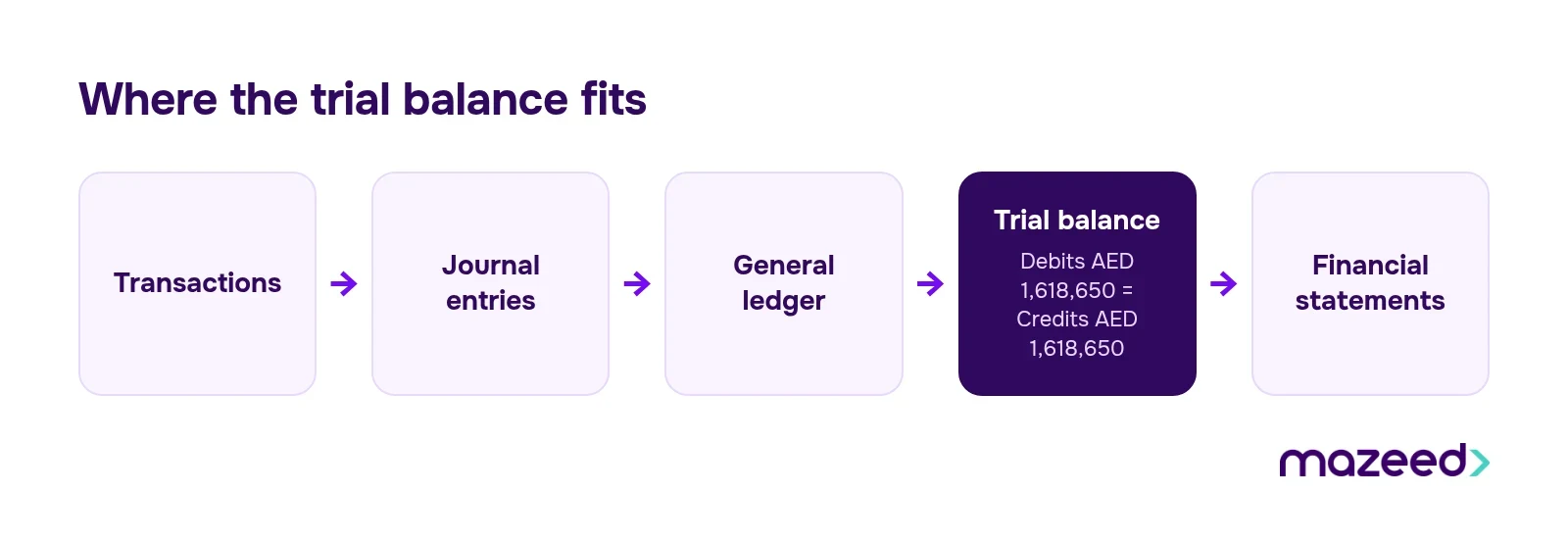
How do you prepare a trial balance?
- Post every transaction to the general ledger. Sales, purchases, payroll, bank payments and journal entries for the period must all be recorded. If you need a refresher, read our guide to the general ledger.
- Close each account. Work out the closing balance of every ledger account at the period end date.
- List the accounts in chart of accounts order. Assets, liabilities, equity, revenue and expenses, in the order of your chart of accounts.
- Put each balance in the right column. Assets and expenses normally carry debit balances; liabilities, equity and revenue normally carry credit balances.
- Total both columns. If they agree, the trial balance balances.
- Investigate any difference. Find and correct the error before moving on.
Trial balance example for a UAE company
Here is the unadjusted trial balance of a small Dubai trading company at 31 December 2026, in AED.
| Account | Debit | Credit |
|---|---|---|
| Cash at bank | 186,400 | |
| Accounts receivable | 142,750 | |
| Inventory | 98,300 | |
| Input VAT recoverable | 6,850 | |
| Office equipment | 75,000 | |
| Accumulated depreciation | 22,500 | |
| Accounts payable | 91,200 | |
| Output VAT payable | 18,400 | |
| End of service benefits provision | 34,600 | |
| Share capital | 150,000 | |
| Retained earnings (opening) | 61,950 | |
| Sales | 1,240,000 | |
| Cost of goods sold | 742,000 | |
| Salaries and wages | 228,000 | |
| Rent | 84,000 | |
| Utilities and telecom | 21,600 | |
| Depreciation expense | 15,000 | |
| Bank charges | 3,750 | |
| Marketing | 15,000 | |
| Total | 1,618,650 | 1,618,650 |
Both columns total AED 1,618,650, so the books are arithmetically in balance. Notice the UAE-specific lines: input and output VAT, and the end of service benefits provision that most UAE employers carry for gratuity. For how inventory cost moves into cost of goods sold, see cost of goods sold entry in the trial balance.
What are the three types of trial balance?
| Type | When it is prepared | What it includes |
|---|---|---|
| Unadjusted trial balance | Right after all transactions are posted | Balances before period-end adjustments |
| Adjusted trial balance | After adjusting entries | Accruals, prepayments, depreciation, provisions and corrections included |
| Post-closing trial balance | After closing entries at year end | Only balance sheet accounts; income and expense accounts are reset to zero |
In the example above, typical adjusting entries would include an accrual for December electricity, a prepayment for rent paid in advance, and the year-end update to the end of service provision. The adjusted trial balance is the one used to prepare the balance sheet and the profit and loss statement.
What errors does a trial balance not catch?
A balanced trial balance is a good sign, not a guarantee. These errors leave debits and credits equal:
- Errors of omission: a transaction never recorded at all, such as a supplier invoice left in someone's inbox.
- Errors of commission: the right amount posted to the wrong account of the same type, such as rent posted to utilities.
- Errors of principle: a transaction recorded in the wrong class of account, such as buying a laptop booked as an expense instead of an asset.
- Compensating errors: two separate errors that cancel each other out.
- Errors of original entry: the wrong amount entered on both sides, such as AED 5,400 recorded as AED 4,500.
- Complete reversal: the debit and credit accounts swapped.
This is why accountants also reconcile bank accounts, review receivables and payables, and compare the VAT accounts with the VAT return.
How do you find an error when the trial balance does not balance?
- Re-add both columns. Simple addition errors are common in manual trial balances.
- Check the difference. If it is divisible by 9, a transposition such as 54 entered as 45 is likely. If it equals one balance, an account may be missing.
- Halve the difference. If half the difference matches an amount, it may have been posted to the wrong side.
- Check that every balance is in the right column.
- Trace recent journal entries back to the ledger, especially manual ones.
Accounting software removes most of these problems, because it will not post an unbalanced entry.
Where does the trial balance fit in the month-end close?
A reliable month-end close follows the same order every time, and the trial balance appears twice in it:
- Record everything. Post all sales invoices, supplier bills, payroll and expense claims for the month.
- Reconcile the bank. Match every bank line to the ledger, so cash is right before anything else.
- Run the unadjusted trial balance. Check it balances and scan for odd balances, such as negative inventory or a supplier with a debit balance.
- Post adjustments. Accruals for bills not yet received, prepayments, depreciation, the end of service provision and any corrections found in step 3.
- Run the adjusted trial balance. This is the version you report from.
- Reconcile control accounts. Receivables and payables in the trial balance should equal the customer and supplier aging totals; VAT accounts should match the VAT working.
- Produce the reports. Balance sheet, profit and loss and management reports come straight from the adjusted trial balance.
- Lock the period. Prevent back-dated changes once the month is signed off.
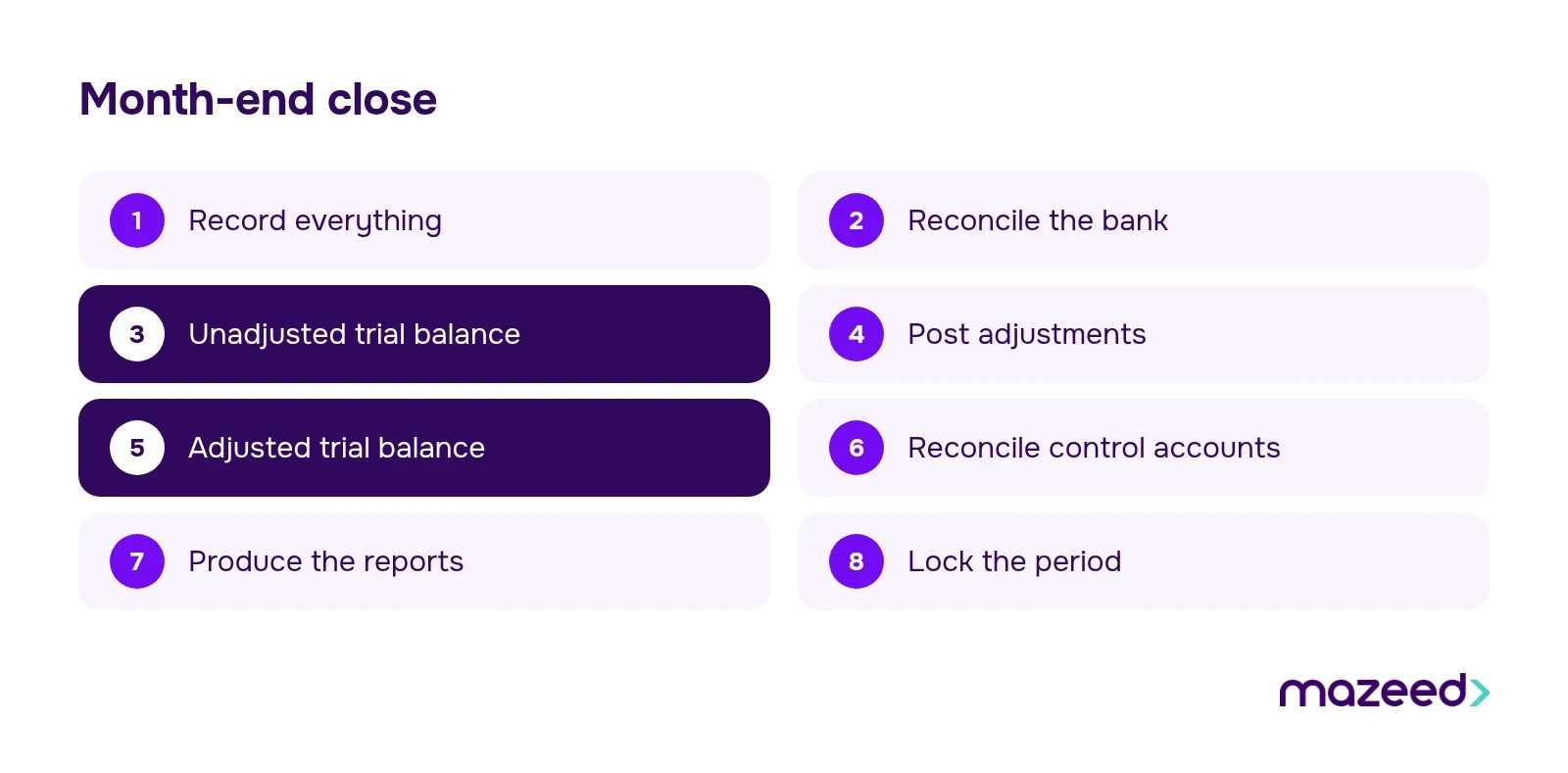
Teams that follow this order every month find the year-end close becomes a twelfth month-end close rather than a separate project.
Trial balance and UAE compliance
The trial balance is also where tax checks start. Before each VAT return, compare the output and input VAT balances in the trial balance with the return figures; differences usually point to an invoice in the wrong period. Before your Corporate Tax return, the adjusted trial balance shows the accounting profit that tax adjustments are made to. Businesses with revenue above AED 50 million, and all qualifying free zone persons, must also have audited financial statements for Corporate Tax, and auditors will request the trial balance first.
How mazeed helps
In mazeed's financial reporting software, the trial balance is always up to date because every invoice, bill and bank transaction posts to the ledger as it happens, with equal debits and credits enforced.
This article is general information. It is not accounting, tax or legal advice; for your specific case, speak to a qualified accountant.