
An invoice goes out. Then the customer returns half the order, or you discover you charged the wrong rate, or a discount was agreed after the fact.
You can’t just delete the invoice and issue a new one. Under UAE VAT rules, once a tax invoice has been issued, the correction has to leave a trail, and that trail is the credit note.
This guide covers what credit and debit notes are, when each applies, the fields they must contain, and how they work under e-invoicing.
What is a credit note?
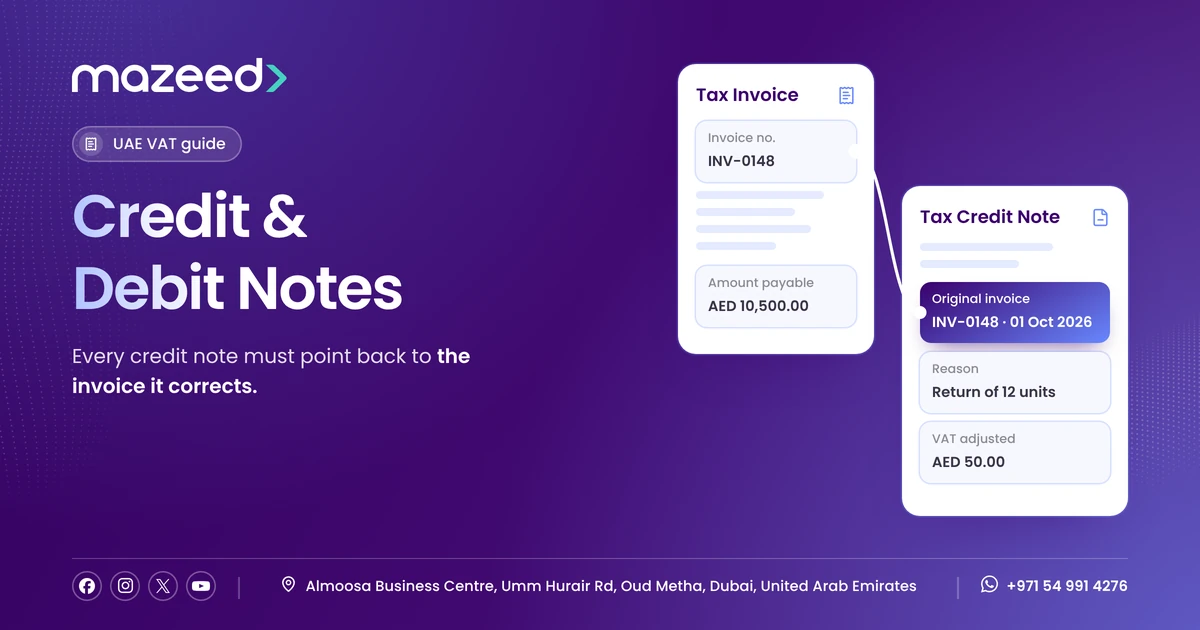
A credit note is a document that reduces the value of a previously issued tax invoice. It’s issued by the supplier to the customer, and it adjusts both parties’ VAT position: your output VAT goes down, and your customer’s recoverable input VAT goes down by the same amount.
That symmetry is the whole point. The FTA matches what you declared against what your customer claimed. A credit note keeps both sides aligned after a change.
When to issue a credit note
Article 61 of the VAT Law lists the events that require a supplier to adjust output VAT. In practice, these are:
Goods returned by the customer, in whole or in part
Services cancelled or not fully provided
A discount agreed after invoicing, such as volume rebates, early-settlement discounts, or negotiated reductions
Overcharging: wrong price, wrong quantity, wrong VAT rate applied
An error in the original invoice that overstates the value, including VAT charged or a tax treatment applied in error
A transaction cancelled entirely after the invoice was issued
The common factor: the amount actually payable turns out to be less than the invoice said.
What about debit notes?
A debit note is the commercial term for the opposite document: one that increases the amount payable on an earlier invoice. It applies when:
Additional goods or services are supplied against the same order
You undercharged: wrong price or quantity in your favour
VAT was applied at too low a rate, or omitted
Additional costs were agreed after the original invoice
The UAE VAT legislation doesn’t set out a separate “tax debit note” the way it does for credit notes. When the output VAT due on a supply is higher than what you charged, Article 62.1 of the VAT Law requires you to issue a new tax invoice for the additional amount, and the additional VAT is accounted for in the period in which the change or error is identified.
In practice: whatever your system calls it, issue the increase as a tax invoice that meets every tax invoice requirement and clearly references the original invoice. If it’s a completely different sales transaction rather than a change to an earlier one, issue a new sales invoice as normal.
Credit note vs. debit note at a glance
Credit note | Debit note / additional invoice | |
|---|---|---|
Effect on invoice value | Decreases | Increases |
UAE VAT document | Tax Credit Note | Additional tax invoice |
Usually issued by | Supplier | Supplier |
Your output VAT | Decreases | Increases |
Customer’s input VAT | Decreases | Increases |
Typical trigger | Return, discount, overcharge | Extra supply, undercharge |
What must a tax credit note contain?
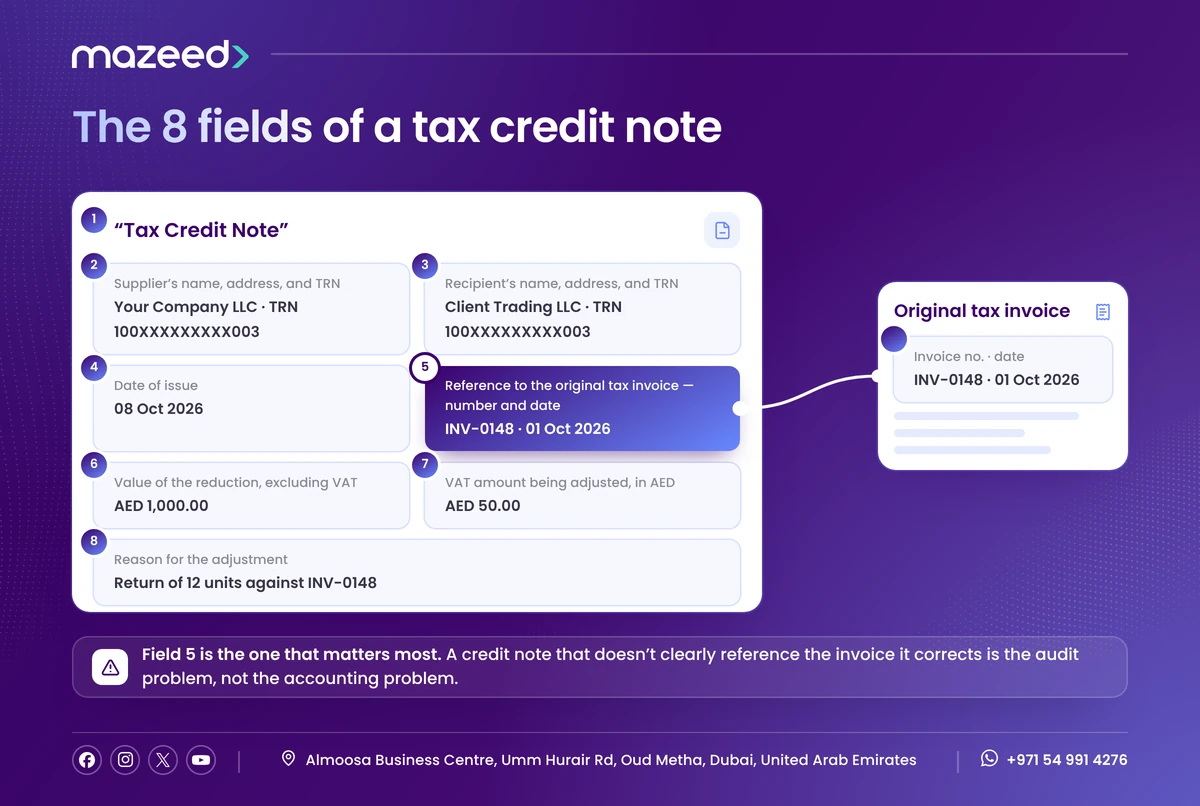
The content requirements are set out in Article 60 of the VAT Executive Regulation. A tax credit note generally must show:
The words “Tax Credit Note” displayed clearly
A unique serial number
Supplier’s name, address, and TRN
Recipient’s name, address, and TRN, where the recipient is VAT-registered
Date of issue
Reference to the original tax invoice: the invoice number and date it relates to
The value of the reduction, excluding VAT
The VAT amount being adjusted, in AED
The reason for the adjustment
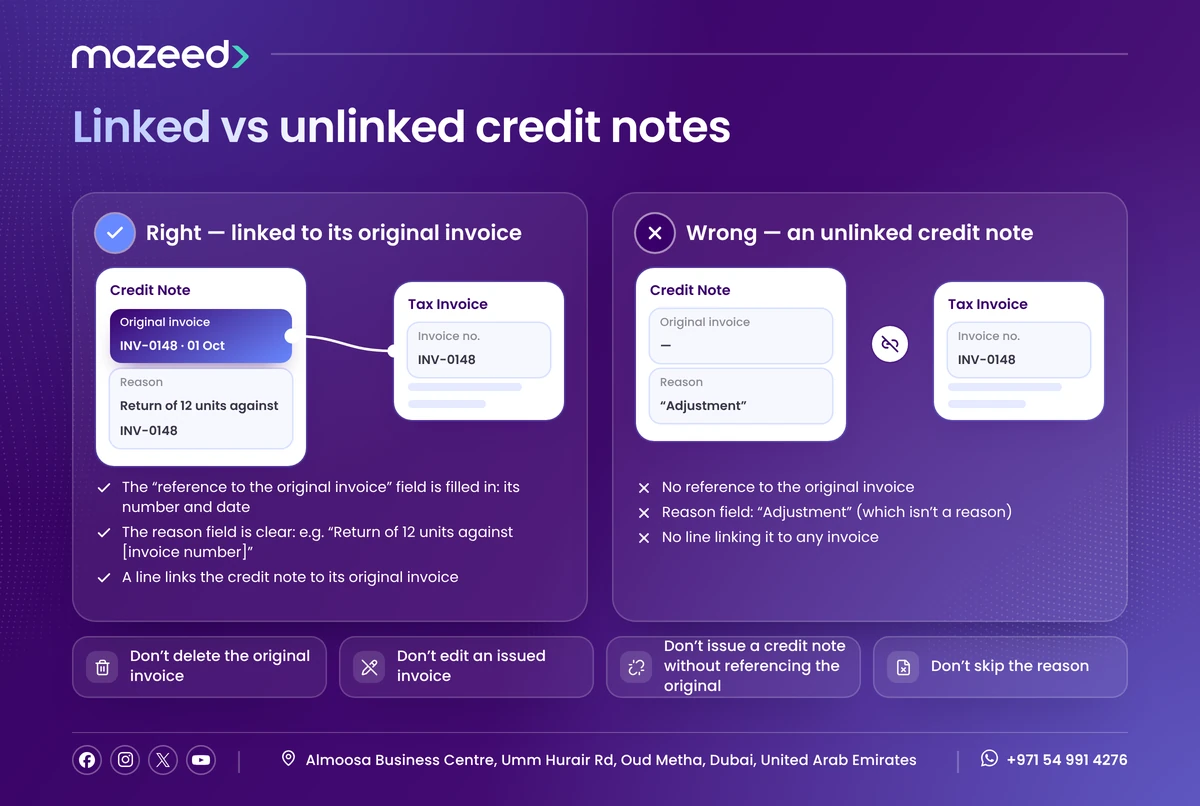
The reference to the original invoice is the one that matters most. A credit note that doesn’t clearly reference the invoice it corrects is an audit problem, not just an accounting one. The FTA needs to trace the adjustment back to the original transaction, and a floating credit note with no link is exactly the kind of gap that turns a routine audit into a lengthy one.
For the fields required on the original invoice, see our guide to the UAE tax invoice format.
Time limits
A tax credit note must be issued within 14 days of the event that triggers the adjustment.
The clock runs from the triggering event itself, such as the return or the agreed discount, not from the date of the original invoice and not from when your finance team gets around to processing it. This catches out businesses that process returns in batches or reconcile disputes slowly.
How credit notes affect your VAT return
A credit note reduces your output VAT in the period the adjustment is made, and your customer correspondingly reduces the input VAT they’ve claimed.
Two practical points:
The customer must adjust too. If the customer has already claimed the input VAT, they must adjust it once they receive the credit note. Delays create mismatches between what you’ve declared and what they’ve claimed, and mismatches invite questions.
Genuine post-supply changes land in the later period. For returns, agreed discounts and price changes, the credit note is reflected in the VAT period in which it’s issued. You don’t reopen and refile the earlier return.
Errors are different. KPMG reports that where a supply was wrongly treated, for example reported as zero-rated when it should have been standard-rated, the FTA’s position in private clarifications is that the correction should be made through a voluntary disclosure for the original period where the VAT difference exceeds AED 10,000, even if the credit note and replacement invoice are issued later. The corrective documents must still be issued to keep the audit trail. If you’re correcting a material error rather than adjusting a genuine change, take advice before you decide which route applies.
Our guide to VAT return filing covers how these adjustments flow through to your return.
What not to do
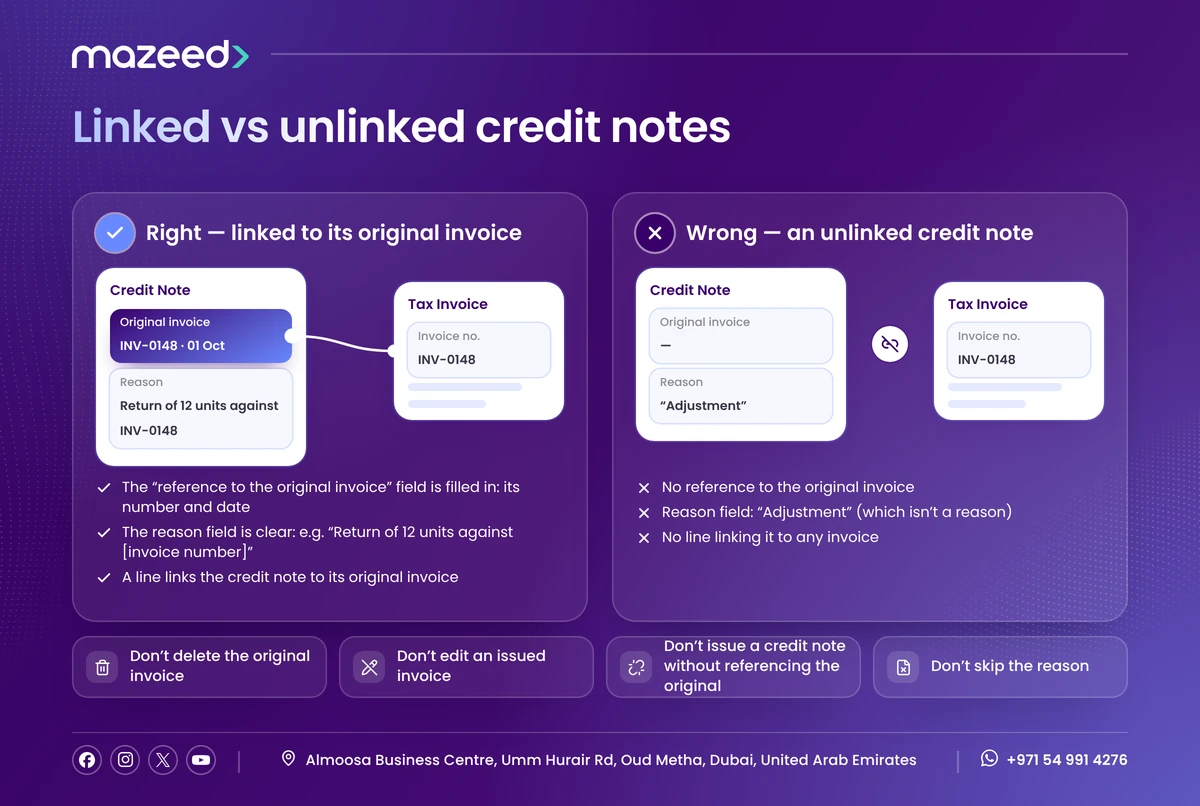
Don’t delete the original invoice. Sequential numbering is a requirement, and a gap in the sequence is a visible audit flag. If an invoice was issued in error, credit it. Don’t erase it.
Don’t edit an issued invoice. Overwriting a PDF and resending it leaves no record that anything changed. If the customer has already recorded the original, you now have two versions of one transaction in circulation.
Don’t issue a credit note without referencing the original. An unlinked credit note is a reduction the FTA can’t trace.
Don’t use a credit note to write off bad debt. Non-payment is a different situation from a reduction in the value supplied. Bad debt relief is a separate mechanism under Article 64 of the VAT Law, and the FTA’s clarification VATP024 sets out four conditions: VAT was charged and accounted for, the consideration was written off in your accounts in full or in part, more than six months have passed since the supply, and you’ve notified the customer of the amount written off.
Don’t skip the reason. “Adjustment” isn’t a reason. “Return of 12 units against INV-4821” is.
Credit notes under e-invoicing
Under the UAE’s e-invoicing framework, credit notes aren’t an afterthought. They’re part of the same structured exchange as invoices, and electronic credit notes are used for cancellations, refunds, price adjustments and errors.
Where things stand as of October 2026:
The pilot opened in July 2026.
Businesses with annual revenue of AED 50 million or more must appoint an Accredited Service Provider by 30 October 2026, with mandatory e-invoicing from 1 January 2027.
Other in-scope businesses follow with an appointment deadline of 31 March 2027 and mandatory e-invoicing from 1 July 2027.
The framework covers B2B and B2G transactions, under Ministerial Decisions 243 and 244 of 2025.
What changes in practice for credit notes:
The link to the original invoice becomes a structured data field, not a line of text someone typed.
Credit notes are transmitted through your Accredited Service Provider, on the same path as invoices.
Electronic credit notes are subject to the same 14-day window.
Tax data is reported to the FTA as part of the exchange, rather than surfacing only in your periodic return.
This is a meaningful improvement for anyone who has ever untangled a set of credit notes with vague references. The link that today depends on someone typing the right invoice number becomes a structural requirement.
Our guide to e-invoicing in the UAE covers how the framework works.
Getting the process right
For most businesses the failure isn’t understanding the rules. It’s the gap between the sales team agreeing a discount and finance issuing the credit note three weeks later against the wrong invoice.
A few things that prevent this:
Issue credit notes from the same system as invoices, so the reference is selected rather than typed
Require a reason field, not optional
Set a processing deadline internally, well inside the 14-day limit
Reconcile monthly: every credit note should match an invoice, and every agreed return should have a credit note
Frequently asked questions
What is a credit note in UAE VAT?
A tax credit note is a document that reduces the value of a previously issued tax invoice, adjusting the VAT position of both supplier and customer. It must reference the original invoice.
What is the difference between a credit note and a debit note?
A credit note reduces the value of an invoice; a debit note increases it. Credit notes typically follow returns, discounts, or overcharges. Increases follow undercharges or additional supplies, and under the VAT Law they’re handled by issuing a new tax invoice for the additional amount.
Can I cancel a tax invoice instead of issuing a credit note?
No. Issued tax invoices shouldn’t be deleted. Doing so breaks sequential numbering and removes the audit trail. Issue a credit note for the full value instead.
What must a tax credit note include?
The words “Tax Credit Note,” a unique serial number, supplier and recipient details with TRNs where applicable, the date of issue, a reference to the original invoice, the value of the reduction, the VAT adjustment in AED, and the reason.
How long do I have to issue a credit note?
14 days from the event that triggers the adjustment, not from the date of the original invoice.
Does a credit note need a TRN?
Yes: the supplier’s TRN, and the recipient’s where they’re VAT-registered, in the same way as a tax invoice. See our guide to the TRN.
Can a credit note be issued against multiple invoices?
The VAT legislation doesn’t expressly address this. As a general principle, each adjustment should be traceable to the invoice it relates to, so the safest approach is one credit note per invoice, or a single credit note that clearly itemises each invoice it adjusts.
How do credit notes affect my VAT return?
They reduce output VAT in the period the adjustment is made, and your customer reduces their claimed input VAT correspondingly. Corrections of errors may need a voluntary disclosure instead.
Do I need a credit note for a bad debt?
No. Bad debt relief is a separate mechanism under Article 64 of the VAT Law, with its own conditions, including a six-month wait from the date of supply and written notice to the customer.
Credit notes that link themselves
In Mazeed, a credit note is created from the invoice it corrects, so the reference, the customer details, and the VAT adjustment carry across automatically, and the audit trail holds.