
Most businesses get VAT registration wrong in one of two directions: they register when they didn’t need to, or they miss the point at which registration became mandatory and pick up a penalty for late registration.
Both are avoidable. This guide covers who has to register, who can choose to, the documents you’ll need, how the application works, and what happens after you’re registered.
Who needs to register for VAT in the UAE?
There are two categories, and the distinction matters commercially as much as legally.
Mandatory registration
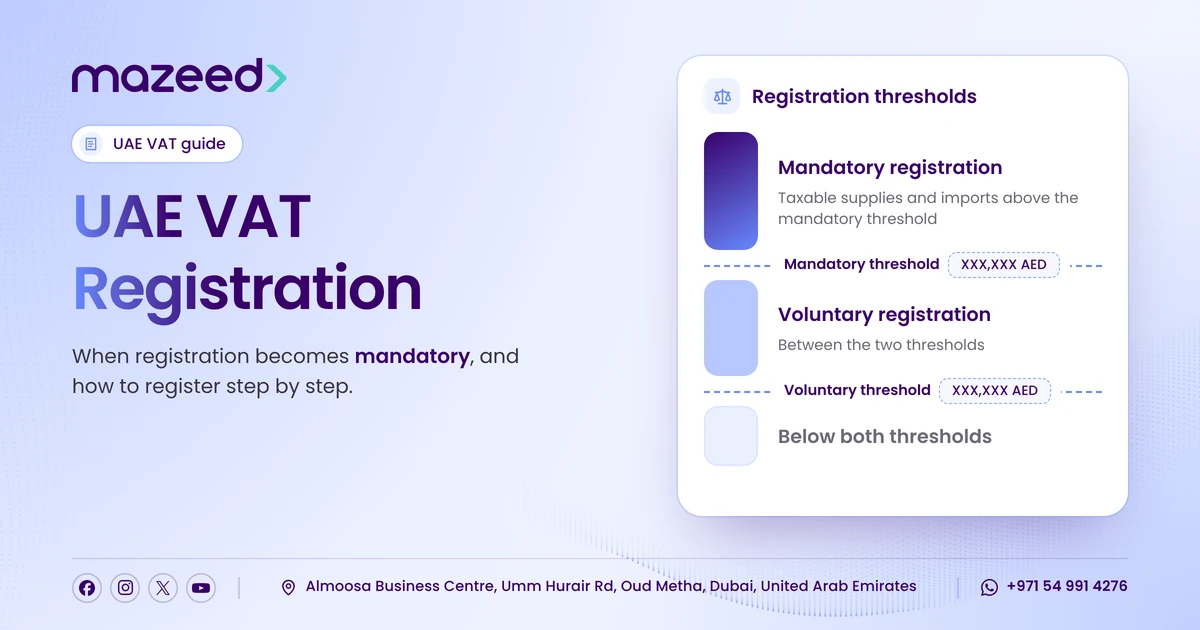
For a UAE-resident business, registration is mandatory when taxable supplies and imports exceed AED 375,000 during the previous 12 months, or are expected to exceed it within the next 30 days. Two tests apply:
Looking back: your taxable supplies and imports over the previous 12 months exceeded the threshold
Looking forward: you expect them to exceed the threshold within the next 30 days
The forward-looking test catches businesses out. You don’t wait until you’ve crossed the line. If you can reasonably anticipate crossing it, the obligation starts then.
Voluntary registration
You may choose to register if your taxable supplies and imports, or your taxable expenses, exceed AED 187,500, even where you’re below the mandatory threshold. The FTA expects voluntary registrants to be genuinely carrying on business in the UAE and to intend to make taxable supplies.
Note the “or expenses” part. A business in its early stages with significant costs but limited revenue can often register voluntarily on the strength of its expenses alone.
Should you register voluntarily?
It’s a genuine trade-off, not an obvious yes.
Arguments for:
You can recover input VAT on your purchases and expenses
B2B customers often prefer suppliers who can issue tax invoices, since it lets them recover the VAT
It avoids a disruptive mid-year transition when you eventually cross the mandatory threshold
Arguments against:
You must charge 5% VAT, which makes you more expensive to customers who can’t recover it, a real issue if you sell to consumers
You take on ongoing filing obligations and the administrative cost that comes with them
Deregistering later isn’t automatic and has its own conditions
The short version: if you sell mainly to VAT-registered businesses, voluntary registration usually helps. If you sell mainly to consumers, it usually costs you.
What counts as taxable turnover?
This is where miscalculation happens. Taxable turnover isn’t the same as revenue on your P&L.
For the threshold calculation, taxable turnover covers standard-rated and zero-rated supplies plus imports of goods and services, and can include supplies made by related parties and by a business you’ve acquired. The value of supplies of capital assets is excluded.
Counts toward the threshold:
Standard-rated supplies (currently at 5%)
Zero-rated supplies
Imported goods and services subject to reverse charge
The value of supplies made by a related party, where relevant
Generally excluded:
Exempt supplies
Supplies made outside the scope of UAE VAT
The sale of capital assets
Zero-rated supplies count toward the threshold even though the VAT charged on them is 0%. Exporters sometimes assume the opposite and register late as a result.
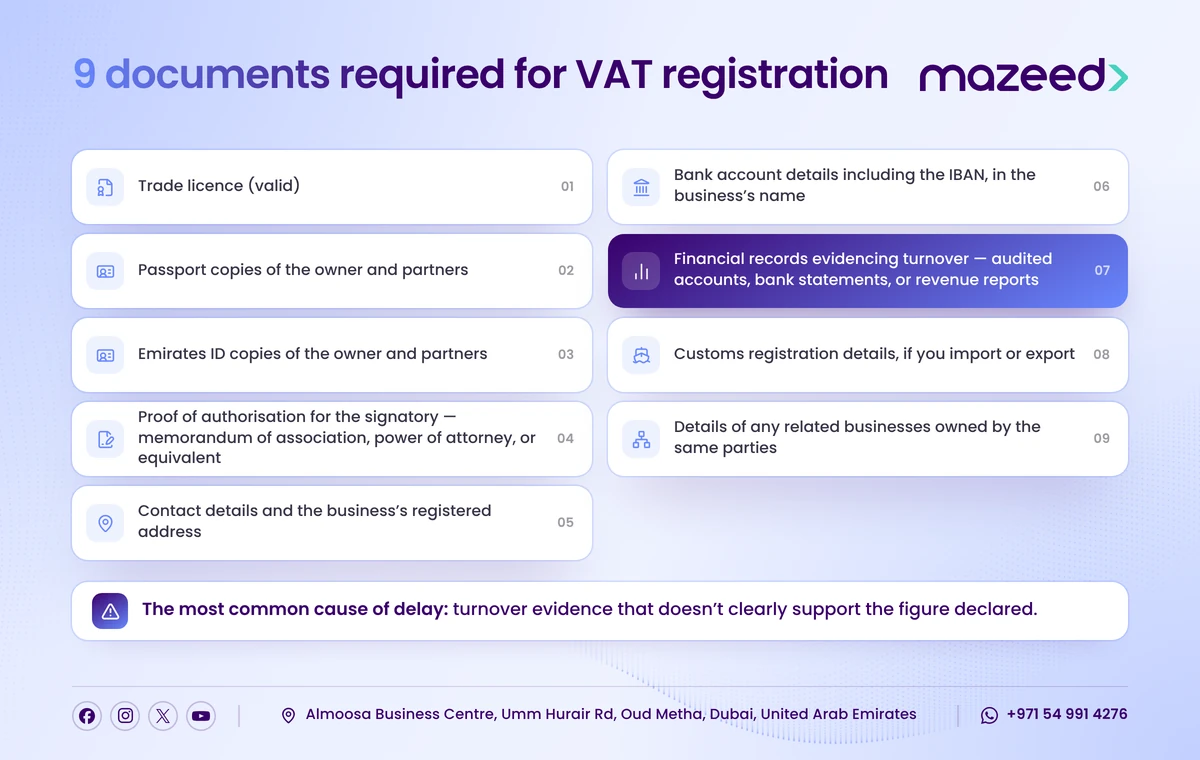
Documents required for VAT registration in the UAE
The required documents vary by entity type and change over time, so check them against the EmaraTax application before you start. Typically you’ll need:
Certificate of Incorporation, Memorandum of Association, or Partnership Agreement (if applicable)
Commercial registration certificate, or any official document issued by the licensing authority
A valid trade licence, along with branch licences (if any)
Emirates ID and passport copies of owners and authorised signatories
Power of attorney for the authorised signatory, required if the manager’s name is not mentioned in the Memorandum of Association or when adding other individuals as authorised signatories
Official declaration letter stating the total taxable supplies and monthly sales from the date of establishment until the date of application, stamped and signed by the authorised signatory
Supporting documents, including invoices, local purchase orders, contracts, ownership deeds, completion certificates, and lease agreements, as applicable to the type of application
For expenses: at least five VAT invoices with amounts exceeding the registration threshold
Expected revenues supported by valid documents, such as purchase orders or contracts, duly stamped and signed by both parties
Bank letter detailing the bank account information (optional). For legal entities, the account must be in the company’s name. For individuals, a personal or sole establishment account can be used
Customs information (if applicable)
Registration documents and supporting evidence for clubs, charities, or associations (when selecting “Legal Person – Club, Charity, or Association”)
Copy of the Decree (when selecting “Legal Person – Federal Government Entity in the UAE” or “Legal Person – Emirate-level Government Entity in the UAE”)
The most common cause of delay: turnover evidence that doesn’t clearly support the figure declared. Prepare a clean 12-month revenue summary you can reconcile to bank statements before you start the application, rather than assembling it under time pressure once the FTA queries it.
If you’re setting up a new company, our guide to VAT registration for a new company covers the early-stage questions.
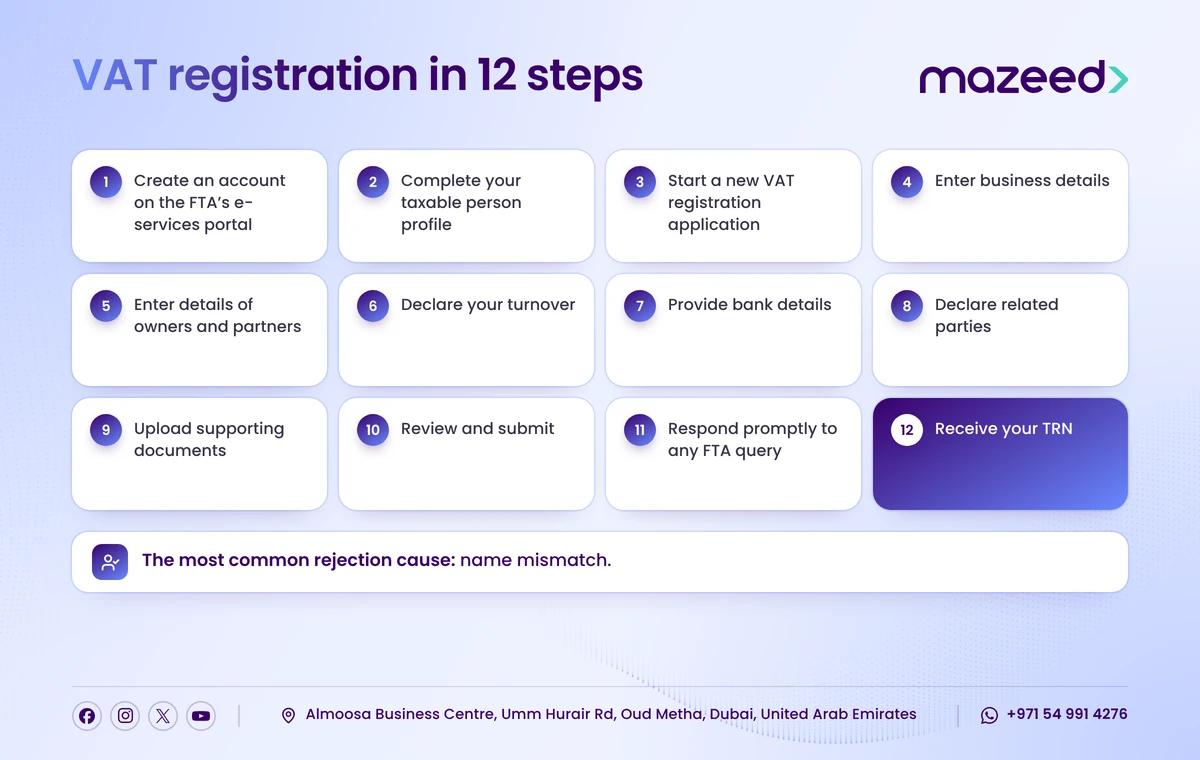
How to register for VAT: step by step
Registration is done on EmaraTax, the FTA’s e-services platform, accessed through tax.gov.ae. On EmaraTax, the sequence is: create and activate your account, log in to your dashboard, create a new taxable person profile, click “View” on that profile, then select “Register” under Value Added Tax. According to the FTA, submitting the application takes around 45 minutes, and the service is free of charge.
Create an account on the FTA’s e-services portal.
Complete your taxable person profile, the entity that will hold the registration.
Start a new VAT registration application from the dashboard.
Enter business details: legal name (exactly as on the trade licence), licence details, and entity type.
Enter details of owners and partners, matching identity documents exactly.
Declare your turnover, with the supporting evidence.
Provide bank details. The account must be in the registered business’s name.
Declare related parties and whether you intend to form a tax group.
Upload supporting documents in the specified formats.
Review and submit.
Respond promptly to any FTA query. Check the deadline stated in the request, and remember that processing time only runs from the date the FTA receives a completed application.
Receive your TRN on approval.
The FTA’s published processing time is 20 business days from the date it receives a completed application. Timelines depend on application completeness and whether the FTA requests further information. You must submit your application within 30 days of the date you become required to register.
The single most common rejection cause
Name mismatches. The legal name on the application, the trade licence, and the bank account must match. A trading name on the bank account where the licence shows a different legal entity will hold up the application.
After you’re registered
Your TRN becomes mandatory on invoices. Every tax invoice must carry it. See our guide to the UAE tax invoice format for the complete field list.
You start charging VAT from your effective registration date, not from when the certificate arrives. If there’s a gap, you may still owe VAT on supplies made in that period, whether or not you charged it.
You must file VAT returns quarterly by default. The FTA can assign a monthly period, which commonly applies to businesses with turnover of AED 150 million or more. Each return must be filed, and any VAT due paid, within 28 days of the end of the tax period. See our guide to VAT return filing.
You must keep records for at least five years, and longer for certain real estate records, in a retrievable form.
Your customers will verify your TRN. They should, at least. Our guide to the TRN covers how that check works from the other side.
Penalties for late registration
Under Cabinet Decision No. 40 of 2017, as amended by Cabinet Decision No. 49 of 2021, failing to submit a registration application within the timeframe set by the law carries an administrative penalty of AED 10,000. You must apply within 30 days of the date you become required to register.
Beyond the penalty itself, late registration creates a practical problem: you’re generally liable for VAT on taxable supplies made from the date registration became mandatory, including supplies where you didn’t charge VAT because you weren’t yet registered.
That VAT comes out of your margin. Customers rarely accept a retrospective 5% invoice months after the fact.
This is why the forward-looking test matters. Monitoring turnover monthly, rather than discovering the breach at year-end, is the difference between a routine registration and an unplanned cost.
VAT deregistration
You must apply to deregister where you stop making taxable supplies, or where your taxable supplies over 12 consecutive months fall below the voluntary threshold of AED 187,500 and you don’t expect to exceed it in the next 30 days.
Deadline: submit the application within 20 business days of the date the obligation arose.
Processing: the FTA generally takes around 20 business days from receipt of a completed application.
Final return: file it, and settle any tax due, within 28 days of the effective date of deregistration.
Voluntary deregistration: businesses whose taxable supplies exceed the voluntary threshold (AED 187,500) but remain below the mandatory threshold (AED 375,000) may apply to deregister voluntarily.
Late applications: a penalty of AED 1,000, with a further AED 1,000 added each month thereafter, up to a maximum of AED 10,000.
Deregistration is neither automatic nor optional when the conditions are met, and late applications attract penalties in the same way late registration does. Our VAT deregistration guide covers the process in full.
Tax groups
Related entities under common control can, subject to conditions, register as a single tax group with one TRN. Under the FTA’s tax group registration service:
Each member must be a legal person with a place of establishment or a fixed establishment in the UAE
All members must be related parties
The members’ combined taxable supplies and imports must exceed the mandatory registration threshold of AED 375,000
The FTA’s processing time for a tax group application is 20 business days from receipt of a completed application.
The practical benefit: supplies between group members generally fall outside the scope of VAT, which removes VAT from intercompany transactions and simplifies compliance across a group. The trade-off is joint liability for the group’s VAT obligations.
Worth considering if you operate multiple entities with significant transactions between them.
What e-invoicing means for newly registered businesses
If you’re registering now, it’s worth setting up with the UAE’s e-invoicing framework in mind rather than retrofitting later.
Under e-invoicing, invoices move from PDFs to structured data transmitted through an accredited network and validated automatically. Businesses that set up on spreadsheets or basic templates at registration typically face a system change later, while those that start on software producing structured data don’t.
The rollout is phased, and it covers B2B and B2G transactions:
Pilot: open since July 2026 for businesses that want to join early.
Businesses with annual revenue of AED 50 million or more: must appoint an Accredited Service Provider (ASP) by 30 October 2026 and go live by 1 January 2027.
All other in-scope VAT-registered businesses: must appoint an ASP by 31 March 2027 and go live by 1 July 2027.
Our guide to e-invoicing in the UAE covers how the framework works and what it requires.
Frequently asked questions
Who must register for VAT in the UAE?
Businesses whose taxable supplies and imports exceed the mandatory registration threshold of AED 375,000 over the previous 12 months, or that expect to exceed it within the next 30 days.
Can I register for VAT voluntarily?
Yes, if your taxable supplies or taxable expenses exceed the voluntary registration threshold of AED 187,500.
What documents are required for VAT registration in the UAE?
Generally: a certificate of incorporation, memorandum of association, or partnership agreement; a commercial registration certificate or other official document from the licensing authority; a valid trade licence (plus any branch licences); Emirates ID and passport copies of owners and authorised signatories; a power of attorney for the authorised signatory where required; a signed and stamped declaration of taxable supplies and monthly sales; supporting documents such as invoices, purchase orders, and contracts; and customs information, if applicable. A bank letter with account details is optional.
How long does VAT registration take in the UAE?
The FTA’s published processing time is 20 business days from the date it receives a completed application. Timelines depend on whether the application is complete and whether the FTA requests further information.
How long do I have to register once I cross the threshold?
30 days from the date you become required to register.
Do zero-rated supplies count toward the registration threshold?
Yes. Zero-rated supplies are taxable supplies charged at 0% and count toward the threshold. Exempt supplies generally do not.
What happens if I register late?
Administrative penalties apply, and you may be liable for VAT on supplies made from the date registration became mandatory, including supplies where VAT wasn’t charged. The penalty for late registration is AED 10,000.
Can I check whether a business is VAT registered?
Yes, using the FTA’s public TRN verification tool. See our guide to the TRN.
Do I need a UAE bank account to register?
The FTA lists a bank letter with account details as optional. If you provide one, a legal entity’s account must be in the company’s name, while an individual can use a personal or sole establishment account.
Can multiple companies register together?
Related entities under common control may register as a tax group under defined conditions, sharing a single TRN. Each member must be a legal person with a place of establishment or fixed establishment in the UAE, and all members must be related parties.
Set up right the first time
Once you’re registered, every invoice you issue has to carry your TRN, calculate VAT correctly, and hold up in an audit.
Mazeed handles that from day one: compliant tax invoices, VAT tracked automatically, and records ready when the FTA asks.