
You're a UAE resident earning income from abroad, and the payer withholds tax at source. Or you run a UAE company invoicing a client overseas, and they deduct withholding tax before paying you.
In both cases there may be a double taxation agreement between the UAE and that country that reduces or eliminates the deduction. But the other country's tax authority won't take your word for it. They need proof you're actually tax resident in the UAE.
That proof is the Tax Residency Certificate.
What is a Tax Residency Certificate?
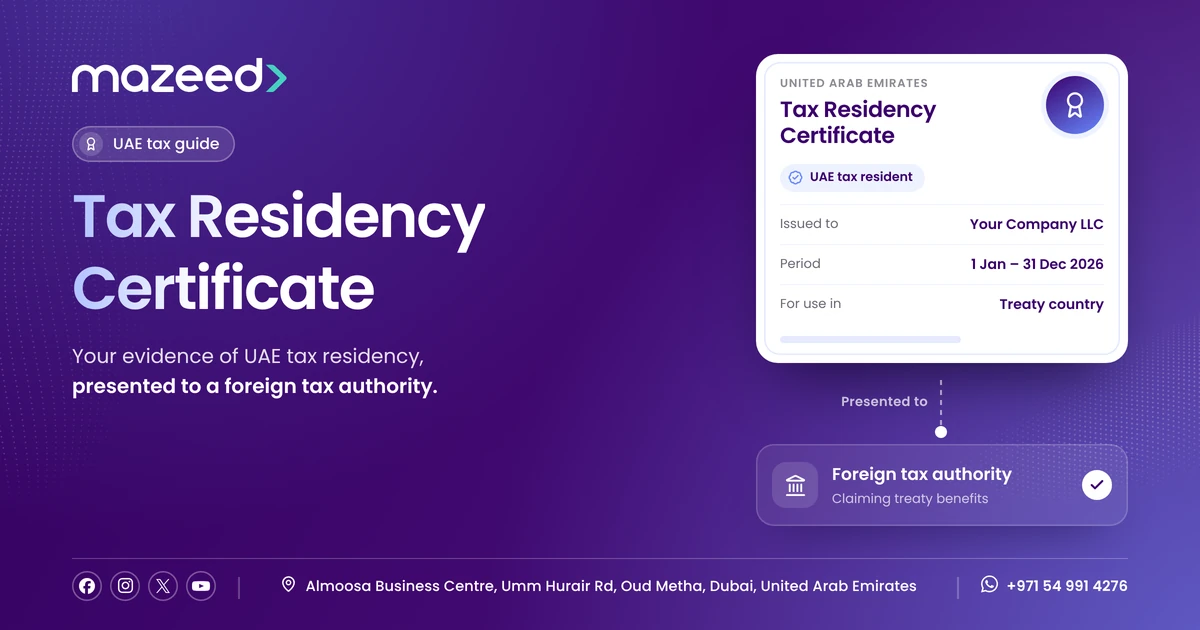
A Tax Residency Certificate (TRC), also called a Tax Domicile Certificate, is an official document issued by the Federal Tax Authority confirming that a person or company is tax resident in the UAE for a specified period.
Its purpose is narrow and specific: it lets you claim benefits under a Double Taxation Avoidance Agreement (DTAA) between the UAE and another country. The FTA can also issue it for domestic purposes.
What it does not do:
It doesn't reduce any UAE tax liability
It isn't a VAT or corporate tax registration document
It isn't a residence visa or an immigration document
It doesn't automatically grant treaty benefits, because the other country applies its own rules
Think of it as evidence you present to a foreign tax authority, not a status that changes anything domestically.
Tax Residency Certificate vs. Tax Domicile Certificate
These are the same document. "Tax Domicile Certificate" was the older name and remains in common use, which is why you'll see both terms. The FTA's official name is "Tax Residency Certificate".
Who needs one?
Companies invoicing clients in countries that apply withholding tax to cross-border payments such as service fees, royalties, interest and dividends. Without a TRC, the client's finance team typically applies the full domestic withholding rate.
Individuals who are UAE tax resident but have income sourced abroad, such as rental income, pensions, dividends, or employment income from another country.
Businesses restructuring across borders, where residency status affects the tax treatment of the group.
You don't need one if you have no cross-border income and no counterparty asking for it. It's a document you obtain for a specific purpose, not something every UAE business should hold as a matter of course.
Eligibility
The residency tests are set out in Articles 3 and 4 of Cabinet Decision No. 85 of 2022, clarified by Ministerial Decision No. 27 of 2023 and the FTA's October 2024 guide on tax residents and the TRC. These are the most consequential figures in the process, so read them carefully.
For individuals
A natural person is UAE tax resident if they meet at least one of three conditions:
They were physically present in the UAE for 183 days or more within the relevant 12 consecutive months.
They were physically present in the UAE for 90 days or more within the relevant 12 consecutive months, are a UAE or GCC national or hold a valid UAE residence permit, and either have a permanent place of residence in the UAE or carry on employment or a business in the UAE.
Their usual or primary place of residence and their centre of financial and personal interests are in the UAE.
When counting days, any part of a day spent in the UAE counts, and the days don't need to be consecutive.
A "permanent place of residence" means a furnished home or other dwelling made continuously available to you. A hotel stay or a relative's address generally won't qualify.
For companies
A juridical person is UAE tax resident if it is incorporated or otherwise formed or recognised in the UAE, including in a free zone, or is otherwise considered tax resident under other UAE tax laws. A foreign company that is effectively managed and controlled in the UAE under the Corporate Tax Law is one example.
Two limits to know about:
A UAE branch of a foreign company is not tax resident on its own, including a branch in a free zone. The foreign company itself would need to be effectively managed and controlled in the UAE.
Newly incorporated companies that haven't yet filed a Corporate Tax return generally need to have been established for 12 months before they can apply.
Treaty residency can be stricter than domestic residency
For a certificate issued for treaty purposes, each treaty sets its own residency test. Where a treaty simply refers to residency under UAE law, the Cabinet Decision criteria above apply. But meeting the domestic test does not guarantee you'll be treated as resident under a particular treaty, for example where a tie-breaker clause applies. If you're unsure, take advice before applying.
A note on substance
Tax authorities in treaty partner countries increasingly look past the certificate to whether the entity has real presence: staff, premises, decision-making. A TRC obtained for an entity with no genuine UAE activity may not achieve much when the other country examines the claim.
Documents required
The documents the FTA asks for depend on whether the certificate is for domestic purposes or for a Double Taxation Agreement and, for individuals, on which residency test applies.
For individuals
An Emirates ID and resident visa, or a passport copy and an entry and exit report from the Federal Authority for Identity and Citizenship (or a local competent government entity)
Under the 90-day test: proof of employment or business (such as a salary certificate), or proof of a permanent place of residence (such as a certified tenancy contract, or a title deed with a utility bill in your name)
Under the centre-of-interests test: a written statement explaining how your financial and personal interests are in the UAE, proof of your primary place of residence, and proof of source of income, if applicable
For a certificate issued for treaty purposes: a source of income or salary certificate, and a bank statement from a local bank covering 6 months within the financial year related to the request
For companies
A licence (such as a trade licence) and lease agreement
The Corporate Tax TRN, if applicable
The certificate of incorporation
A certified copy of the Memorandum of Association
The authorised signatory's name, Emirates ID and passport, with proof of authorisation (Establishment Contract or Power of Attorney)
Where relevant, a written statement explaining how the company is effectively managed and controlled in the UAE
For a certificate issued for treaty purposes: audited financial statements certified by an independent auditor, covering the financial year requested or the year before, and a bank statement from a local bank covering 6 months within the financial year related to the request. For domestic certificates, audited financial statements and bank statements are optional.
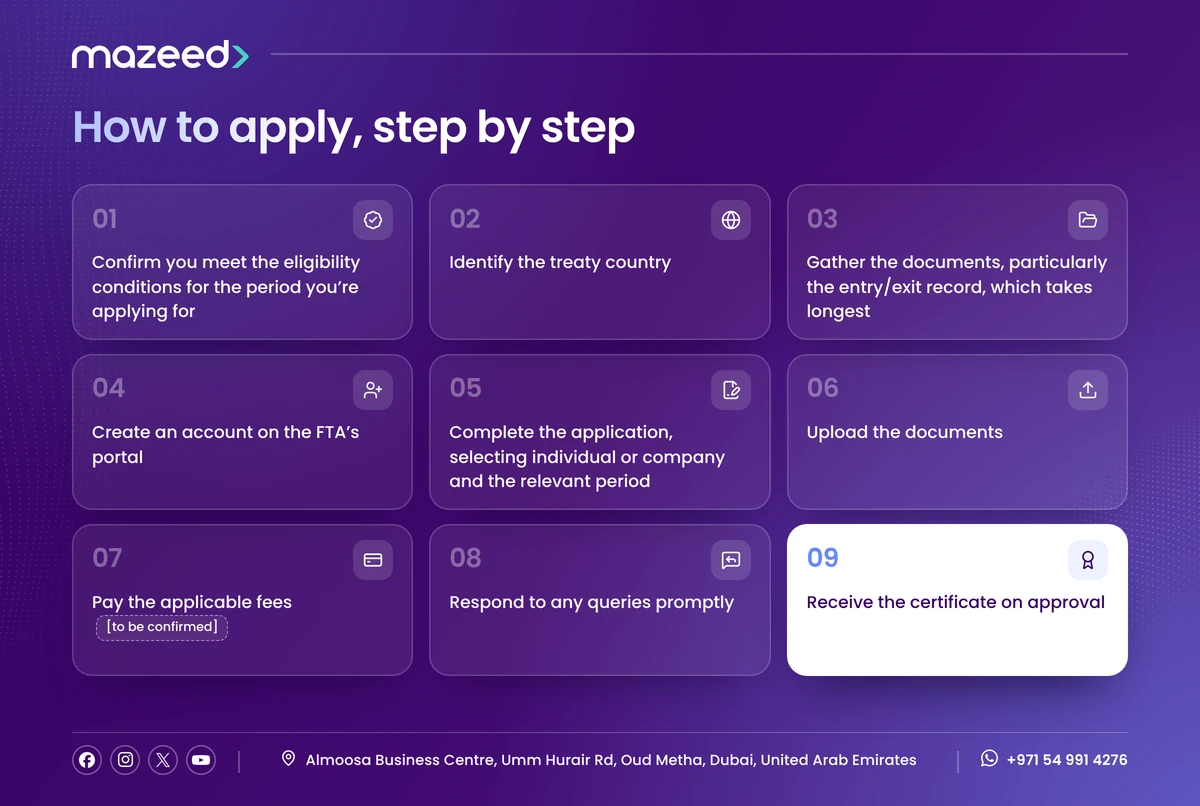
The document that most often causes delay is the entry and exit record for individuals, because it has to be obtained separately and people typically start the application without it.
How to apply
Applications are made through the FTA's EmaraTax portal.
Confirm you meet the eligibility conditions for the period you're applying for. Applying for a period you can't evidence wastes the fee.
Decide the purpose. Is the certificate for domestic purposes or for a Double Taxation Agreement? For a treaty certificate, identify the treaty country.
Gather your documents, starting with the entry and exit record, which takes longest.
Log in to EmaraTax and choose "Other Services", then "Tax Residency Certificate".
Select your Corporate Tax TRN, or "No TRN" if you don't have one.
Choose the purpose (domestic or treaty, with the treaty country) and the period, either the Tax Period or another 12-month period.
Complete the form and upload your documents.
Pay the submission fee of AED 50, which is non-refundable, and submit.
Respond to any queries promptly. If the FTA requests further information, you have 30 business days to reply.
On approval, pay the processing fee and download the certificate. It's also sent to your registered email.
Fees
Fee | Amount |
|---|---|
Submission fee (non-refundable) | AED 50 |
Processing fee, applicant with a Corporate Tax TRN | AED 500 |
Processing fee, natural person without a Corporate Tax TRN | AED 1,000 |
Processing fee, juridical person without a Corporate Tax TRN | AED 1,750 |
Each printed copy (optional) | AED 250 |
If the processing fee isn't paid within 30 business days of approval, the application may be cancelled.
Processing time
The FTA generally responds within 10 business days of receiving a completed application, with an approval, a rejection, or a request for further information. If you request printed copies, the FTA takes a further 5 business days from payment of the certificate fee, and delivers only to addresses in the UAE.
Validity and timing
A TRC covers the Tax Period or other 12-month period you select in the application, and it cannot cover more than 12 months. For individuals the tax period is the calendar year. For companies it's the financial year.
You can apply for the current period or a past period, but not a future one. For the current period, the FTA will consider an application from a company only after three months into the period, and from an individual as soon as the residency criteria are met.
In practice, that means:
You may need a new certificate each year you want to claim treaty benefits
Timing matters: apply in relation to the period the foreign income relates to, not simply the current date
Plan ahead of your counterparty's deadline. A client who needs the certificate before they can release payment without withholding won't wait indefinitely.
Common reasons applications are rejected
Insufficient days in the UAE. The day-count condition is evidential, and the entry and exit record either supports it or doesn't.
No permanent place of residence. A hotel address or a relative's address generally won't satisfy the requirement.
Incomplete or inconsistent documents. Names that don't match across the passport, visa and tenancy contract are a common cause of queries.
Applying for the wrong period. The certificate relates to a defined period, and it needs to be the one your foreign income falls in.
Insufficient company substance. For entities, evidence of genuine UAE activity matters.
What happens after you receive it
You provide the certificate to the foreign payer or tax authority, along with whatever forms that country requires.
Two things worth being clear about:
The other country decides. The TRC evidences UAE tax residency. Whether treaty benefits actually apply, and at what rate, is determined by the treaty terms and the other country's own procedures. Some jurisdictions require additional forms, local filings, or advance clearance.
Treaty terms vary by country. The UAE has agreements with many countries, and each has its own provisions on which income types are covered and at what rates. Check the relevant agreement, or take advice, rather than assuming a general rule.
How this differs from your other tax registrations
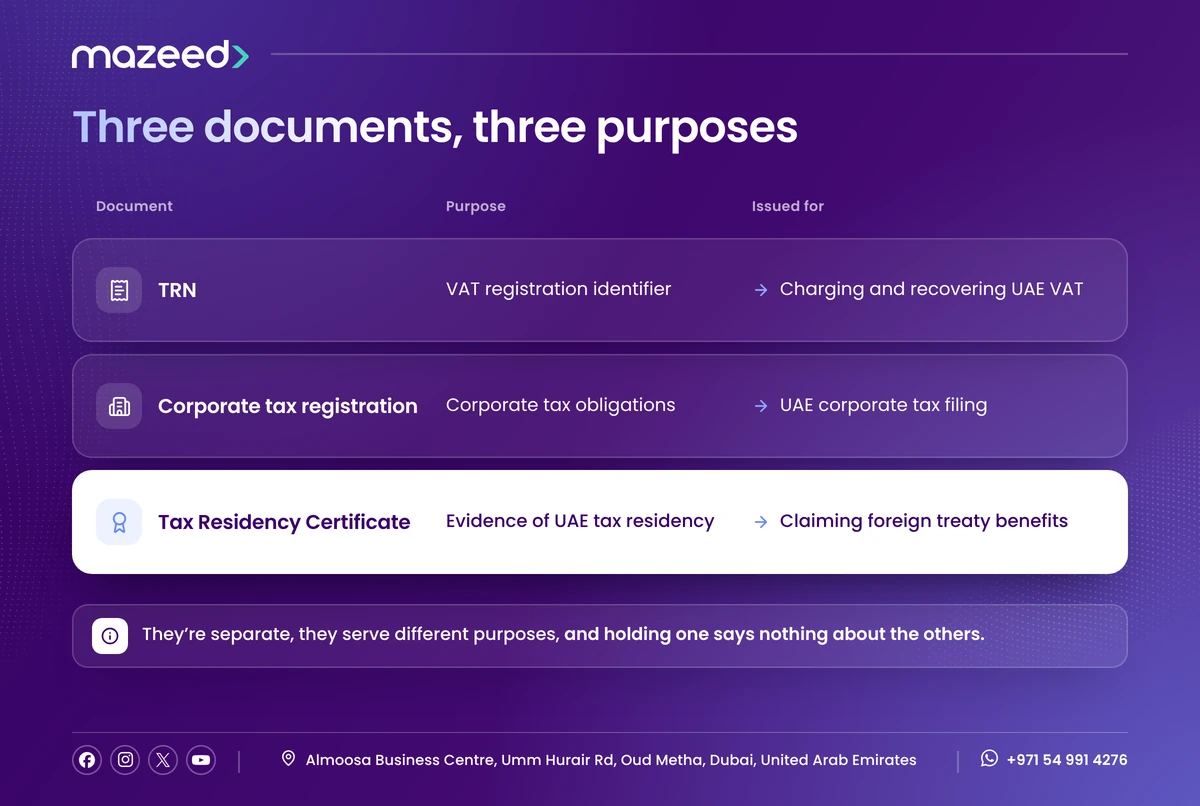
Businesses routinely confuse these, so to be explicit:
Document | Purpose | Issued for |
|---|---|---|
TRN | VAT registration identifier | Charging and recovering UAE VAT |
Corporate tax registration | Corporate tax obligations | UAE corporate tax filing |
Tax Residency Certificate | Evidence of UAE tax residency | Claiming foreign treaty benefits |

They're separate, they serve different purposes, and holding one says nothing
about the others. Our guide to the TRN covers the VAT identifier, and our corporate tax registration guide covers that regime.
Frequently asked questions
What is a Tax Residency Certificate?
An official FTA document confirming that a person or company is tax resident in the UAE for a specified period, used to claim benefits under a double taxation agreement.
Is a Tax Domicile Certificate the same thing?
Yes. "Tax Domicile Certificate" is the older name for the same document.
Who can apply for a TRC in the UAE?
Individuals and companies meeting the FTA's residency conditions. Individuals must meet one of three tests: 183 days; 90 days plus additional conditions; or primary place of residence and centre of financial and personal interests in the UAE. Companies must be incorporated or otherwise formed or recognised in the UAE, or be tax resident under other UAE tax laws.
How long does it take to get a TRC?
The FTA generally responds within 10 business days of receiving a completed application. Timelines depend on whether the application is complete and whether the FTA raises queries.
How long is a TRC valid?
A certificate covers the period you select, up to a maximum of 12 months. It can be issued for the current or a past period, but not a future one.
How much does a TRC cost?
AED 50 to submit, plus a processing fee of AED 500, AED 1,000 or AED 1,750 depending on whether you hold a Corporate Tax TRN and whether you're an individual or a company. Printed copies are AED 250 each.
Do I need a TRC if I don't have foreign income?
Generally no. It's obtained for a specific purpose: claiming treaty benefits on cross-border income.
Can a free zone company get a TRC?
Yes. A company incorporated or formed in a UAE free zone is UAE tax resident and can apply. A free zone branch of a foreign company can't, because the branch isn't tax resident on its own.
Is a TRC the same as a TRN?
No. A TRN is your registration number with the FTA. A TRC is evidence of tax residency for treaty purposes. Different documents, different purposes.
Does a TRC reduce my UAE tax?
No. It has no effect on UAE tax liability. It's used to reduce tax in another country under a treaty.
Records that support your application
A TRC application rests on evidence: financial statements, bank records, and proof of genuine activity in the UAE.
Mazeed keeps your books current and your reports ready, so gathering what the FTA asks for isn't a scramble.
Start Free · Talk to a Tax Expert