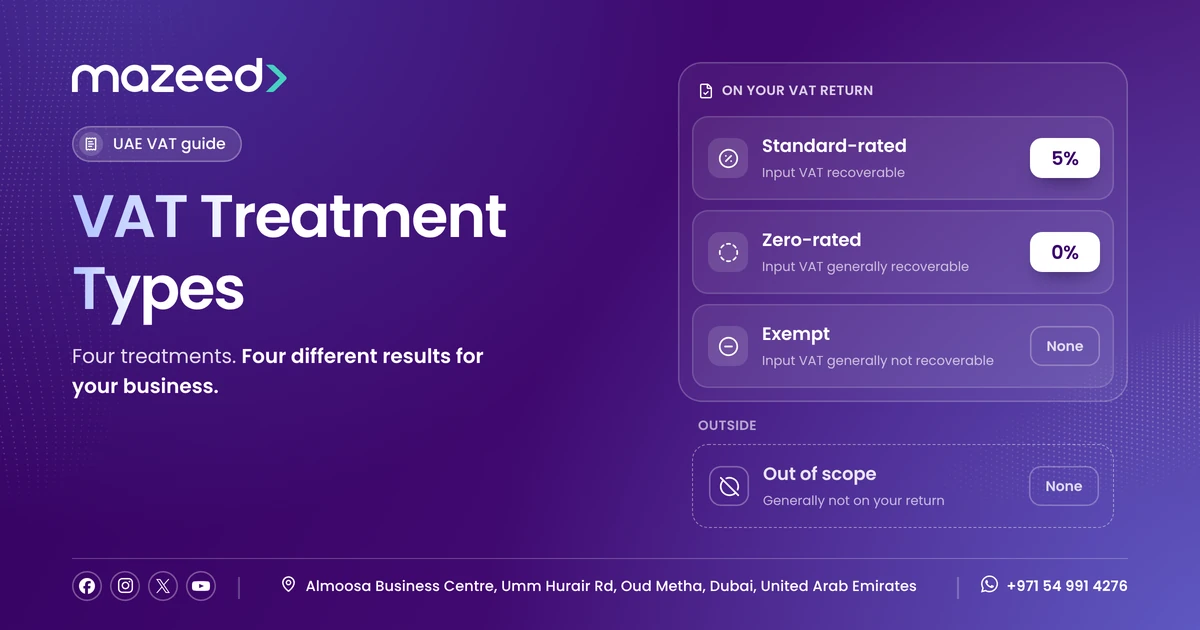

"No VAT was charged" can mean four different things in the UAE, and they're not interchangeable.
Two of them let you recover the VAT on your own costs. One doesn't. One isn't UAE VAT business at all. Getting the classification wrong doesn't just misstate a line on your return. It can mean you've been recovering input VAT you weren't entitled to, across every period since.
This guide explains each treatment, how they differ, and where the errors usually happen.
The four treatments
Treatment | VAT charged | Reported on return | Input VAT recovery |
|---|---|---|---|
Standard-rated | 5% | Yes | Yes |
Zero-rated | 0% | Yes | Generally yes |
Exempt | None | Yes | Generally no |
Out of scope | None | Generally no | Often yes, if the supply would have been taxable had it been made in the UAE |
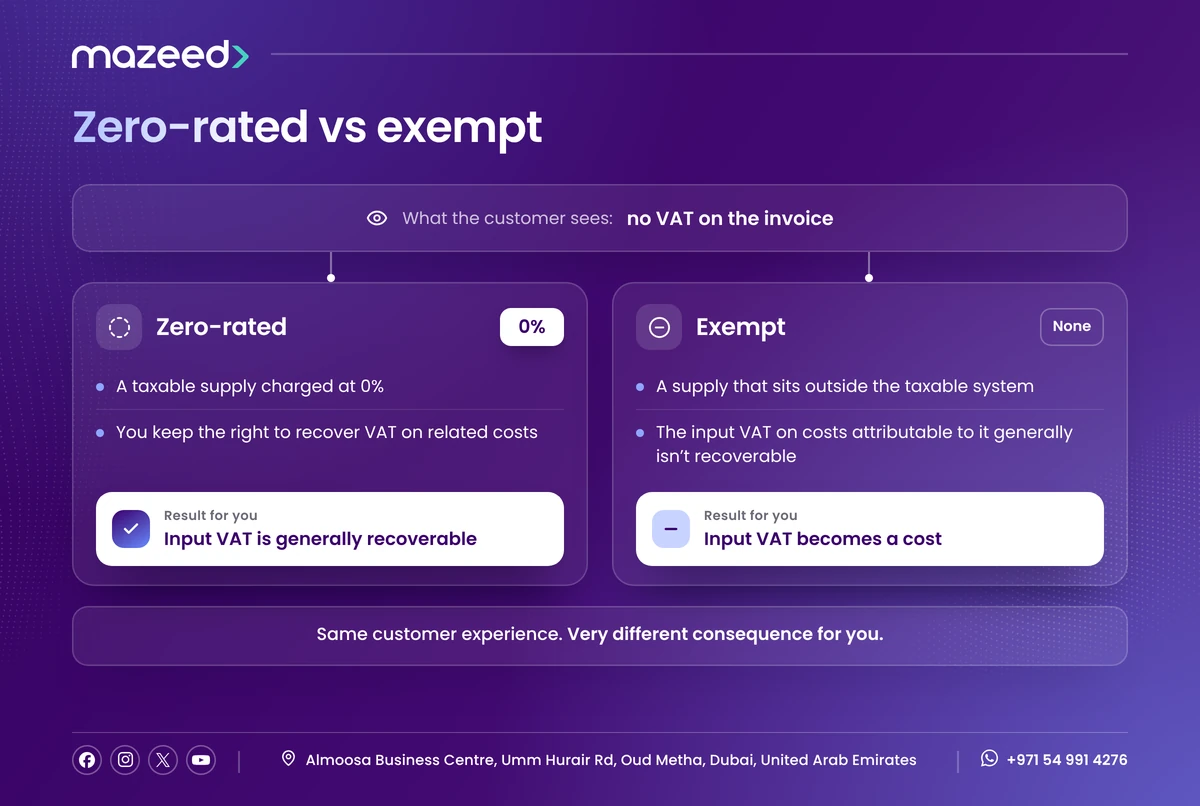
The distinction that costs money is zero-rated versus exempt. Both look identical
to your customer: no VAT on the invoice. But zero-rated supplies are taxable supplies charged at 0%, so you keep the right to recover VAT on related costs. Exempt supplies sit outside the taxable system, and the input VAT on costs attributable to them generally isn't recoverable.
Same customer experience. Very different consequence for you.
Standard-rated supplies
The UAE standard VAT rate is 5%, and it remains unchanged under the 2026 amendments.
This is the default. Most goods and services supplied in the UAE are standard-rated, and unless a supply falls into one of the specific categories below, this is the treatment that applies.
If you're unsure how to classify something, standard-rated is the starting assumption. The exceptions are defined in law, not inferred.
Zero-rated supplies
Zero-rated supplies are taxable supplies on which VAT is charged at 0%.
The practical effect: your customer pays no VAT, and you still recover input VAT on the costs of making that supply. For businesses whose output is largely zero-rated, exporters in particular, this often produces a recurring VAT refund position rather than a payment.
The categories are listed in Article 45 of the VAT Law (Federal Decree-Law No. 8 of 2017). They include:
Exports of goods and services outside the GCC states that have implemented VAT
International transport, and the supply of qualifying air, sea and land means of transport
Crude oil and natural gas
Qualifying education services and related goods and services, for institutions owned or funded by federal or local government
Qualifying preventive and basic healthcare services and related goods
The first supply of new residential buildings
Investment-grade precious metals
Each category comes with specific conditions in the Executive Regulation. Check your exact transaction against them rather than assuming a category applies. For a category-by-category breakdown, see our guide to zero-rated supplies in the UAE.
Zero-rating usually comes with conditions
This is where businesses get caught. A supply doesn't become zero-rated because of what it is in general terms. It becomes zero-rated when the defined conditions are met, and those conditions usually involve evidence.
Exports are the clearest example. For goods, zero-rating generally depends on the goods physically leaving the UAE within 90 days of the date of supply, and on holding the official and commercial documentation that proves it. Without that evidence, the supply is treated as standard-rated, and the 5% comes out of your margin, because you can't go back to the customer months later.
Keep the evidence at the time of supply, not when the FTA asks for it.
Exempt supplies
Exempt supplies are not taxable supplies. No VAT is charged, and input VAT attributable to making them generally cannot be recovered.
Article 46 of the VAT Law lists exactly four categories:
Certain financial services, as specified in the Executive Regulation
Residential buildings supplied by sale or lease, other than those that are zero-rated
Bare land
Local passenger transport
The consequence people miss
If your business makes only exempt supplies, you don't register for VAT at all, and the VAT you pay on your own costs becomes a real cost rather than something you reclaim.
If you make both taxable and exempt supplies, you're partially exempt, and input VAT has to be apportioned between the two. Under the standard method, the recoverable share is based on the proportion of your taxable supplies (standard-rated and zero-rated) to your total supplies. The FTA can approve an alternative method where the standard one doesn't fairly reflect your activity. Only the portion attributable to taxable supplies is recoverable.
Partial exemption is one of the more technical areas of VAT, and it's worth getting advice on rather than approximating.
Out of scope
Out-of-scope supplies fall outside UAE VAT entirely, typically because the place of supply isn't the UAE, or because the transaction isn't a supply for VAT purposes.
The distinction from zero-rated matters for your return: zero-rated supplies are reported, while out-of-scope supplies generally aren't. Businesses selling to overseas customers sometimes report everything as zero-rated when part of it is actually out of scope, or vice versa.
Input VAT and output VAT
Two terms that appear constantly and get mixed up.
Output VAT is the VAT you charge your customers on your sales. You collect it and pay it to the FTA.
Input VAT is the VAT you pay your suppliers on your purchases. Subject to conditions, you recover it.
Your VAT return nets the two:
Output VAT − recoverable Input VAT = amount payable to the FTA
If input exceeds output, you're in a refund position rather than a payment one. Since 1 January 2026, excess recoverable input VAT can only be refunded or carried forward for five years from the end of the tax period in which it arose. Exporters and other businesses with regular refund positions should not leave credits sitting unclaimed.
When input VAT isn't recoverable
Input VAT recovery generally requires:
A valid tax invoice containing your TRN (see our tax invoice format guide)
The cost being used for making taxable supplies
The expense not falling into a blocked category. The Executive Regulation excludes certain categories regardless of documentation, typically including some entertainment and motor vehicle costs
Recovery being claimed within the legal time limits
The 2026 amendments also let the FTA deny input VAT where a transaction is connected to tax evasion and the recipient knew or should have known. Valid paperwork alone is no longer the whole test.
The most common audit finding is still straightforward: input VAT claimed without a valid tax invoice. A payment receipt, a supplier statement, or a bank transfer record is not a tax invoice.
Reverse charge
Under the reverse charge mechanism, the recipient accounts for the VAT rather than the supplier. (Our full guide to the reverse charge mechanism in UAE VAT covers the journal entries.)
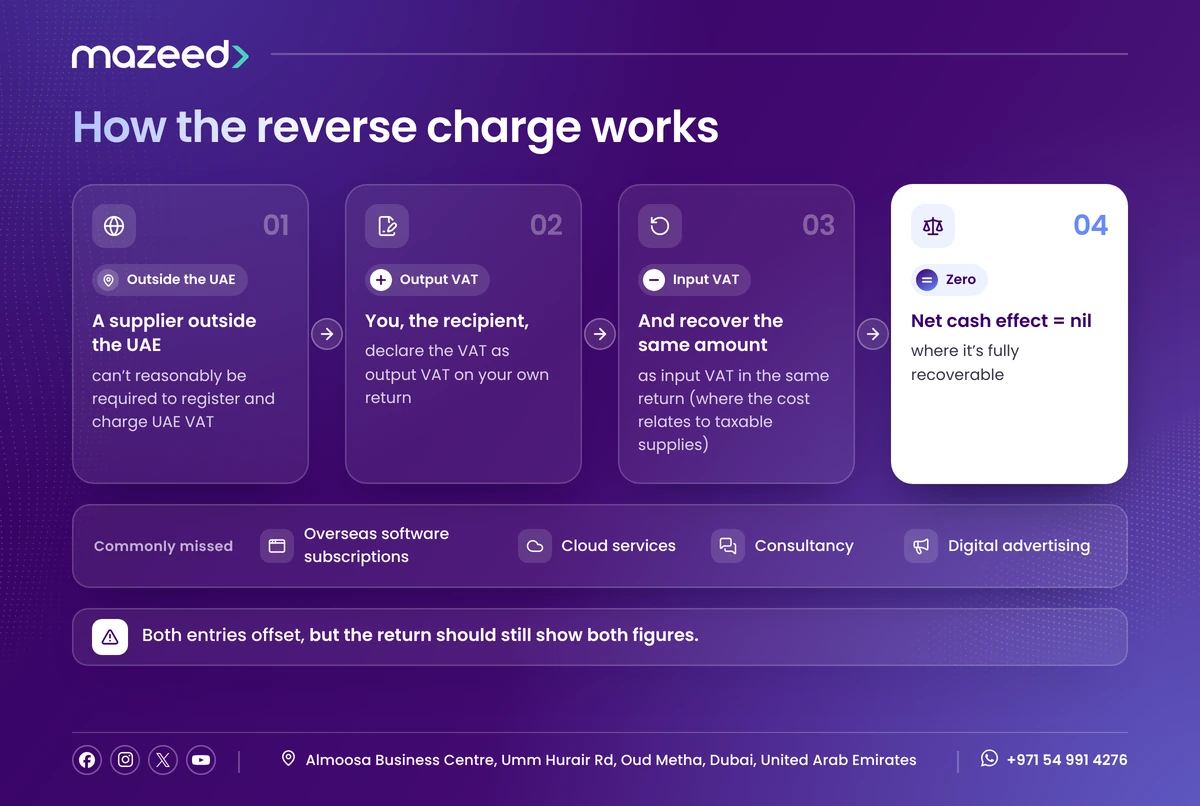
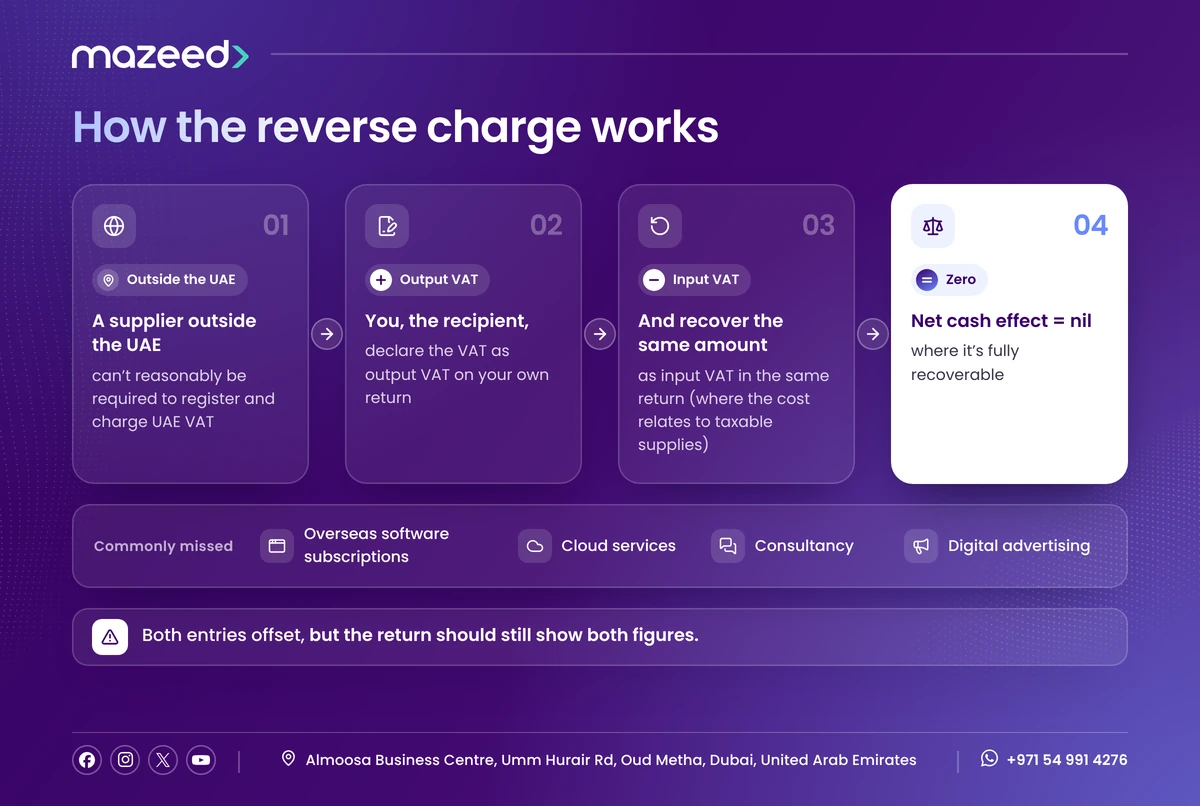
It typically applies to imported goods and services, where a supplier outside the UAE can't reasonably be required to register and charge UAE VAT. Instead, you as the recipient declare the VAT as output VAT on your own return and, where the cost relates to taxable supplies, recover the same amount as input VAT in the same return.
Where it's fully recoverable, the net cash effect is nil. Both entries offset. That's exactly why it gets ignored, and ignoring it is still a reporting error, because the return should show both figures.
One update: from 1 January 2026, businesses no longer have to issue a self-invoice for reverse-charge imports used for business purposes. You still need proper supporting documentation, and a self-invoice may still be needed to support your recovery where the supplier's documents aren't available.
The commonly missed case
Overseas software subscriptions, cloud services, consultancy, and digital advertising. These are imported services, they're frequently paid by card without anyone treating them as a VAT event, and they often go unreported entirely.
If you buy services from suppliers outside the UAE, review those expenses specifically before filing.
Designated zones
Certain fenced free zones listed by Cabinet Decision No. 59 of 2017 (as amended) are treated as outside the UAE for VAT purposes, but only for defined goods transactions.
Qualifying goods supplied within a designated zone, or moved between designated zones under customs control, can fall outside the scope of UAE VAT.
Services are different. Services supplied in or from a designated zone are treated the same as services anywhere else in the UAE, so 5% generally applies.
Goods moving from a designated zone into the mainland are treated as imported, and VAT becomes due at that point.
Not every free zone is a designated zone, and being located in one doesn't make all your supplies out of scope. This is a frequent misunderstanding among free zone businesses. Check your zone against the FTA's official list before you set pricing.
Where classification errors show up
On your VAT return. Zero-rated and exempt supplies sit in different boxes. Misclassification misstates the return even where no VAT was underpaid.
In your input VAT recovery. If you've treated exempt supplies as zero-rated, you may have recovered input VAT you weren't entitled to, compounding across every period since.
During an audit. The FTA examines classification, not just arithmetic. A return where the totals balance can still be wrong.
When zero-rating evidence is requested. No evidence, no zero-rating, and the VAT becomes payable from your own margin.
Getting classification right in practice
Classify at the point of setup, not at filing time. Set the VAT treatment on each product or service once, in your system.
Don't infer categories. Zero-rated and exempt lists are defined in legislation. If a supply isn't clearly within one, it's standard-rated.
Keep zero-rating evidence with the transaction, not in a separate folder someone has to reconstruct.
Review imported services quarterly for missed reverse charge.
Get advice on partial exemption if you make both taxable and exempt supplies.
Our guide to VAT return filing covers how these classifications flow through to your return.
Frequently asked questions
What is the difference between zero-rated and exempt?
Zero-rated supplies are taxable at 0%, and input VAT on related costs is generally recoverable. Exempt supplies are outside the taxable system, and related input VAT generally isn't recoverable. The customer sees no VAT either way.
What is input VAT and output VAT?
Output VAT is what you charge customers on sales. Input VAT is what you pay suppliers on purchases. Your return nets the two.
Are exports zero-rated or exempt?
Qualifying exports are zero-rated, not exempt. For goods, you generally need proof that they left the UAE within 90 days of supply, backed by the required official and commercial documents. Without it, the supply may be treated as standard-rated.
Can I recover input VAT on exempt supplies?
Generally no. If you make both taxable and exempt supplies, input VAT must be apportioned and only the taxable portion is recoverable.
What is the reverse charge mechanism?
An arrangement where the recipient accounts for VAT instead of the supplier, typically on imported goods and services. You declare it as output VAT and, where recoverable, claim the same amount as input VAT. Since 1 January 2026, no self-invoice is required for business imports.
Do I report out-of-scope supplies on my VAT return?
Generally no. Out-of-scope supplies are treated differently from zero-rated supplies, which are reported.
Is a free zone company outside UAE VAT?
No. Only specific designated zones receive special treatment, only for defined goods transactions, and services are still subject to UAE VAT.
What happens if I classify a supply incorrectly?
Your return is misstated, and if you've over-recovered input VAT, the error compounds across periods. Correcting it may require a voluntary disclosure.
Classification set once, applied every time
In Mazeed, VAT treatment is set on each item, so every invoice applies the right rate, and your return reflects the right categories without anyone reclassifying line by line.