

An aging report lists unpaid invoices grouped by how long they have been outstanding, usually in buckets of current, 1 to 30 days, 31 to 60 days, 61 to 90 days and over 90 days past due. An accounts receivable aging shows what customers owe you; an accounts payable aging shows what you owe suppliers. Finance teams use it to chase overdue customers, plan cash, estimate bad debts and, in the UAE, keep track of the six-month timelines that affect VAT.
How does an aging report work?
Each open invoice is placed in a bucket based on how many days have passed since its due date (or, in some reports, since the invoice date). The report shows each customer or supplier on a line, with their balance split across the buckets.
| Bucket | Meaning | Usual action |
|---|---|---|
| Current | Not yet due | No action, or a friendly reminder before the due date |
| 1 to 30 days | Recently overdue | Reminder email and statement |
| 31 to 60 days | Clearly overdue | Phone call; check for disputes |
| 61 to 90 days | Seriously overdue | Escalate; consider pausing new orders |
| Over 90 days | High risk | Formal demand, payment plan or legal action; assess bad debt |
Due dates come from your invoice payment terms, so clear terms make the report reliable; see our guide to invoice payment terms.
Accounts receivable aging example
A Dubai building materials supplier runs its receivables aging on 31 March 2027, in AED.
| Customer | Current | 1 to 30 | 31 to 60 | 61 to 90 | Over 90 | Total |
|---|---|---|---|---|---|---|
| Al Safa Trading | 80,000 | 20,000 | 100,000 | |||
| Gulf Build Contracting | 50,000 | 40,000 | 30,000 | 120,000 | ||
| Marina Retail | 60,000 | 15,000 | 22,000 | 97,000 | ||
| Oasis Hotels | 20,000 | 20,000 | 18,000 | 58,000 | ||
| Delta Logistics | 30,000 | 30,000 | ||||
| Total | 210,000 | 95,000 | 48,000 | 22,000 | 30,000 | 405,000 |
| % of total | 52% | 23% | 12% | 5% | 7% | 100% |
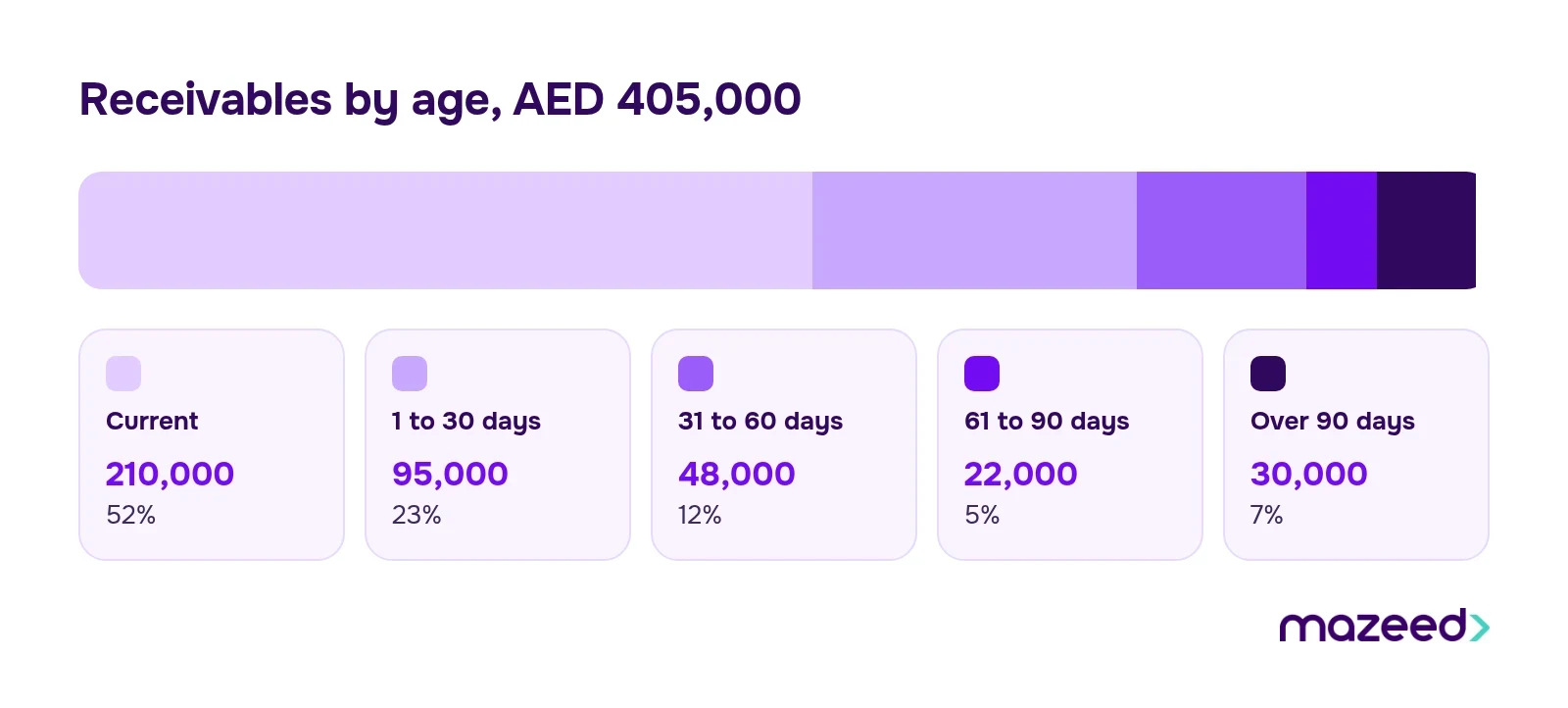
What the report says at a glance:
- Just over half the balance is current, which is healthy.
- Gulf Build has AED 30,000 in the 31 to 60 bucket and is the largest debtor; worth a call this week.
- Marina Retail has a single AED 22,000 invoice at 61 to 90 days while paying newer invoices; that usually means a dispute over that invoice.
- Delta Logistics owes AED 30,000, all over 90 days, with nothing newer; that is a collection risk.
If the supplier's quarterly sales are AED 900,000, its days sales outstanding (DSO) is roughly 405,000 / 900,000 x 90 = 40.5 days.
Should you age by invoice date or due date?
| Basis | How age is counted | Best for |
|---|---|---|
| Due date | Days past the agreed payment date | Collections, because it shows what is genuinely late |
| Invoice date | Days since the invoice was issued | Comparing customers with different terms, and VAT timelines that run from the date of supply |
An invoice issued on 1 January with Net 60 terms is 89 days old on 31 March by invoice date, but only 29 days overdue by due date. Pick one basis for your collections process and use it consistently. Many teams run the collections report by due date and keep an invoice-date version for VAT and bad debt reviews.
How does aging connect to bad debt provisions?
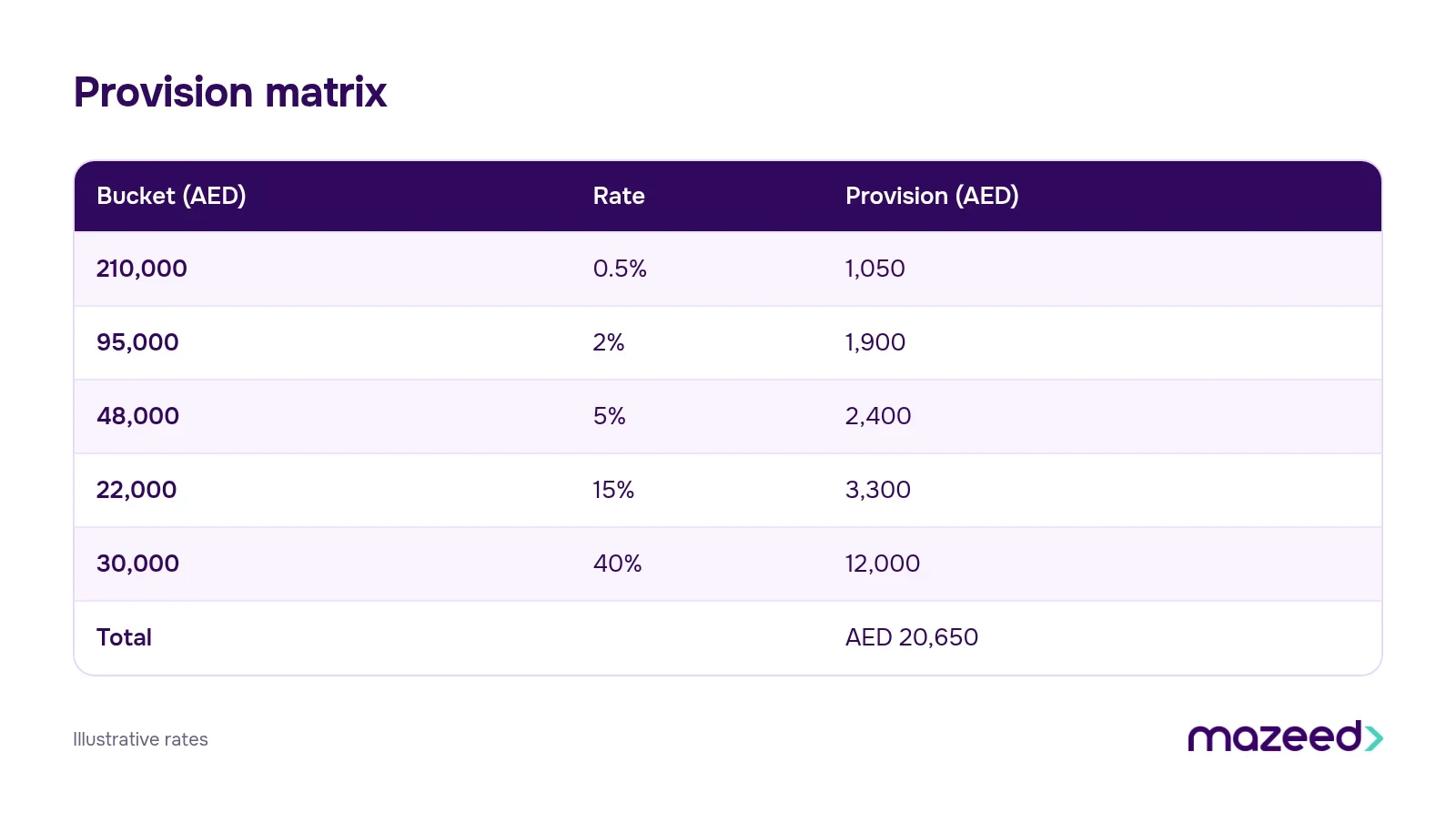
Under IFRS 9 Financial Instruments, companies recognise an allowance for expected credit losses on trade receivables. Most businesses use the simplified approach with a provision matrix, applying a loss rate to each aging bucket based on their own history, adjusted for current conditions.
| Bucket | Balance (AED) | Expected loss rate | Provision (AED) |
|---|---|---|---|
| Current | 210,000 | 0.5% | 1,050 |
| 1 to 30 days | 95,000 | 2% | 1,900 |
| 31 to 60 days | 48,000 | 5% | 2,400 |
| 61 to 90 days | 22,000 | 15% | 3,300 |
| Over 90 days | 30,000 | 40% | 12,000 |
| Total | 405,000 | 20,650 |
The loss rates here are illustrative; yours should come from your own collection history. The provision reduces receivables on the balance sheet and appears as an expense in the profit and loss statement. Companies on IFRS for SMEs follow that standard's impairment rules instead.
How does aging affect VAT in the UAE?
For sellers: bad debt relief. Article 64 of the VAT Decree-Law allows a supplier to reduce output VAT it already paid on a debt that will not be collected, if all the conditions are met: the VAT was charged and paid, the debt has been written off in the accounts, more than six months have passed since the date of supply, and the customer has been notified. The over-90-days bucket is where to look for candidates. In the example, Delta Logistics' AED 30,000 (including AED 1,428.57 VAT) could qualify once those conditions are satisfied.
For buyers: the six-month rule. UAE VAT rules require a buyer that has recovered input VAT but not paid the supplier within six months after the agreed payment date to reduce its input VAT by the unpaid amount, until it pays. Your payables aging shows which supplier invoices are approaching that point.
Accounts payable aging: why it matters
- Plan payments around your cash flow forecast instead of paying whoever calls loudest.
- Take early payment discounts where they are worth it.
- Protect supplier relationships by spotting invoices about to go overdue.
- Track the six-month input VAT rule for unpaid supplier invoices.
- Catch errors, such as duplicate invoices or invoices for goods never received.
Collection metrics to track alongside the aging
| Metric | How to calculate it | What good looks like |
|---|---|---|
| Days sales outstanding (DSO) | Receivables / revenue for the period x days in the period | Close to, or below, your standard payment term |
| Percentage over 60 days | Balances over 60 days / total receivables | Low and stable; a rising share is an early warning |
| Collection effectiveness | Cash collected / (opening receivables + invoices issued minus closing current balances) | As close to 100% as possible |
| Disputed balance | Value of invoices with an open query | Small, and resolved within weeks |
Track these monthly. A DSO that creeps up by a few days each month rarely triggers an alarm, but over a year it can lock up a large share of working capital.
How to collect faster using your aging report
- Review it weekly, not monthly.
- Work from oldest to newest, but call your largest balances first.
- Send statements every month; a statement of account shows the customer every open invoice in one place. Our guide to SOA in accounting explains the format.
- Find disputes early. A single old invoice next to paid newer ones is usually a query, not a cash problem.
- Record PDCs correctly so they do not hide overdue balances; see PDC journal entries.
- Set credit limits and pause orders for customers beyond agreed terms.
- Post receipts promptly so the report reflects reality; our guide to the accounts receivable journal entry shows how.
How mazeed helps
With mazeed's invoicing software, receivables and payables aging update the moment an invoice is issued or a payment is recorded. You can drill into any bucket, send statements and reminders in bulk, and see overdue balances before they become bad debts.
This article is general information. It is not accounting, tax or legal advice; for your specific case, speak to a qualified adviser. Other references: IFRS 9 Financial Instruments (expected credit losses).