
In accounting, a liability is an amount your business owes to others as a result of past events, to be settled with cash, goods or services. Common types are current liabilities, such as supplier invoices and VAT payable, and non-current liabilities, such as end-of-service gratuity. They appear on the balance sheet.
Knowing what your business owes, and when, is the basis of accurate financial statements and correct tax filings. If you would rather have specialists keep these balances in order, mazeed offers accounting and bookkeeping services in the UAE for companies of every size.
How do you record and track liabilities each month?
- Reconcile supplier statements Reconcile supplier statements. Match each major supplier's statement to your accounts payable ledger and investigate differences such as missing invoices or unrecorded payments.
- Accrue month-end costs Accrue month-end costs. Record salaries, utilities, rent and professional fees incurred but not yet invoiced.
- Review VAT payable Review VAT payable. Agree the VAT payable or refundable balance to your VAT workings for the period before filing.
- Update corporate tax payable Update corporate tax payable. Adjust the estimated tax accrual for the month's results.
- Update the gratuity provision Update the gratuity provision. Add the month's gratuity charge and remove amounts paid to leavers.
- Review customer advances and deferred revenue Review customer advances and deferred revenue. Release amounts for goods or services delivered during the month.
- Check the aged payables report Check the aged payables report. Identify overdue invoices and plan payments around supplier terms.
- Review possible obligations Review possible obligations. Note any new claims or disputes that may need disclosure or a provision.
What is the meaning of liabilities in accounting?
A liability is a present obligation of your business that arises from a past event and that you expect to settle by giving up cash, goods or services. In short, it is what the business owes at a specific date.
Three conditions usually apply. The obligation exists now, it comes from something that has already happened (such as receiving goods from a supplier), and settling it will mean an outflow of resources. For example, once a supplier delivers stock and issues an invoice, the unpaid amount is a liability until you pay it.
UAE businesses generally prepare financial statements under International Financial Reporting Standards (IFRS), which define liabilities in this way.
How do liabilities fit in the accounting equation?
Liabilities sit on the right side of the accounting equation: Assets = Liabilities + Equity. Everything the business owns is funded either by what it owes to others or by what belongs to its owners.
If liabilities rise while assets stay the same, equity falls. This is why missing or understated liabilities make a business look stronger than it really is.
Are liabilities the same as expenses?
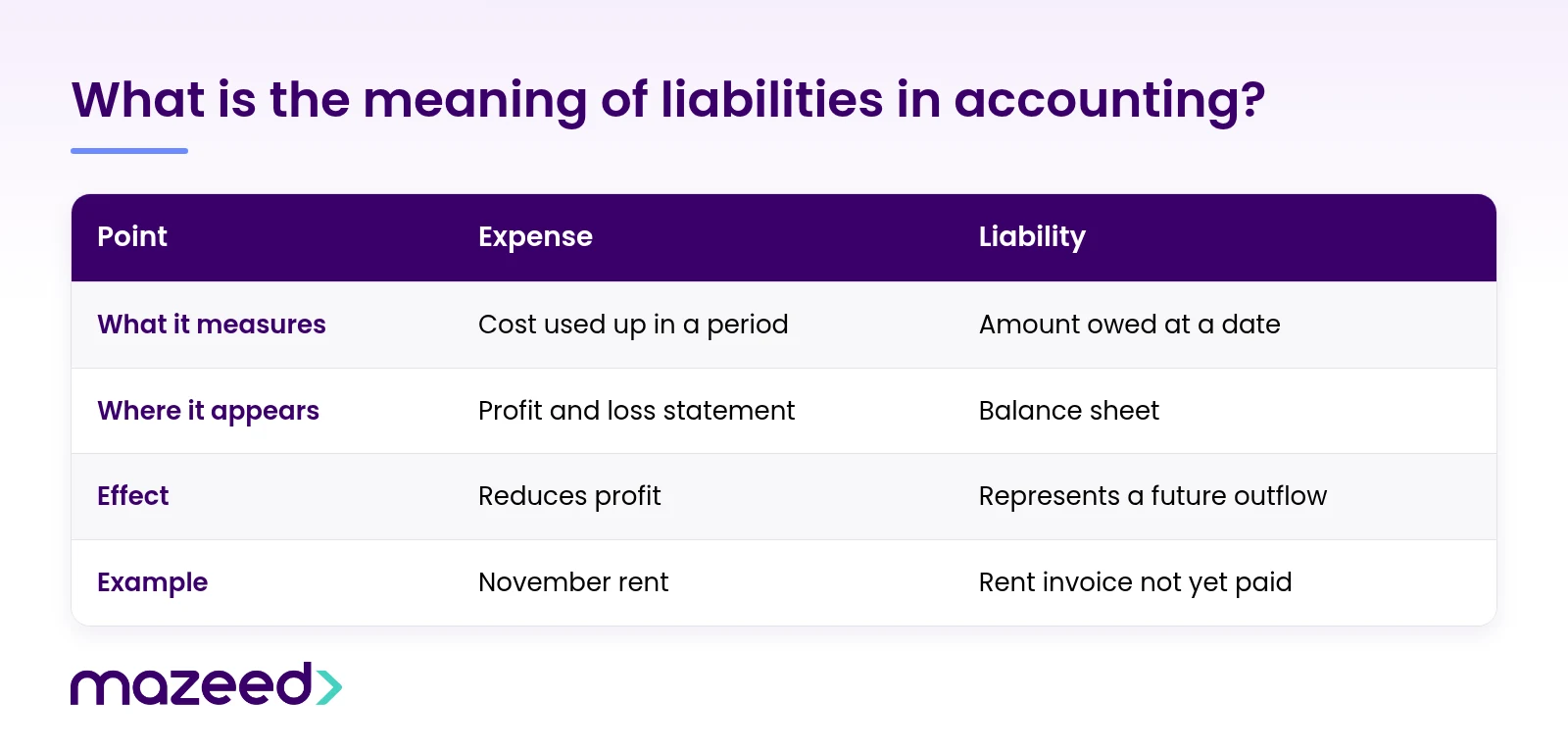
No. An expense is a cost of the period that reduces profit, while a liability is an amount still owed at a point in time.
The two are often linked. When staff work in November but are paid in December, the November salary is an expense in November. At 30 November it is also a liability called accrued salaries. Once payroll runs, the liability is cleared, but the expense stays in November's profit and loss.
| Point | Expense | Liability |
|---|---|---|
| What it measures | Cost used up in a period | Amount owed at a date |
| Where it appears | Profit and loss statement | Balance sheet |
| Effect | Reduces profit | Represents a future outflow |
| Example | November rent | Rent invoice not yet paid |
What are the main types of liabilities?
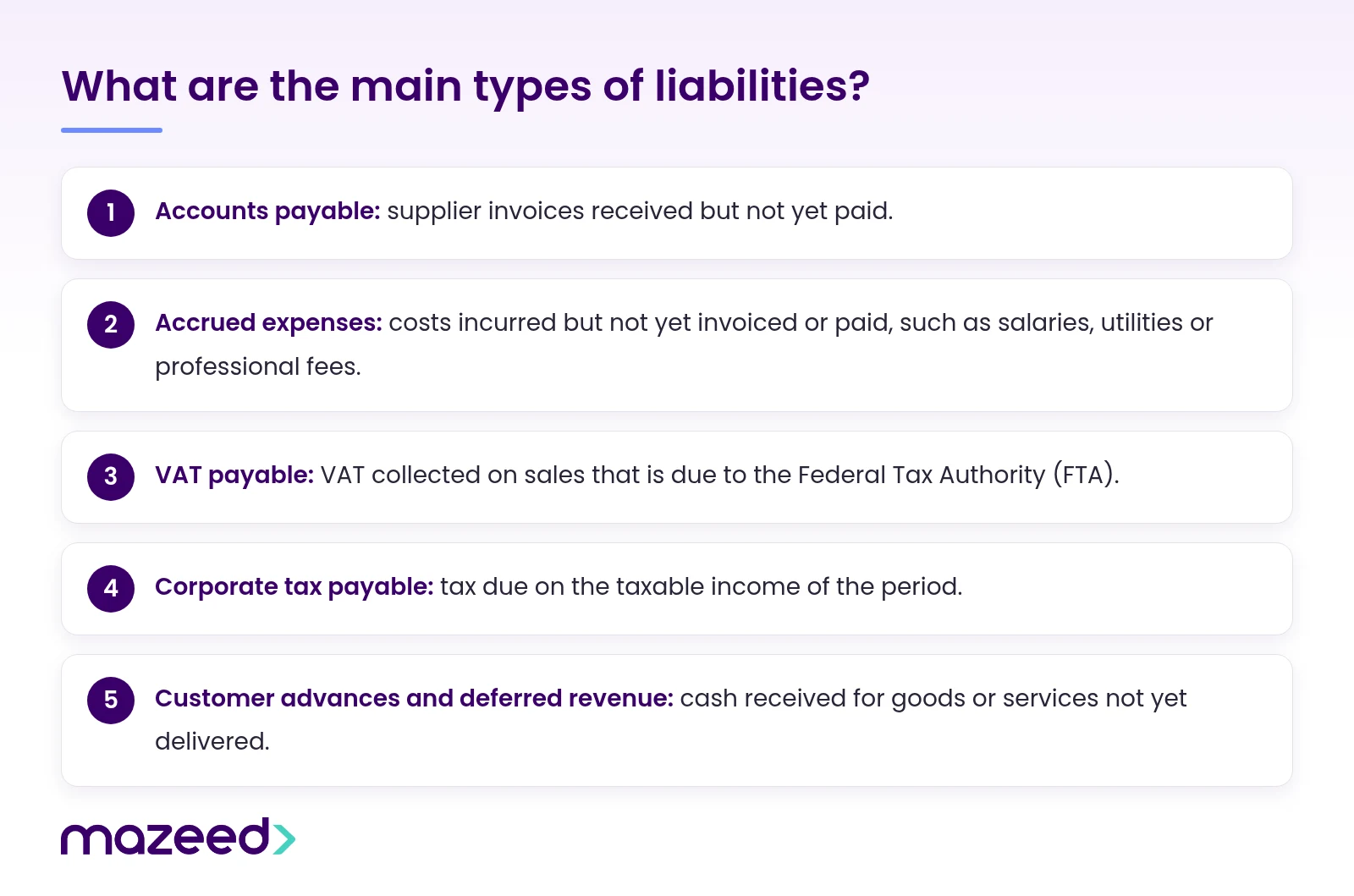
Liabilities are grouped as current, non-current and contingent, based on when they fall due and how certain they are. The classification table below shows common UAE examples.
What are current liabilities?
Current liabilities are obligations due within 12 months of the balance sheet date, or within the normal operating cycle of the business. They are settled from day-to-day cash flow.
Typical current liabilities for a UAE business include:
- Accounts payable: supplier invoices received but not yet paid.
- Accrued expenses: costs incurred but not yet invoiced or paid, such as salaries, utilities or professional fees.
- VAT payable: VAT collected on sales that is due to the Federal Tax Authority (FTA).
- Corporate tax payable: tax due on the taxable income of the period.
- Customer advances and deferred revenue: cash received for goods or services not yet delivered.
What is the difference between accounts payable and accrued expenses?
Accounts payable are amounts supported by a supplier invoice you have already received. Accrued expenses are costs you have incurred where the invoice has not yet arrived or the payment date has not yet come.
For example, if your electricity for November is used but the bill arrives in December, you record an accrued expense at the end of November. When the bill arrives, the accrual is replaced by an accounts payable entry, and payment clears it. Reversing accruals in the following month is a common adjusting step, similar in purpose to the balance adjustments explained in our guide on how contra entries work in UAE accounting.
What are non-current liabilities?
Non-current liabilities are obligations due more than 12 months after the balance sheet date. For most UAE operating companies, the largest is the end-of-service gratuity provision.
Other non-current items can include long-term deposits held from customers or tenants, and the non-current portion of lease obligations. A provision is a liability where the timing or amount is uncertain but can be reliably estimated, and gratuity is the most common UAE example.
What are contingent liabilities?
A contingent liability is a possible obligation that depends on a future event outside the business's full control, such as the outcome of a legal claim. It is usually disclosed in the notes rather than recorded on the balance sheet.
The treatment depends on likelihood:
| Likelihood of payment | Can the amount be estimated? | Treatment |
|---|---|---|
| Probable | Yes | Record a provision on the balance sheet |
| Possible | Yes or no | Disclose in the notes to the financial statements |
| Remote | Not relevant | No recording or disclosure needed |
Examples include a disputed supplier claim, a pending employee case, or a performance guarantee given to a customer. Review these items at every reporting date, because a possible obligation can become probable.
What are examples of liabilities for a UAE business?
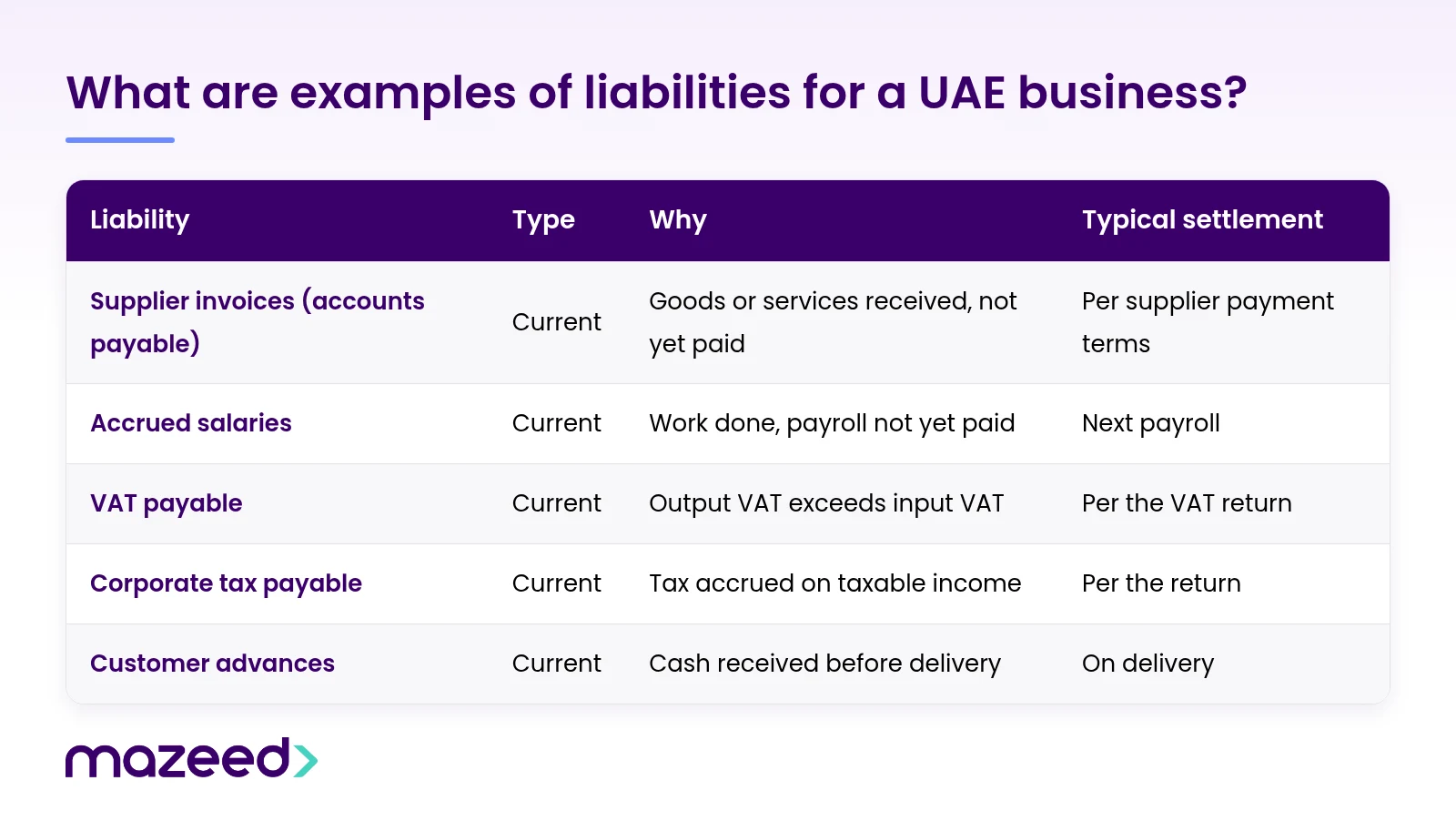
The most common UAE liabilities are supplier invoices, accrued salaries, VAT payable, corporate tax payable, customer advances and end-of-service gratuity. The table below classifies each one.
| Liability | Type | Why | Typical settlement |
|---|---|---|---|
| Supplier invoices (accounts payable) | Current | Goods or services received, not yet paid | Per supplier payment terms |
| Accrued salaries | Current | Work done, payroll not yet paid | Next payroll |
| VAT payable | Current | Output VAT exceeds input VAT | Per the VAT return |
| Corporate tax payable | Current | Tax accrued on taxable income | Per the return |
| Customer advances | Current | Cash received before delivery | On delivery |
| End-of-service gratuity | Non-current (mostly) | Accrued employee entitlement | On employee exit |
Is VAT payable a liability?
Yes. VAT payable is a current liability, because it is tax you have collected on behalf of the government and must pay to the FTA.
VAT in the UAE is charged at a standard rate of 5% as of November 2026 under Federal Decree-Law No. 8 of 2017 on Value Added Tax and its Executive Regulation, Cabinet Decision No. 52 of 2017 (Federal Tax Authority, VAT). Output VAT is the VAT you charge on sales, and input VAT is the VAT you pay on eligible purchases. When output VAT is higher than recoverable input VAT for the tax period, the difference is VAT payable. When it is lower, the business holds a VAT refundable balance, which is an asset rather than a liability.
The return and payment deadline for each tax period is set by the FTA.
Is corporate tax payable a liability?
Yes. Corporate tax payable is a current liability, recorded for the tax due on the taxable income of the period until it is paid to the FTA.
Under Federal Decree-Law No. 47 of 2022 on the Taxation of Corporations and Businesses, taxable income up to AED 375,000 is taxed at 0%, and taxable income above AED 375,000 is taxed at 9%, as of November 2026 (Federal Tax Authority, Corporate Tax). Businesses usually accrue an estimate during the year and adjust it when the tax return is prepared.
Deferred tax liabilities can also arise where accounting profit and taxable income differ in timing. These are normally non-current.
How is end-of-service gratuity treated?
End-of-service gratuity is recorded as a provision that grows each month an employee works, and it is mostly non-current. Only the portion expected to be paid within 12 months, for example for staff known to be leaving, is classed as current.
For private sector employees, gratuity is governed by Federal Decree-Law No. 33 of 2021 on the Regulation of Labour Relations. Each month, the business records the gratuity expense for the period in profit and loss and adds the same amount to the provision on the balance sheet. When an employee leaves, the payment reduces the provision.
Review the provision at least once a year against current basic salaries and service periods. Salary increases change the amount owed for past service as well as future service.
What about customer advances and deferred revenue?
Customer advances and deferred revenue are liabilities because the business has received cash but still owes the customer goods or services. The liability is cleared, and revenue is recognised, when the business delivers.
Common UAE examples include deposits on custom orders, annual subscriptions paid upfront, and advance payments on contracts. A business that receives AED 24,000 for a 12-month service contract would record AED 24,000 as deferred revenue, then recognise AED 2,000 as revenue each month. Check the VAT treatment of advance payments separately, as the date VAT becomes due may differ from the date revenue is recognised.
How do liabilities appear on the balance sheet?
Liabilities are shown on the balance sheet below assets, split into current and non-current, with equity shown after them. The totals must satisfy Assets = Liabilities + Equity.
Under IFRS presentation, many UAE companies list non-current liabilities first and current liabilities second, though both orders are accepted. The notes then give detail, such as the gratuity movement for the year and any contingent liabilities.
Worked example (AED, illustrative)
A trading company prepares its balance sheet at 30 November and identifies the following:
| Item | Type | AED |
|---|---|---|
| Supplier invoices unpaid | Current | 120,000 |
| Accrued salaries | Current | 30,000 |
| Net VAT payable | Current | 18,000 |
| Customer advances | Current | 50,000 |
| Total current liabilities | 218,000 | |
| End-of-service gratuity provision | Non-current | 90,000 |
| Total liabilities | 308,000 | |
| Total assets | 700,000 | |
| Equity (700,000 less 308,000) | 392,000 |
The equation balances: AED 700,000 of assets equals AED 308,000 of liabilities plus AED 392,000 of equity. If the company forgot to accrue the AED 30,000 of salaries, liabilities would be understated and equity would be overstated by the same amount.
How do you record and track liabilities each month?
Track liabilities with a fixed month-end routine: reconcile suppliers, accrue costs, review tax balances and check the ageing of what you owe. A consistent checklist stops small errors from building up over the year.
- Reconcile supplier statements. Match each major supplier's statement to your accounts payable ledger and investigate differences such as missing invoices or unrecorded payments.
- Accrue month-end costs. Record salaries, utilities, rent and professional fees incurred but not yet invoiced.
- Review VAT payable. Agree the VAT payable or refundable balance to your VAT workings for the period before filing.
- Update corporate tax payable. Adjust the estimated tax accrual for the month's results.
- Update the gratuity provision. Add the month's gratuity charge and remove amounts paid to leavers.
- Review customer advances and deferred revenue. Release amounts for goods or services delivered during the month.
- Check the aged payables report. Identify overdue invoices and plan payments around supplier terms.
- Review possible obligations. Note any new claims or disputes that may need disclosure or a provision.
For more on the habits that keep finance records reliable, see our article on the success factors behind well-run UAE finance functions.
Track every liability in one place with mazeed accounting software The mazeed accounting software keeps supplier invoices, accruals, VAT and gratuity balances up to date, with an aged payables report and month-end reconciliation tools built in. Ask our team for a demo.
If you are still comparing tools, our roundup of popular accounting software options in Dubai explains what to look for.
When should you get help with liabilities?
Get help when month-end balances do not reconcile, tax payable balances are uncertain, or your team lacks time for regular reviews. Errors in liabilities affect both your financial statements and your tax filings.
Common warning signs include supplier statements that never match your ledger, a gratuity provision that has not been recalculated in over a year, VAT payable balances that differ from your returns, and customer deposits recorded as revenue on receipt. To see how outsourced finance support typically works for local companies, read our overview of working with an external finance team in Dubai and across the UAE.
Talk to the mazeed team Share three details and a mazeed specialist will contact you about keeping your payables, accruals and tax balances accurate.
- Name
- Mobile
- Service