

Business expenses in the UAE are the costs a company incurs to earn income, such as rent, salaries, licences, marketing and utilities. To manage them, categorise each cost, keep valid tax invoices, separate personal spending, and record everything monthly. Before you rely on a cost, check whether it is deductible for corporate tax and whether its VAT is recoverable.
What are business expenses in the UAE?
A business expense is any cost a company incurs wholly and exclusively to run its business and earn taxable income. Under the UAE Corporate Tax Law, Federal Decree-Law No. 47 of 2022, these costs can reduce your taxable income, subject to the limits set out in the law.
Expenses are different from capital purchases. An expense is used up within the year, such as rent, salaries or a phone bill. A capital purchase, also called capital expenditure, is an asset that benefits the business for more than one year, such as a laptop, vehicle or office fit-out. Capital purchases are recorded as assets and their cost is spread over their useful life through depreciation.
Getting this split right affects your profit, your corporate tax and your VAT return. If you would rather hand the classification and monthly recording to specialists, mazeed offers accounting and bookkeeping services for UAE companies.
What are the main types of business expenses?
Most UAE business expenses fit into six groups: fixed and variable costs, operating and capital costs, payroll, government fees, premises costs, and marketing, travel and entertainment. The table below shows each category with a short tax note.
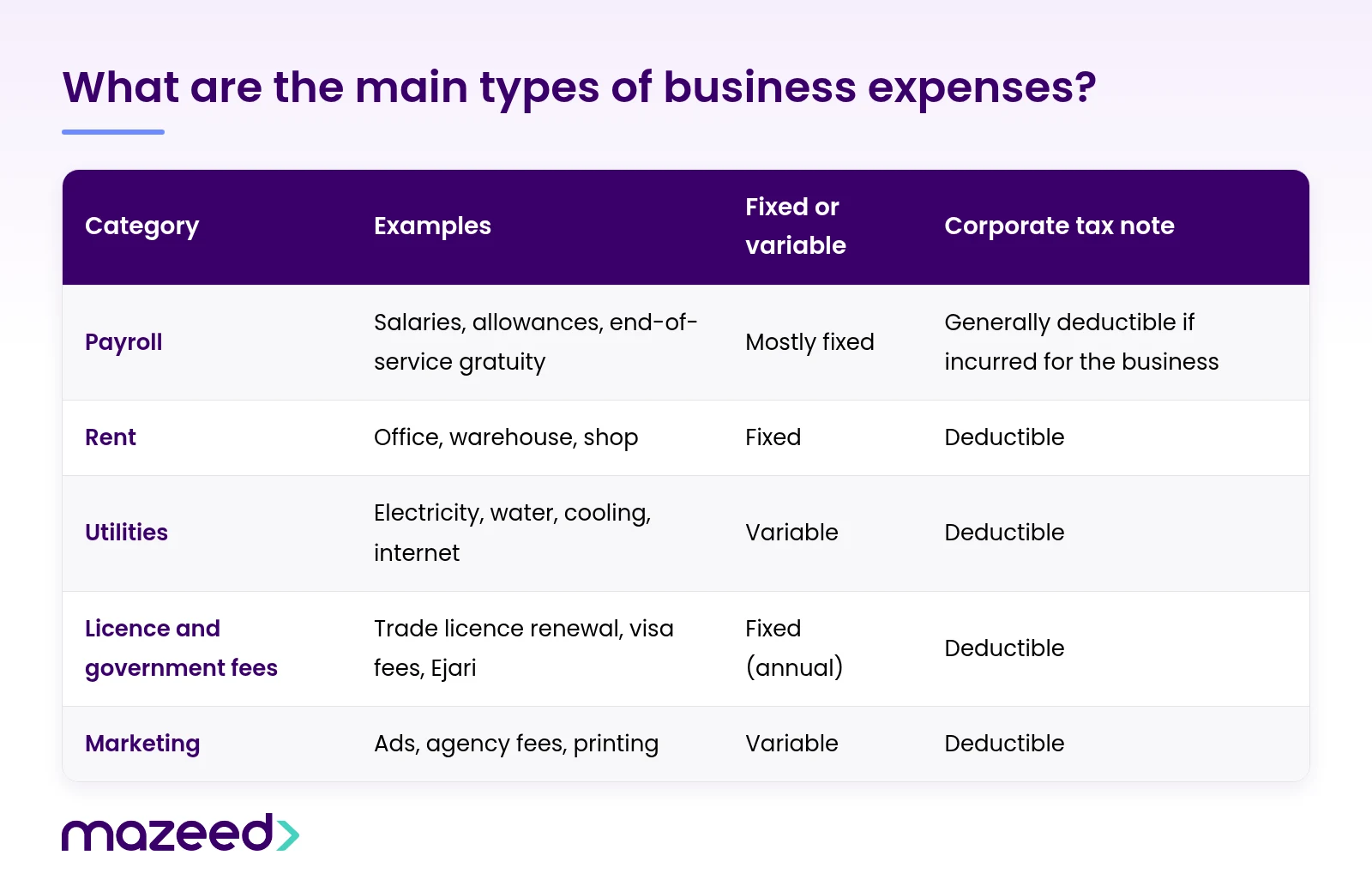
Table 1: Expense category cheat sheet (as of November 2026)
| Category | Examples | Fixed or variable | Corporate tax note | VAT note | Document needed |
|---|---|---|---|---|---|
| Payroll | Salaries, allowances, end-of-service gratuity | Mostly fixed | Generally deductible if incurred for the business | Salaries are not subject to VAT | Payroll register, employment contracts, WPS records |
| Rent | Office, warehouse, shop | Fixed | Deductible | Commercial rent: input VAT normally recoverable. Residential rent (for example staff housing) is exempt, so there is no VAT to recover | Tenancy contract, tax invoice |
| Utilities | Electricity, water, cooling, internet | Variable | Deductible | Input VAT normally recoverable | Tax invoice from provider |
| Licence and government fees | Trade licence renewal, visa fees, Ejari | Fixed (annual) | Deductible | Many government fees fall outside the scope of VAT | Official receipt |
| Marketing | Ads, agency fees, printing | Variable | Deductible | Input VAT normally recoverable | Tax invoice, agency contract |
| Professional fees | Accounting, audit, legal | Fixed or variable | Deductible | Input VAT normally recoverable | Tax invoice, engagement letter |
| Travel | Flights, hotels on business trips | Variable | Deductible if for business | Recoverable where a valid tax invoice exists and the cost is for the business | Tax invoice, trip purpose note |
| Entertainment | Client meals, events, hospitality | Variable | 50% deductible | Input VAT blocked for non-employee entertainment | Tax invoice, guest list and purpose |
| Equipment purchase | Laptops, furniture, vehicles | One-off (capital) | Not expensed at once. Depreciation is deductible | Recoverable if used for taxable supplies. Vehicles available for personal use are blocked | Tax invoice, asset register entry |
What is the difference between fixed and variable expenses?
Fixed expenses stay roughly the same each month whatever your sales. Variable expenses rise and fall with activity. Typical fixed costs in the UAE are office rent, the annual trade licence spread over twelve months, and core salaries. Variable costs include utilities, sales commissions, delivery charges, marketing spend and travel.
Knowing the split helps you plan cash. Fixed costs must be covered in a slow month, while variable costs can usually be cut quickly.
What is the difference between operating and capital expenses?
Operating expenses keep the business running day to day and are recorded in the profit and loss account in the month they are incurred. Capital expenses buy assets that last more than a year and are recorded on the balance sheet.
For example, a AED 6,000 laptop is not a AED 6,000 expense in the month you buy it. You record it as an asset and depreciate it, for example AED 167 a month over three years. The depreciation is what reduces your taxable income each period.
What counts as payroll and employee-related costs?
Payroll costs are everything you pay to or for employees. That includes basic salary, housing and transport allowances, overtime, bonuses, end-of-service gratuity provisions, visa and medical insurance costs, and training.
Payroll is usually the largest cost line for service businesses. Keep it in its own group of accounts so you can see staff costs separately from other spending.
Which licence, registration and government fees are business expenses?
Fees you pay to keep the company legally operating are business expenses. These include trade licence renewals, establishment cards, employee visas and permits, Ejari registration, and chamber of commerce membership.
Licence costs vary by emirate, free zone and activity. For current pricing, see our guide on what a UAE trade licence costs in 2026. Official information on licences is available on u.ae.
What premises, utilities and office costs can a business claim?
Premises costs include rent, service charges, maintenance, cleaning and security. Utilities include electricity, water and district cooling from providers such as DEWA, SEWA or ADDC, plus telecoms and internet.
Office running costs such as stationery, software subscriptions and small equipment under your capitalisation limit also belong here.
How are marketing, travel and entertainment expenses treated?
Marketing and business travel are normally fully deductible for corporate tax. Entertainment is the exception: only part of it is deductible, and its VAT is often blocked.
Under the Corporate Tax Law, only 50% of entertainment expenditure for customers, shareholders, suppliers and other business partners is deductible, as of November 2026. Entertainment includes meals, accommodation, transport, admission to events and leisure activities provided to those people.
Which expenses are tax-deductible for corporate tax?
An expense is deductible for UAE corporate tax if it is incurred wholly and exclusively for the business, is not capital in nature, and is not specifically disallowed. The general rule is in Article 28 of Federal Decree-Law No. 47 of 2022.
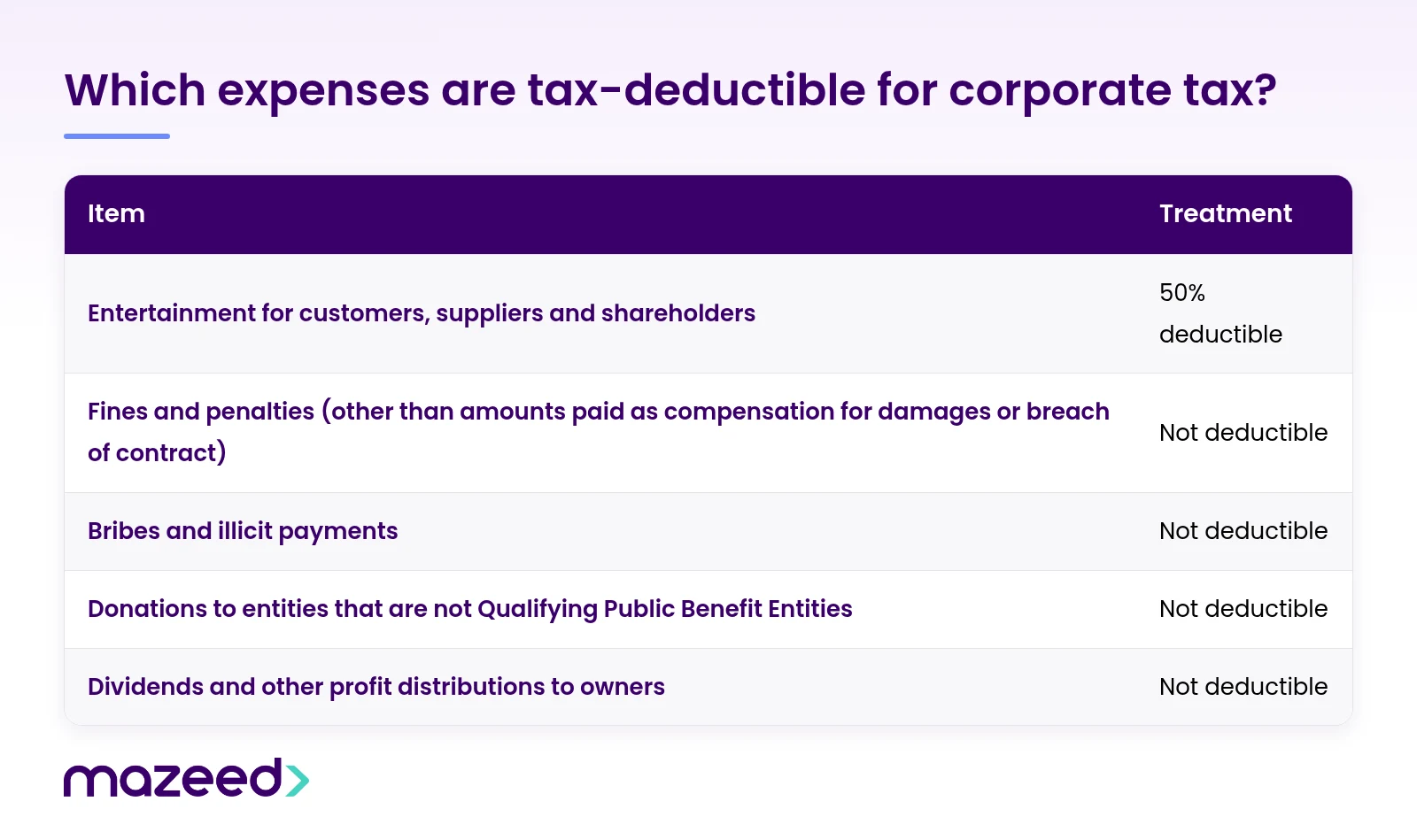
Corporate tax is charged at 0% on taxable income up to AED 375,000 and 9% above that, as of November 2026 (Federal Tax Authority, Corporate Tax). Because deductible expenses reduce taxable income, classifying them correctly directly affects the tax you pay.
Expenses that are not deductible or only partly deductible (as of November 2026)
| Item | Treatment |
|---|---|
| Entertainment for customers, suppliers and shareholders | 50% deductible |
| Fines and penalties (other than amounts paid as compensation for damages or breach of contract) | Not deductible |
| Bribes and illicit payments | Not deductible |
| Donations to entities that are not Qualifying Public Benefit Entities | Not deductible |
| Dividends and other profit distributions to owners | Not deductible |
| Corporate tax itself | Not deductible |
| Input VAT you can recover | Not deductible, because you get it back from the FTA |
| Personal expenses of owners or staff not related to the business | Not deductible |
| Capital purchases | Not deductible at once. Depreciation is deductible |
Check whether any Cabinet or Ministerial Decision issued since 2023 has changed this list.
Does Small Business Relief change how expenses work?
Yes. If you elect Small Business Relief, you are treated as having no taxable income for the period, so individual expense deductions do not reduce your tax that year. The relief is available to resident persons with revenue of AED 3 million or less in the relevant and previous tax periods, for tax periods ending on or before 31 December 2026, as of November 2026, under Ministerial Decision No. 73 of 2023.
You still need full expense records even if you elect the relief. The FTA can ask for them, and you will need them once the relief ends.
Can you recover VAT on business expenses?
Yes, you can usually recover the VAT you pay on business expenses if you are VAT-registered, the cost relates to taxable supplies you make, and you hold a valid tax invoice. VAT paid on business purchases is called input tax. The standard VAT rate is 5%, as of November 2026 (Federal Tax Authority, VAT).
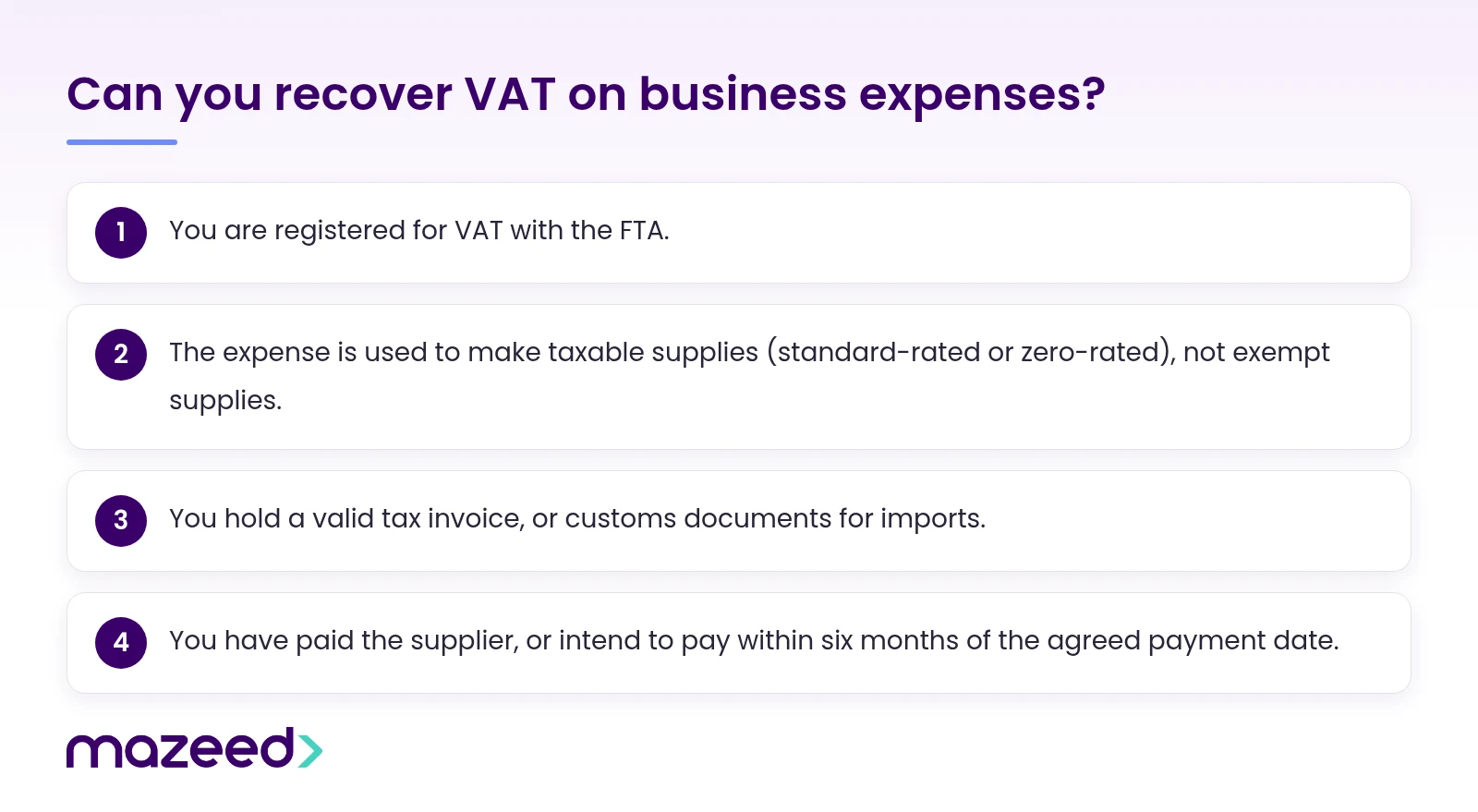
The recovery rules are set out in Federal Decree-Law No. 8 of 2017 on Value Added Tax and its Executive Regulation, Cabinet Decision No. 52 of 2017.
Conditions for recovering input tax
- You are registered for VAT with the FTA.
- The expense is used to make taxable supplies (standard-rated or zero-rated), not exempt supplies.
- You hold a valid tax invoice, or customs documents for imports.
- You have paid the supplier, or intend to pay within six months of the agreed payment date.
Items where input tax is blocked (as of November 2026)
| Blocked item | Why |
|---|---|
| Entertainment for clients, suppliers and other non-employees | Specifically blocked |
| Motor vehicles available for personal use by staff | Specifically blocked |
| Goods or services provided to employees for their personal use at no charge, unless there is a legal or contractual obligation | Specifically blocked |
| Costs related to exempt supplies, such as residential rent you charge to tenants | Not linked to taxable supplies |
If your business makes both taxable and exempt supplies, you can only recover a proportion of shared input tax. Check the apportionment rules in the Executive Regulation.
What documents do you need to support an expense?
Every expense needs proof of what was bought, from whom, when, for how much and why. For VAT recovery, that proof must be a valid tax invoice.
A full tax invoice must show, among other details, the supplier's name, address and Tax Registration Number (TRN), the date, a sequential invoice number, a description of the goods or services, the amount before VAT, the VAT rate and amount, and the total. A simplified tax invoice may be issued for supplies of AED 10,000 or less, as of November 2026.
Checklist: what auditors and the FTA expect
- A tax invoice or receipt for every expense, matching the amount in your books
- Contracts for recurring costs: tenancy, agency retainers, service agreements
- A short business purpose note for travel and entertainment, including guest names
- Proof of payment: bank statement line or company card statement
- An approval record showing who authorised the spend
- An asset register for capital purchases
- Payroll registers and WPS salary files
How long must you keep expense records in the UAE?
Keep tax records for at least five years for VAT and seven years for corporate tax, as of November 2026. Records for real estate transactions may need to be kept longer.
Electronic records are acceptable if they are complete, readable and available to the FTA on request.
Do e-invoicing rules apply to expense documents?
The UAE is introducing mandatory e-invoicing in phases, starting with larger businesses. When your suppliers move to e-invoicing, the invoices you receive must come through the approved system, and your expense records should store them in that form.
Want expert help keeping your expenses clean and tax-ready? Tell us what you need.
Name: ________ Mobile: ________ Service: [Accounting and bookkeeping / VAT / Corporate tax / Other]
Request a callback from our bookkeeping team
Worked example: how does a Dubai consultancy classify its monthly costs?
The figures below are illustrative only. They show how a bookkeeper would classify one month of costs for a small VAT-registered consultancy in Dubai.
| Cost line | Amount (AED, before VAT) | Type | VAT paid (AED) | VAT recoverable? | Corporate tax treatment |
|---|---|---|---|---|---|
| Staff salaries | 45,000 | Payroll, fixed | 0 | Not applicable | Deductible |
| Office rent | 12,000 | Premises, fixed | 600 | Yes | Deductible |
| DEWA | 1,800 | Utilities, variable | 90 | Yes | Deductible |
| Internet and phones | 900 | Utilities, variable | 45 | Yes | Deductible |
| Bookkeeping fees | 3,000 | Professional, fixed | 150 | Yes | Deductible |
| Marketing agency | 2,500 | Marketing, variable | 125 | Yes | Deductible |
| Client dinner | 1,200 | Entertainment, variable | 60 | No, blocked | 50% deductible |
| Trade licence (1/12 of annual fee) | 1,500 | Government fee, fixed | 0 | Not applicable | Deductible |
| New laptop | 6,000 | Capital | 300 | Yes | Depreciated, not expensed |
Monthly summary the bookkeeper would produce
| Item | AED |
|---|---|
| Operating expenses (including the AED 60 blocked VAT added to the dinner cost) | 67,960 |
| Laptop recorded as an asset | 6,000 |
| Depreciation on laptop (3 years, straight line) | 167 |
| Input VAT to claim on the VAT return | 1,310 |
| Non-deductible part of entertainment (50% of 1,260) | 630 |
| Deductible expenses for corporate tax (67,960 + 167 - 630) | 67,497 |
The key flags are the client dinner, where the VAT is blocked and only half the cost is deductible, and the laptop, which goes on the balance sheet instead of the monthly expenses.
How do you manage business expenses step by step?
Good expense control comes down to four habits: clear categories and approvals, a strict split between personal and business spending, monthly recording, and a regular cost review.
How do you set expense categories and an approval policy?
Agree a fixed list of categories, based on Table 1, and a written policy that everyone follows. Below is a one-page template you can copy and adjust.
Mini template: expense policy
- Approval limits: Up to AED 1,000: line manager. AED 1,001 to 10,000: finance manager. Above AED 10,000: managing director.
- Receipt rule: No tax invoice or receipt, no reimbursement. The invoice must show the supplier's TRN if the supplier is VAT-registered.
- Submission deadline: Submit claims with receipts within 7 days of the spend, and no later than the 5th of the following month.
- Entertainment: Record the guest names, company and business purpose on every claim.
- Personal spending: Company cards and company accounts must never be used for personal costs. Any personal spend must be repaid within 7 days and is recorded as an amount due from the employee or owner.
- Capital items: Any single item above AED 2,000 that lasts more than a year is added to the asset register.
How do you separate personal and business expenses?
Use a dedicated business bank account and company card, and never pay personal costs from them. Mixing the two makes your records unreliable, risks disallowed deductions, and can raise questions in an audit.
If an owner pays a business cost personally, record it as an amount the company owes the owner, backed by the invoice. If the company pays a personal cost, record it as a drawing or an amount due from the owner, not as an expense.
How do you record expenses monthly and reconcile them?
Record every expense in your accounting system as it happens, then reconcile your books against bank and card statements at month end. This catches missing invoices, duplicates and wrong categories before they reach your VAT return.
For the detailed process, follow our step-by-step guide on tracking expenses for a small business in the UAE. Small cash purchases such as taxis, parking and refreshments are best handled through a petty cash float. Our article on managing and recording petty cash explains how.
How can a small business reduce its expenses?
Review your top ten cost lines every quarter and ask whether each one still earns its keep. In most small UAE businesses, payroll, rent, licences and marketing make up the bulk of spending, so small changes there have the biggest effect.
Practical steps:
- Compare each cost line to the same quarter last year and to your budget.
- Cancel unused software subscriptions and duplicate tools.
- Renegotiate annual contracts such as rent, telecoms and agency retainers before renewal.
- Check marketing spend against the leads or sales it produced.
- Make sure you are claiming all recoverable input VAT. Missed claims are lost cash.
How do expenses map to your accounts?
Each expense category should match one expense account in your chart of accounts, so every cost lands in the right place in your general ledger. This keeps your profit and loss statement readable and makes VAT and corporate tax returns easier to prepare.
For a ready-made structure, see our 2026 chart of accounts list for UAE businesses. To see how each posted expense flows into your books, read how the general ledger works, with examples.
What are common mistakes UAE businesses make with expenses?
The most common mistakes are missing invoices, mixed personal spending and wrong VAT treatment. Each one can cost you money in lost VAT recovery or disallowed deductions.
| Mistake | Consequence | Fix |
|---|---|---|
| Keeping receipts instead of tax invoices | Input VAT cannot be recovered | Ask suppliers for a tax invoice showing their TRN |
| Paying personal costs from the business account | Disallowed deductions and unclear records | Use the personal spending rule in your policy |
| Claiming VAT on client entertainment | Over-claimed VAT and possible penalties | Treat client entertainment VAT as blocked |
| Deducting 100% of entertainment for corporate tax | Taxable income understated | Add back the non-deductible 50% |
| Expensing assets in full | Profit understated in year one | Capitalise and depreciate |
| Recording expenses only at year end | Errors, missed claims, late returns | Record monthly and reconcile |
Record and categorise expenses in one place with mazeed accounting software. Snap receipts, assign categories, track VAT on every purchase and see your monthly cost summary at a glance.
[Try mazeed accounting software]()