
Petty cash is a small amount of cash a business keeps on hand to pay for minor, everyday expenses that are impractical to pay by card or bank transfer, such as courier fees, parking, stationery or a client's coffee. Most businesses run it on the imprest system: a fixed float is set, every payment is backed by a receipt and a voucher, and the fund is topped back up to the same amount at regular intervals. In the UAE, the receipts matter for more than housekeeping, because they decide whether you can recover VAT and deduct the expense for Corporate Tax.
What is petty cash used for?
Petty cash exists for speed and convenience. Typical petty cash spending in a UAE office includes:
- Taxi fares and Salik or parking charges for staff on business trips within the emirate
- Courier and postage fees
- Stationery, printer ink and small office supplies
- Cleaning materials and pantry items
- Small repairs, such as a plumber's call-out or a replacement key
- Government typing-centre and attestation fees paid in cash
- Refreshments for client meetings
What petty cash should not be used for: salaries and allowances (these go through the Wage Protection System), supplier invoices with credit terms, large purchases, personal loans to employees, or anything above the limit set in your petty cash policy.
How does the imprest system work?
Under the imprest system, the fund always returns to the same amount, called the float.
- Set the float. Choose an amount that covers roughly two to four weeks of small expenses, for example AED 2,000.
- Appoint a custodian. One person holds the cash and is accountable for it.
- Pay against vouchers. For each payment, the custodian completes a petty cash voucher and attaches the receipt.
- Replenish. When the cash runs low, or at month end, the custodian submits the vouchers. Finance reviews them and transfers exactly the amount spent, restoring the float.
- Count and reconcile. At any time, cash in the box plus vouchers should equal the float.
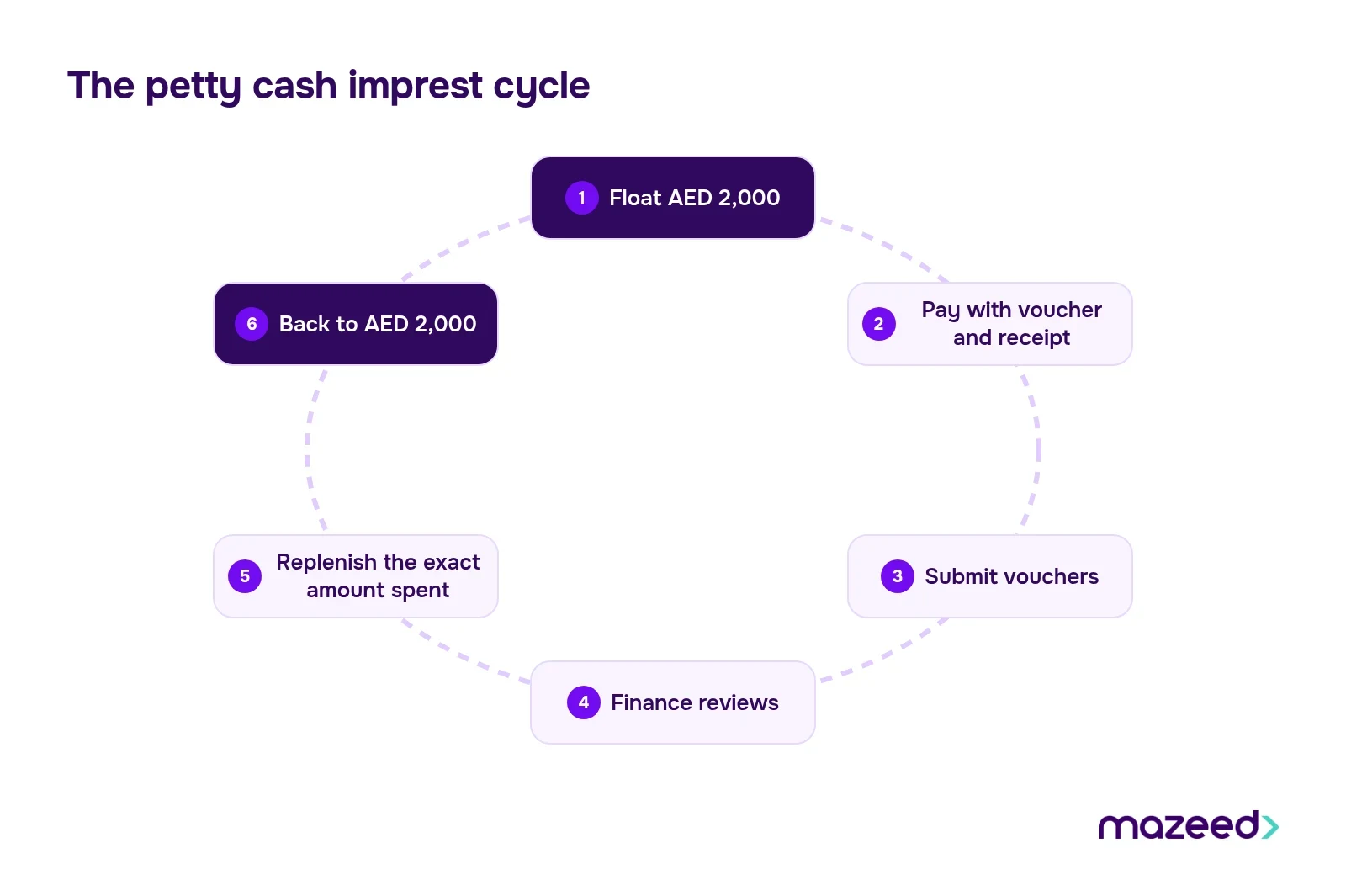
Because the float is fixed, any difference between cash plus vouchers and the float is a shortage or surplus that must be explained.
What should a petty cash voucher include?
| Field | Why it matters |
|---|---|
| Voucher number | Creates a sequential audit trail |
| Date | Places the expense in the right month and VAT period |
| Amount paid | Must match the attached receipt |
| Description and business purpose | Supports the Corporate Tax deduction |
| Expense category | Lets you post it to the right account in your chart of accounts |
| Paid to | Identifies the supplier |
| VAT amount, if any | Needed to claim input VAT |
| Requested by and approved by | Separates duties and prevents misuse |
| Receipt or tax invoice attached | The evidence for VAT and audit |
Petty cash journal entries, with a worked example
A Dubai design studio sets up a petty cash float of AED 2,000 on 1 December. During the month the custodian pays:
| Voucher | Expense | Amount paid (AED) | VAT on tax invoice (AED) |
|---|---|---|---|
| PC-001 | Courier to Abu Dhabi | 63.00 | 3.00 |
| PC-002 | Stationery | 210.00 | 10.00 |
| PC-003 | Taxi fares (receipts, no tax invoice) | 145.00 | 0.00 |
| PC-004 | Coffee and snacks for client meeting | 105.00 | 5.00 |
| PC-005 | Typing centre fees | 120.00 | 0.00 |
| Total | 643.00 | 18.00 |
1. Setting up the fund (1 December):
| Account | Debit | Credit |
|---|---|---|
| Petty cash | 2,000.00 | |
| Bank | 2,000.00 |
2. Replenishing the fund (31 December). Expenses are recorded net of recoverable VAT. The client coffee is posted gross, because VAT on entertainment for non-employees is blocked:
| Account | Debit | Credit |
|---|---|---|
| Postage and courier | 60.00 | |
| Office supplies | 200.00 | |
| Travel | 145.00 | |
| Client entertainment | 105.00 | |
| Government fees | 120.00 | |
| Input VAT recoverable | 13.00 | |
| Bank | 643.00 |
The petty cash account itself still shows AED 2,000. Only the expenses move, which is exactly what makes the imprest system easy to audit. Every entry above lands in your general ledger and then in your trial balance.
A note on the client coffee: the AED 5 of VAT on the tax invoice is real, but the VAT Executive Regulation blocks input tax recovery on entertainment provided to people who are not employees. That is why only AED 13 of the AED 18 shown on receipts is claimed, and the coffee is booked at AED 105.
What are the VAT rules for petty cash in the UAE?
VAT on petty cash purchases can only be recovered if you hold a valid tax invoice, as required by Article 59 of the VAT Executive Regulation (Cabinet Decision No. 52 of 2017). A till slip that only shows a total, or a taxi receipt with no VAT details, does not support a claim.
The same article allows a simplified tax invoice where the buyer is VAT-registered and the value does not exceed AED 10,000, which covers almost every petty cash purchase. In practice, ask the shop for a tax invoice showing the supplier's TRN and the VAT amount; most UAE retailers print this on the receipt.
Two more points matter:
- Blocked input tax. VAT on certain expenses, including most entertainment for non-employees, cannot be recovered even with a tax invoice. Do not claim it.
- Timing. Record the VAT in the period of the tax invoice. Leaving vouchers unprocessed until a later quarter can push claims into the wrong return. For a refresher on how input and output VAT interact, see our guide to input and output VAT.
What about Corporate Tax?
Under the UAE Corporate Tax Law, Federal Decree-Law No. 47 of 2022, an expense is deductible only if it is incurred wholly and exclusively for the business. A petty cash voucher with a clear business purpose is the evidence. Client entertainment is only 50% deductible, so it helps to keep it in its own account. Corporate Tax records must be kept for seven years after the end of the tax period they relate to, so keep scanned copies of petty cash receipts, not just the paper.
Petty cash controls that prevent problems
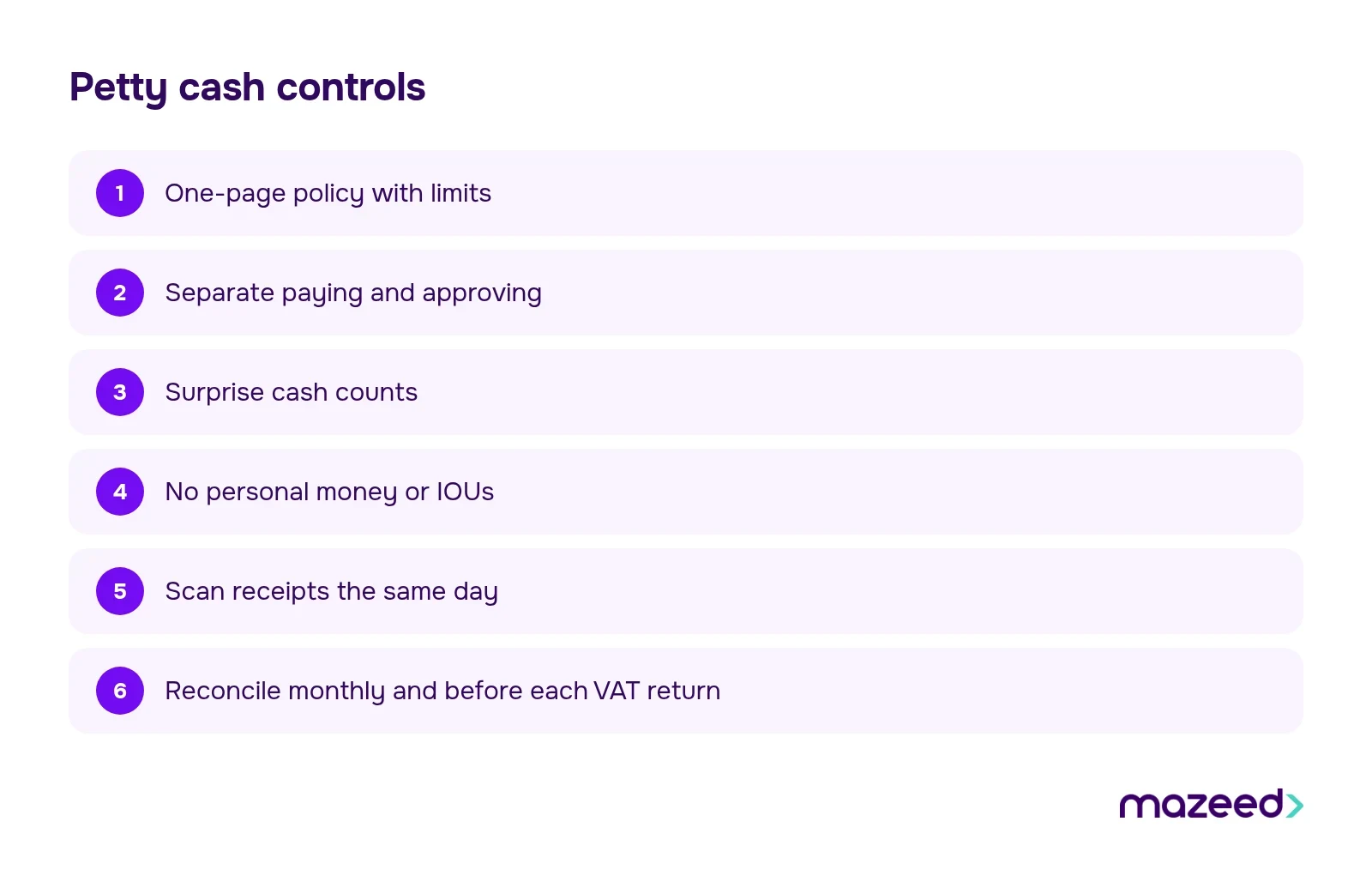
- Write a one-page policy: float amount, maximum single payment (for example AED 500), allowed expense types, and who approves.
- Separate duties: the custodian pays; someone else approves replenishments and posts the entries.
- Do surprise counts: count the cash and vouchers against the float without notice, a few times a year.
- Never mix personal money with the fund, and never allow IOUs.
- Scan receipts the same day. Thermal-paper receipts fade within months.
- Reconcile monthly and before every VAT return.
How to track expenses beyond petty cash
Petty cash is only one part of how a business spends. Card payments, employee reimbursements and supplier bills need the same discipline. Our guide on how to track expenses for a small business covers the full picture, and our guide to invoice vs receipt explains which documents support a VAT claim.
How mazeed helps
With mazeed's expense management software, staff snap receipts on their phone, the VAT amount is captured from the tax invoice, and each expense is posted to the right account. Petty cash replenishments become a review-and-approve step instead of a pile of paper vouchers at month end.
This article is general information based on UAE legislation in force on 16 November 2026. It is not tax or legal advice; for your specific case, speak to a qualified tax adviser.