

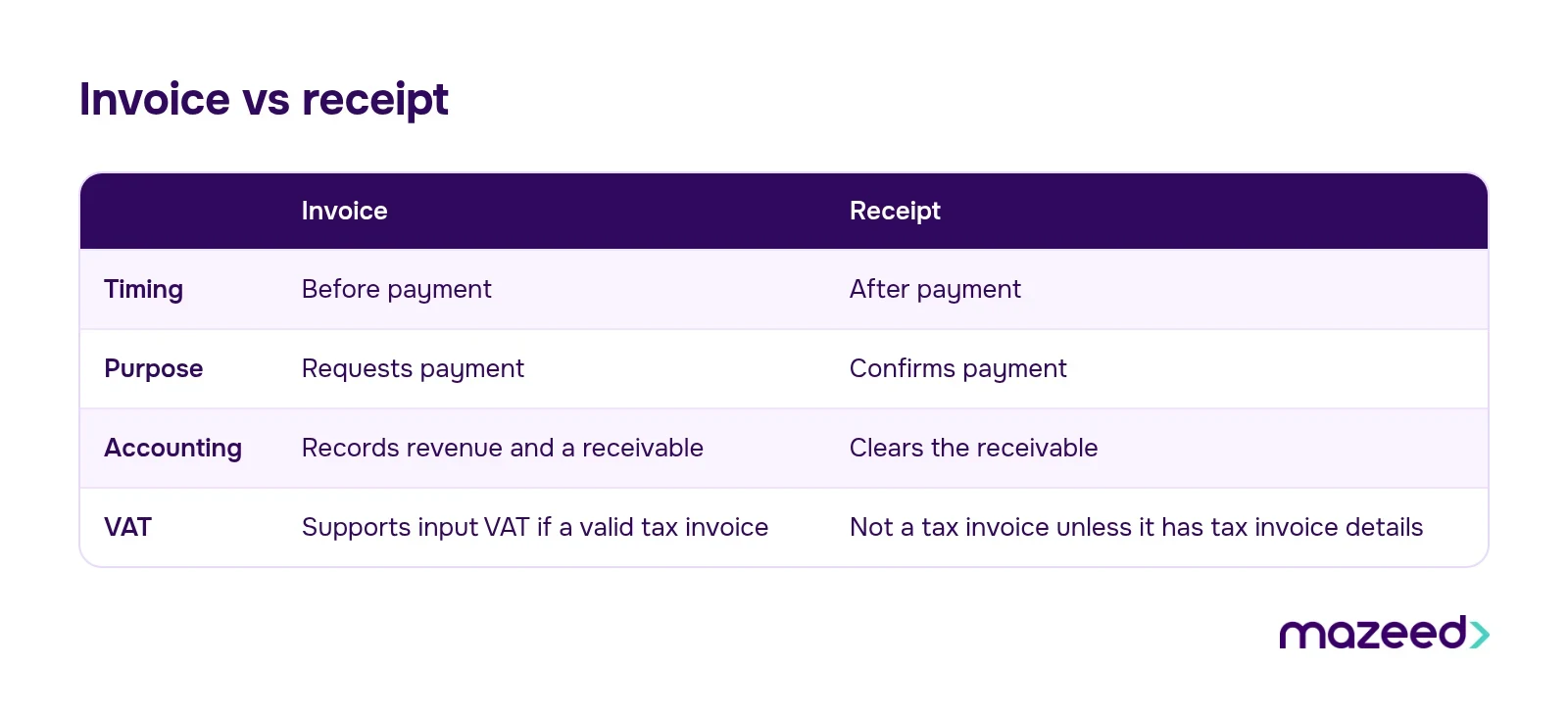
An invoice is a request for payment that a seller sends to a buyer, listing what was supplied, the amount due and when it must be paid. A receipt is proof that payment has been received. In short: the invoice comes before payment and the receipt comes after it. In the UAE, the distinction also matters for VAT, because a VAT-registered business must issue a tax invoice for taxable supplies, and a plain receipt only counts for VAT if it contains the particulars of a tax invoice.
Invoice vs receipt at a glance
| Invoice | Receipt | |
|---|---|---|
| Purpose | Requests payment | Confirms payment |
| Timing | Before payment (or at the same time for cash sales) | After payment |
| Shows | Items, prices, VAT, total due, due date, payment details | Amount paid, date, method, what it was for |
| Accounting effect | Records revenue and a receivable (for credit sales) | Records cash received and clears the receivable |
| UAE VAT role | A tax invoice is required for taxable supplies by registered businesses | Only counts for VAT if it contains tax invoice particulars |
| Lets the buyer recover input VAT | Yes, if it is a valid tax invoice | No, unless it is also a valid tax invoice |
| Common in | B2B sales on credit terms | Retail, cash sales, payments against invoices |
When do you issue an invoice, and when a receipt?
It depends on how the customer pays.
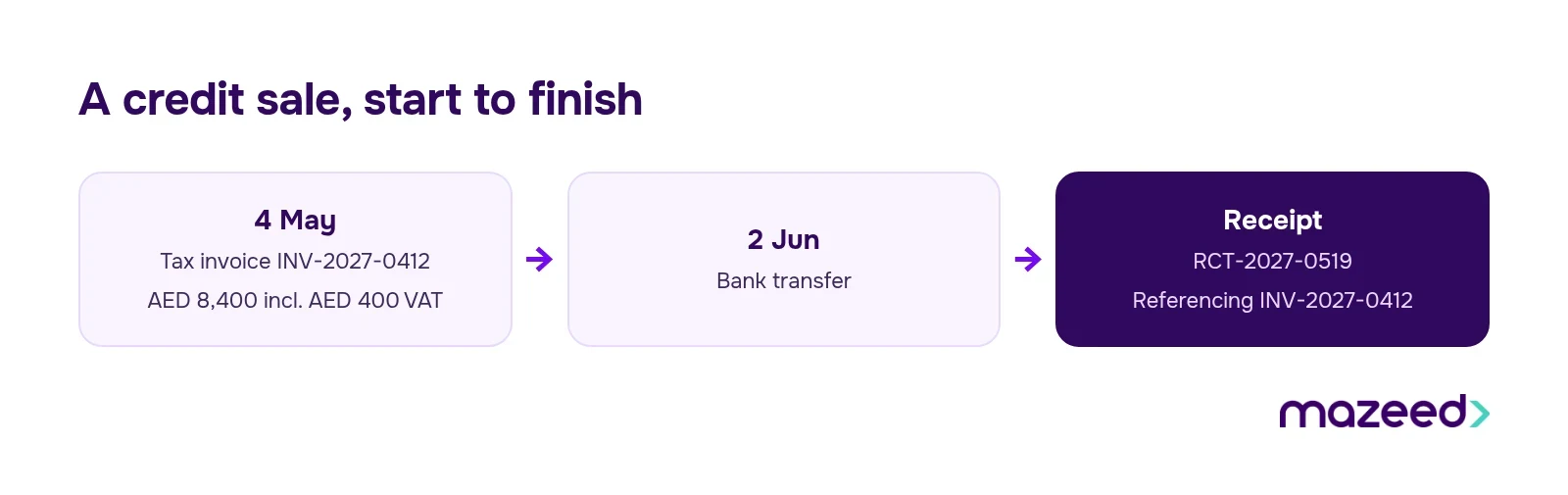
Credit sale (pay later). A Dubai IT company services a client's network on 4 May and issues a tax invoice for AED 8,400 (AED 8,000 plus AED 400 VAT) with Net 30 terms. On 2 June the client pays by bank transfer, and the company sends a payment receipt referencing the invoice number. Two documents: the invoice records the sale and the VAT; the receipt confirms the payment.
Cash sale (pay now). A customer buys a printer cartridge for AED 210 at a shop in Sharjah and pays by card. The shop prints one document that serves as both: it shows the supplier's details, TRN, the item, the VAT and the total, and confirms payment. That single receipt is also a simplified tax invoice.
Advance payment. A customer pays a deposit before delivery. The seller issues a receipt for the money and, because receiving payment can trigger the VAT date of supply, a tax invoice for the advance within 14 days. Our guide to the proforma invoice walks through this case.
Is a receipt a tax invoice in the UAE?
Only if it contains the information a tax invoice requires.
Article 65 of the VAT Decree-Law requires a registrant making a taxable supply to issue a tax invoice, and Article 67 sets the 14-day deadline from the date of supply. Article 59 of the VAT Executive Regulation sets out what a tax invoice must contain, and allows a simplified tax invoice where:
- the recipient is not VAT-registered, or
- the recipient is VAT-registered and the value of the supply does not exceed AED 10,000.
A simplified tax invoice needs fewer details than a full one, such as the words "Tax Invoice", the supplier's name, address and TRN, the date, a description of the supply, and the total including VAT with the VAT amount or rate shown. Most UAE point-of-sale systems print these on the till receipt, which is why a shop receipt usually works as a simplified tax invoice. The FTA explains the details in its public clarification on tax invoices (VATP006), listed on the FTA Guides, References and Public Clarifications page. For the full list of fields, see our guide to the UAE tax invoice format.
A payment receipt that only says "Received AED 8,400 from Client X" is not a tax invoice. It cannot replace the invoice, and the buyer cannot use it to recover VAT.
What should an invoice include?
For a VAT-registered UAE business, a full tax invoice should include, among other details:
- The words "Tax Invoice"
- Supplier's name, address and TRN
- Customer's name, address and TRN, where registered
- A unique sequential invoice number
- Date of issue, and date of supply if different
- Description, quantity and unit price of each item
- VAT rate and VAT amount for each item, in AED
- Total amount payable
- Payment terms and due date, and bank details
What should a receipt include?
There is no legal format for a payment receipt, but a clear one shows:
| Field | Example |
|---|---|
| Title | Payment Receipt |
| Receipt number | RCT-2027-0519 |
| Date received | 2 June 2027 |
| Received from | Gulf Ventures FZ-LLC |
| Amount | AED 8,400 |
| Payment method | Bank transfer, ref. FT2715300123 |
| For | Payment of tax invoice INV-2027-0412 dated 4 May 2027 |
| Balance remaining | AED 0 |
| Issued by | Name and signature, or system-generated |
Linking every receipt to the invoice it pays keeps your receivables accurate, and a monthly statement of account gives customers the full picture of invoices and payments.
How do invoices and receipts work with UAE e-invoicing?
Under the e-invoicing decisions issued by the Ministry of Finance, B2B and B2G invoices and credit notes move through the Electronic Invoicing System once your business is in scope, while B2C transactions are excluded until the Minister decides otherwise. Payment receipts are not invoices and are not exchanged through the system. In practice:
- Your tax invoices to business customers become e-invoices from your go-live date.
- Your receipts continue as normal, and should reference the e-invoice number they pay.
- Retail till receipts to consumers stay outside e-invoicing for now.
For the dates and exclusions, read our guide: Is e-invoicing mandatory in the UAE?
Common mistakes with invoices and receipts
- Sending a receipt instead of an invoice for a credit sale, leaving the customer unable to recover VAT and your VAT records incomplete.
- Issuing the invoice late. The 14-day deadline runs from the date of supply, not from when the customer asks for an invoice.
- Receipts with no invoice reference, which makes it hard to know which invoice was paid.
- Re-using numbers. Invoices and receipts should each have their own sequential series.
- Accepting staff receipts without VAT details for expenses, which loses input VAT; see our guide to petty cash.
- Emailing invoices without checking they arrived. Our guide on how to send an invoice by email has practical tips.
What about refunds and credit notes?
When a customer returns goods or you reduce the price after invoicing, a receipt is not the right document. A VAT-registered business issues a tax credit note, which reduces the output VAT on the original sale. Under Article 62 of the VAT Decree-Law, the credit note must be issued within 14 days of the event that reduced the supply, such as the return or the agreed discount. If you then pay the money back, a refund receipt or payment advice confirms the payment, but it is the credit note that corrects the VAT. Once your business is live on e-invoicing, credit notes to business customers are issued as electronic credit notes through the system, just like invoices.
Do I need to keep invoices and receipts?
Yes. UAE tax law requires businesses to keep accounting records and supporting documents, including invoices and receipts, generally for at least five years under the Tax Procedures Law, and for seven years for Corporate Tax purposes. Keep digital copies; thermal receipts fade.
How mazeed helps
With mazeed's invoicing software, you issue compliant tax invoices, record payments against them, and send receipts automatically, with each receipt linked to the invoice it settles. Receivables update as soon as a payment is recorded.
This article is general information based on UAE legislation in force on 16 November 2026. It is not tax or legal advice; for your specific case, speak to a qualified tax adviser.