
Misc expenses are small, infrequent business costs that do not fit any named account in your chart of accounts. In the UAE, record them in a Miscellaneous Expenses account, keep a tax invoice or receipt for each, and review the balance monthly, because large or recurring items should move to their own account.
What are misc expenses in accounting?
Misc expenses (short for miscellaneous expenses) are small, occasional business costs that do not belong in any specific expense account. They are grouped together so the books stay tidy without creating a new account for every one-off payment.
"Miscellaneous expenses" is an accounting convention, not a legal or tax category in UAE law. Your accountant decides what goes into the account. The tax rules look at what each cost actually is.
Misc expenses appear in the income statement as an operating expense, so they reduce profit in the period they are incurred. They are not an asset.
If your expense accounts have grown messy and you are unsure what belongs where, you can get help with your bookkeeping from mazeed's accountants.
What is the difference between misc expenses, other expenses and sundry expenses?
In day-to-day UAE bookkeeping, the three terms usually mean the same thing: a small catch-all account for minor operating costs. Some businesses use them differently, so the distinction depends on your own chart of accounts.
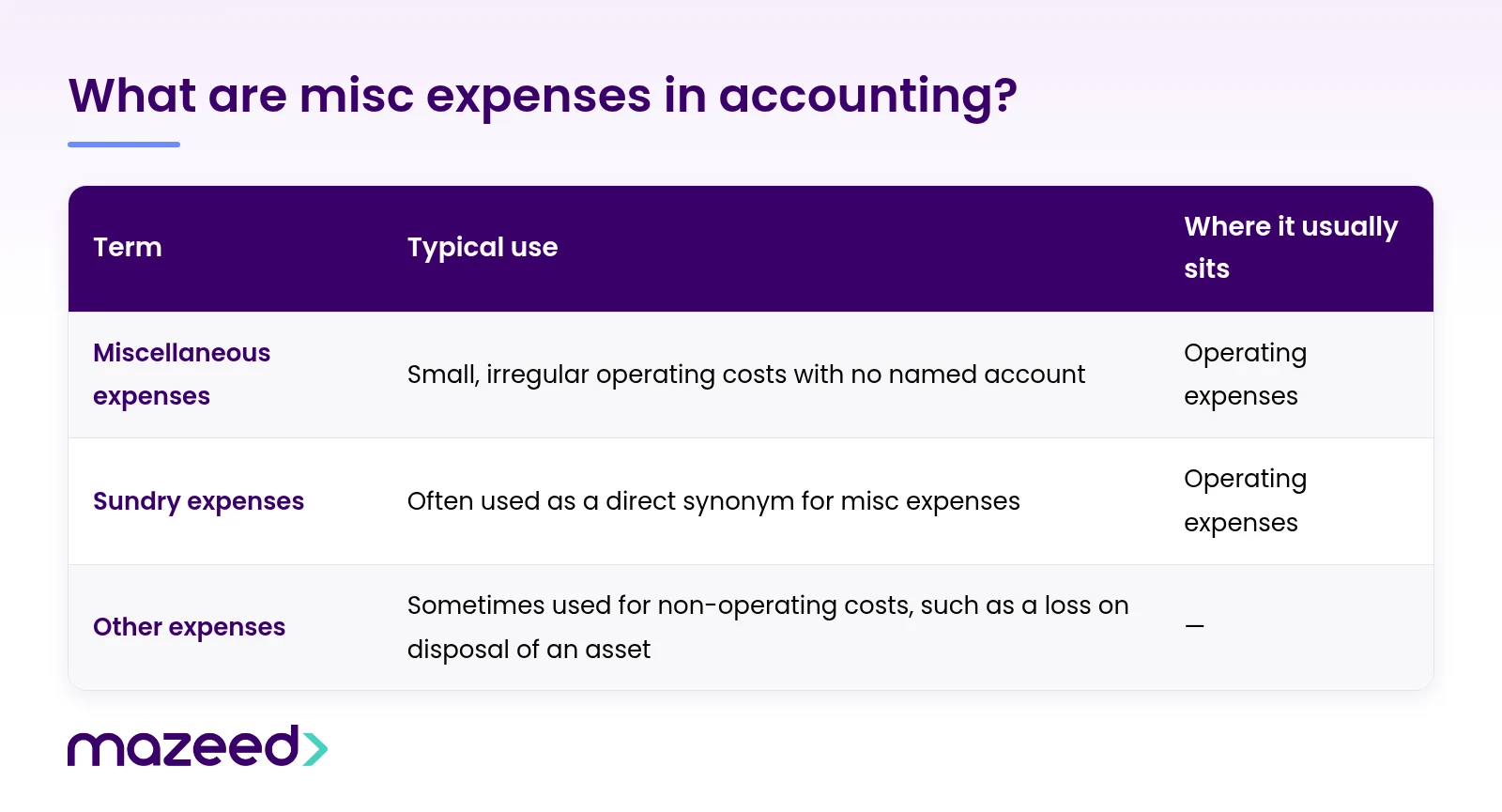
| Term | Typical use | Where it usually sits |
|---|---|---|
| Miscellaneous expenses | Small, irregular operating costs with no named account | Operating expenses |
| Sundry expenses | Often used as a direct synonym for misc expenses | Operating expenses |
| Other expenses | Sometimes used for non-operating costs, such as a loss on disposal of an asset | Below operating profit, or in operating expenses if used as a synonym |
Pick one label, define it in your accounting policy, and use it consistently.
What are common examples of misc expenses in a UAE business?
Typical misc expenses are low-value, one-off costs that happen a few times a year at most. If a cost repeats every month, it is not miscellaneous.
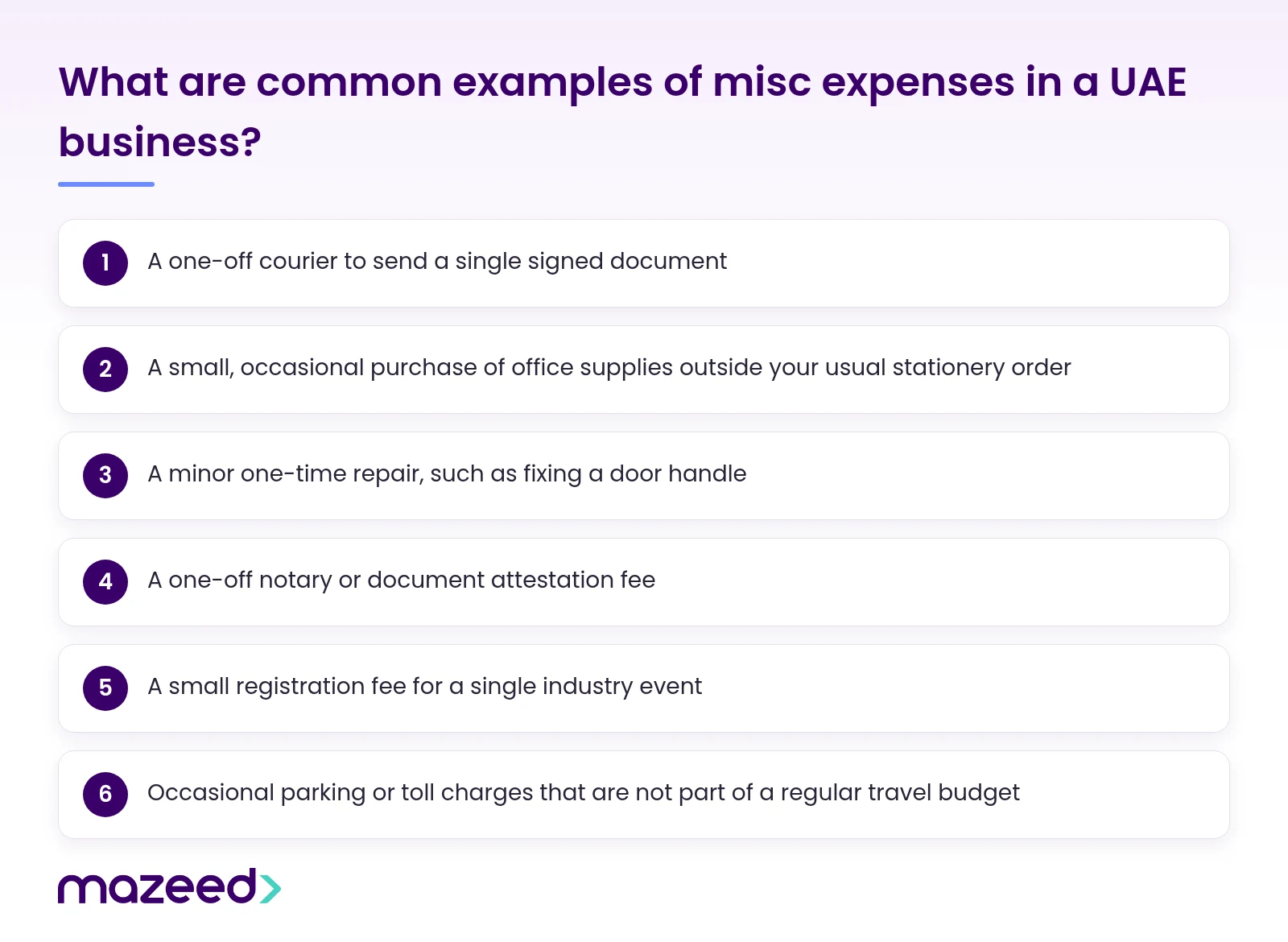
Common examples include:
- A one-off courier to send a single signed document
- A small, occasional purchase of office supplies outside your usual stationery order
- A minor one-time repair, such as fixing a door handle
- A one-off notary or document attestation fee
- A small registration fee for a single industry event
- Occasional parking or toll charges that are not part of a regular travel budget
Notary and attestation fees charged by government bodies may carry no VAT, so there may be no input tax to record.
When staff pay small items from a cash float, the payment source does not change the classification. Our guide to managing petty cash in a UAE business covers the float process itself.
What should NOT be recorded as misc expenses?
Assets, owner personal spending, fines and recurring costs should never sit in misc expenses. Each has a different accounting and tax treatment, and mixing them in hides that difference.
| Cost | Treat as misc? | Better account |
|---|---|---|
| One-off courier for a single document | Yes | n/a |
| Monthly courier fees | No, recurring | Courier / Delivery |
| Small client gift | Check first | Entertainment / Gifts (separate tax treatment) |
| Laptop purchase | No | Fixed assets |
| Owner's personal purchase | No | Owner drawings |
| Penalty or fine | No | Fines and penalties (separate) |
Owner drawings are amounts the owner takes from the business for personal use. They reduce equity and are not a business expense at all.
How do you record misc expenses?
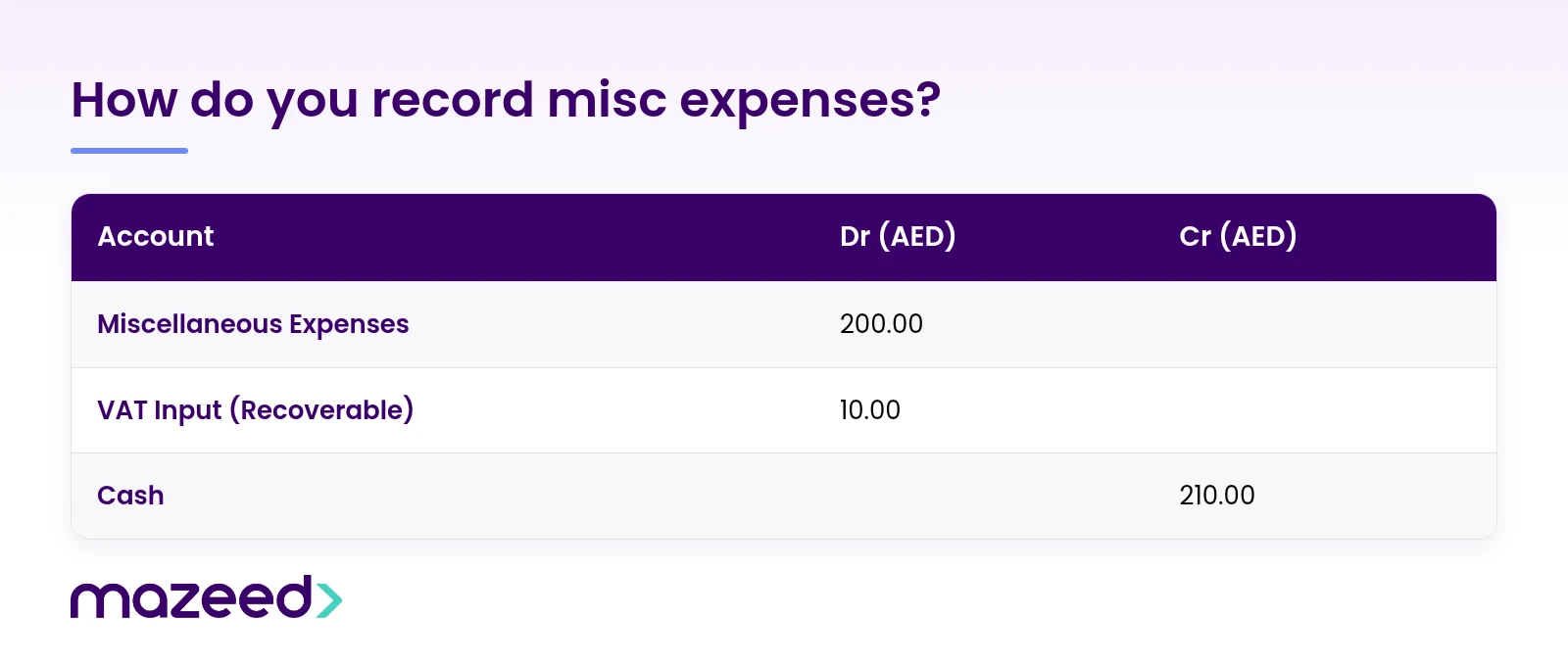
You debit (Dr) the Miscellaneous Expenses account for the net cost, debit VAT Input (Recoverable) for any recoverable VAT, and enter the payment side (Cr) against Cash, Bank or Accounts Payable. Record the VAT line only if you hold a valid tax invoice and the cost is for business use.
Input tax is the VAT you pay on business purchases that a VAT-registered business can recover, subject to the conditions in Article 54 of Federal Decree-Law No. 8 of 2017 on Value Added Tax. The standard VAT rate is 5% as of November 2026.
Worked example: AED 210 including 5% VAT, paid in cash
| Account | Dr (AED) | Cr (AED) |
|---|---|---|
| Miscellaneous Expenses | 200.00 | |
| VAT Input (Recoverable) | 10.00 | |
| Cash | 210.00 |
For how these lines flow into account balances, see our explanation of how entries post to the general ledger.
How do you record a misc expense paid by cash, card or on supplier terms?
The expense and VAT lines stay the same. Only the payment side changes.
1. Paid in cash (one-off courier, AED 105 including VAT)
| Account | Dr (AED) | Cr (AED) |
|---|---|---|
| Miscellaneous Expenses | 100.00 | |
| VAT Input (Recoverable) | 5.00 | |
| Cash | 105.00 |
2. Paid by company card (minor repair, AED 315 including VAT)
| Account | Dr (AED) | Cr (AED) |
|---|---|---|
| Miscellaneous Expenses | 300.00 | |
| VAT Input (Recoverable) | 15.00 | |
| Bank | 315.00 |
3. Supplier invoice paid later (event registration, AED 420 including VAT)
When the invoice arrives:
| Account | Dr (AED) | Cr (AED) |
|---|---|---|
| Miscellaneous Expenses | 400.00 | |
| VAT Input (Recoverable) | 20.00 | |
| Accounts Payable | 420.00 |
When you pay:
| Account | Dr (AED) | Cr (AED) |
|---|---|---|
| Accounts Payable | 420.00 | |
| Bank | 420.00 |
How do you treat misc expenses that belong to another period?
Book the expense in the period that benefits from it, not when the cash moves. Use an accrual when the cost is incurred before you pay or receive the invoice, and a prepayment when you pay before the benefit arrives.
Accrual: A minor repair is done on 28 December, and the invoice arrives in January. In December, Dr Miscellaneous Expenses and Cr Accrued Expenses for the net amount. When the tax invoice arrives, reverse the accrual and record the invoice with its VAT line.
Prepayment: You pay in November for a one-off event held in December. In November, Dr Prepaid Expenses and Cr Bank. In December, Dr Miscellaneous Expenses and Cr Prepaid Expenses.
Where do misc expenses sit in the chart of accounts?
Misc expenses sit in the operating expenses section, usually as the last account in that group. Placing the account last makes it clear that it is used only after every named account has been considered.
Many businesses number it at the end of the operating expense range so it stands apart from specific accounts. For the full account structure and numbering, see our chart of accounts for UAE businesses.
Are misc expenses tax deductible in the UAE?
For UAE corporate tax, a misc expense is deductible only if the cost itself is deductible. The "misc" label has no effect. What counts is whether the cost was incurred wholly and exclusively for business purposes and is not specifically restricted.
The general deduction rule is in Article 28 of Federal Decree-Law No. 47 of 2022 on the Taxation of Corporations and Businesses. Certain costs are restricted or excluded by later articles of the same law, as summarised below.
| Nature of the cost | Corporate tax treatment | VAT input tax |
|---|---|---|
| General business cost, wholly for business | Deductible under Article 28 | Recoverable with a valid tax invoice |
| Entertaining clients, shareholders or suppliers | 50% deductible under Article 32 | Generally blocked under Article 53 of Cabinet Decision No. 52 of 2017 |
| Fines and penalties (other than compensation for damages or breach of contract) | Not deductible under Article 33 | Fines are generally outside the scope of VAT |
| Owner's personal spending | Not deductible, as it is not for business purposes | Not recoverable |
| Asset purchase (for example, a laptop) | Capital cost, recovered through depreciation, not as an immediate expense | Recoverable under normal rules if used for business |
The corporate tax rate is 0% on taxable income up to AED 375,000 and 9% on taxable income above AED 375,000, as of November 2026, under Cabinet Decision No. 116 of 2022 (see also the Ministry of Finance confirmation).
Resident persons with revenue of AED 3,000,000 or less in the tax period and in every previous tax period can elect Small Business Relief under Article 21 of Federal Decree-Law No. 47 of 2022 and Ministerial Decision No. 73 of 2023, as of November 2026. Businesses that elect it are treated as having no taxable income for the relevant tax period, but must still keep proper records. The relief is not available to Qualifying Free Zone Persons or members of large multinational groups.
Can you recover VAT on misc expenses?
Yes, if your business is VAT-registered, the cost is for making taxable supplies, and you hold a valid tax invoice. Blocked categories, such as most client entertainment, stay blocked even when booked as misc.
A tax invoice must include specific details, such as the supplier's Tax Registration Number, the date, a description of the supply and the VAT amount, under Article 59 of Cabinet Decision No. 52 of 2017. A simplified tax invoice may be issued where the supply value does not exceed AED 10,000, as of November 2026.
Small client gifts need extra care. Gifts above a set value per recipient may be treated as a deemed supply, with output VAT due.
Which records must you keep for misc expenses, and for how long?
Keep a tax invoice or receipt for every misc expense, together with a short note of its business purpose. The retention period depends on the tax.
| Record | Minimum retention | Source |
|---|---|---|
| Corporate tax records | 7 years after the end of the tax period, as of November 2026 | Article 56, Federal Decree-Law No. 47 of 2022 |
| VAT records (general) | 5 years after the end of the tax period, as of November 2026 | Federal Decree-Law No. 28 of 2022 on Tax Procedures and its Executive Regulation |
| VAT records relating to real estate | Longer period applies, as of November 2026 |
In practice, keep misc expense records for at least 7 years, so the longer corporate tax period covers both taxes.
How big should the misc expenses line be?
As a mazeed rule of thumb, keep misc expenses below about 2% of total operating expenses. This is our internal guidance, not a legal requirement.
Three practical triggers tell you when to move a cost out of misc:
- Recurrence: the same type of cost appears 3 or more times in a quarter.
- Size: a single item exceeds a threshold you set, for example AED 1,000.
- Share: the misc balance rises above about 2% of operating expenses.
When any trigger is met, create a named account and reclassify past entries in the current period. A high misc balance makes your management reports less useful and draws questions during a tax review.
How do you keep misc expenses under control?
Review the misc account every month, using a short, fixed checklist. A 15-minute review prevents a year-end cleanup.
Copy this checklist into your month-end routine:
Monthly misc expense review checklist
- Compare this month's misc balance with last month's and the same month last year
- Check that the balance is below your share threshold (for example, 2% of operating expenses)
- List every item above your single-item threshold (for example, AED 1,000)
- Flag any cost type that has appeared 3 or more times this quarter
- Reclassify flagged items to a named account
- Move any assets, owner drawings, fines or entertainment out of misc
- Confirm each entry has a tax invoice or receipt and a business purpose note
- Confirm VAT was recorded only where a valid tax invoice exists and recovery is not blocked
- Record missing documents and chase them before the VAT return is filed
Classification is the focus here. For choosing tools and building a daily routine, read our guide to tracking business expenses in the UAE.
Not sure how to classify your expenses? Talk to a mazeed accountant. Share three details and our team will contact you:
- Name
- Mobile
- Service
Next steps with mazeed
Once your expenses are classified correctly, the next step is to keep them that way automatically.
Tag and review every expense automatically with mazeed accounting software. Assign accounts as you record costs, attach receipts, and spot a growing misc balance before month-end.