

An audit is an independent examination of a company's financial records and statements by a licensed auditor, who gives an opinion on whether they are fairly presented. In the UAE, the main types are statutory, internal, tax and VAT audits. The process runs from planning and fieldwork to a signed report.
If you want help getting your records ready or finding the right engagement, mazeed offers accounting and audit support for UAE companies.
What is the audit process step by step?
- Agree the engagement Agree the engagement. You and the auditor sign an engagement letter covering scope, timing and responsibilities.
- Plan and assess risk Plan and assess risk. The auditor learns your business, sets materiality and decides where errors are most likely.
- Carry out fieldwork Carry out fieldwork. The auditor tests transactions, balances and controls against your records.
- Discuss findings Discuss findings. The auditor raises proposed adjustments and control points with management.
- Issue the report Issue the report. Management signs a representation letter, and the auditor signs the audit report with an opinion.
What is an audit?
An audit is a structured, independent check of a company's financial statements. It ends with a written opinion on whether those statements give a true and fair view of the business.
Financial statements are the formal year-end reports of a business: the statement of financial position (balance sheet), the income statement, the cash flow statement and the supporting notes. The audit opinion is the auditor's signed conclusion on those statements. Banks, shareholders, regulators and tax authorities rely on it because someone outside the business has tested the figures.
What does an auditor actually check?
An auditor checks three things: whether your records are complete and accurate, whether your internal controls work, and whether your financial statements are fairly presented.
In practice, this means tracing transactions back to invoices and contracts, confirming bank balances, counting or verifying assets, and reviewing how management made estimates. The auditor does not check every transaction. They test samples chosen according to risk and materiality. Materiality is the size of error that could change a reader's view of the accounts.
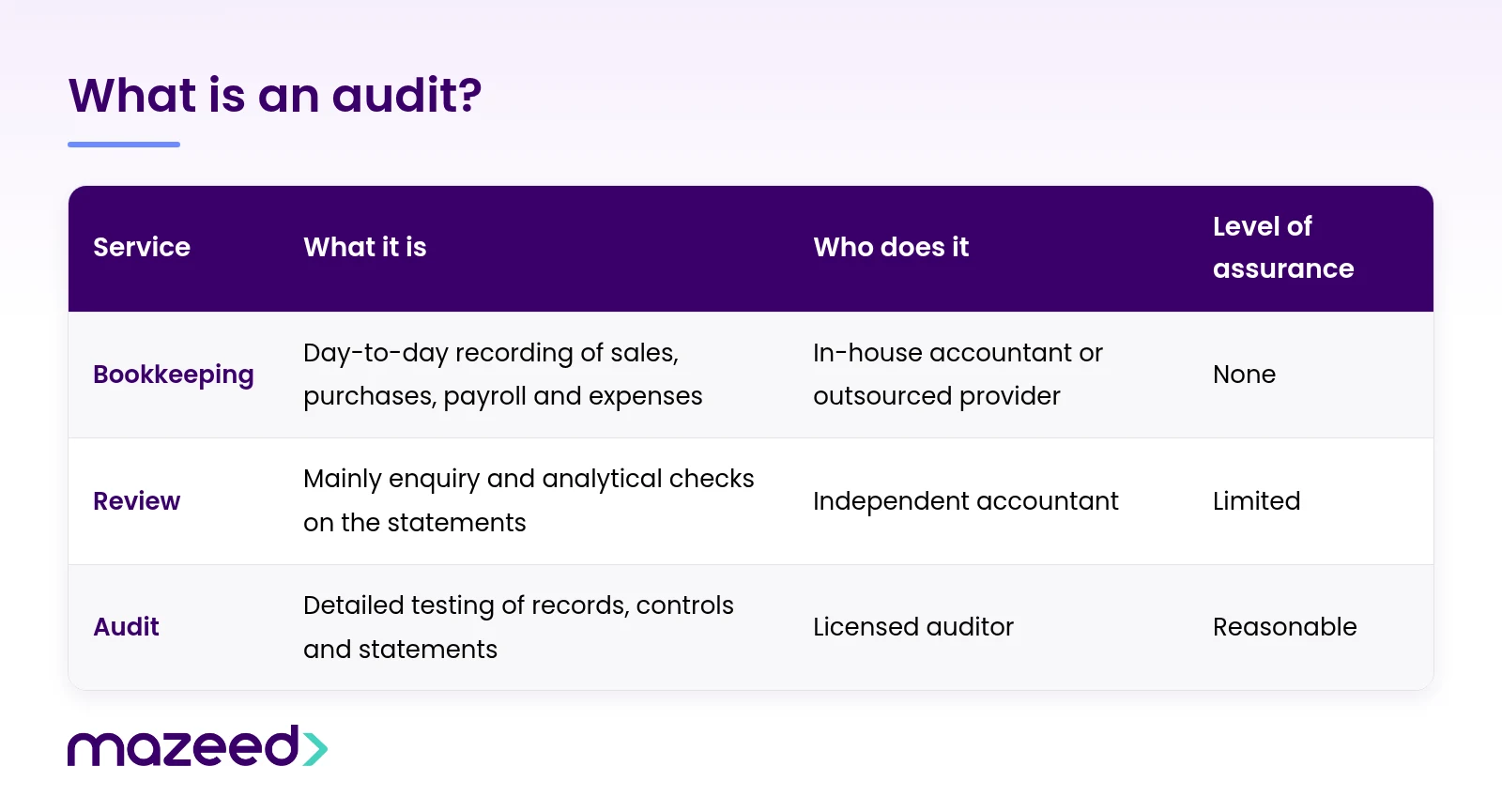
What is the difference between an audit, a review and bookkeeping?
Bookkeeping records your transactions. A review gives limited comfort on your statements. An audit gives the highest level of independent assurance.
| Service | What it is | Who does it | Level of assurance |
|---|---|---|---|
| Bookkeeping | Day-to-day recording of sales, purchases, payroll and expenses | In-house accountant or outsourced provider | None. It produces the records |
| Review | Mainly enquiry and analytical checks on the statements | Independent accountant | Limited ("nothing has come to our attention") |
| Audit | Detailed testing of records, controls and statements | Licensed auditor | Reasonable ("the statements are fairly presented") |
What are the main types of audit?
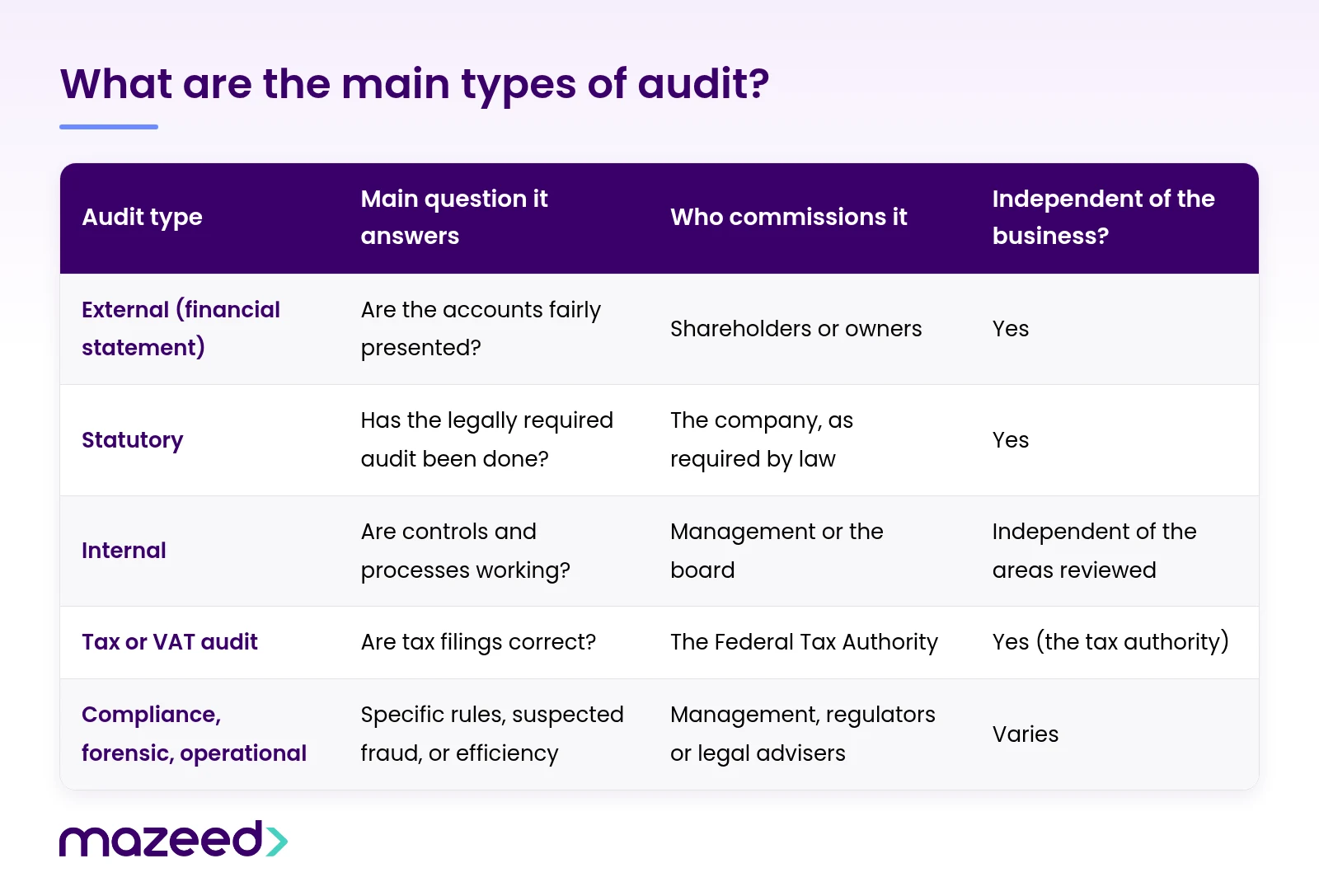
The main types of audit are external (financial statement), statutory, internal, and tax or VAT audits. Compliance, forensic and operational audits also exist for specific needs.
| Audit type | Main question it answers | Who commissions it | Independent of the business? |
|---|---|---|---|
| External (financial statement) | Are the accounts fairly presented? | Shareholders or owners | Yes |
| Statutory | Has the legally required audit been done? | The company, as required by law | Yes |
| Internal | Are controls and processes working? | Management or the board | Independent of the areas reviewed, but part of or hired by the business |
| Tax or VAT audit | Are tax filings correct? | The Federal Tax Authority | Yes (the tax authority) |
| Compliance, forensic, operational | Specific rules, suspected fraud, or efficiency | Management, regulators or legal advisers | Varies |
What is an external audit?
An external audit is an independent audit of your annual financial statements by a licensed auditor who is not part of your business.
The auditor plans the work, tests your figures and issues a signed report with an opinion. Shareholders, partners and outside parties use this report to decide how far they can trust the accounts.
What is a statutory audit?
A statutory audit is an external audit that the law requires a company to carry out. For UAE companies, the Commercial Companies Law sets the core rules (Federal Decree-Law No. 32 of 2021 on Commercial Companies, UAE Legislation).
Who must have one, when, and what it involves are covered in our guide to statutory audit for UAE business.
What is an internal audit?
An internal audit is a review of controls, risks and processes, commissioned by management or the board to improve how the business runs.
It does not produce an opinion on the annual accounts. Instead, it delivers findings and recommendations, for example on purchasing approvals, cash handling or IT access. For most private UAE businesses, internal audit is good practice rather than a general legal duty.
What is a tax or VAT audit?
A tax audit is a check by the Federal Tax Authority (FTA) that a business has filed and paid tax correctly. A VAT audit focuses on VAT returns, invoices and records (Federal Tax Authority).
If you need to document your VAT position, see how to prepare a VAT audit report in the UAE.
What are compliance, forensic and operational audits?
These are specialised audits. A compliance audit checks that the business follows specific rules or contracts. A forensic audit investigates suspected fraud or disputes, often to produce evidence. An operational audit looks at how efficiently a department or process works.
Is an audit mandatory for businesses in the UAE?
For many UAE businesses, yes. But the answer depends on your legal form, where you are licensed, and your tax position, so check the rules for your situation.
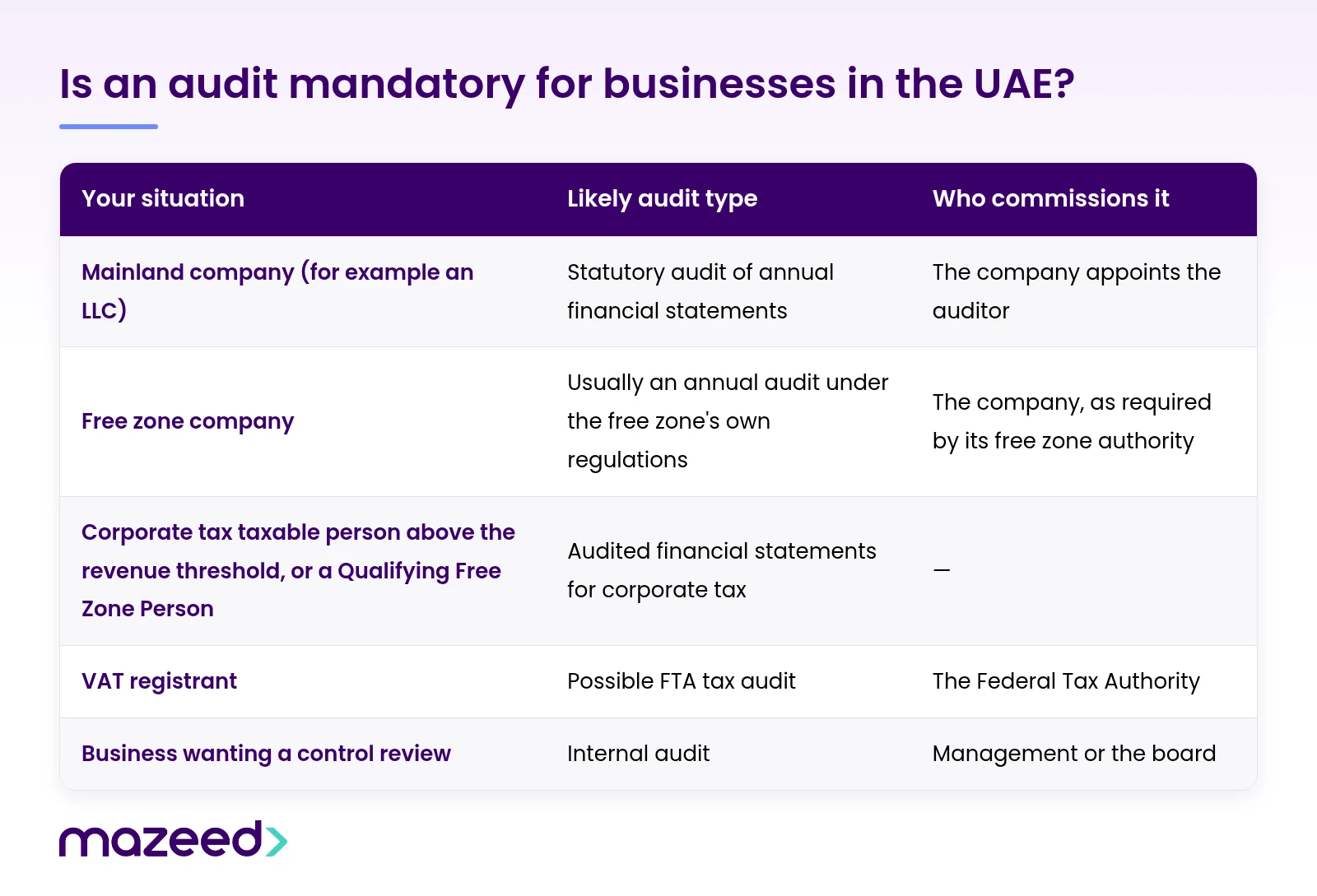
Table A: Which audit do I need?
| Your situation | Likely audit type | Who commissions it | Learn more |
|---|---|---|---|
| Mainland company (for example an LLC) | Statutory audit of annual financial statements | The company appoints the auditor (Federal Decree-Law No. 32 of 2021, UAE Legislation) | Our statutory audit guide |
| Free zone company | Usually an annual audit under the free zone's own regulations | The company, as required by its free zone authority | |
| Corporate tax taxable person above the revenue threshold, or a Qualifying Free Zone Person | Audited financial statements for corporate tax purposes | The business | See the next section |
| VAT registrant | Possible FTA tax audit | The Federal Tax Authority | Our VAT audit report guide |
| Business wanting a control review | Internal audit | Management or the board | Good practice, not a general legal duty |
When do audited financial statements matter for corporate tax?
Under the UAE corporate tax regime, some businesses must prepare audited financial statements. The UAE corporate tax law is Federal Decree-Law No. 47 of 2022 on the Taxation of Corporations and Businesses (Ministry of Finance, Corporate Tax).
A Ministerial Decision requires audited financial statements from taxable persons whose revenue exceeds AED 50 million, and from Qualifying Free Zone Persons (as of November 2026). A Qualifying Free Zone Person is a free zone business that meets the conditions to benefit from the free zone corporate tax treatment (Federal Tax Authority).
What is the audit process step by step?
A typical audit moves through four stages: planning and engagement, risk assessment and fieldwork, testing and findings, then the signed report.
- Agree the engagement. You and the auditor sign an engagement letter covering scope, timing and responsibilities.
- Plan and assess risk. The auditor learns your business, sets materiality and decides where errors are most likely.
- Carry out fieldwork. The auditor tests transactions, balances and controls against your records.
- Discuss findings. The auditor raises proposed adjustments and control points with management.
- Issue the report. Management signs a representation letter, and the auditor signs the audit report with an opinion.
What happens at planning and engagement?
At planning, the auditor agrees the scope with you and builds an audit plan around your main risks.
You confirm the financial year, the reporting framework and key contacts. The auditor checks their own independence before accepting the work.
What happens during risk assessment and fieldwork?
The auditor identifies areas where the accounts could be wrong, then gathers evidence in those areas.
Expect requests for bank confirmations, samples of invoices, contracts and payroll records. Fieldwork can happen on site, remotely, or both.
What happens at testing, findings and management discussion?
The auditor compares the evidence with your figures and lists any errors or weaknesses found.
Management can accept the proposed adjustments or explain why not. Control weaknesses are often reported in a separate management letter.
What are the types of audit opinion?
An audit opinion is the auditor's formal conclusion on your financial statements. There are four types:
- Unmodified (clean): the statements are fairly presented in all material respects.
- Qualified: the statements are fairly presented except for a specific, contained issue.
- Adverse: the statements are materially misstated in a way that is widespread.
- Disclaimer: the auditor could not gather enough evidence to form an opinion.
Table B: Typical audit timeline
| Stage | What the auditor does | What you provide | Typical effort |
|---|---|---|---|
| Engagement | Agrees scope and checks independence | Trade licence, ownership details, prior-year statements | Light |
| Planning | Assesses risks and sets materiality | Trial balance, overview of operations | Light to moderate |
| Fieldwork | Tests balances, transactions and controls | Invoices, bank statements, contracts, payroll records | Heaviest stage |
| Findings | Proposes adjustments and control points | Explanations and corrected entries | Moderate |
| Reporting | Finalises and signs the report | Signed representation letter, approved statements | Light |
Worked example (fictional, illustrative only). A Dubai mainland trading company signs an engagement letter shortly after its year end. Its accountant sends the trial balance, bank reconciliations and fixed asset register before planning, so fieldwork focuses on stock and receivables rather than chasing missing documents. The auditor proposes two small adjustments, management accepts them, and the signed report follows. The company's main time saver was having reconciled records ready before fieldwork began.
Who can perform an audit in the UAE?
Only an auditor registered and licensed under UAE law can sign an audit report. The auditing profession is regulated by Federal Law No. 12 of 2014 on Regulating the Auditing Profession (UAE Legislation), and the Ministry of Economy keeps the register of auditors (Ministry of Economy).
When you compare providers, our guide on how to choose the right audit firm in Dubai covers what to look for. Accountants who want to practise can read about the route to an audit licence in the UAE.
How should you prepare for an audit?
Prepare by closing your books, reconciling key balances and collecting supporting documents before fieldwork starts.
Checklist: documents auditors commonly request
- Trial balance and general ledger for the year
- Bank statements and bank reconciliations
- Sales and purchase invoices
- Fixed asset register
- Payroll records
- Contracts and agreements (leases, supplier and customer contracts)
- VAT returns
- Trade licence and company documents
- Prior-year audited financial statements
Keep records for the period the law requires. For tax, the FTA sets record retention rules.
How long does an audit take?
How long an audit takes depends mainly on the size of the business and the quality of its records. There is no single fixed timeframe.
The main factors are:
- The number of transactions, entities and locations
- How quickly you supply documents
- Whether bank and balance reconciliations are already done
- The complexity of areas such as stock, revenue recognition or related parties
- Whether it is a first-year audit, which usually takes longer
Talk to mazeed about audit support. Share three details and our team will get back to you: your name, your mobile number and the service you need. Request audit support from mazeed
| Field | |
|---|---|
| Name | |
| Mobile | |
| Service | Audit |
Keep your books audit-ready with mazeed accounting software. Record transactions, reconcile bank accounts and export the reports auditors ask for.